


Artificial Intelligence and Machine Learning Articles
Finance Manager to Data Analytics: Career Growth, Salary and Seniority
How to Evaluate LLM Outputs in Production Deployments
AI/ML Skills Gap 2026: Why Companies Can't Find Job-Ready Talent
20 AI/ML Interview Questions Recruiters Can Use Without a Tech Background - Best Guide


Get In Touch For Details! Request More Information

Detecting Hallucinations in Generative AI: Types, Examples, Methods, and Best Practices
Sep 29, 2026 6 Min Read 1908 Views
(Last Updated)
What if an AI system gave you an answer that sounded correct but was completely wrong? As generative AI tools are increasingly used for writing, coding, research, and business tasks, the reliability of their responses has become a major concern. One common issue is AI hallucination, where a model generates information that looks believable but is actually incorrect or made up. These errors can spread misinformation and create risks when AI is used in important areas like healthcare, finance, and enterprise decision-making. Because of this, detecting hallucinations has become essential for building reliable and trustworthy AI systems.
Read this blog to understand what hallucinations in generative AI are, why they occur, and how they can be detected and reduced.
Table of contents
- AI Overview:
- What Are Hallucinations in Generative AI?
- Factual Errors vs AI Hallucinations
- Types of AI Hallucinations
- Examples of Hallucinations in AI Systems
- Factual Errors vs AI Hallucinations
- Why Do Generative AI Models Hallucinate?
- Methods for Detecting Hallucinations in Generative AI
- Tools and Frameworks for Detecting AI Hallucinations
- Automatic Hallucination Detection Techniques
- Token Probability Analysis
- Entropy and Uncertainty Metrics
- Embedding Similarity Checks
- Chain-of-Thought Verification
- Role of Retrieval-Augmented Generation (RAG) in Hallucination Detection
- RAG Architecture
- Limitations of RAG
- Best Practices to Reduce and Detect Hallucinations
- Conclusion
- FAQs
- Can prompt design reduce hallucinations in generative AI?
- Do smaller AI models hallucinate less than larger models?
- Can hallucination detection be fully automated?
AI Overview:
AI hallucination detection is the process of identifying incorrect, unsupported, fabricated, or misleading information generated by a generative AI model. Common detection approaches include checking claims against trusted sources, evaluating retrieved context, measuring response faithfulness, comparing multiple outputs, and using human review for high-impact applications.
A practical hallucination detection workflow is:
Generate response → Extract claims → Retrieve trusted evidence → Verify claims → Measure faithfulness → Flag unsupported claims → Human review
What Are Hallucinations in Generative AI?
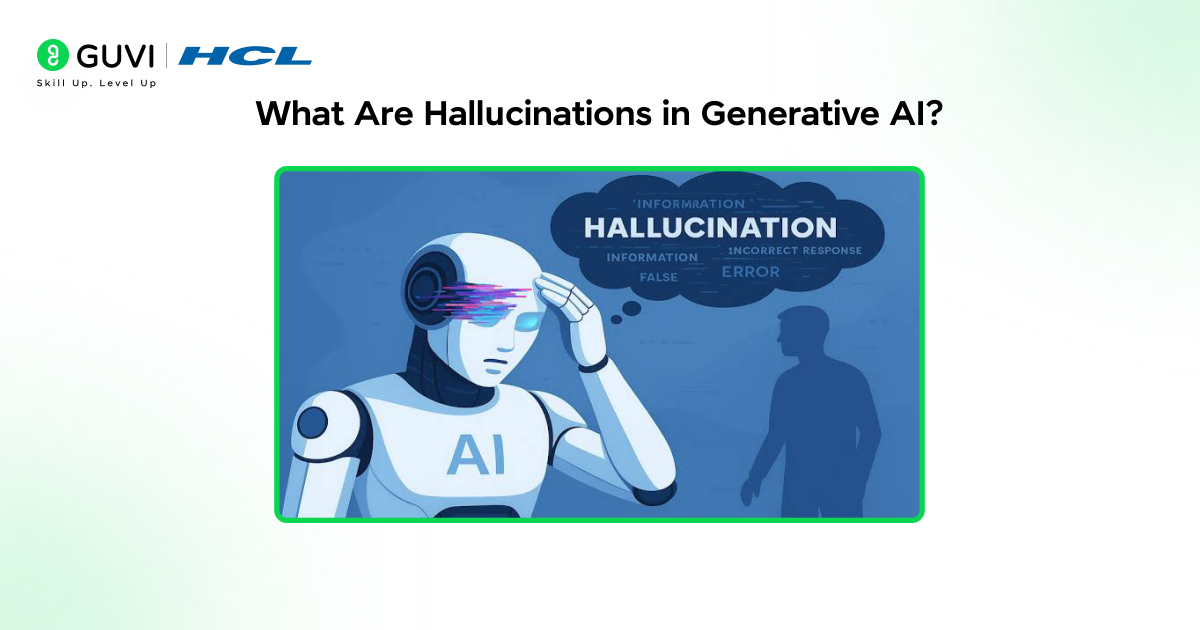
Generative AI systems such as large language models generate responses by predicting word sequences from patterns learned during training. This process produces fluent text but can also create outputs that appear credible while being factually incorrect. These outputs are known as AI hallucinations and pose a reliability challenge for organizations using generative AI. An AI hallucination occurs when a model generates fabricated or incorrect information with high confidence. The system does not intentionally produce false content. Instead, it predicts language patterns that appear plausible based on its training data.
Factual Errors vs AI Hallucinations
Factual errors and AI hallucinations can overlap, but they describe different aspects of an incorrect response.
| Factor | Factual Error | AI Hallucination |
|---|---|---|
| Meaning | A statement that contains incorrect information | AI-generated information that is unsupported, fabricated, or inconsistent with available evidence |
| Example | Giving the wrong year for an event | Inventing a study, citation, person, or statistic |
| Detection | Compare the statement with a reliable source | Check whether the generated claim can be supported by trusted evidence |
| Common cause | Outdated, incomplete, or incorrect information | Unsupported generation, weak grounding, or missing evidence |
| Common mitigation | Update and verify data | Ground responses in trusted sources and add validation |
A response can also contain a factual error without being entirely fabricated. Therefore, hallucination detection should focus on evidence and claim support, rather than treating every incorrect statement as the same type of failure.
Types of AI Hallucinations
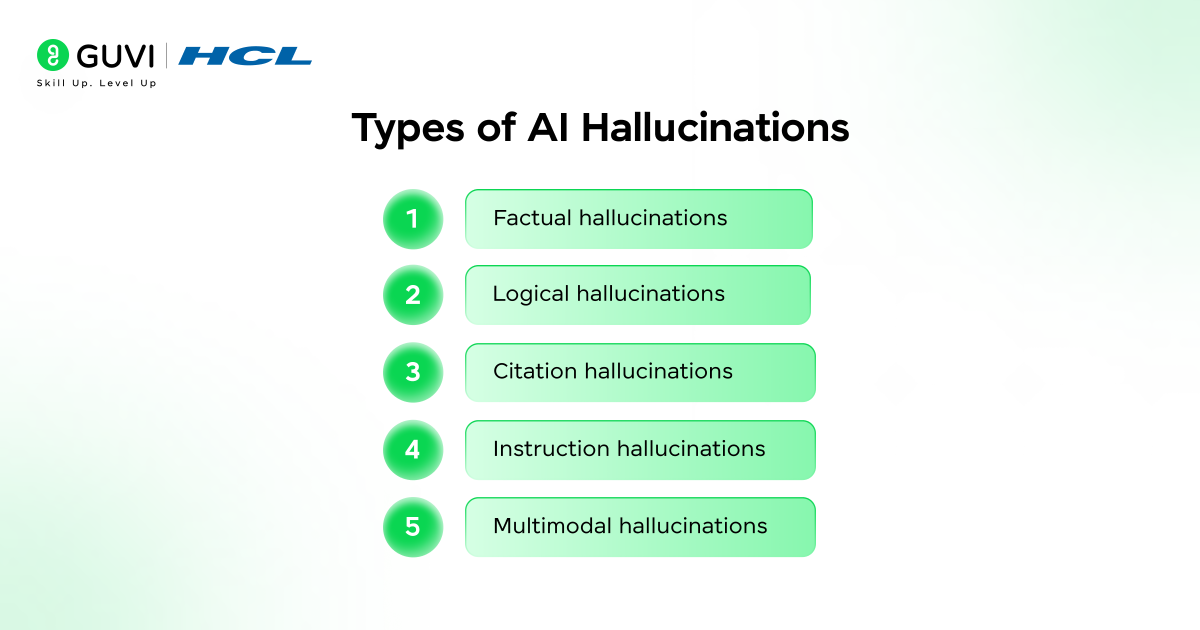
- Factual hallucinations occur when a model produces incorrect information about real-world facts such as wrong statistics, inaccurate dates, or misrepresented events.
- Logical hallucinations appear when the reasoning structure is flawed. Individual statements may appear correct, yet the conclusion does not logically follow.
- Citation hallucinations occur when a model generates references to sources that do not exist or incorrectly attributes findings to real publications.
- Instruction hallucinations appear when AI provides incorrect technical steps, commands, or operational guidance that conflict with official documentation.
- Multimodal hallucinations occur in systems that process images, audio, or video. The model may misinterpret visual or contextual data and generate incorrect descriptions.
Examples of Hallucinations in AI Systems
- Incorrect citations in research summaries often occur when language models generate literature reviews. The system may present a convincing reference list even though some of the papers or authors are fabricated.
- Fabricated statistics in generated reports appear when AI tools produce business analysis or market research summaries. The text may include numerical data that appears authoritative but cannot be traced to credible datasets.
- Nonexistent sources in academic outputs also represent a common failure pattern. Students or researchers using AI writing tools sometimes receive references to studies or reports that do not exist in any academic database.
Want to understand and control hallucinations in Generative AI systems? Download HCL GUVI’s GenAI eBook to master core concepts, practical safeguards, and real-world implementation strategies.
Factual Errors vs AI Hallucinations
| Factor | Factual Errors | AI Hallucinations |
| Meaning | Incorrect facts due to outdated or incomplete data | Fabricated information not found in real sources |
| Cause | Data limitations | Probabilistic text generation |
| Example | Wrong statistic or date | Invented citation or study |
| Fix | Update data sources | Add validation or human review |
Why Do Generative AI Models Hallucinate?
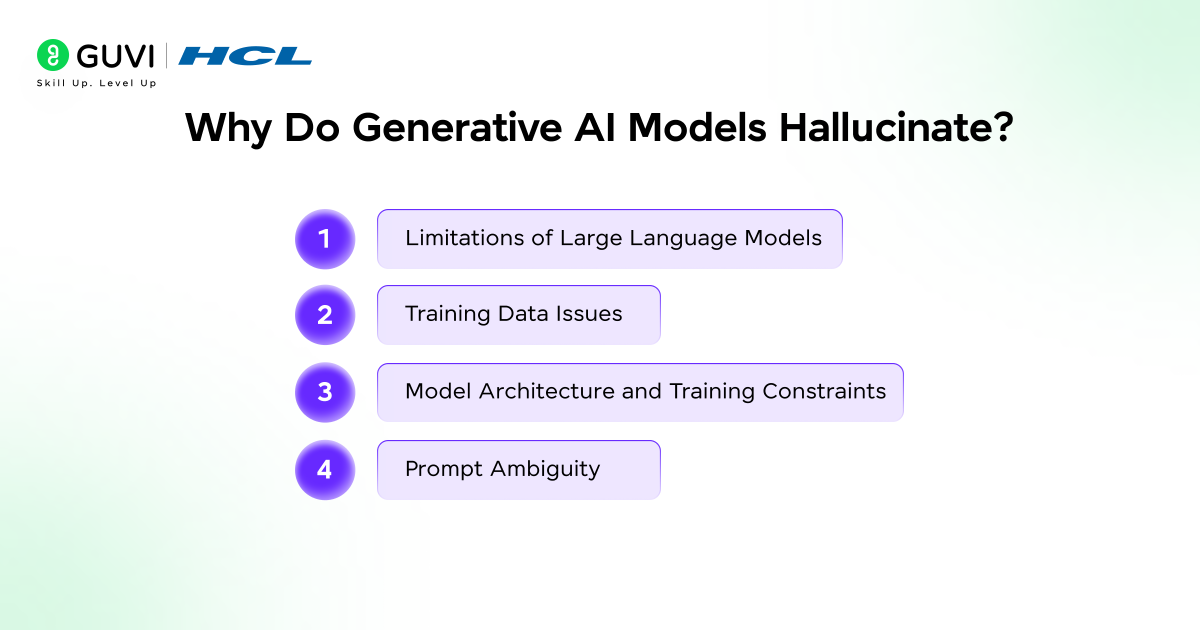
- Limitations of Large Language Models
Hallucinations in generative AI arise from the way large language models are trained and how they generate responses. Large language models generate text through probabilistic token prediction. During inference, the model calculates the probability distribution of possible next tokens and selects the most likely sequence. The system does not verify factual correctness during this process. It optimizes for linguistic coherence rather than factual validity.
Another limitation is the absence of true knowledge or reasoning. LLMs do not store structured knowledge in the way databases or knowledge graphs do. Instead, they encode statistical relationships between words and concepts learned during training. When asked about unfamiliar or incomplete topics, the model may construct responses that appear logical but are not grounded in verified information. These limitations explain why a response can sound authoritative even when it contains fabricated details.
- Training Data Issues
The quality and structure of training data strongly influence hallucination behavior. Many models are trained on large-scale internet datasets that contain incomplete, biased, or outdated information. When training data lacks coverage of a topic, the model may attempt to fill gaps by generating plausible language patterns.
Another challenge involves noise and conflicting information in datasets. Public web content often contains contradictory claims, speculation, or unverified sources. When models learn from such material, the resulting representations may blend inconsistent information. During generation, the model may synthesize fragments of conflicting data into a response that does not correspond to any real source. These training limitations increase the likelihood of fabricated facts or references.
- Model Architecture and Training Constraints
Certain behaviors also arise from architectural and training constraints. During training, models learn generalized patterns across large datasets. This process can lead to overgeneralization, where the system applies patterns too broadly when generating responses.
Another constraint involves the lack of grounding in real-time data. Most generative models operate on static training corpora that represent a snapshot of information at a particular time. Without access to current databases or external retrieval systems, the model may generate outdated or speculative answers when asked about recent developments.
- Prompt Ambiguity
The structure and clarity of prompts also influence hallucination frequency. Ambiguous or underspecified prompts leave room for interpretation, which increases the likelihood that the model will generate speculative content. In many LLM projects, poorly defined prompts often lead to responses that appear complete but contain unsupported details.
When instructions lack clear boundaries, the model may infer context or produce explanations that were not explicitly requested. In research tasks, open-ended prompts can cause the model to generate references or statistics to make the response appear more complete. Structured prompts with defined constraints help reduce this behavior and improve reliability in LLM deployments.
Why Early Detection of AI Hallucinations Matters
- Risks for Enterprises
In enterprise environments, hallucinations can introduce misinformation into internal reports, research summaries, and operational documents. When decisions rely on inaccurate data, strategic planning, forecasting, and risk assessments may be affected.
Hallucinations can also create legal and compliance exposure. AI-generated content that contains incorrect financial figures, fabricated regulatory interpretations, or misleading product claims may lead to regulatory scrutiny or liability.
Organizations deploying generative AI therefore require validation layers, monitoring pipelines, and human oversight so that outputs are verified before influencing business decisions.
- Impact on Critical Industries
The impact becomes more serious in industries where accuracy directly affects safety, regulation, or financial outcomes.
In healthcare, AI systems used for clinical documentation or patient support must avoid fabricated medical guidance or incorrect treatment information.
In finance, applications require precise data interpretation and regulatory compliance. Hallucinated financial figures or incorrect policy explanations can create operational and regulatory risk.
In legal research, platforms depend on accurate citations and case law references. Fabricated legal precedents weaken the reliability of AI-assisted analysis.
In cybersecurity, tools must provide accurate threat intelligence and response guidance. Incorrect recommendations or misinterpreted attack patterns can weaken defensive strategies.
- Trust and Reliability in AI Systems
Trust remains essential for the adoption of AI systems. When users repeatedly encounter fabricated information, confidence declines and adoption slows.

Regulators are also increasing scrutiny of AI deployments. Emerging governance frameworks emphasize transparency, validation, and accountability in AI-generated outputs. Organizations must demonstrate that they can monitor and control hallucination risks.
For this reason, hallucination detection is not only a technical concern. It is a requirement for reliable AI deployment, responsible governance, and sustained user trust.
Methods for Detecting Hallucinations in Generative AI
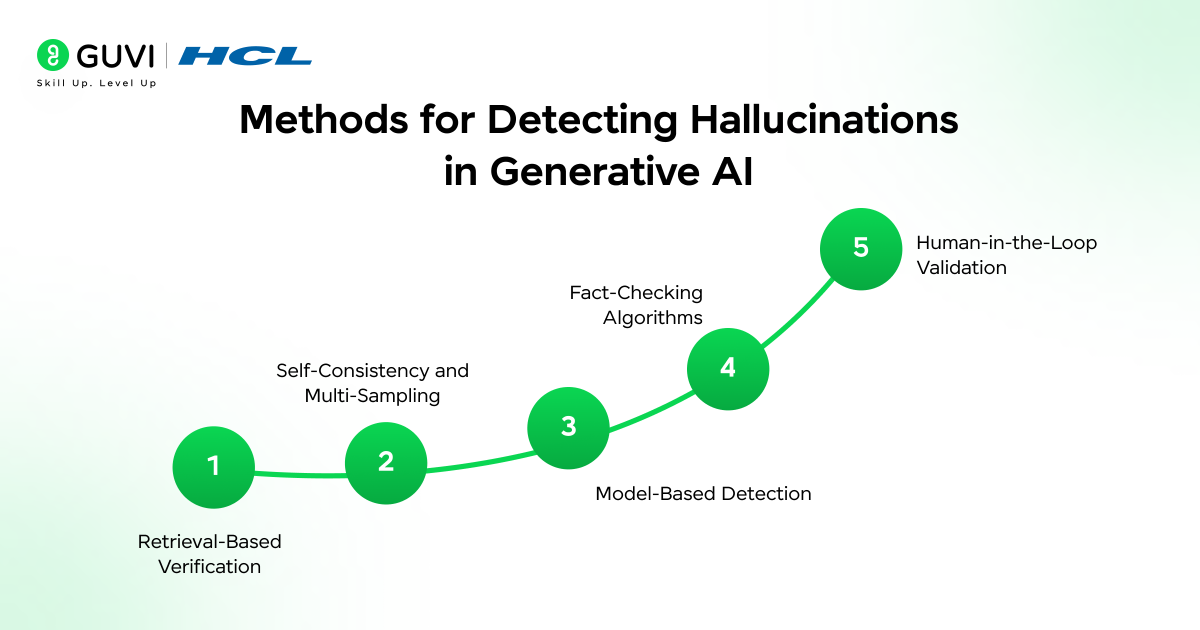
- Retrieval-Based Verification
Retrieval-based verification compares generated outputs with trusted external knowledge sources. Instead of relying only on model memory, the system retrieves relevant documents or database records and validates whether the generated response aligns with those sources.
Many production AI systems use retrieval-augmented generation frameworks. In this setup, relevant documents are retrieved first and then injected into the model’s context window. The generated response must therefore align with verifiable information rather than relying solely on internal model patterns.
This approach reduces hallucination risk in domains where accurate references are available, such as enterprise documentation, research databases, or product knowledge repositories.
- Self-Consistency and Multi-Sampling
Another detection method involves multiple generation passes for the same prompt. If the model produces widely different answers across runs, the response may indicate uncertainty or hallucination.
Self-consistency evaluation compares multiple outputs and identifies patterns. When several responses converge on the same conclusion, the likelihood of correctness increases. When outputs diverge substantially, the system can flag the result for review. This method is widely used in reasoning tasks and complex analytical prompts.
- Model-Based Detection
Some systems deploy secondary models designed to identify hallucinated content. These models evaluate generated responses and detect signals such as unsupported claims, fabricated references, or logical inconsistencies.
Confidence scoring mechanisms also contribute to detection. Models can estimate the probability of generated tokens and identify segments of text where confidence drops. Low-confidence outputs often correlate with hallucinated content.
- Fact-Checking Algorithms
Automated fact-checking techniques validate generated information against structured knowledge sources.
Knowledge graph validation compares entities, relationships, and claims against established data structures. If a generated statement conflicts with the graph, the system flags the output.
Another approach involves cross-referencing structured databases such as scientific repositories, financial datasets, or regulatory records. This method is common in applications where factual accuracy is critical.
- Human-in-the-Loop Validation
Automated detection systems cannot capture every hallucination scenario. Human oversight remains an important layer in high-risk environments.
Organizations often implement expert verification workflows where domain specialists review AI-generated outputs before publication or decision-making. Review systems are particularly important in healthcare, finance, legal research, and cybersecurity, where incorrect information can have serious consequences. Review systems are particularly important in healthcare, finance, legal research, and cybersecurity, where incorrect information can have serious consequences. In documents that mix human and machine writing, reviewers often run the draft through an AI detector before verification begins, then concentrate their checks on the flagged passages, since fabricated citations and unsupported figures tend to appear in the model-generated sections rather than the human ones.
Tools and Frameworks for Detecting AI Hallucinations
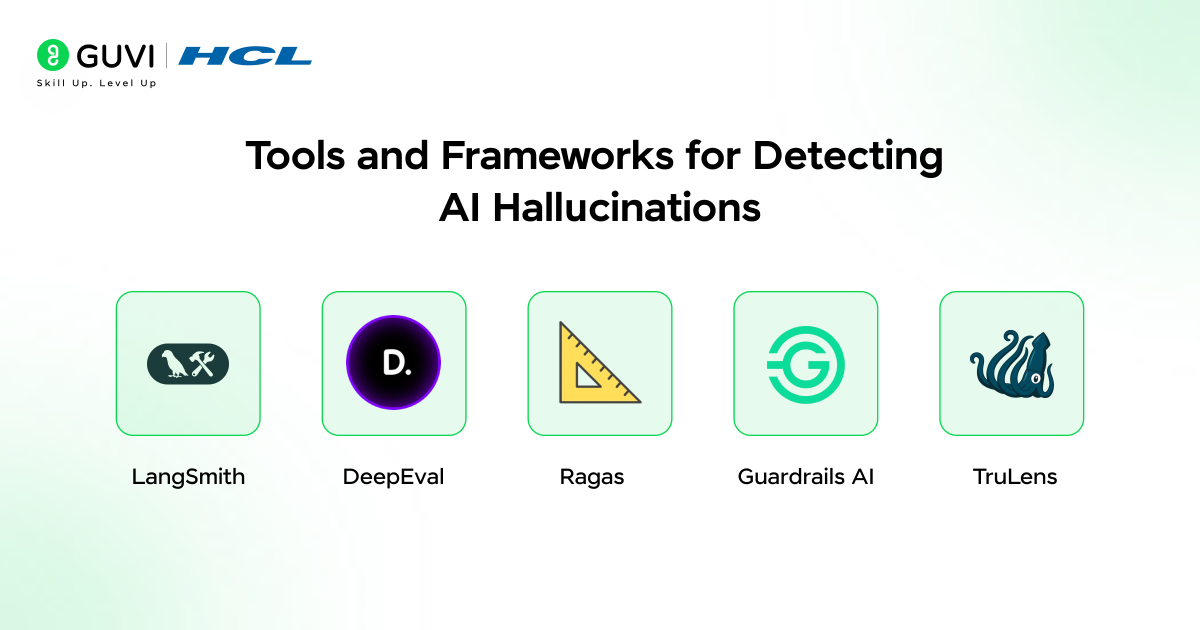
- LangSmith: Provides observability tools for LLM applications, allowing developers to trace prompts, responses, and evaluation metrics to identify unreliable outputs.
- DeepEval: An evaluation framework for testing LLM reliability across metrics such as factual accuracy, relevance, and hallucination detection.
- Ragas: A popular evaluation library designed for retrieval-augmented generation systems, measuring factual consistency between responses and retrieved documents.
- Guardrails AI: Applies validation rules to model outputs and restricts responses that violate defined constraints or contain unsupported information.
- TruLens: Offers monitoring tools that evaluate LLM applications using feedback metrics such as groundedness and context relevance.
Automatic Hallucination Detection Techniques
1. Token Probability Analysis
Language models assign probability scores to each generated token. Low-probability token sequences can indicate uncertainty. When a response contains many low-confidence tokens, the likelihood of hallucination increases.
2. Entropy and Uncertainty Metrics
Entropy measures the uncertainty in the model’s probability distribution. High entropy indicates that the model is uncertain about which token should appear next. Responses generated under high uncertainty often contain speculative or unsupported information.
3. Embedding Similarity Checks
Embedding-based methods compare generated content with verified knowledge sources. Semantic similarity metrics determine whether the output aligns with trusted documents or datasets. Large semantic deviations may indicate hallucinated claims.
4. Chain-of-Thought Verification
When models generate reasoning steps, systems can evaluate whether each step logically supports the final answer. Logical inconsistencies or unsupported reasoning steps may indicate hallucination.
Want to go beyond identifying hallucinations and build reliable, production-grade AI systems? Join HCL GUVI’s Artificial Intelligence & Machine Learning Course to master model evaluation, generative AI safeguards, and enterprise-ready deployment. Gain 1:1 expert doubt sessions, complete 20+ industry-grade projects plus a capstone, and build in-demand skills in Python, SQL, Machine Learning, MLOps, Generative AI, and Agentic AI. With dedicated placement assistance and 1000+ hiring partners, transition confidently into real-world AI roles.
Role of Retrieval-Augmented Generation (RAG) in Hallucination Detection
Retrieval-Augmented Generation has become one of the most effective architectural strategies for reducing hallucinations in generative AI systems. RAG grounds model responses in external knowledge sources such as document repositories, enterprise databases, or research archives. By retrieving relevant documents before generating an answer, the model operates with verified context rather than relying solely on learned patterns.
RAG Architecture
A typical RAG system contains three main components.
- Retrieval: Relevant documents are retrieved from indexed knowledge bases using semantic search.
- Context Injection: The retrieved information is inserted into the model prompt or context window.
- Generation: The model generates an answer based on the retrieved material, which improves factual grounding.
Limitations of RAG
Although RAG reduces hallucination risk, it does not eliminate it.
- Retrieval failures may occur when relevant documents are not identified by the search system.
- Outdated knowledge sources can also produce incorrect responses if the underlying database is not updated regularly.
Best Practices to Reduce and Detect Hallucinations
- Use Reliable Knowledge Sources: Models should be connected to verified datasets and curated knowledge bases. Controlled data sources reduce exposure to unreliable information.
- Implement Output Verification Layers: AI pipelines should include secondary validation models or rule-based checks that verify factual claims before outputs reach end users.
- Improve Prompt Engineering: Clear prompts with structured instructions and explicit source requirements reduce ambiguity and limit speculative responses.
- Continuous Model Monitoring: Monitoring systems should track response quality over time. Feedback loops allow developers to identify hallucination patterns and refine models through evaluation and retraining cycles.
Conclusion
Detecting hallucinations in generative AI is essential for building reliable and trustworthy AI systems. Because models generate responses through probabilistic prediction, organizations must combine retrieval frameworks, validation layers, monitoring systems, and human oversight. A robust LLM evaluation framework helps measure response accuracy, identify hallucination patterns, and improve model reliability for responsible AI deployment across enterprise and high-impact industries.
FAQs
1. Can prompt design reduce hallucinations in generative AI?
Yes. Clear and structured prompts reduce ambiguity and limit speculative responses. Providing context, specifying constraints, and requesting sources improves response accuracy.
2. Do smaller AI models hallucinate less than larger models?
Not necessarily. Hallucination rates depend more on training data quality, grounding mechanisms, and validation systems than model size alone.
3. Can hallucination detection be fully automated?
No. Automated systems can identify many risks, but high-impact domains still require human review to verify complex claims and domain-specific information.
Success Stories

About the Author
Vaishali
I'm a seasoned writer with four years of experience across technical, non-technical, and just about every genre or niche you can imagine. Adaptable and curious, I enjoy exploring new topics and making information engaging and easy to understand. Fueled by a steady stream of tea, I approach each project with creativity, reliability, and genuine enthusiasm for storytelling.
View all posts by Vaishali
Connect with me @













Did you enjoy this article?