


Artificial Intelligence and Machine Learning Articles
Finance Manager to Data Analytics: Career Growth, Salary and Seniority
How to Evaluate LLM Outputs in Production Deployments
AI/ML Skills Gap 2026: Why Companies Can't Find Job-Ready Talent
20 AI/ML Interview Questions Recruiters Can Use Without a Tech Background - Best Guide

Get In Touch For Details! Request More Information
Agentic AI vs Generative AI: Key Differences, Use Cases, and Enterprise Impact in 2026
Aug 27, 2026 7 Min Read 1720 Views
(Last Updated)
Agentic AI vs Generative AI is rapidly becoming one of the most critical debates in enterprise technology strategy. But here is the real question: are you deploying AI that simply generates responses, or AI that can independently plan, decide, and execute actions toward measurable goals? As organizations move from experimentation to operational dependence on artificial intelligence, understanding the difference between Generative AI and Agentic AI is no longer optional. It determines governance models, infrastructure investments, risk exposure, and ultimately, competitive advantage in 2026 and beyond.
Curious which AI model truly fits your enterprise strategy? Read the full blog to understand the key differences between Agentic AI and Generative AI. Also, explore real-world use cases and discover how to align the right AI approach with measurable business impact.
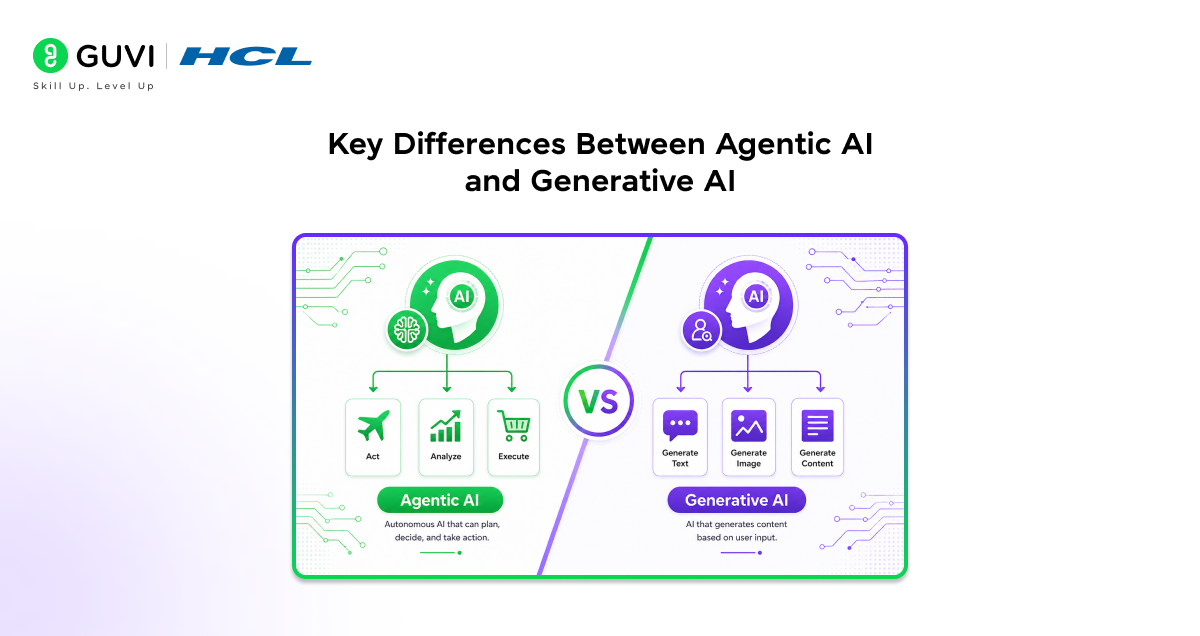
Quick Answer: Agentic AI vs Generative AI defines enterprise AI strategy in 2026. Generative AI creates content, supports knowledge synthesis, and enhances productivity through reactive outputs. Agentic AI pursues defined goals using planning, memory, and system integration to execute workflows autonomously. The choice impacts architecture, governance, risk exposure, infrastructure complexity, and measurable business outcomes.
Table of contents
- What Is Agentic AI?
- What Is Generative AI?
- Best Benefits of Agentic AI
- Best Benefits of Generative AI
- Top 5 Agentic AI Use Cases For Enterprises
- Top 5 Generative AI Use Cases For Enterprises
- Key Differences Between Agentic AI and Generative AI
- Agentic AI vs Generative AI: Major Differences
- Challenges in Implementing Agentic AI
- Challenges in Implementing Generative AI
- Best Practices for Agentic AI
- Best Practices for Generative AI
- The Bottom Line
- FAQs
- Is Agentic AI built on large language models?
- Which is easier to implement, Agentic AI or Generative AI?
- Does Agentic AI replace human decision-makers?
- Can Generative AI be used in regulated industries?
- How should organizations choose between Agentic AI and Generative AI?
- What is the difference between an AI course and an AI & ML course?
- Why is SQL important for AI & ML professionals?
- What job roles can I apply for after completing an AI & ML course?
- How do I choose the best AI course for my career goals?
- What should I look for before enrolling in an AI & ML course?
- How should I evaluate AI & ML certifications before enrolling?
What Is Agentic AI?
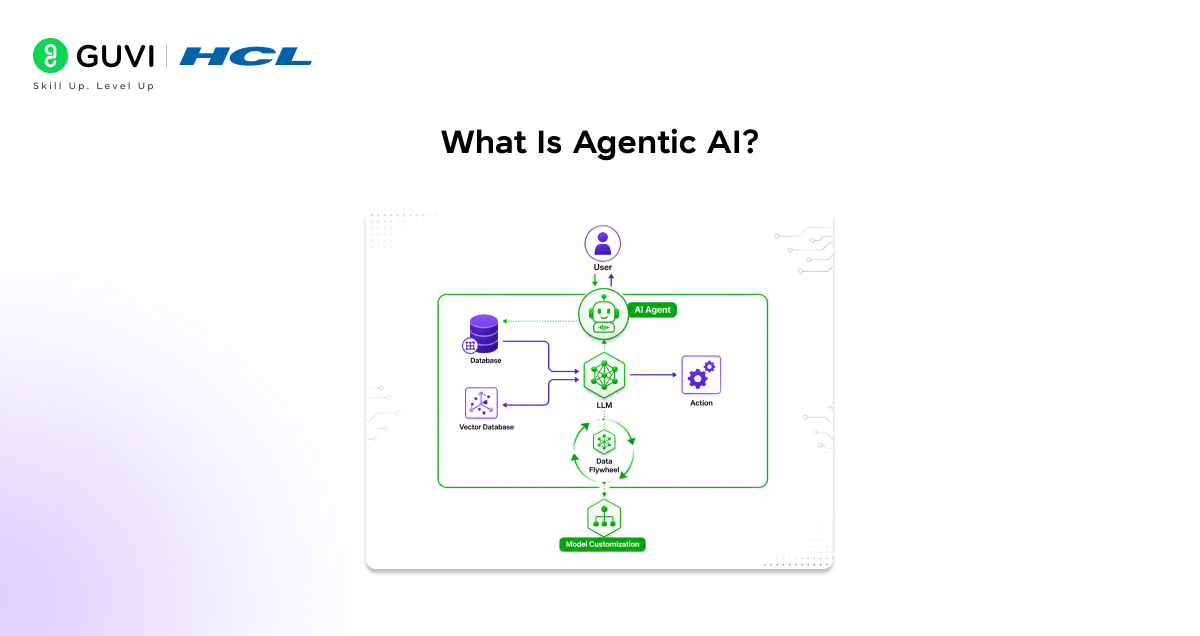
Agentic AI refers to artificial intelligence systems that can pursue a defined goal by planning, reasoning through multiple steps, using tools, and adjusting actions based on feedback. These systems typically combine large language models with memory layers, planning components, and API integrations that allow them to interact with enterprise software.
What Is Generative AI?
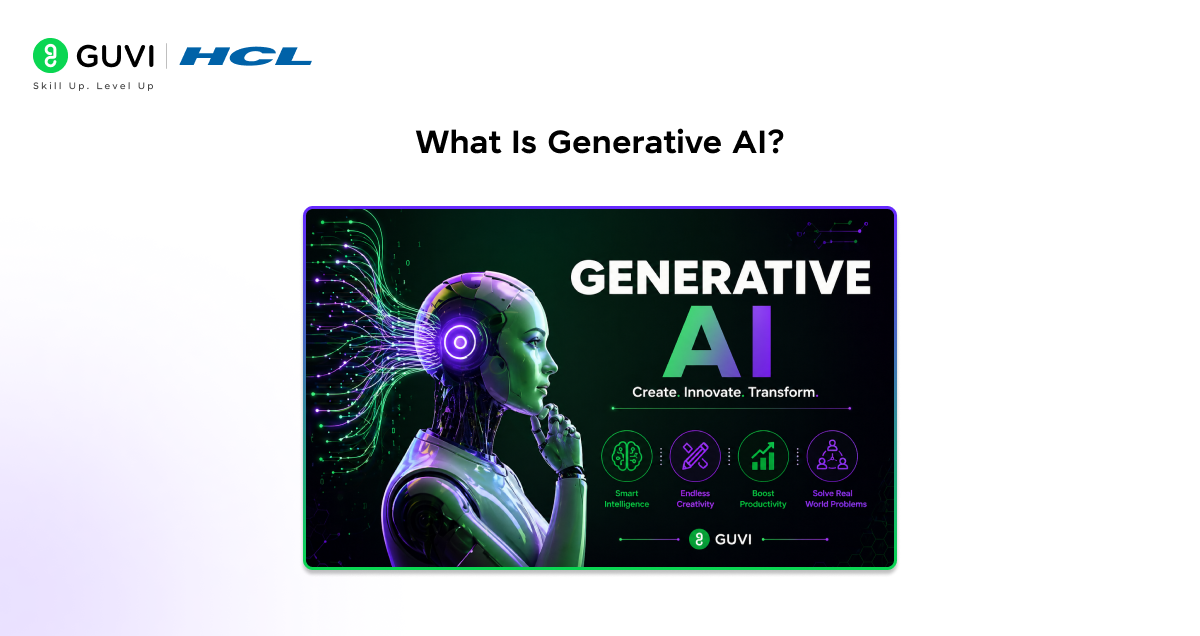
Generative AI refers to machine learning models that create new content by learning patterns from large datasets. Most generative systems use transformer architectures for text and diffusion models for images or audio. LLMs generate responses by predicting the most probable sequence of words based on context. In business environments, generative AI is used for drafting documents, building chat interfaces, summarizing data, and generating code.
Best Benefits of Agentic AI
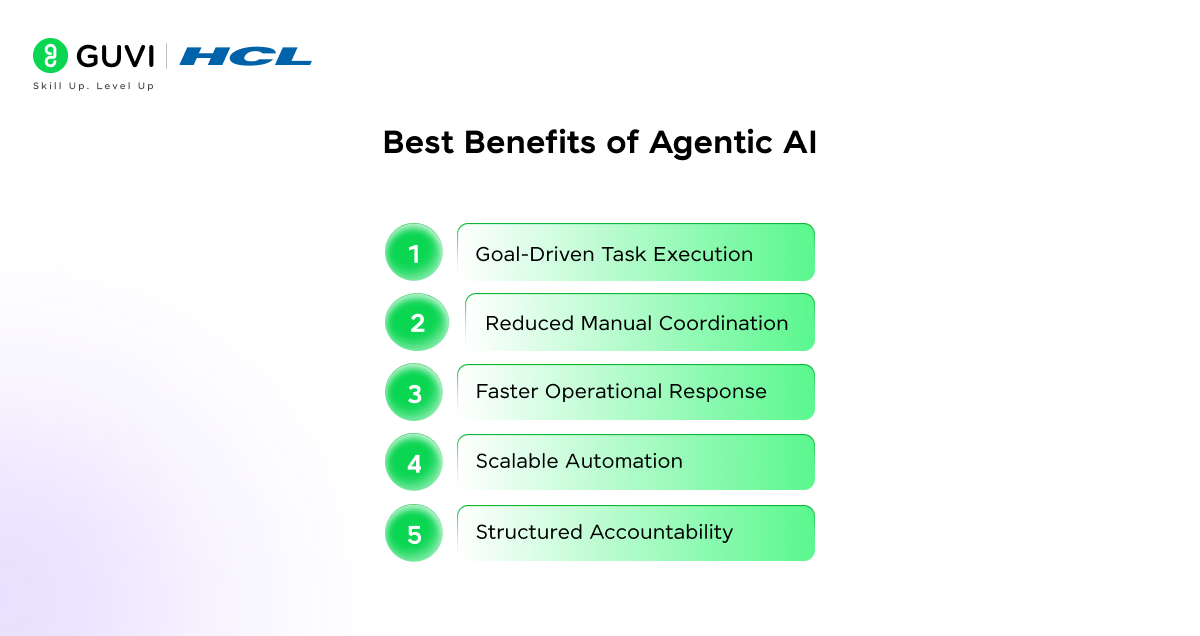
- Goal-Driven Task Execution
Agentic AI can pursue a defined objective through structured planning and multi-step action. Unlike systems that only generate responses, it can break down goals, select tools, evaluate outcomes, and adjust its approach. This makes it suitable for complex tasks that require coordination rather than isolated outputs.
- Reduced Manual Coordination
By managing sequences of tasks across platforms or processes, agentic AI lowers the need for constant human supervision. It can handle follow-ups, monitor progress, and trigger next steps automatically within set boundaries.
- Faster Operational Response
Because it can act on real-time data, agentic AI shortens response cycles in areas such as technical troubleshooting, workflow management, or risk monitoring. The benefit lies in structured action based on predefined objectives.
- Scalable Automation
Agentic systems scale without requiring proportional increases in human effort. Once governance controls and policies are defined, the system can execute similar workflows repeatedly with consistent logic.
- Structured Accountability
Well-designed agentic systems maintain logs of decisions, actions, and tool usage. This creates traceability and supports oversight, which is essential when AI systems interact with real processes.
Best Benefits of Generative AI
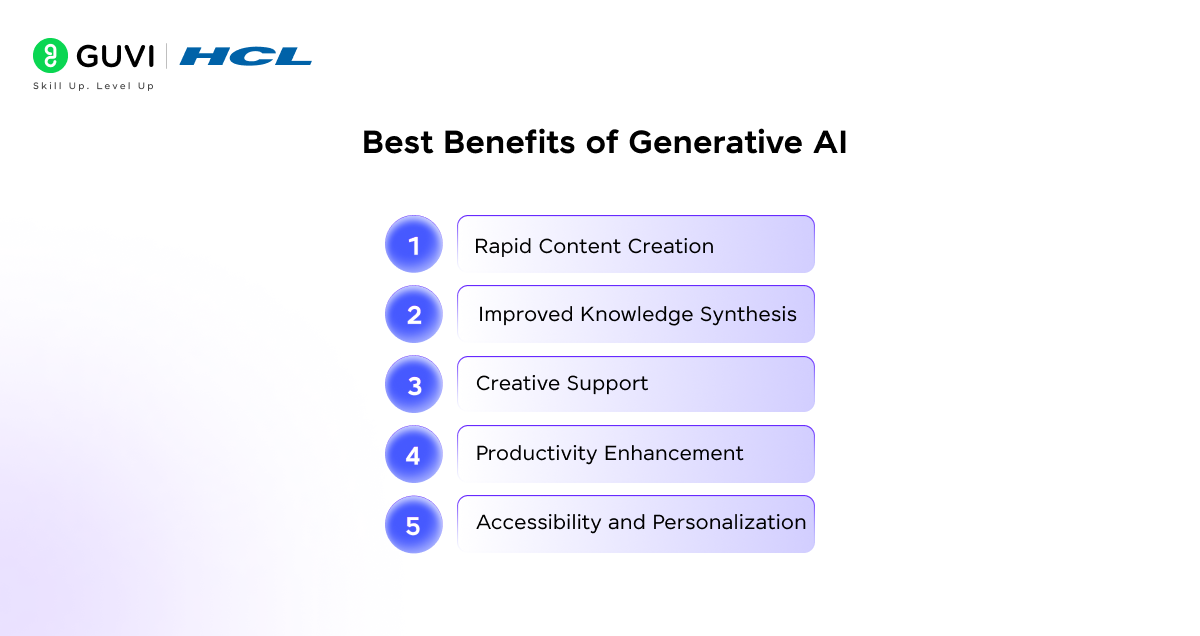
- Rapid Content Creation
Generative AI produces text, images, code, and audio quickly by learning patterns from large datasets. This accelerates writing, design, and content-heavy tasks across education, business, media, and software development.
- Improved Knowledge Synthesis
It can summarize complex information, explain technical topics, and translate ideas into accessible language. This makes large volumes of information easier to understand and apply.
- Creative Support
Generative AI assists with brainstorming, drafting, concept development, and design ideation. It expands the range of creative options available to individuals and teams.
- Productivity Enhancement
By automating repetitive drafting and formatting tasks, generative AI allows users to focus on analysis, strategy, or refinement rather than starting from a blank page.
- Accessibility and Personalization
Generative systems can tailor responses to user context, language preference, or skill level. This improves accessibility across different user groups while keeping the interaction assistive rather than autonomous.
Top 5 Agentic AI Use Cases For Enterprises
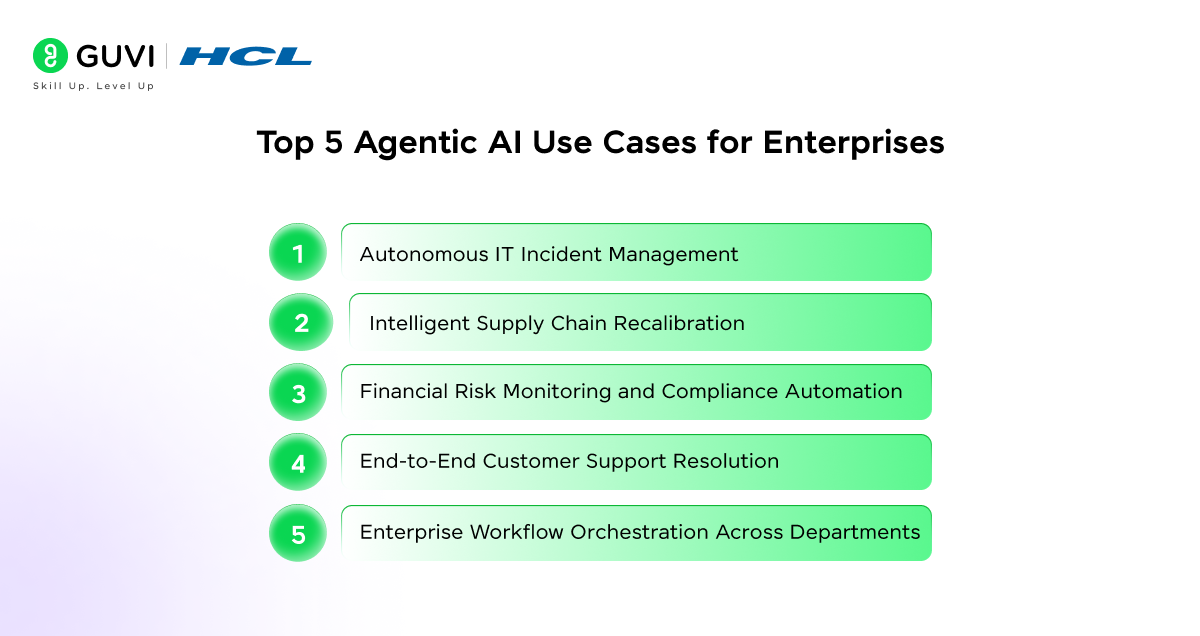
- Autonomous IT Incident Management
Unlike traditional AI, which typically generates alerts that require manual intervention, agentic AI monitors infrastructure signals, detects anomalies, classifies severity, and executes predefined remediation steps without waiting for escalation. Integrated with IT service management and observability tools, it can isolate faulty nodes, restart services, trigger rollbacks, and log every action for audit review. This structured execution reduces resolution time, improves uptime reliability, and lowers the financial risk associated with system downtime.
- Intelligent Supply Chain Recalibration
Agentic AI analyzes inventory, supplier lead times, logistics constraints, and demand forecasts to make coordinated adjustments. It can place orders, reroute shipments, and modify procurement schedules within policy limits. This supports margin stability in manufacturing and retail environments exposed to demand volatility and transport disruptions.
- Financial Risk Monitoring and Compliance Automation
Agentic systems process continuous transaction streams, flag suspicious patterns, apply regulatory thresholds, and trigger due diligence workflows. With decision logs and traceable rules, they strengthen audit readiness while reducing manual compliance workload in regulated sectors.
- End-to-End Customer Support Resolution
Beyond chat responses, AI agents powered by agentic AI can authenticate users, retrieve records, process refunds, update backend systems, and close tickets without manual intervention. When integrated with CRM and billing platforms, these AI agents execute structured service workflows end to end. The result is faster resolution cycles, reduced backlog, and greater consistency in high-volume customer support operations.
- Enterprise Workflow Orchestration Across Departments
Agentic AI coordinates multi-step processes across finance, HR, and procurement. It validates documents, runs compliance checks, notifies stakeholders, and tracks milestones. The result is streamlined execution, reduced fragmentation, and stronger accountability under structured oversight.
Top 5 Generative AI Use Cases For Enterprises
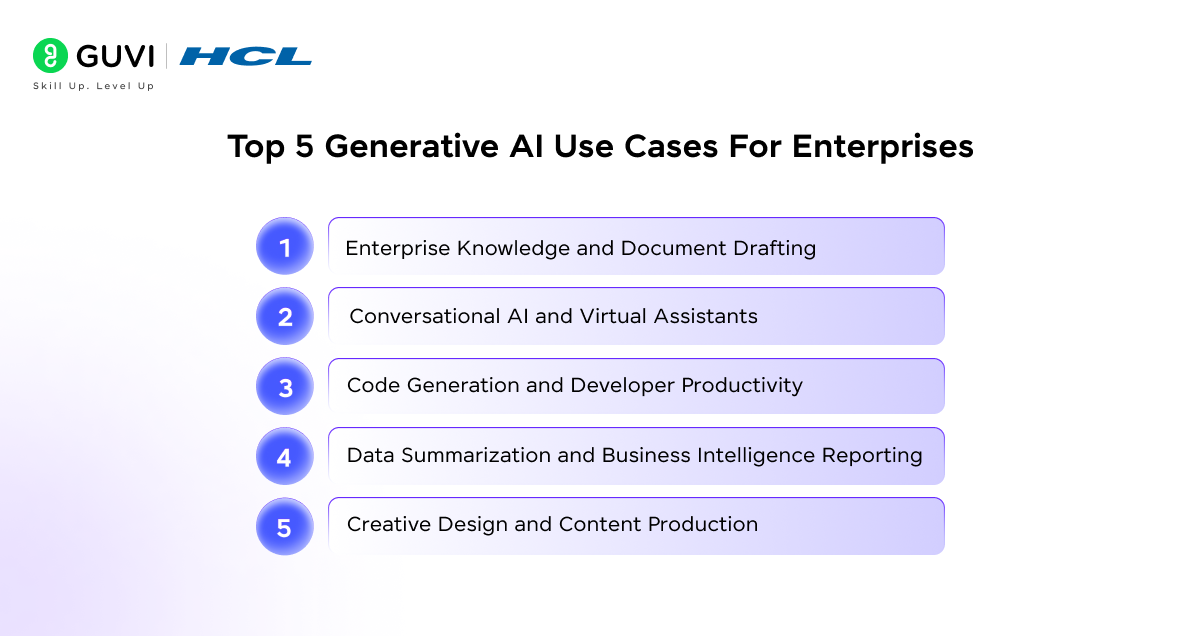
- Enterprise Knowledge and Document Drafting
Generative AI enables large-scale document creation across legal, marketing, HR, and operations. It drafts policies, proposals, contracts, and summaries using structured prompts and enterprise data. When integrated with retrieval systems, it produces context-aware outputs that maintain tone and terminology consistency. Human validation remains necessary, but drafting efficiency improves in content-intensive workflows.
- Conversational AI and Virtual Assistants
Large language models power chat interfaces for customer support, IT help desks, and internal knowledge queries. Responses are generated using conversation history and structured data integration. In regulated sectors, guardrails and validation layers support compliance. The value lies in scalable, standardized communication rather than autonomous execution.
- Code Generation and Developer Productivity
Generative AI assists developers by producing boilerplate code, suggesting functions, explaining legacy scripts, and identifying errors. Integrated into development environments, it reduces repetitive tasks and accelerates iteration while preserving human oversight for architecture and security decisions.
- Data Summarization and Business Intelligence Reporting
Generative models condense structured and unstructured data into executive-ready summaries. They translate dashboards, reports, and transcripts into clear narratives, improving accessibility of complex insights while leaving analytical validation to human experts.
- Creative Design and Content Production
Marketing and product teams use generative models to produce campaign copy, product descriptions, and visual drafts. Diffusion and multimodal systems support rapid experimentation aligned with brand guidelines. Final approval remains human-led, but production cycles become more efficient.
Key Differences Between Agentic AI and Generative AI
- Objective and Core Function
The most fundamental difference lies in purpose. Generative AI is designed to produce content such as text, images, code, or summaries based on learned statistical patterns. Its output is the final deliverable. Agentic AI, in contrast, is designed to achieve a defined goal. Content generation may be one step in the process, but the system continues beyond output to planning, decision sequencing, and action execution.
- Level of Autonomy
Generative AI is reactive. It responds to prompts and stops once the response is delivered. Agentic AI is proactive within defined boundaries. It can initiate steps, evaluate intermediate results, and continue executing tasks until the objective is completed or constraints are met.
- Workflow Interaction
Generative AI typically operates in isolation unless manually integrated into broader systems. It generates responses but does not independently interact with software platforms. Agentic AI is built for system interaction. It can access tools, call APIs, update databases, and coordinate across multiple platforms as part of a structured workflow.
- Decision-Making Scope
Generative AI predicts the most probable output based on context. Its reasoning is limited to producing coherent responses. Agentic AI incorporates planning logic, memory retention, and feedback evaluation. It makes sequential decisions based on evolving task states rather than a single inference cycle.
- Governance and Risk Exposure
Because generative AI primarily produces content, its risks are centered on accuracy, bias, and intellectual property concerns. Agentic AI carries higher operational risk because it can take real actions that affect systems, transactions, or processes. As a result, agentic systems require stronger access controls, monitoring layers, and human oversight mechanisms.

- Infrastructure Complexity
Generative AI can function as a standalone model accessed through an interface or API. Agentic AI requires additional architectural layers such as planning modules, memory systems, tool integration frameworks, and monitoring pipelines. This makes agentic systems structurally more complex and governance-intensive.
Also, Read: Agentic AI Developer Explained: Skills, Salary, and Career Path for 2026
Agentic AI vs Generative AI: Major Differences
| Dimension | Generative AI | Agentic AI |
| Primary Purpose | Creates content such as text, images, code, or audio | Achieves defined goals through planning and action |
| Output Type | Single response or generated asset | Multi-step task completion with execution |
| Autonomy Level | Reactive to prompts | Proactive within defined objectives |
| Decision Scope | One inference cycle based on probability | Sequential decision-making with feedback loops |
| Workflow Interaction | Limited unless manually integrated | Direct interaction with tools, APIs, and systems |
| Memory Usage | Context-bound, short session memory | Persistent memory and state tracking |
| Risk Profile | Accuracy, bias, hallucination concerns | Operational, compliance, and system-level risk |
| Governance Needs | Moderate review and validation | Strong access control, logging, and oversight |
| Infrastructure Complexity | Model plus interface layer | Model plus planning, orchestration, and monitoring layers |
| Role in Practice | Assistive productivity tool | Autonomous task executor under supervision |
Challenges in Implementing Agentic AI
- Governance and Control Complexity: Agentic systems can take real actions within software environments. This requires strict access controls, audit logs, role-based permissions, and escalation protocols.
- Operational Risk Exposure: Incorrect decisions or flawed logic can trigger cascading failures across interconnected systems. The impact is broader than content errors.
- Infrastructure and Architectural Demands: Agentic AI requires planning modules, memory systems, orchestration layers, monitoring pipelines, and tool integration frameworks. This increases implementation complexity.
- Real-Time Monitoring and Accountability: Continuous tracking of actions, decisions, and performance metrics is necessary to maintain compliance and operational stability.
- Regulatory and Compliance Constraints: In regulated sectors such as finance and healthcare, autonomous decision systems must align with strict documentation and explainability requirements.
Understanding the difference between Agentic AI and Generative AI is just the beginning. Master real-world AI systems with HCL GUVI’s Mastering AI and Machine Learning Course featuring a Globally Recognised Certification, 100% online self-paced learning, and full lifetime access to all course content.
Challenges in Implementing Generative AI
- Data Quality and Bias Risk: Generative models learn from large datasets that may contain bias, outdated information, or inaccuracies. Poor training data directly affects output reliability and can introduce reputational or legal risk.
- Hallucination and Accuracy Limitations: Large language models generate responses based on probability, not verified truth. This can lead to confident but incorrect outputs, particularly in technical, medical, or legal contexts.
- Intellectual Property and Copyright Concerns: Content generation may raise questions around originality, training data sourcing, and derivative works. Organizations must establish clear policies for review and usage rights.
- Model Drift and Updating Requirements: Generative systems can become outdated if not retrained or fine-tuned with current data. Continuous monitoring is required to maintain relevance and accuracy.
- Integration with Existing Systems: While easier to deploy than agentic systems, generative AI still requires structured API integration, prompt governance, and workflow alignment to deliver consistent value.
Best Practices for Agentic AI
- Define Clear, Measurable Objectives: Agentic systems should operate against explicitly defined goals with quantifiable success metrics. Ambiguous objectives increase execution drift and raise operational risk.
- Implement Role-Based Access Control: Limit tool usage and system permissions based on predefined roles. Agentic AI should not have unrestricted access to enterprise infrastructure or financial systems.
- Establish Human Override Protocols: Design structured human-in-the-loop checkpoints for high-impact actions. Escalation paths must be predefined for exceptions, anomalies, or confidence threshold breaches.
- Maintain Action-Level Audit Logging: Log every decision, tool call, and execution step. This supports accountability, compliance verification, and post-incident analysis.
- Deploy in Controlled Environments First: Pilot agentic systems in sandbox or limited-scope workflows before scaling. Gradual rollout reduces exposure to cascading operational failures.
Best Practices for Generative AI
- Use Verified Data Sources for Contextualization: When deploying generative systems with retrieval capabilities, connect them to validated internal or authoritative external data sources to improve factual grounding.
- Implement Output Review Mechanisms: Establish structured human review for high-stakes content such as legal, financial, or medical material. Automated confidence scoring can support prioritization.
- Define Prompt Governance Standards: Standardize prompt templates and usage guidelines to maintain consistency, reduce variability, and limit misuse across teams.
- Apply Content Filtering and Safety Layers: Deploy moderation filters to reduce biased, harmful, or non-compliant outputs. This protects brand credibility and regulatory alignment.
- Monitor Model Performance Over Time: Track accuracy benchmarks, user feedback, and content reliability metrics. Regular evaluation prevents silent degradation of output quality.
The Bottom Line
In 2026, the debate around Agentic AI vs Generative AI is no longer theoretical but strategic. Generative AI strengthens human productivity through scalable content creation, while Agentic AI advances toward structured, goal-driven execution across systems. The real impact lies in aligning architecture, autonomy, governance, and risk controls with business objectives. Organizations that differentiate clearly and deploy responsibly will convert AI capability into measurable operational advantage.
FAQs
1. Is Agentic AI built on large language models?
Yes. Most agentic systems use large language models for reasoning and interpretation, then layer planning modules, memory systems, and tool integrations to execute multi-step objectives.
2. Which is easier to implement, Agentic AI or Generative AI?
Generative AI is generally easier to deploy because it functions as a model plus interface layer. Agentic AI requires orchestration frameworks, monitoring systems, and stricter governance controls.
3. Does Agentic AI replace human decision-makers?
No. Agentic AI operates within predefined rules and oversight structures. Human supervision remains essential for high-impact decisions, policy design, and exception handling.
4. Can Generative AI be used in regulated industries?
Yes, but it requires structured review processes, validated data sources, and content controls to meet compliance and documentation standards.
5. How should organizations choose between Agentic AI and Generative AI?
The decision depends on whether the goal is content productivity or structured task execution. Output-driven needs align with generative systems, while workflow automation requires agentic architectures.
6. What is the difference between an AI course and an AI & ML course?
An AI course focuses on artificial intelligence concepts, while an AI & ML course includes machine learning, deep learning, NLP, computer vision, and practical model-building skills. If you’re looking for hands-on AI and ML training, explore the HCL GUVI AI & ML Programme.
7. Why is SQL important for AI & ML professionals?
SQL helps AI & ML professionals extract, clean, and analyze data from databases, making it essential for building accurate machine learning models. Most industry-focused AI & ML programmes include SQL as a core data skill.
8. What job roles can I apply for after completing an AI & ML course?
You can apply for roles such as AI Engineer, Machine Learning Engineer, Data Scientist, NLP Engineer, Computer Vision Engineer, and AI Developer. To prepare for these roles, consider a project-based AI & ML Programme with career support.
9. How do I choose the best AI course for my career goals?
Choose an AI course based on your career goals, curriculum, hands-on projects, mentor support, industry tools, and placement assistance. A structured AI & ML Programme can help you build practical skills and a strong portfolio.
10. What should I look for before enrolling in an AI & ML course?
Look for a structured curriculum, practical projects, experienced mentors, updated AI tools, certification value, and career support. Compare programmes carefully before enrolling in an AI & ML Programme.
11. How should I evaluate AI & ML certifications before enrolling?
Evaluate AI & ML certifications based on industry recognition, curriculum relevance, hands-on learning, project experience, and career outcomes. You can also compare what’s included in the HCL GUVI AI & ML Programme before making a decision.
Success Stories

About the Author
Vaishali
I'm a seasoned writer with four years of experience across technical, non-technical, and just about every genre or niche you can imagine. Adaptable and curious, I enjoy exploring new topics and making information engaging and easy to understand. Fueled by a steady stream of tea, I approach each project with creativity, reliability, and genuine enthusiasm for storytelling.
View all posts by Vaishali
Connect with me @







Did you enjoy this article?