


Artificial Intelligence and Machine Learning Articles
Finance Manager to Data Analytics: Career Growth, Salary and Seniority
How to Evaluate LLM Outputs in Production Deployments
AI/ML Skills Gap 2026: Why Companies Can't Find Job-Ready Talent
20 AI/ML Interview Questions Recruiters Can Use Without a Tech Background - Best Guide

Get In Touch For Details! Request More Information
Traditional AI vs Agentic AI: A Complete Comparison
Oct 22, 2025 5 Min Read 2353 Views
(Last Updated)
What happens when artificial intelligence stops being a tool you consult and starts becoming an active participant in your workflows? That’s the question behind the shift from traditional AI to agentic AI.
Traditional systems have long been effective at predicting, classifying, or recommending, but they rely on humans to interpret results and act on them. Agentic AI, by contrast, doesn’t just wait for instructions, it takes initiative, plans actions, and executes steps toward a goal with minimal supervision.
This change is opening up new opportunities in industries ranging from healthcare to logistics, but it also raises important questions about control, accountability, and safety. That is what we are going to learn in this article – key differences between Traditional AI Vs Agentic AI, right from its definition to the challenges that it poses. So, without further ado, let’s get started!
Table of contents
- What is Traditional AI?
- How it’s typically built (high level)
- Typical characteristics
- Common examples
- What is Agentic AI?
- Key capabilities
- Example behaviors
- Agentic AI vs Traditional AI: Key Differences
- Use Cases: Where Agentic AI Outshines Traditional AI
- Customer Service and Support
- Supply Chain and Logistics
- Healthcare and Patient Care
- Insurance and Finance
- Research and Knowledge Work
- Benefits & Limitations of Traditional and Agentic AI
- Benefits
- Limitations
- When to use which?
- Conclusion
- FAQs
- What is the main difference between agentic AI and traditional AI?
- Where does agentic AI outperform traditional AI?
- What are the benefits of agentic AI?
- What are the challenges of using agentic AI?
- Can agentic AI replace humans completely?
What is Traditional AI?
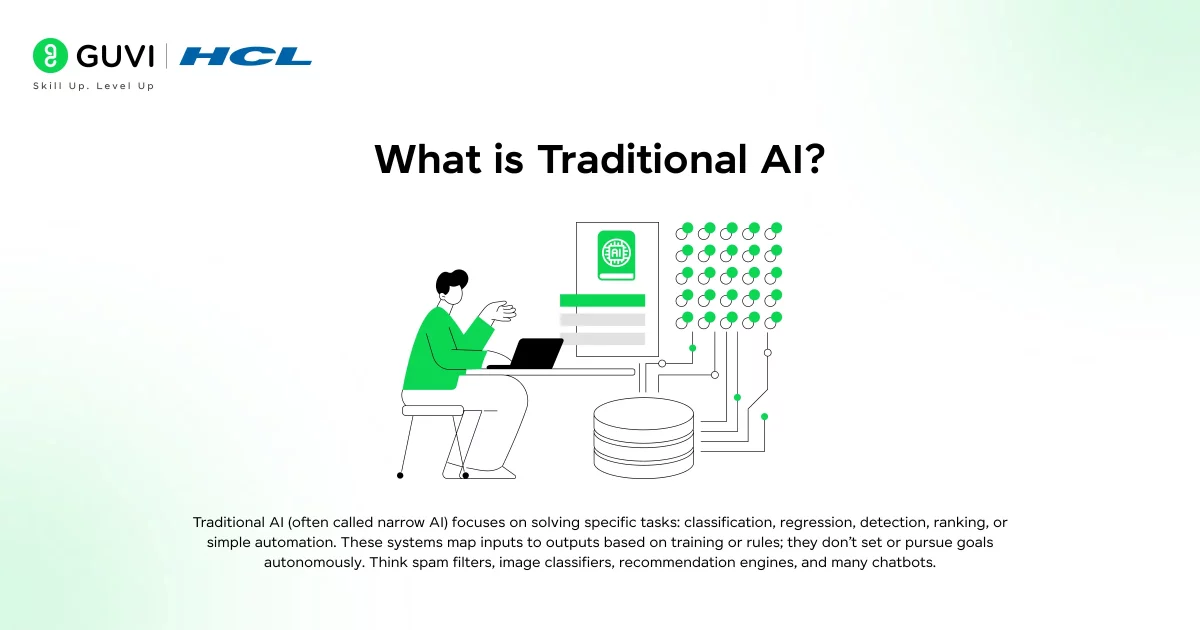
Traditional AI (often called narrow AI) focuses on solving specific tasks: classification, regression, detection, ranking, or simple automation.
These systems map inputs to outputs based on training or rules; they don’t set or pursue goals autonomously. Think spam filters, image classifiers, recommendation engines, and many chatbots.
How it’s typically built (high level)
- Problem framing: Define a narrow task (e.g., “is this email spam?”).
- Data & model training: Supervised learning (labels), unsupervised methods, or rule-based logic.
- Inference: The Model produces predictions or suggestions when fed input.
- Human action: A person or another system interprets the output and takes the next step.
Typical characteristics
- Task-specific: It performs well in the domain it was trained for; it fails outside that scope.
- Reactive: It responds to an input; it does not plan multi-step strategies.
- Stateless or short-context: It often doesn’t retain long-term memory about past interactions (unless engineered to).
- Human-in-the-loop: Humans usually validate, correct, or act on outputs.
- Easier to verify: Because behavior is constrained, testing and safety checks are simpler than for autonomous systems.
Common examples
- Fraud detection models that flag suspicious transactions.
- Recommender systems on streaming platforms.
- Image recognition in medical imaging (where clinicians examine outputs).
This model is excellent when you need accurate, predictable behavior on a well-defined task. It’s the safe, well-understood foundation of most production AI today.
If you are curious to know the difference between Generative AI vs Traditional AI, read – Generative AI vs Traditional AI: Key Differences
What is Agentic AI?
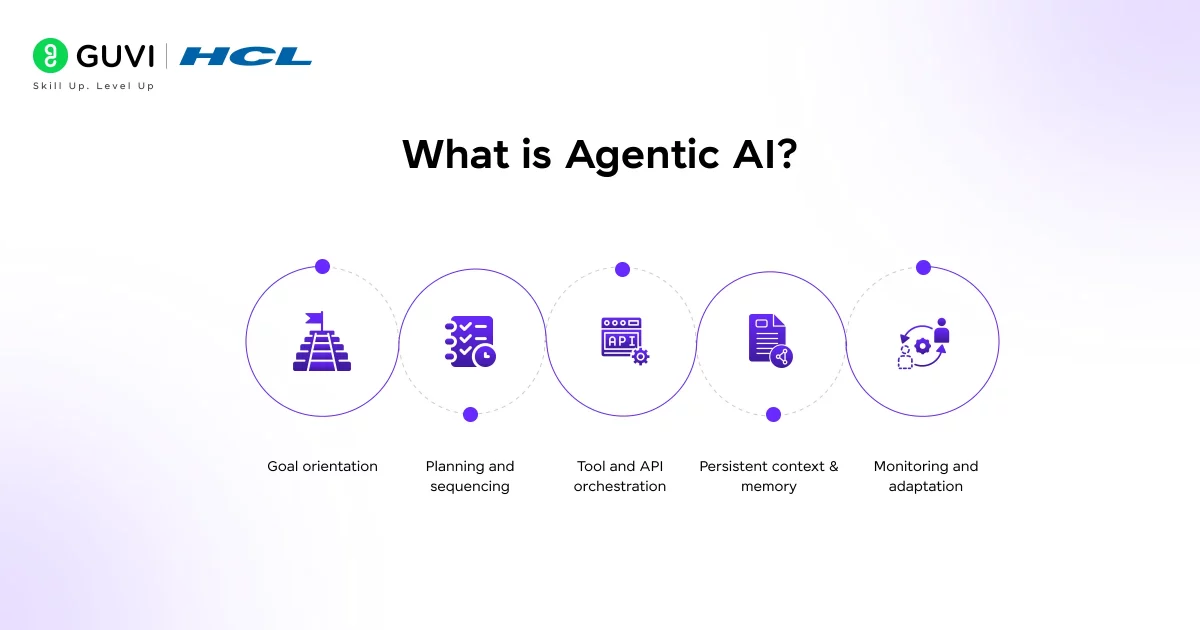
Agentic AI refers to systems that act to achieve goals with minimal human direction. Instead of just returning a prediction, an agentic system can plan a sequence of steps, call external tools or APIs, keep state or memory, and adapt when things change. It’s a move from “tell me” to “I’ll do it for you.”
Key capabilities
- Goal orientation: You specify a goal (explicitly or implicitly), and the agent breaks it down into tasks.
- Planning and sequencing: It can create multi-step plans and reorder steps if conditions change.
- Tool and API orchestration: It invokes external services, databases, or scripts to execute parts of a workflow.
- Persistent context & memory: Keeps state across interactions so future decisions are informed by history.
- Monitoring and adaptation: Observes results and revises plans (retry, escalate, or abort) when needed.
Example behaviors
Instead of: “Here’s a suggested reply,” this model will:
- Identify an issue from logs, open a ticket, attempt an automated remediation, escalate to a human if remediation fails, and follow up until resolution.
- Monitor inventory levels, reorder suppliers, reroute shipments, and notify stakeholders when delays occur.
- Schedule a sequence of experiments, run them, evaluate results, and iterate on parameters until a stopping criterion is met.
Agentic AI revives and modernizes older AI ideas (like “intelligent agents” and BDI-style reasoning) but combines them with modern LLMs, memory stores, and API ecosystems, that’s why it looks familiar but behaves very differently in practice.
Agentic AI vs Traditional AI: Key Differences
| Aspect | Traditional AI | Agentic AI |
| Autonomy | Systems are fundamentally reactive. They sit idle until prompted by a user or another system and then generate an output. | It operates with a much higher level of independence. Once you define a goal, it takes initiative by deciding how to achieve it, breaking the task into steps, and executing them with minimal human involvement. |
| Decision-Making | Decision-making in this model is confined to a single step: it evaluates data, applies a model, and provides a result. The process ends there, and further action must be taken by a human or another system. | It uses multi-step reasoning. It doesn’t just provide an answer; it continuously observes, plans, acts, and adapts. |
| Adaptability | It is designed to function best in stable, predictable environments. When unexpected changes occur, it struggles and usually requires retraining or reprogramming to remain effective. | It is built to be flexible in dynamic contexts. It can respond to changes in real time, adjust strategies on the fly, and continue progressing toward objectives. |
| Memory & Context | Most traditional AI systems operate without memory. They treat each interaction as isolated, meaning past data or user history rarely influences future outputs. | It incorporates both short-term and long-term memory. It recalls previous interactions, learns from outcomes, and uses that stored knowledge to make more informed decisions in future tasks. |
| Human Role | Humans play a central role in the workflows. The AI generates insights or outputs, but people remain responsible for interpreting results, validating accuracy, and carrying out the next steps. | With this, humans shift into a supervisory position. Instead of handling every step, they set high-level goals and intervene only when exceptions arise. |
| Risk Profile | The risks with this model are usually contained. An incorrect prediction or misclassification is often caught by a human before serious consequences occur, keeping the overall impact relatively low. | It carries a greater risk because it has the ability to act on its own. A poor decision can trigger cascading errors across systems, which is why oversight, safety nets, and clear boundaries are essential. |
Also Read: Generative AI vs AI Agents vs Agentic AI
Use Cases: Where Agentic AI Outshines Traditional AI
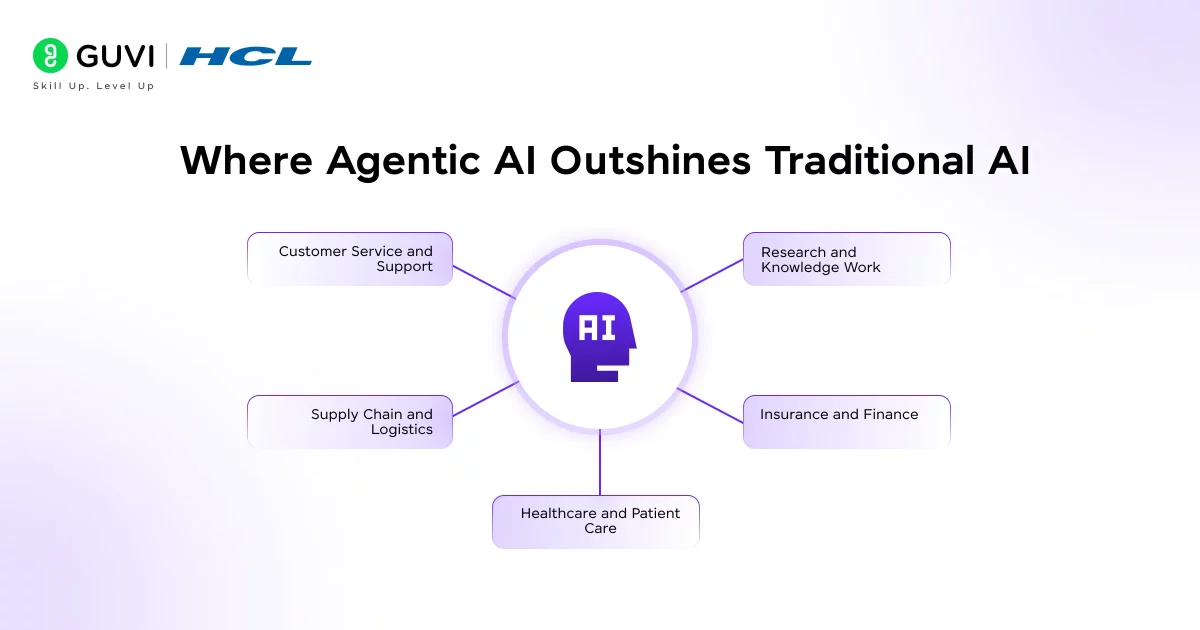
The true value of Agentic AI becomes clear when you compare how it performs against traditional AI in real-world applications. Traditional systems are strong at isolated, predictive tasks, but they stop short of acting on results.
1. Customer Service and Support
Traditional AI in customer service is usually limited to chatbots or ticket classification. It can detect sentiment, suggest responses, or route a query to the right department, but it doesn’t own the process.
Agentic AI can go further: it can detect when a customer issue arises, initiate a ticket, craft a contextual response, escalate to a human if needed, and even follow up until the case is closed.

2. Supply Chain and Logistics
Logistics is inherently unpredictable, with weather delays, supplier shortages, and traffic disruptions. Traditional AI helps with demand forecasting or route optimization, but it still requires humans to decide how to act on those insights. Agentic AI, however, can monitor real-time conditions, reroute shipments automatically, notify stakeholders, and reorder supplies.
3. Healthcare and Patient Care
In healthcare, traditional AI is used to analyze images, predict risks, or assist in diagnosis. It gives doctors better information but doesn’t act beyond that. Agentic AI can handle care coordination: scheduling tests, ensuring prescriptions are filled, sending reminders, and monitoring patient vitals to trigger alerts.
4. Insurance and Finance
Traditional AI is commonly used for fraud detection, risk scoring, or claims classification. But it stops after providing a score or a label. Agentic AI, on the other hand, can automate entire claims processes: validate documentation, query third-party data, flag anomalies, approve low-risk claims automatically, and escalate complex cases.
5. Research and Knowledge Work
In R&D and academia, traditional AI might help crunch datasets or run specific models. But agentic AI can orchestrate entire research workflows, designing an experiment, running simulations, collecting results, refining hypotheses, and preparing a summary.
Benefits & Limitations of Traditional and Agentic AI
Like any paradigm shift, adopting agentic AI offers powerful advantages but also introduces new complexities. Understanding both sides is crucial before implementing it in real workflows.
Benefits
- End-to-End Automation: The biggest strength of agentic AI is its ability to close the loop. Instead of requiring humans to interpret AI outputs and take the next step, it executes the steps autonomously.
- Increased Adaptability: Because agentic systems can adjust to real-time feedback, they are better suited to dynamic environments. They can reroute, reschedule, or reprioritize on their own, which reduces downtime and improves overall efficiency.
- Operational Efficiency: By handling multi-step processes without constant human oversight, the model reduces repetitive workloads. This allows humans to focus on higher-level oversight, problem-solving, and strategic work rather than micromanagement.
- Continuous Learning: Agentic systems often include feedback loops. They learn from outcomes, adjust strategies, and improve over time without waiting for large retraining cycles, unlike traditional model, which needs periodic updates.
- Scalability: In industries where workloads surge, like retail during holiday seasons or healthcare during emergencies, agentic models can scale their decision-making and actions to handle complexity without needing proportional human resources.
Limitations
- Higher Complexity and Cost: Agentic systems require sophisticated orchestration, memory, connectors to external tools, and robust safety nets. This makes them harder and more expensive to build compared to single-purpose traditional models.
- Amplified Risks: When agentic systems make mistakes, the consequences can spread quickly because it has the power to act. A poor decision in routing, for example, could disrupt an entire supply chain rather than just misclassify a data point.
- Explainability Challenges: It’s easier to understand why a traditional model predicted than to explain why a multi-step agentic system chose a specific sequence of actions. This creates challenges for accountability and debugging.
- Dependence on Data Quality: Since agentic models use real-time feedback and tool orchestration, bad data or unreliable inputs can cause a cascade of faulty decisions. Ensuring data integrity becomes even more critical.
- Ethical and Compliance Issues: Granting autonomy to AI agents raises regulatory and ethical questions. Decisions that were once human-controlled now happen automatically, making accountability harder to pin down.
When to use which?
- Choose traditional AI when you need reliable, explainable predictions for a constrained task and want simpler validation and compliance.
- Choose agentic AI when you need automation across systems, want the system to close the loop end-to-end, or you face dynamic environments that require planning and adaptation.
Bottom line, traditional models are all about answering; agentic models are about doing. Both are valuable. If you’re building systems that must reduce human handoffs and coordinate across multiple tools or steps, agentic approaches offer a lot, but they require stronger engineering, governance, and safety design.
If you’re serious about mastering artificial intelligence and want to apply it in real-world scenarios, don’t miss the chance to enroll in HCL GUVI’s Intel & IITM Pravartak Certified Artificial Intelligence & Machine Learning course. Endorsed with Intel certification, this course adds a globally recognized credential to your resume, a powerful edge that sets you apart in the competitive AI job market.
Conclusion
In conclusion, the move from traditional AI to agentic AI is more than a technical upgrade; it’s a philosophical shift in how we think about machines working alongside humans.
Traditional models remain powerful in domains where accuracy and predictability matter most, but it is limited to single, narrow tasks. Agentic systems expands the scope, acting like an autonomous partner capable of handling multi-step workflows and adapting in real time.
The future of AI won’t be about choosing one over the other, but about understanding when to rely on traditional models and when to empower agentic systems to act.
FAQs
1. What is the main difference between agentic AI and traditional AI?
Traditional AI is reactive, giving predictions or answers when prompted. Agentic AI is proactive, setting plans, taking actions, and adapting on its own.
2. Where does agentic AI outperform traditional AI?
The former excels in dynamic, multi-step workflows like customer service, logistics, and healthcare. It can adapt and act, while the latter only provides insights.
3. What are the benefits of agentic AI?
It enables end-to-end automation, reduces manual workload, improves adaptability, and scales easily. The result is faster, smarter decision-making across systems.
4. What are the challenges of using agentic AI?
Agentic systems are complex, harder to explain, and carry higher risks if decisions go wrong. It demands strict governance, security, and oversight.
5. Can agentic AI replace humans completely?
No. Agentic AI is best used with humans in the loop, augmenting workflows rather than fully replacing human judgment and accountability.
Success Stories

About the Author
Lukesh S
A professional content writer who has experience in freelancing and now working as a Technical Content Writer at HCL GUVI having sound knowledge in Blog Writing and Creative Writing!
View all posts by Lukesh S
Connect with me @






Did you enjoy this article?