


Artificial Intelligence and Machine Learning Articles
Learn How to Use Stable Diffusion Easily (Beginner-Friendly Guide)
How to Use AWS Bedrock: Build AI Chatbots with Console and Python


Get In Touch For Details! Request More Information

Knowledge Representation in AI: A Beginner’s Guide That Actually Makes Sense (2025)
Sep 24, 2025 7 Min Read 3690 Views
(Last Updated)
Knowledge representation in AI describes how machines understand and process information about the real world. Unlike humans, who naturally interpret experiences, machines need structured frameworks to make sense of data.
Essentially, what is knowledge representation in AI involves converting real-world information into formats computers can work with and reason from. This isn’t simply storing data in a database but allowing machines to learn and behave intelligently like humans. The importance of knowledge representation in AI becomes clear when you understand its role in modeling intelligent behavior for AI agents.
In this beginner’s guide, you’ll learn how knowledge representation techniques support intelligent systems, why they matter, and how they enable machines to reason through complex problems in ways that actually make sense. Let’s get right to it!
Table of contents
- What is Knowledge Representation in AI?
- Why machines need structured knowledge
- Types of Knowledge in AI
- 1) Declarative knowledge
- 2) Procedural knowledge
- 3) Meta knowledge
- 4) Heuristic knowledge
- 5) Structural knowledge
- Techniques of Knowledge Representation in AI
- 1) Logic-based representation
- 2) Semantic networks
- 3) Frames and scripts
- 4) Ontologies
- 5) Production rules
- How Knowledge Representation Supports Reasoning
- 1) Deductive reasoning
- 2) Inductive reasoning
- 3) Abductive reasoning
- 4) Role in decision-making
- Applications of Knowledge Representation in AI
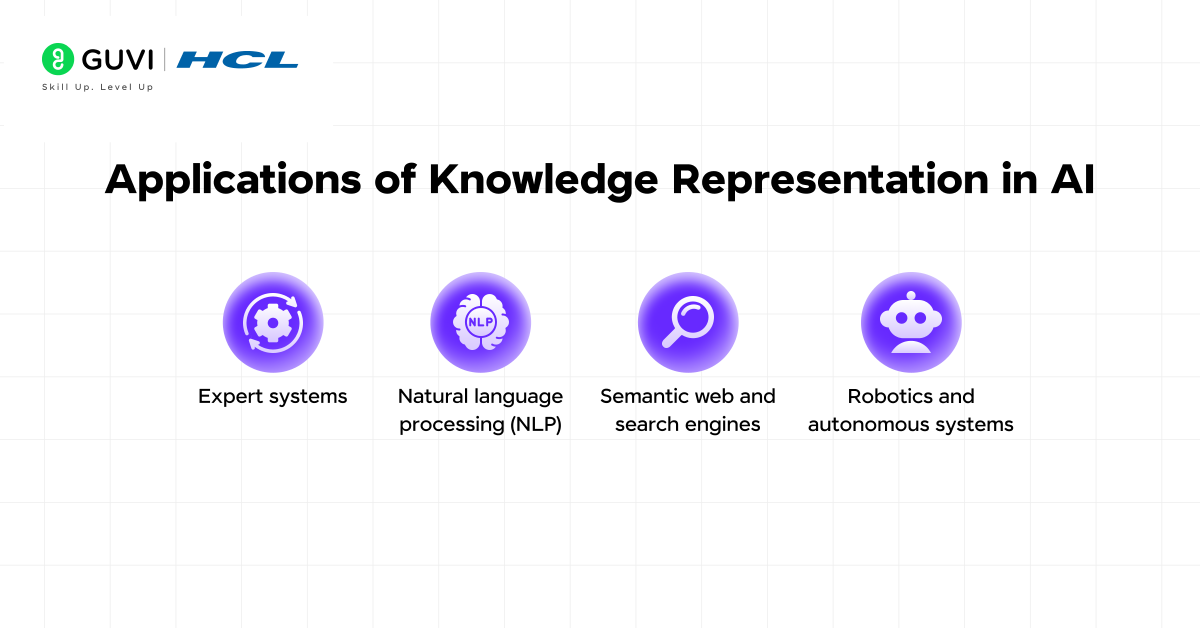
- 1) Expert systems
- 2) Natural language processing
- 3) Robotics and autonomous systems
- 4) Semantic web and search engines
- Concluding Thoughts…
- FAQs
- Q1. What are the main types of knowledge representation in AI?
- Q2. How does knowledge representation support AI reasoning?
- Q3. What are some practical applications of knowledge representation in AI?
- Q4. Why do machines need structured knowledge?
What is Knowledge Representation in AI?
Knowledge Representation and Reasoning (KR, KRR) serves as the foundation for how AI systems interpret and interact with the world around them. Rather than simply warehousing information in databases, knowledge representation creates symbolic systems that allow machines to comprehend their environment.
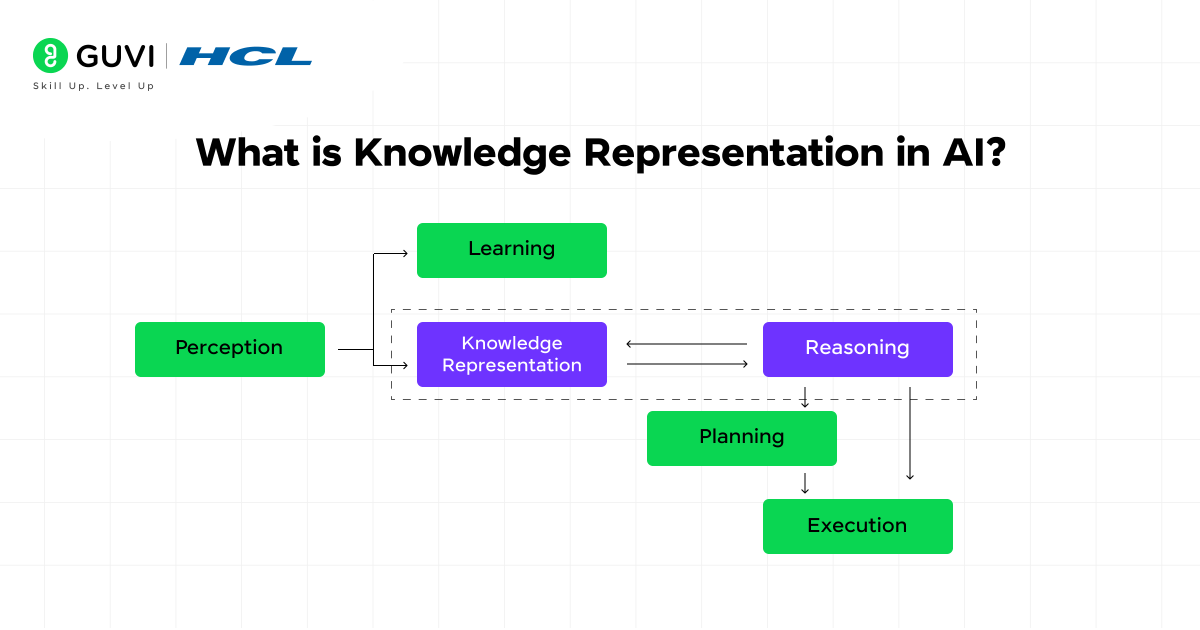
The primary purpose is enabling AI programs to make intelligent inferences about real-world facts and solve complex problems.
A successful knowledge representation system should demonstrate several key capabilities:
- Represent any required knowledge comprehensively
- Manipulate representational structures to generate new knowledge
- Steer inferential mechanisms productively
- Acquire new information quickly and easily
Through these capabilities, knowledge representation bridges the gap between raw information and machine intelligence, allowing computers to communicate in natural language, plan activities, and tackle challenges that typically require human expertise.
Why machines need structured knowledge
Just as humans cannot respond appropriately to unfamiliar situations, AI systems cannot act intelligently without adequate knowledge. Consider meeting someone speaking a language you don’t understand—your ability to respond meaningfully is limited. Similarly, AI agents require structured knowledge to demonstrate intelligent behavior.
Machines specifically need structured knowledge because:
- First, structured data provides the foundation for reliable and scalable AI systems through its inherent clarity and consistency. Unlike unstructured data (emails, social media posts, audio files), structured data follows predefined formats that AI algorithms can interpret consistently.
- Second, structured knowledge forms the backbone for knowledge graphs, enhancing AI’s ability to understand context and relationships. This organization allows AI systems to navigate complex information environments more effectively than with raw data alone.
- Third, well-structured knowledge is crucial for training machine learning models, particularly for tasks involving classification, prediction, and decision-making. Without this structured foundation, AI systems would struggle to interpret information or apply logical reasoning in complex environments.
Types of Knowledge in AI
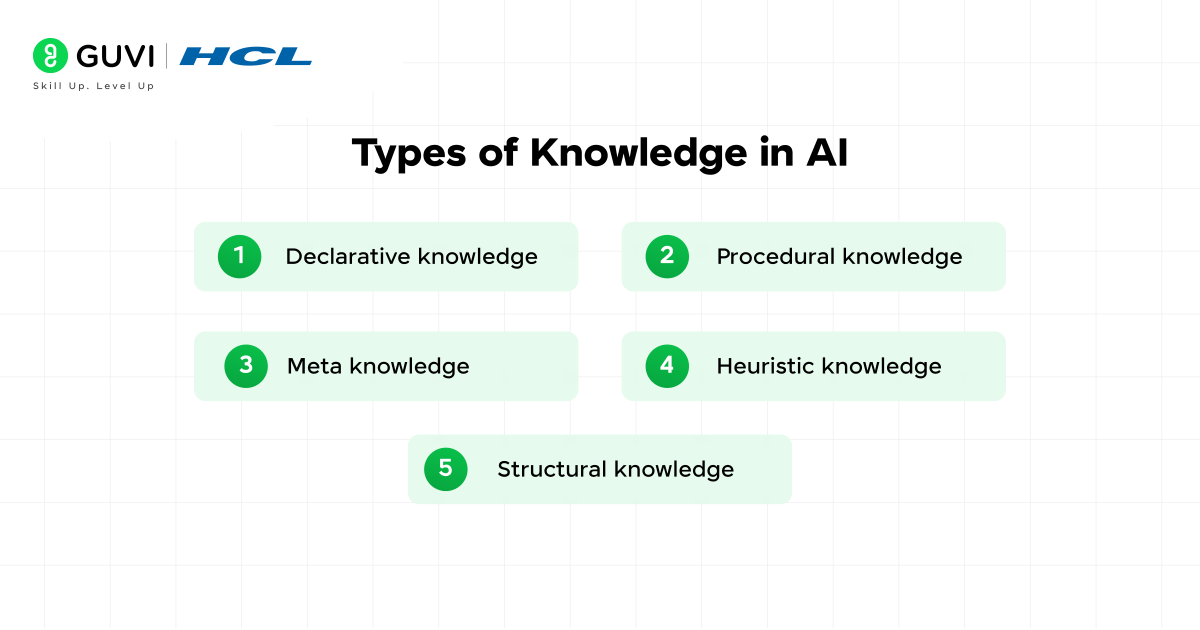
In AI systems, different forms of knowledge enable machines to understand and interact with the world. These knowledge types serve as building blocks for effective knowledge representation in AI, each playing a unique role in how machines process information.
1) Declarative knowledge
Declarative knowledge encompasses facts and statements that describe the world, often referred to as “knowing what.” This form of knowledge is static in nature and focuses on describing objects, events, and concepts without explaining how to use them.
Key characteristics:
- Expresses facts that can be directly stated
- Represents “what is known” about a domain
- Primarily answers “what” questions rather than “how” questions
- Often stored in structured formats like databases and knowledge graphs
For example, statements such as “Paris is the capital of France” or “A triangle has three sides” represent declarative knowledge. In AI applications, question-answering systems utilize this type of knowledge to respond to factual queries.

2) Procedural knowledge
Procedural knowledge, also known as imperative knowledge, refers to understanding how to perform specific tasks or actions. Unlike its declarative counterpart, procedural knowledge is dynamic and action-oriented.
Key characteristics:
- Describes step-by-step procedures to complete tasks
- Focuses on “how” rather than “what”
- Typically acquired through practice and experience
- Often requires time to master
For instance, knowing how to solve a quadratic equation or drive a car represents procedural knowledge. In AI applications, this knowledge type appears in robotics where machines follow defined processes to navigate spaces or assemble products.
3) Meta knowledge
Meta knowledge refers to “knowledge about knowledge” – understanding what you know, how reliable that information is, and when to apply it. This higher-order knowledge helps AI systems evaluate and enhance their reasoning abilities.
Key characteristics:
- Helps AI understand what it knows and doesn’t know
- Enables evaluation of information reliability
- Guides AI in choosing appropriate knowledge for specific situations
- Improves over time as the system learns
In practice, meta knowledge allows an AI system to determine which sources are trustworthy or which strategies work best for particular problem types. For example, a self-driving vehicle might use meta knowledge to recognize when sensor data is compromised by fog.
4) Heuristic knowledge
Heuristic knowledge consists of experience-based rules of thumb or shortcuts that help in making quick decisions without complete information. Often described as “shallow knowledge,” heuristics provide practical approaches to problem-solving based on past experiences.
Key characteristics:
- Relies on intuition, experience, and common sense
- Offers shortcuts for complex decision-making
- Reduces computational time by focusing on likely solutions
- Doesn’t guarantee optimal results, but provides efficient approximations
In AI applications, heuristic knowledge appears in game-playing systems like chess engines, which use evaluation heuristics to determine promising moves without examining every possible option.
5) Structural knowledge
Structural knowledge deals with relationships between concepts or entities, organizing information into meaningful frameworks like hierarchies or networks. This knowledge type helps AI understand how different pieces of information connect.
Key characteristics:
- Represents relationships and connections between concepts
- Often visualized as networks, graphs, or hierarchies
- Enables inference of new relationships from existing ones
- Enhances understanding of complex systems and domains
For example, understanding that a dog is a type of animal and a poodle is a type of dog represents structural knowledge. In AI, structural knowledge appears in knowledge graphs and semantic networks that map relationships between entities.
These five knowledge types form the foundation of modern knowledge representation in AI systems, enabling machines to understand facts, perform tasks, evaluate information quality, make quick decisions, and recognize relationships—all essential capabilities for intelligent behavior.
Techniques of Knowledge Representation in AI
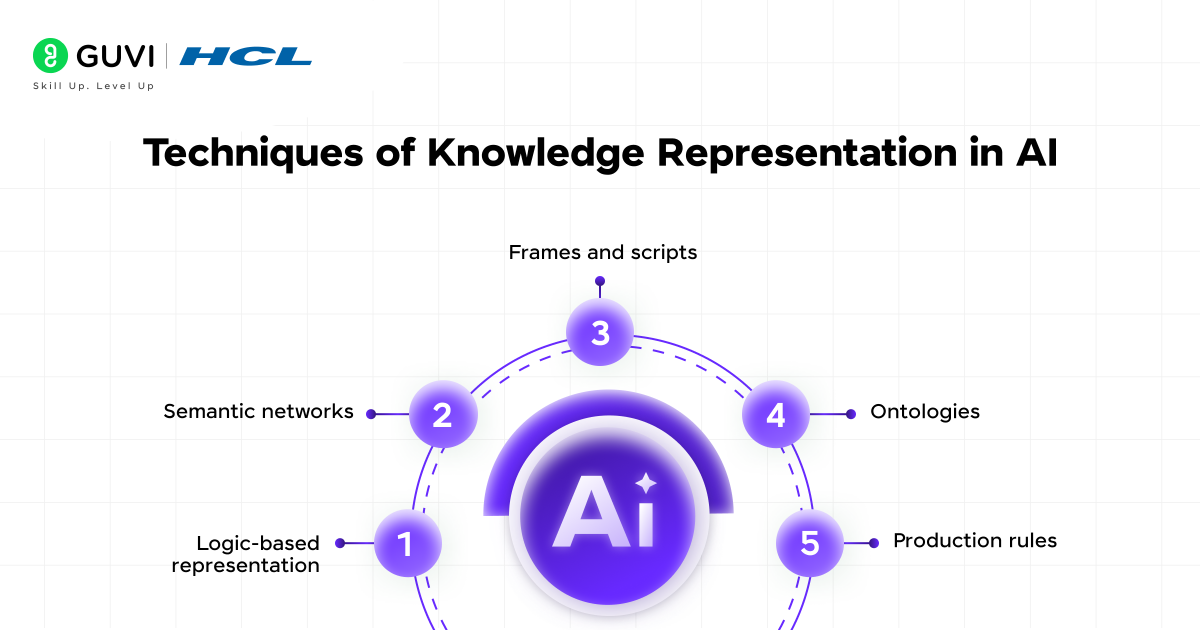
To implement intelligent behavior in machines, various techniques of knowledge representation in AI have been developed over time. These methods serve as the bridge between raw data and machine reasoning, each with distinct approaches to organizing and utilizing information.
1) Logic-based representation
Logic-based representation forms the foundation of formal reasoning in AI systems. This approach uses precise rules and symbols to represent facts, making it ideal for deterministic environments where information is definite.
Propositional logic utilizes simple declarative statements connected by operators like AND, OR, and NOT. First-order logic (FOL) extends this foundation by introducing variables, quantifiers, and predicates, enabling AI to express more nuanced relationships between objects.
Furthermore, FOL supports complex reasoning but requires significant computational resources. Despite its strengths, logic-based systems often struggle with uncertain or incomplete information, requiring extensions like fuzzy logic for real-world scenarios.
2) Semantic networks
Semantic networks represent knowledge as interconnected concepts through a graph structure. In these networks, nodes represent objects or concepts while edges define the relationships between them.
The structure consists of:
- Nodes: Representing concepts, objects, or ideas
- Edges: Showing relationships between nodes (e.g., “is-a,” “has-a”)
- Labels: Specifying the nature of relationships
For example, a semantic network might connect “Dog” to “Animal” with an “is-a” relationship, enabling the system to infer that dogs inherit properties of animals.
Although semantic networks offer intuitive visualization of knowledge, they lack formal semantics and can become unwieldy as they grow in complexity.
3) Frames and scripts
Frames organize knowledge into structured units resembling record-like structures. Each frame contains slots (attributes) and fillers (values) describing an entity or concept. This approach was introduced by Marvin Minsky in the 1970s to represent stereotypical situations.
Scripts expand on frames by representing sequences of events or actions in particular contexts. Generally, they capture expected patterns of behavior in common scenarios, making them valuable for understanding narratives or planning actions.
The primary strength of frames lies in their ability to group related information, making knowledge easily accessible and modifiable while supporting default reasoning.
4) Ontologies
Ontologies provide formal frameworks for defining concepts, categories, and relationships within a specific domain. As computational artifacts, they offer both a conceptual and computational model of particular domains of interest.
In the context of the Semantic Web, ontologies help machines understand and connect data across the internet. Google’s Knowledge Graph represents a prominent application of ontologies, enhancing search results by connecting related concepts.
5) Production rules
Production rules represent knowledge through conditional statements following an “IF-THEN” format. These rules link conditions to actions, making them particularly useful for expert systems.
The production rule system consists of three main components:
- A set of rules (knowledge base)
- Working memory (current state)
- A recognize-act cycle (reasoning mechanism)
During execution, if a rule’s condition matches the current state, it “fires,” performing its associated action. This mechanism mimics human logical inference based on explicit domain knowledge.
The modularity of production rules makes them easy to update and maintain, though they lack learning capabilities and can become complex with increasing rule numbers.
How Knowledge Representation Supports Reasoning
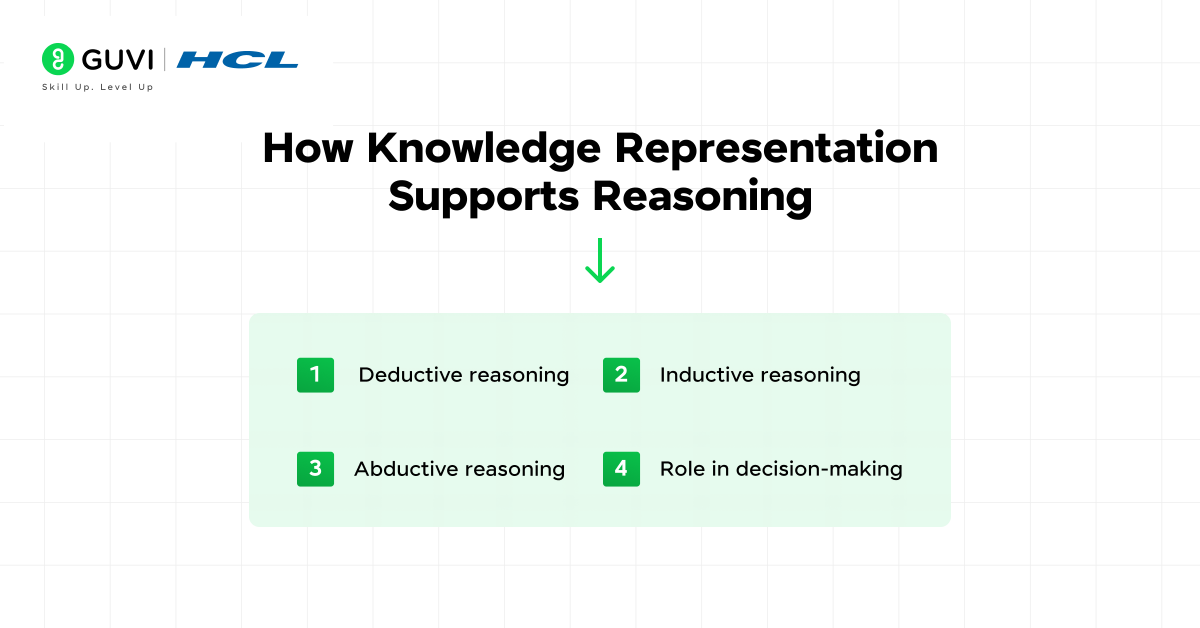
Effective knowledge representation in AI serves as the foundation for various reasoning mechanisms, enabling machines to draw conclusions and solve complex problems based on available information.
1) Deductive reasoning
Deductive reasoning moves from general principles to specific conclusions with logical certainty. When implemented in AI systems, this reasoning approach ensures that if the premises are true, the conclusion must necessarily be true as well.
Key implementations:
- Expert systems that emulate human reasoning capabilities
- Rule-based systems utilizing if-then rules for fraud detection and diagnostics
- Automated Theorem Proving (ATP) systems for mathematical validation
In medical diagnosis, for instance, an AI system might apply deductive reasoning by analyzing symptoms through established diagnostic rules, systematically matching them with known medical conditions stored in its knowledge base.
2) Inductive reasoning
Inductive reasoning operates as a bottom-up approach, drawing broader generalizations from specific observations. Unlike deduction, induction doesn’t guarantee certainty but provides conclusions that are likely true based on observed patterns.
The process typically involves:
- Careful observation of data or situations
- Recognition of recurring patterns or trends
- Formation of tentative hypotheses
- Creation of broader generalizations
This reasoning method powers many machine learning applications, including spam filtering, image classification, and recommendation systems, allowing AI to adapt to new, previously unseen scenarios.
3) Abductive reasoning
Abductive reasoning identifies the most plausible explanation for a set of observations, especially when dealing with incomplete information. Often called “inference to the best explanation,” it helps AI systems become more intuitive and human-like.
When implementing abductive reasoning, AI systems:
- Generate multiple potential hypotheses for observed data
- Evaluate explanations based on simplicity, scope, and coherence
- Select the most probable explanation using probabilistic models
For example, a medical diagnostic system encountering a patient with chest pain might consider various causes before determining a heart attack as the most likely explanation based on symptoms and medical history.
4) Role in decision-making
Knowledge representation combined with reasoning mechanisms transforms AI from basic automation tools into sophisticated decision-making partners. This synergy enables AI to:
- Draw logical conclusions using various reasoning strategies
- Solve complex problems through structured approaches
- Make predictions based on available evidence
- Adapt to new information and uncertain scenarios
Indeed, effective reasoning capabilities allow AI systems to anticipate outcomes, evaluate trade-offs, and adjust strategies dynamically—much like human thought processes. By integrating different reasoning methods, modern AI systems can navigate complex real-world problems where information may be uncertain or incomplete, thereby delivering more precise and context-aware results.
To keep things interesting, here are a couple of surprising facts about knowledge representation:
The Idea Dates Back to the 1950s: The concept of representing knowledge for machines was first formally discussed at the Dartmouth Conference in 1956, the same workshop where the term “Artificial Intelligence” was coined.
Knowledge Graphs Power Google Search: When you search on Google and see quick answers (like famous people, places, or relationships), you’re actually seeing AI-driven knowledge representation in action through Google’s Knowledge Graph, which connects billions of facts and entities.
These fun facts show how knowledge representation is not just a technical framework—it’s been shaping AI since its earliest days and continues to power the tools we use daily!
Applications of Knowledge Representation in AI
Knowledge representation in AI enables practical applications that solve real-world problems through structured information processing. Here’s how different sectors utilize this foundational technology.
1) Expert systems
Expert systems apply specialized knowledge to solve domain-specific problems that normally require human expertise. These systems consist of:
- A knowledge base containing facts and rules about a specific domain
- An inference engine that applies this knowledge to answer questions
Early examples like MYCIN helped diagnose bacterial infections, while Dendral analyzed chemical compounds. These systems proved particularly valuable in fields ranging from medical diagnosis to petroleum engineering. Moreover, expert systems remain useful in financial planning, making recommendations based on structured knowledge rather than replacing human experts.
2) Natural language processing
NLP systems rely heavily on knowledge representation to understand human language. By integrating various knowledge sources, these applications can process:
- Definite references and ambiguities in text
- Contextual meaning beyond literal words
- Semantic relationships between concepts
The computational nature of language makes it ideal for knowledge processing tasks. Notably, NLP combines qualitative characteristics of human knowledge with a computer’s quantitative advantages, allowing systematic processing of vast amounts.
3) Robotics and autonomous systems
Robots use knowledge representation to understand their surroundings and plan actions. In robotics, knowledge representation extends beyond logical formalism to include:
- Perception modules (vision, audio, touch)
- Motion planning systems
- Inference mechanisms
This comprehensive approach helps robots connect abstract logic with real-world meanings. Additionally, cognitive robots must use their knowledge against their perception to generate appropriate actions based on goals and beliefs.
4) Semantic web and search engines
The Semantic Web adds a layer of meaning on top of the internet, allowing machines to process web content meaningfully. Key components include:
- Resource Description Framework (RDF) for defining knowledge-based objects
- Web Ontology Language (OWL) for adding semantics
Unlike traditional keyword-based searches, the Semantic Web creates ontologies of concepts, making information retrieval more effective. This approach transforms the internet from hypertext links into a semantic graph where relationships between information are explicitly defined.
Master AI & ML with HCL GUVI’s IIT-M-Pravartak and Intel-certified AI and ML Course, designed with Intel. Learn Knowledge Representation, Generative AI, Deep Learning, and MLOps through hands-on projects—plus gain career support from 1000+ hiring partners.
Concluding Thoughts…
Knowledge representation stands as the fundamental bridge between how machines understand our world and how they use that understanding to demonstrate intelligent behavior. Throughout this guide, you’ve seen how AI systems utilize various knowledge types—from declarative facts to procedural methods—to make sense of complex information.
Knowledge representation thus serves as both the foundation and future of artificial intelligence, transforming simple data into meaningful insights that drive intelligent behavior. The next time you interact with an AI system, you’ll recognize how its ability to understand your requests depends on the knowledge structures working quietly behind the scenes.
FAQs
Q1. What are the main types of knowledge representation in AI?
There are five main types of knowledge representation in AI: declarative, procedural, meta, heuristic, and structural knowledge. Each type serves a specific function in how machines interpret and use information to demonstrate intelligent behavior.
Q2. How does knowledge representation support AI reasoning?
Knowledge representation supports AI reasoning by providing a structured foundation for deductive, inductive, and abductive reasoning methods. This enables AI systems to draw logical conclusions, solve complex problems, make predictions, and adapt to new information, ultimately supporting sophisticated decision-making processes.
Q3. What are some practical applications of knowledge representation in AI?
Knowledge representation in AI has various practical applications, including expert systems for specialized problem-solving, natural language processing for understanding human language, robotics and autonomous systems for environmental interaction, and semantic web technologies for enhancing information retrieval and search engine capabilities.
Q4. Why do machines need structured knowledge?
Machines need structured knowledge to demonstrate intelligent behavior, as it provides clarity and consistency for AI algorithms. Structured knowledge forms the basis for knowledge graphs, enhances contextual understanding, and is crucial for training machine learning models, enabling AI systems to interpret information and apply logical reasoning effectively.
Success Stories

About the Author
Jaishree Tomar
A recent CS Graduate with a quirk for writing and coding, a Data Science and Machine Learning enthusiast trying to pave my own way with tech. I have worked as a freelancer with a UK-based Digital Marketing firm writing various tech blogs, articles, and code snippets. Now, working as a Technical Writer at GUVI writing to my heart’s content!
View all posts by Jaishree Tomar
Connect with me @













Did you enjoy this article?