


Artificial Intelligence and Machine Learning Articles
How to Audit LLM Models for Backdoors: Tools & Frameworks for Developers
AI Governance & Compliance in Web Apps: Why You Can’t Ignore Data Risk When Using LLMs
How to Evaluate LLMs for Production: Beyond Benchmarks (A Developer’s Guide)


Get In Touch For Details! Request More Information

What is Data Centric AI? The Plain English Guide for 2025
Nov 25, 2025 5 Min Read 1223 Views
(Last Updated)
Data-centric AI shifts your focus from complex algorithms to what truly drives machine learning success: the quality of your data. Indeed, as highlighted in recent research, “data is the fuel for any ML system”. Rather than obsessing over model refinement, this approach puts data at the center stage.
When you’re new to the concept of data-centric AI, understanding its fundamentals is essential for staying relevant in 2025. This beginner’s guide will introduce you to the data-centric definition and methodology. Throughout this article, you’ll discover how this approach can transform your understanding of artificial intelligence. Let’s begin!
Table of contents
- What is Data Centric AI?
- Why it matters in 2025
- Core Principles of Data Centric AI
- Data as a living asset
- Systematic data improvement
- Scalable data workflows
- Collaboration between teams
- Benefits of a Data Centric Approach
- 1) Improved model performance
- 2) Lower costs and faster development
- 3) Fairer and more ethical AI
- 4) Reusable and scalable datasets
- Real-World Applications of Data-Centric AI
- 1) Healthcare and medical imaging
- 2) Autonomous vehicles
- 3) Natural language processing
- 4) Manufacturing and predictive maintenance
- Concluding Thoughts…
- FAQs
- Q1. What is the main focus of data-centric AI?
- Q2. How does data-centric AI differ from model-centric AI?
- Q3. What are the core principles of data-centric AI?
- Q4. What are the benefits of adopting a data-centric AI approach?
- Q5. In which industries is data-centric AI making a significant impact?
What is Data Centric AI?
Data-centric AI (DCAI) is a systematic approach to curating, managing, and enhancing training data throughout its lifecycle to drive increased model accuracy. Unlike traditional approaches, this methodology treats data as the primary driver of AI success.
Data-centric AI focuses on improving the quality of your training data instead of constantly tweaking model architectures. Think of it as programming with a focus on data instead of code. This approach treats the improvement of training data as a software engineering discipline in its own right.
Furthermore, DCAI views your data not as a static input but as a living, evolving asset that requires careful stewardship. The key principles include:
- Placing primary focus on elevating data above models
- Adopting programmatic and scalable data workflows
- Directly involving subject matter experts in the data pipeline
- Continuously improving data based on model feedback
Why it matters in 2025
- Data-centric AI is particularly relevant now because sophisticated models are available as off-the-shelf commodities. Consequently, the biggest opportunity for differentiation in the market lies in data quality.
- In 2025, with AI increasingly relying on unstructured data inputs like text, images, and video, a data-centric approach becomes key to tackling this complexity. Specifically, as generative AI technologies advance, the demands on data quality grow exponentially.
- Above all, adopting a data-centric mindset helps organizations position themselves for success in the era of unstructured AI data. By 2030, synthetic data (a form of generative AI) is projected to surpass real data in AI models, highlighting the growing importance of data engineering skills.
- Data-centric AI ultimately creates a flywheel effect on model accuracy and business value – making it the approach that will define successful AI implementations in 2025 and beyond.
Core Principles of Data Centric AI
The foundation of data-centric AI rests on four core principles that transform how you approach machine learning projects. These principles prioritize data quality, systematization, and collaboration as the driving forces behind successful AI systems.
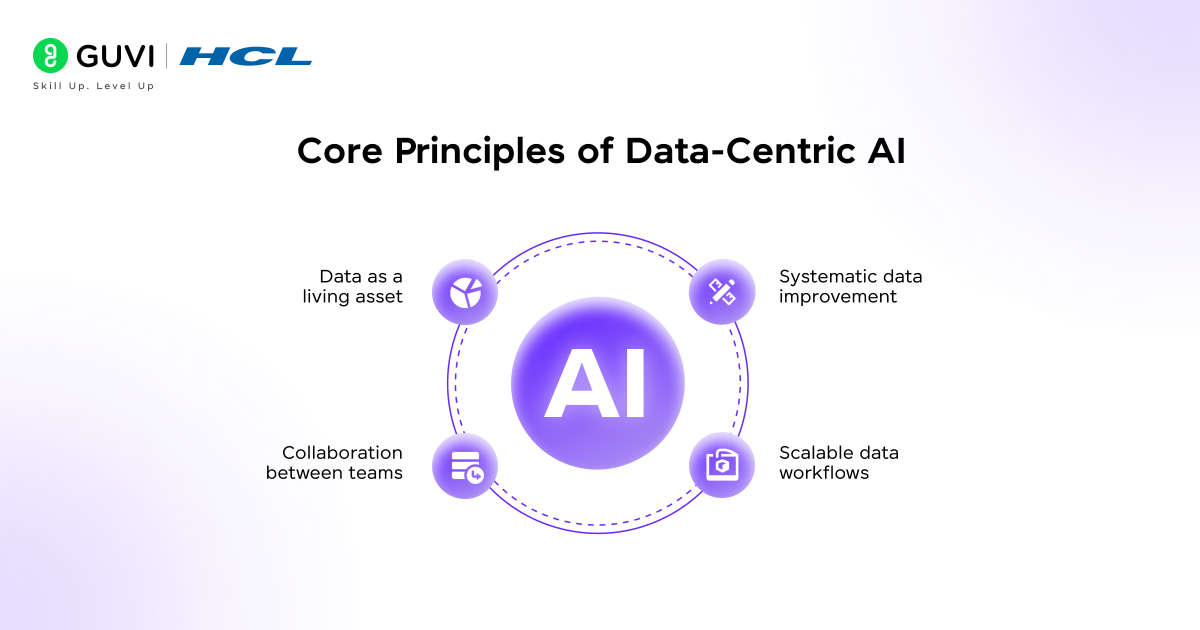
1. Data as a living asset
In the data-centric approach, your data isn’t a static collection gathered once and forgotten. Instead, it functions as a dynamic, evolving resource that requires ongoing stewardship. This perspective treats data as an organic representation of the living world that continuously changes and adapts. Your datasets become strategic assets requiring:
- Careful documentation and versioning
- Regular quality assessments
- Ongoing refinement and updates
The value of your data emerges only when it drives decisions and powers your AI systems. Therefore, treating data as a living asset means actively curating it throughout its lifecycle.
2. Systematic data improvement
Data-centric AI involves an iterative loop of assessment and enhancement. After training a model, you analyze performance gaps to identify data issues. Additionally, this approach emphasizes:
- Conducting error analysis to evaluate data fit and consistency
- Implementing improvements based on findings
- Using data benchmarking to compare quality across iterations
This systematic improvement creates a continuous feedback loop between your data and models, mutually enhancing both components.

3. Scalable data workflows
As AI applications grow, scalable data workflows become essential. These workflows should handle increasing volumes without performance degradation. Accordingly, your infrastructure must support both batch and real-time data processing.
Scalable workflows incorporate technologies like data lakes and distributed computing frameworks that efficiently manage large datasets while adapting to evolving AI needs.
4. Collaboration between teams
Perhaps most importantly, data-centric AI thrives on breaking down silos between subject matter experts (SMEs) and data scientists. This collaboration enables:
- SMEs to share their domain expertise in multiple ways
- Data scientists to iterate on data quality rather than just model parameters
- Faster development through reduced communication friction
When teams work together on a shared platform, they create a more agile system capable of adapting to complex real-world problems.
Benefits of a Data Centric Approach
Adopting a data-centric mindset unlocks tangible advantages that go far beyond theoretical improvements. Let’s explore how focusing on data quality can transform your AI initiatives.
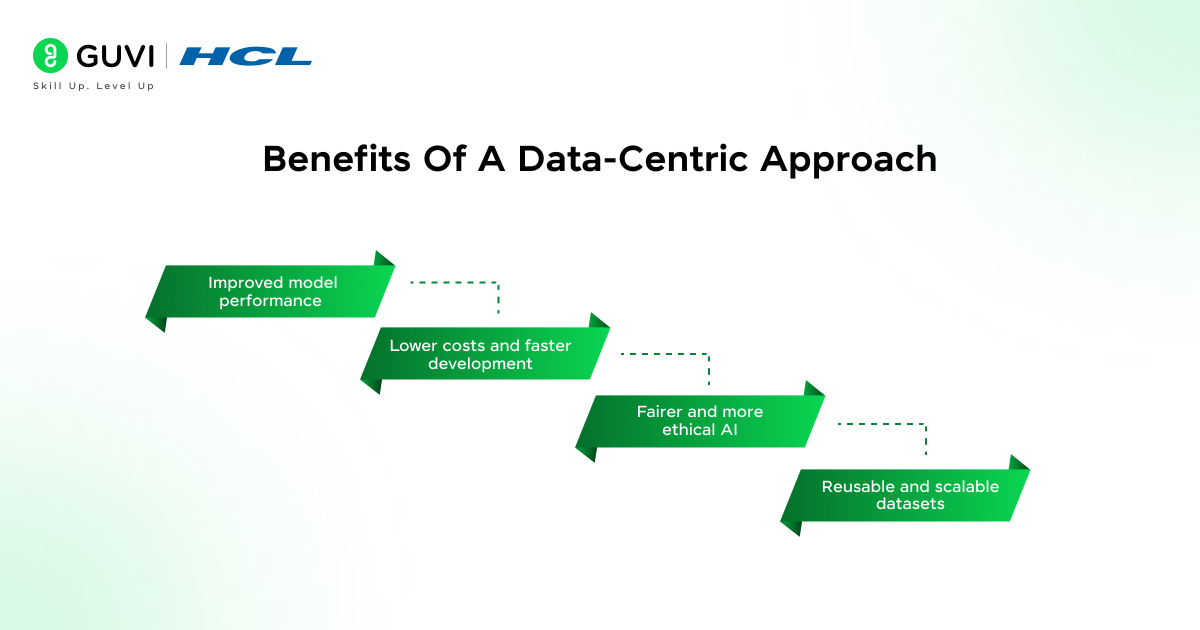
1) Improved model performance
High-quality data directly translates to superior AI results. In fact, even smaller models can perform equally to larger ones when trained on specific, high-quality datasets. This represents a fundamental shift in thinking about AI success.
2) Lower costs and faster development
The economic benefits of what is data-centric AI become crystal clear when examining real-world case studies:
Organizations report building computer vision applications up to 10x faster through systematic data improvements. Similarly, development cycles shrink dramatically—from 20 weeks to 14 weeks in one case.
3) Fairer and more ethical AI
As AI systems increasingly influence decisions affecting people’s lives, the ethical dimension becomes crucial. Data-centric approaches help eliminate bias through careful analysis and data improvement.
By prioritizing data quality, you can build AI that makes fairer decisions across domains like lending models, hiring tools, and healthcare. Subsequently, this leads to more inclusive systems that maintain public trust and safety.
4) Reusable and scalable datasets
Perhaps the most strategic advantage of data-centric AI is the creation of reusable data assets. Feature stores function as centralized marketplaces for storing and sharing data features, eliminating duplication of effort across projects.
Reusable data products shift focus from routine data preparation to strategic decision-making. Each data product comes with detailed metadata and transparent usage guidelines, making it easier to understand and trust.
Ultimately, this approach transforms how organizations view their data—not as a one-time input, but as strategic assets that deliver ongoing value across multiple AI initiatives.
To bring a lighter twist to this technical topic, here are some intriguing facts about the evolution and influence of data-centric AI:
1. The Idea Was Popularized by Andrew Ng: Although data quality has always mattered, the term “data-centric AI” gained prominence when AI pioneer Andrew Ng emphasized in 2021 that “AI development has become too model-focused.” This sparked a global movement toward improving datasets rather than endlessly tweaking models.
2. Small Data Can Beat Big Models: Surprisingly, smaller, simpler models trained on clean and well-labeled data often outperform large, complex models trained on noisy or unstructured datasets. This insight reshaped how industries approach AI efficiency and fairness.
3. 80% of AI Project Time Goes Into Data: Studies reveal that up to 80% of an AI project’s effort is spent collecting, cleaning, and labeling data — highlighting why the data-centric approach is now seen as the backbone of real-world AI success.
These insights show that the real power of AI lies not just in algorithms but in the precision, structure, and quality of the data that fuels them.
Real-World Applications of Data-Centric AI
The practical impact of data-centric AI is transforming industries through real-world applications that leverage high-quality datasets over complex algorithms.
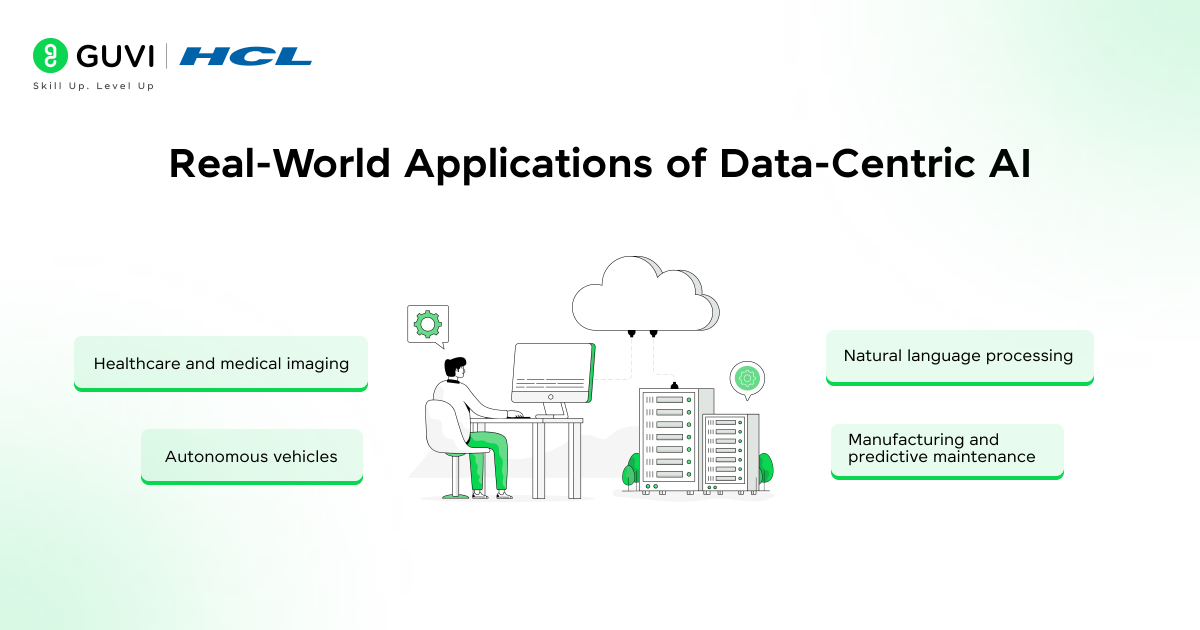
1) Healthcare and medical imaging
Medical imaging represents a breakthrough area for data-centric AI, with AI-based diagnostic tools significantly improving early disease detection. These systems analyze images with remarkable speed and precision, identifying early-stage conditions that traditional methods might miss. Notably, AI algorithms have demonstrated performance comparable to human experts in detecting:
- Pneumonia in radiology
- Skin lesions in dermatology
- Lymph node metastases in pathology
- Heart attacks in cardiology
2) Autonomous vehicles
Waymo exemplifies data-centric AI in self-driving technology, focusing on building a predictive, generalized driving model through extensive data collection—over 100,000 autonomous miles weekly. Their approach prioritizes data quality in rare encounters and difficult situations, automatically expanding datasets where they are sparse.
3) Natural language processing
Data-centric approaches in NLP power applications, including sentiment analysis, toxicity classification, machine translation, and question answering systems. These capabilities enable everyday technologies like search engines, voice assistants, and content moderation tools.
4) Manufacturing and predictive maintenance
Predictive maintenance represents what is data-centric AI in action—analyzing equipment sensor data to anticipate failures before they occur. This approach reduces downtime by up to 15% while boosting labor productivity between 5-20%.
Want to turn ideas into real AI solutions? Enroll in HCL GUVI’s IIT-M Pravartak Certified AI & ML Course— a 5-month, project-first, mentor-led course that equips you to build, deploy, and scale models in the real world
Concluding Thoughts…
Data-centric AI represents a fundamental shift in how you approach machine learning success. Throughout this guide, you’ve seen how focusing on data quality rather than complex algorithms can dramatically improve AI outcomes across industries. This approach treats your data as a living, evolving asset requiring continuous improvement and collaboration between teams.
As we move toward 2025, data-centric AI will likely define successful AI implementations. The biggest competitive advantage now comes from data quality rather than model architecture. Therefore, mastering this approach positions you at the forefront of AI innovation. After all, even the most sophisticated algorithms can only perform as well as the data they’re trained on.
FAQs
Q1. What is the main focus of data-centric AI?
Data-centric AI focuses on improving the quality of training data rather than constantly tweaking model architectures. It treats data as a primary driver of AI success, emphasizing systematic data improvement and management throughout its lifecycle.
Q2. How does data-centric AI differ from model-centric AI?
While model-centric AI focuses on adjusting model architecture using static datasets, data-centric AI keeps the model relatively fixed and iteratively improves the data. Data-centric AI recognizes that even simple models can outperform complex ones when trained on high-quality data.
Q3. What are the core principles of data-centric AI?
The core principles of data-centric AI include treating data as a living asset, implementing systematic data improvement processes, developing scalable data workflows, and fostering collaboration between subject matter experts and data scientists.
Q4. What are the benefits of adopting a data-centric AI approach?
Benefits of data-centric AI include improved model performance, lower costs, faster development cycles, fairer and more ethical AI systems, and the creation of reusable and scalable datasets that can be leveraged across multiple projects.
Q5. In which industries is data-centric AI making a significant impact?
Data-centric AI is transforming various industries, including healthcare (medical imaging), autonomous vehicles, natural language processing, finance (fraud detection), and manufacturing (predictive maintenance). These applications demonstrate the practical power of focusing on data quality in AI development.
Success Stories

About the Author
Jaishree Tomar
A recent CS Graduate with a quirk for writing and coding, a Data Science and Machine Learning enthusiast trying to pave my own way with tech. I have worked as a freelancer with a UK-based Digital Marketing firm writing various tech blogs, articles, and code snippets. Now, working as a Technical Writer at GUVI writing to my heart’s content!
View all posts by Jaishree Tomar
Connect with me @











Did you enjoy this article?