


Artificial Intelligence and Machine Learning Articles
Autoencoders Explained: Compression and Reconstruction
AI in Legal Tech: Contract Review and Case Research


Get In Touch For Details! Request More Information
What is Contrastive Learning Explained: A Complete Guide
Aug 27, 2026 5 Min Read 26 Views
(Last Updated)
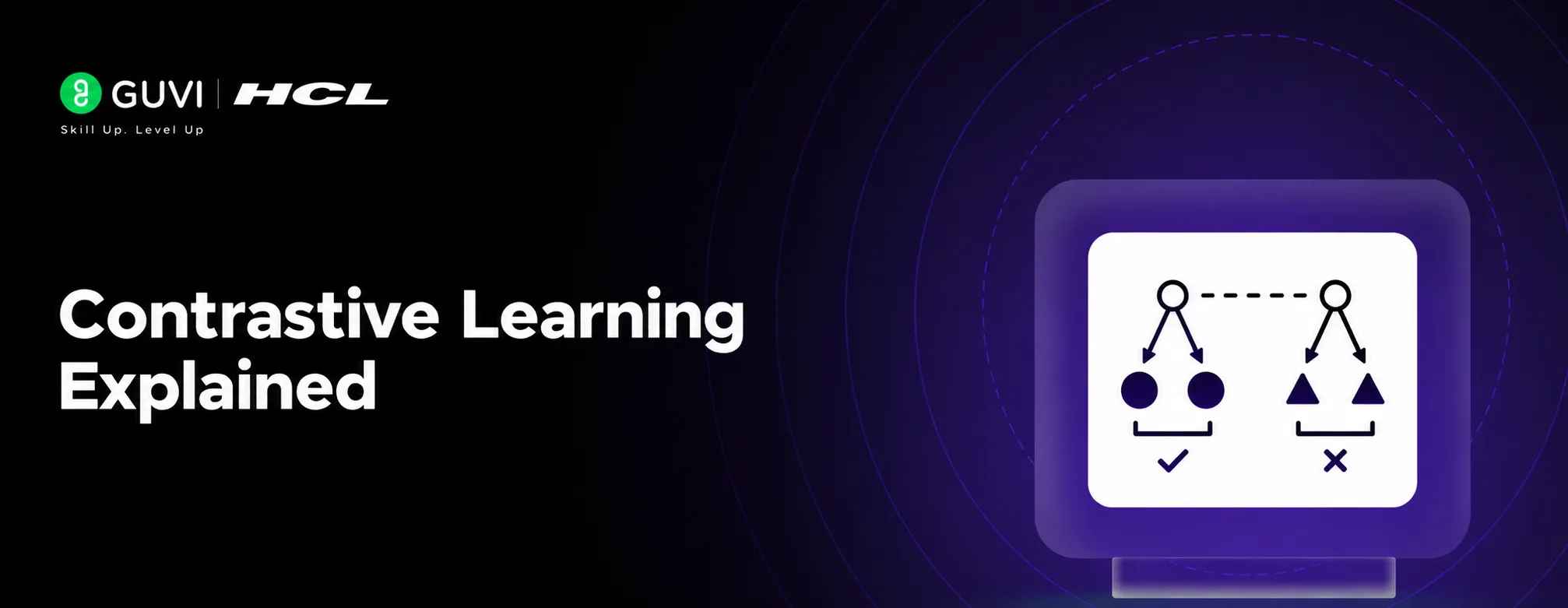
If you have ever wondered how models learn useful features without thousands of labeled examples, Contrastive Learning is one of the most important ideas to understand. It teaches models by comparison instead of classification.
Instead of telling the model “this is a cat” or “this is a dog,” you show it pairs of examples and let it figure out what belongs together and what does not. Over time, the model learns representations that group similar things and separate dissimilar ones
Direct Answer
Contrastive Learning is a self-supervised technique that trains models to learn useful representations by comparing data points. It pulls similar items (positive pairs) closer together in the embedding space and pushes dissimilar items (negative pairs) farther apart. This allows models to learn strong features from unlabeled data by focusing on what is similar and what is different.
Table of contents
- TL;DR Summary
- What Is Contrastive Learning?
- How Contrastive Learning Works
- Step 1: Create Pairs
- Step 2: Encode into Embeddings
- Step 3: Compute Similarity
- Step 4: Update the Model
- Contrastive Loss Functions
- Triplet Loss
- Contrastive Loss (Pair-Based)
- InfoNCE Loss (Used in SimCLR, MoCo)
- Popular Contrastive Learning Methods
- SimCLR (Simple Framework for Contrastive Learning)
- MoCo (Momentum Contrast)
- Triplet Networks and Siamese Networks
- Contrastive Learning in NLP
- Why Contrastive Learning Matters
- Learning from Unlabeled Data
- Better Representations
- Scalability
- Foundation for Downstream Tasks
- Real-World Applications
- Computer Vision
- Natural Language Processing
- Recommender Systems
- Speech and Audio
- Common Mistakes to Avoid
- What to Do Next
- Conclusion
- FAQs
- What is Contrastive Learning?
- How does Contrastive Learning work?
- What are positive and negative pairs?
- What is InfoNCE loss?
- What are popular contrastive learning methods?
- Where is Contrastive Learning used?
- Is Contrastive Learning better than supervised learning?
TL;DR Summary
- Contrastive Learning trains models by comparing similar and dissimilar pairs.
- Positive pairs are pulled together; negative pairs are pushed apart in the embedding space.
- It works well with unlabeled data and is widely used in self-supervised learning.
- Popular methods include SimCLR, MoCo, and triplet-based approaches.
- Common applications include image representation, NLP embeddings, and retrieval systems.
What Is Contrastive Learning?
Contrastive learning is a machine learning paradigm that learns representations by contrasting similar and dissimilar samples. Unlike traditional supervised learning, it often operates in self-supervised settings where labels are scarce or unavailable.
The core idea is simple:
- Bring representations of related items (positive pairs) closer together in a vector space.
- Push representations of unrelated items (negative pairs) farther apart.
This process allows models to build robust, generalizable features from large amounts of unlabeled data.
Contrastive learning trains models to pull similar data points closer and push dissimilar ones apart in feature space no labels needed. Learn AI & ML with HCL GUVI’s Artificial Intelligence and Machine Learning course.
💡 Pro Tip: Think of contrastive learning as teaching a model to recognize “same vs different” instead of “cat vs dog.” That shift unlocks learning from raw, unlabeled data.
How Contrastive Learning Works
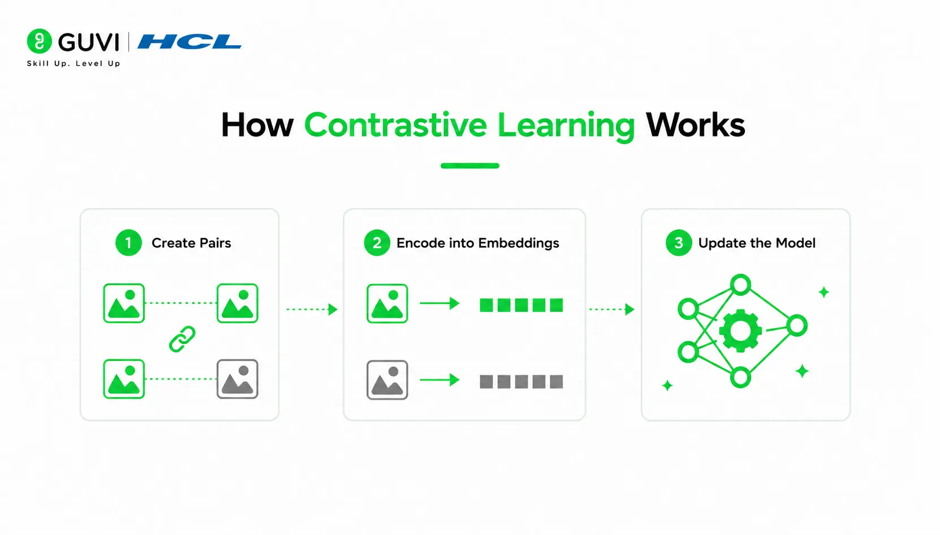
Contrastive learning follows a consistent pattern across images, text, and audio.
Step 1: Create Pairs
Every training example starts as a pair.
- Positive pairs: Two views of the same item (for example, two augmented versions of the same image, or two sentences with similar meaning).
- Negative pairs: Two different items (for example, two unrelated images or sentences).
In many vision methods, a single image is augmented twice to create a positive pair. Other images in the batch serve as negative examples.
Step 2: Encode into Embeddings
Both data points pass through an encoder network that converts them into vectors (embeddings).
- The encoder can be a CNN for images, a transformer for text, or another architecture.
- The goal is to map each input into a representation space where similarity is meaningful.
Step 3: Compute Similarity
Once you have two embeddings, you measure how close they are.
- Common metrics include cosine similarity or dot product.
- Positive pairs should have high similarity scores.
- Negative pairs should have low similarity scores.
Step 4: Update the Model
The model compares its similarity scores against what they should be.
- For positive pairs, the loss encourages high similarity.
- For negative pairs, the loss encourages low similarity.
Over many iterations, the encoder learns to place similar items near each other and dissimilar items far apart in the embedding space.
Contrastive Loss Functions
The heart of contrastive learning is the loss function that enforces these relationships.
1. Triplet Loss
Triplet loss works with three items:
- Anchor: The reference sample.
- Positive: A similar sample to the anchor.
- Negative: A dissimilar sample.
The loss encourages the anchor to be closer to the positive than to the negative by at least a margin.
L=max(d(a,p)−d(a,n)+margin,0)L = \max\left( d(a, p) - d(a, n) + \text{margin}, 0 \right)L=max(d(a,p)−d(a,n)+margin,0)
where d(⋅,⋅)d(\cdot, \cdot)d(⋅,⋅) is a distance metric (for example, Euclidean or cosine distance).2. Contrastive Loss (Pair-Based)
Pair-based contrastive loss directly penalizes distances for positive and negative pairs:
- Positive pairs: minimize distance.
- Negative pairs: maximize distance up to a threshold.
This is often used in face recognition and metric learning.
3. InfoNCE Loss (Used in SimCLR, MoCo)
InfoNCE (Noise Contrastive Estimation) is widely used in modern contrastive methods like SimCLR and MoCo.
For a positive pair (i,j)(i, j)(i,j) in a batch, the loss is:
Li,j=−logexp(sim(zi,zj)/τ)∑k≠iexp(sim(zi,zk)/τ)L_{i,j} = -\log \frac{\exp(\text{sim}(z_i, z_j) / \tau)}{\sum_{k \ne i} \exp(\text{sim}(z_i, z_k) / \tau)}Li,j=−log∑k=iexp(sim(zi,zk)/τ)exp(sim(zi,zj)/τ)where:
- zi,zjz_i, z_jzi,zj are embeddings of the positive pair.
- sim(⋅,⋅)\text{sim}(\cdot, \cdot)sim(⋅,⋅) is a similarity function (often cosine similarity).
- τ\tauτ is a temperature parameter.
- The denominator sums over one positive and many negatives in the batch.
This formulation treats contrastive learning as a classification problem: identify the correct positive partner among many candidates.
⚠️ Warning: Choosing too few negatives or a poor temperature can weaken the learning signal. Modern methods carefully tune these hyperparameters.
Popular Contrastive Learning Methods
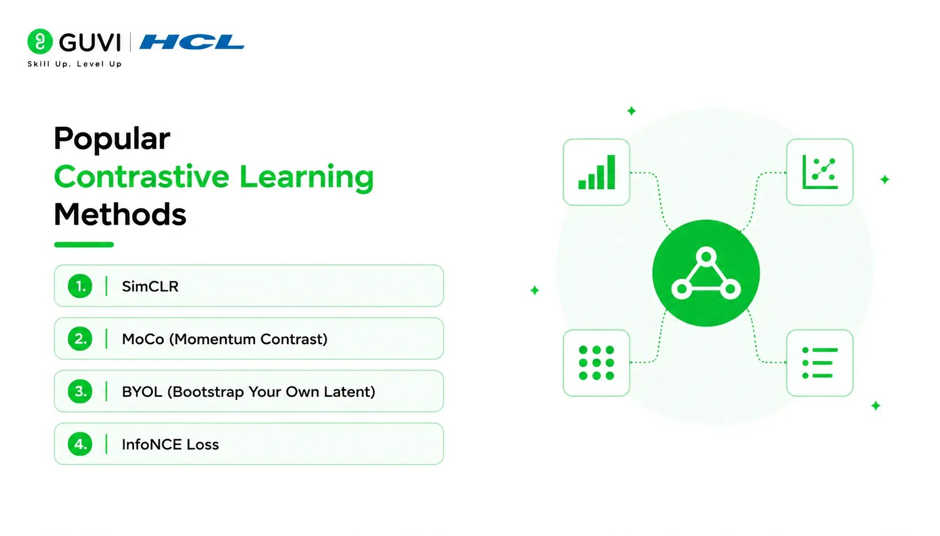
Several influential methods have shaped the field.
1. SimCLR (Simple Framework for Contrastive Learning)
SimCLR popularized a clean, effective recipe for contrastive learning in vision:
- Generate two augmented views of each image.
- Encode both views with a CNN.
- Apply a small projection head to get embeddings.
- Use InfoNCE loss over a large batch, treating other images as negatives.
SimCLR showed that strong augmentations and large batch sizes are critical for good performance.
2. MoCo (Momentum Contrast)
MoCo addresses the need for many negatives without requiring huge batches:
- Maintains a dynamic queue of negative embeddings from previous batches.
- Uses a momentum-updated encoder to keep negatives consistent.
- Allows effective contrastive learning with smaller batch sizes.
MoCo is widely used in self-supervised pretraining for vision and beyond.

3. Triplet Networks and Siamese Networks
- Siamese networks use two identical encoders to process pairs and learn embeddings.
- Triplet networks extend this to triplets (anchor, positive, negative) with triplet loss.
These are common in face recognition, person re-identification, and retrieval tasks.
Contrastive Learning in NLP
In NLP, contrastive objectives are used to:
- Learn sentence embeddings (for example, Sentence-BERT variants with contrastive loss).
- Align multimodal representations (for example, image-text pairs in CLIP).
- Improve retrieval and clustering by pulling semantically similar texts together.
Contrastive learning trains models to pull similar data points closer and push dissimilar ones apart in feature space no labels needed. Learn AI & ML with HCL GUVI’s Artificial Intelligence and Machine Learning course.
Why Contrastive Learning Matters
Contrastive learning addresses several limitations of traditional supervised learning.
1. Learning from Unlabeled Data
Labeling large datasets is expensive and slow. Contrastive learning leverages the structure of unlabeled data to learn strong representations.
2. Better Representations
By focusing on similarity and dissimilarity, models learn features that generalize well across tasks. These representations often improve downstream performance in classification, detection, and retrieval.
3. Scalability
Contrastive methods scale well with data and compute. Larger batches and more negatives typically lead to better representations, making them suitable for large-scale pretraining.
4. Foundation for Downstream Tasks
Contrastively pretrained models are often fine-tuned on smaller labeled datasets for specific tasks. This two-step approach (pretrain with contrastive loss, then fine-tune) is common in modern pipelines.
✅ Best Practice: Use contrastive pretraining when you have lots of unlabeled data and a smaller labeled set for fine-tuning.
Real-World Applications
Contrastive learning is used across many domains.
Computer Vision
- Self-supervised pretraining for image classification and object detection.
- Learning robust features for medical imaging where labels are scarce.
- Face recognition and person re-identification using triplet or contrastive losses.
Natural Language Processing
- Sentence and paragraph embeddings for semantic search.
- Aligning text and image embeddings in multimodal models.
- Improving retrieval and clustering by grouping similar texts.
Recommender Systems
- Learning user and item embeddings by contrasting positive interactions (clicks, purchases) with negative ones.
- Improving retrieval and ranking by pulling relevant items closer in the embedding space.
Speech and Audio
- Learning speaker embeddings for verification and identification.
- Pretraining representations for speech recognition and audio classification.
Common Mistakes to Avoid
- Using weak augmentations that do not create meaningful positive pairs.
- Choosing too few negatives, which weakens the contrastive signal.
- Ignoring the temperature parameter in InfoNCE loss.
- Expecting contrastive learning to fully replace supervised fine-tuning for all tasks.
- Evaluating only on training metrics instead of downstream task performance.
- Overlooking computational costs of large batches or negative queues.
What to Do Next
If you want to explore contrastive learning:
- Start with a tutorial implementation of SimCLR or a triplet network on a small dataset.
- Experiment with different augmentations to create strong positive pairs.
- Try different numbers of negatives and temperature values.
- Evaluate representations by fine-tuning on a downstream task (for example, classification or retrieval).
- Read key papers like SimCLR, MoCo, and CLIP to understand design choices.
Contrastive learning is a cornerstone of modern self-supervised learning. Understanding how it constructs positive and negative pairs, defines similarity, and shapes the embedding space will help you build better representation models.
Contrastive learning was heavily inspired by how humans learn concepts by comparing examples rather than memorizing labels. Methods like SimCLR and MoCo have enabled models to reach supervised-level performance on image benchmarks using only unlabeled data for pretraining.
Conclusion
Contrastive Learning trains models to learn representations by comparing similar and dissimilar data points. Positive pairs are pulled together in the embedding space, while negative pairs are pushed apart. This enables strong feature learning from unlabeled data using self-supervised objectives like triplet loss, contrastive loss, and InfoNCE.
Popular methods such as SimCLR, MoCo, and triplet networks have made contrastive learning a key tool in vision, NLP, speech, and recommender systems. When used well, it provides robust representations that improve downstream tasks with limited labeled data.
FAQs
What is Contrastive Learning?
Contrastive Learning is a self-supervised technique that learns representations by pulling similar pairs (positive) closer together and pushing dissimilar pairs (negative) farther apart in an embedding space.
How does Contrastive Learning work?
It creates pairs of data points, encodes them into embeddings, computes similarity, and updates the model so that positive pairs have high similarity and negative pairs have low similarity.
What are positive and negative pairs?
Positive pairs are similar items (for example, two augmented views of the same image). Negative pairs are dissimilar items (for example, two different images or sentences).
What is InfoNCE loss?
InfoNCE is a contrastive loss that treats learning as identifying the correct positive partner among many candidates. It maximizes similarity for the positive pair and minimizes it for negatives in a batch.
What are popular contrastive learning methods?
Popular methods include SimCLR, MoCo, triplet networks, Siamese networks, and contrastive objectives in NLP and multimodal models like CLIP.
Where is Contrastive Learning used?
It is used in computer vision, NLP, speech, recommender systems, face recognition, medical imaging, and any task where learning strong representations from limited labels is valuable.
Is Contrastive Learning better than supervised learning?
Not always. Contrastive learning excels at learning representations from unlabeled data, but supervised fine-tuning is often still needed for best performance on specific tasks.
Success Stories

About the Author
HCL GUVI
This article was selected and published as part of the HCL GUVI AI Blogathon 2026, an initiative designed to encourage students, AI enthusiasts, and aspiring tech writers to simplify complex AI concepts through impactful technical content. The contest recognized high-quality, original, and insightful AI-focused blogs, with selected authors receiving publication opportunities on the HCL GUVI blog platform along with official author credits and recognition.
View all posts by HCL GUVI
Connect with me @










Did you enjoy this article?