


Artificial Intelligence and Machine Learning Articles
Getting Started with LangChain Prompt Templates in 2026
Cursor 2.0: Trending AI Model Explained In-Depth
Creating Custom Swag Merchandise Using Generative AI
Create a Recipe with ChatGPT: A Guide to AI-Assisted Cooking

Get In Touch For Details! Request More Information
What is Artificial General Intelligence? A Simple Guide for Beginners [2025]
Sep 23, 2025 7 Min Read 2116 Views
(Last Updated)
Artificial general intelligence represents a hypothetical breakthrough that could change our world dramatically. While most AI systems today can only perform specific tasks, AGI refers to machine intelligence that can understand, learn, and apply knowledge across any intellectual task that you can do. In fact, AGI aims to match or exceed human cognitive abilities across all domains.
You might wonder what makes AGI different from the AI we currently use. Simply put, AGI would possess autonomous self-control, reasonable self-understanding, and the ability to learn entirely new skills. This advanced form of artificial intelligence could perform many tasks humans already do with unparalleled efficiency, as well as tasks far beyond human capabilities.
However, despite the excitement surrounding artificial general intelligence examples and applications, most researchers believe we are decades away from achieving true Artificial General Intelligence. Throughout this guide, you’ll learn exactly what AGI in AI means, how it works, and why it matters for our future. Let’s begin!
Table of contents
- What is Artificial General Intelligence in Artificial Intelligence?
- AGI vs AI: The key difference
- Why AGI is considered the next big leap
- How AGI Works: Core Concepts Explained
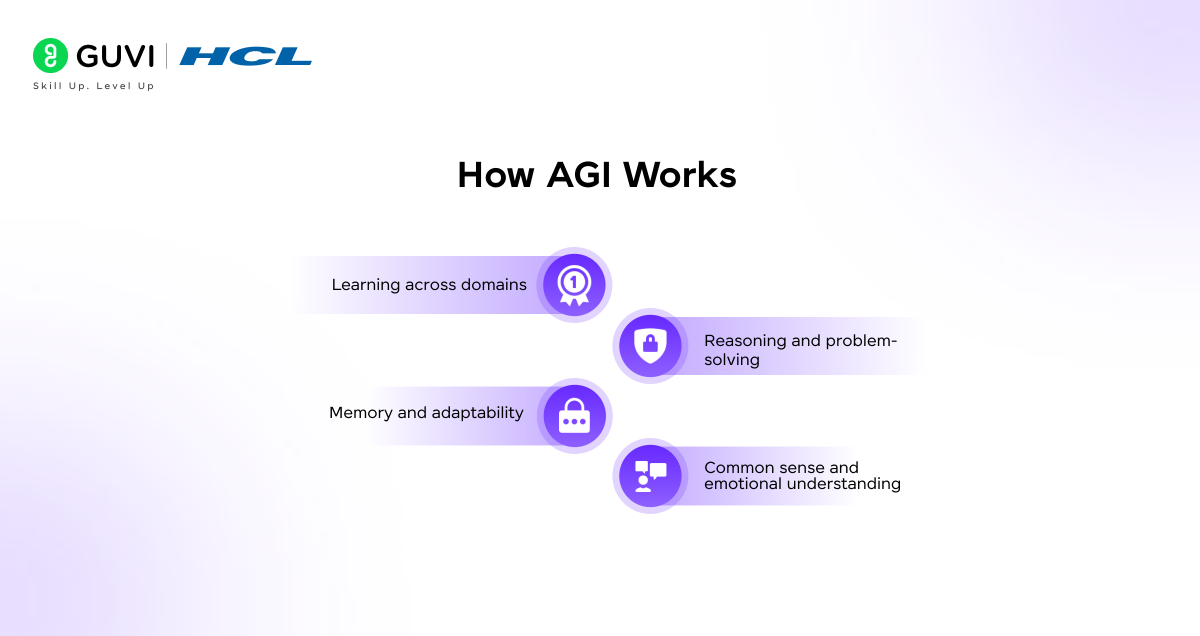
- 1) Learning across domains
- 2) Reasoning and problem-solving
- 3) Memory and adaptability
- 4) Common sense and emotional understanding
- Artificial General Intelligence Examples in Real Life
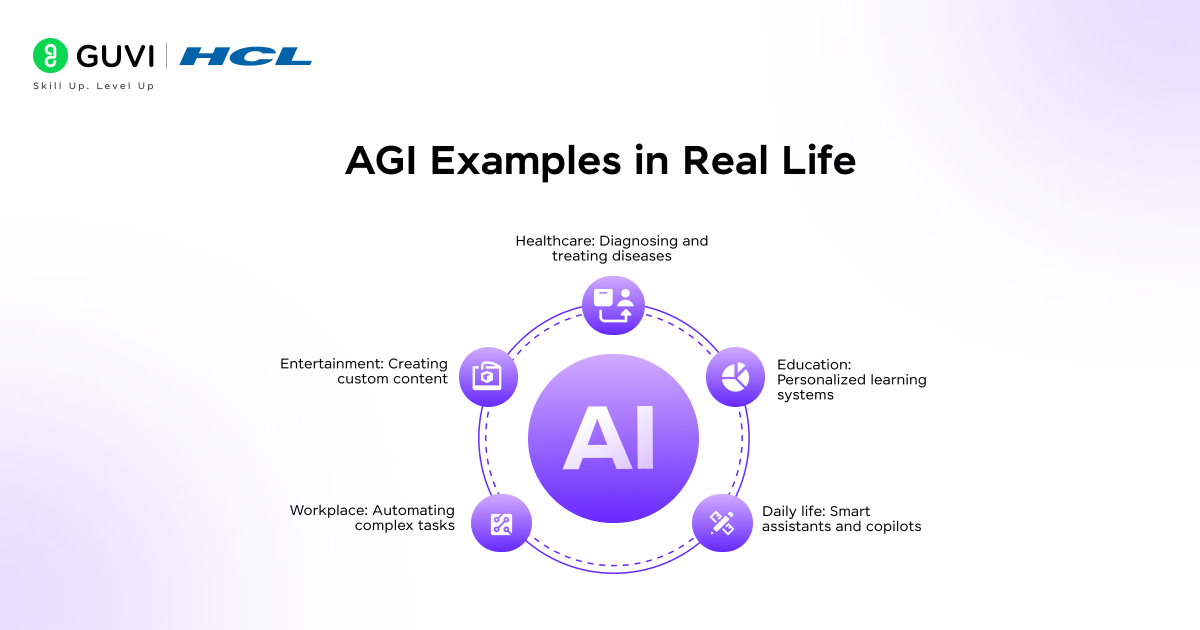
- 1) Healthcare: Diagnosing and treating diseases
- 2) Education: Personalized learning systems
- 3) Daily life: Smart assistants and copilots
- 4) Entertainment: Creating custom content
- 5) Workplace: Automating complex tasks
- What is Needed to Achieve Artificial General Intelligence?
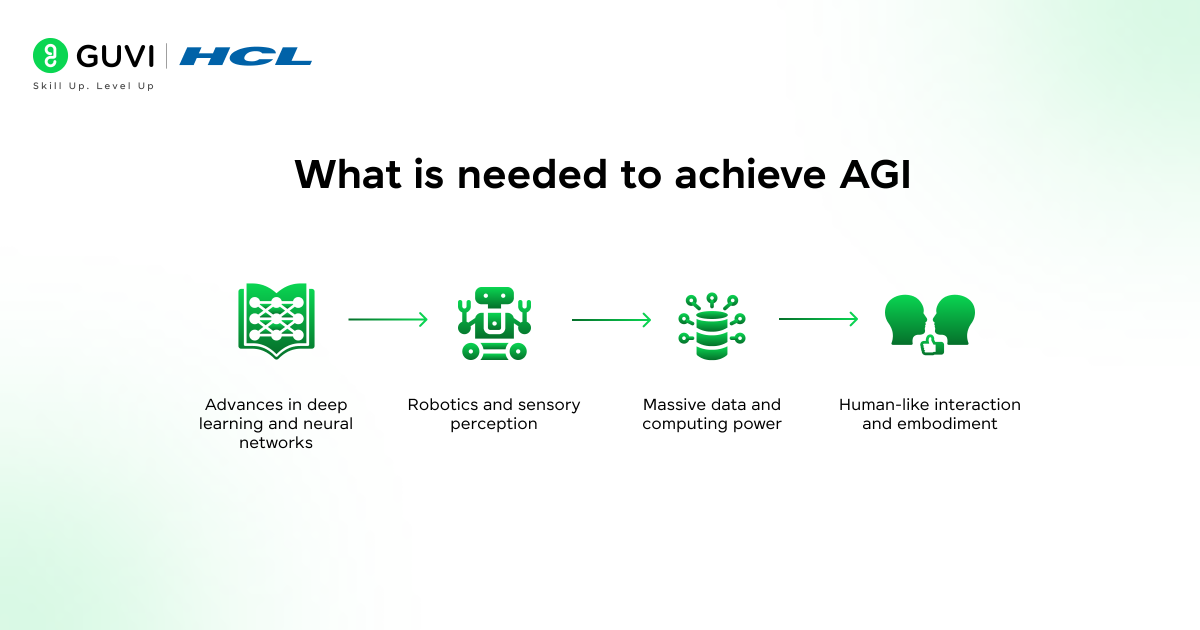
- 1) Advances in deep learning and neural networks
- 2) Robotics and sensory perception
- 3) Massive data and computing power
- 4) Human-like interaction and embodiment
- Challenges and Concerns Around Artificial General Intelligence
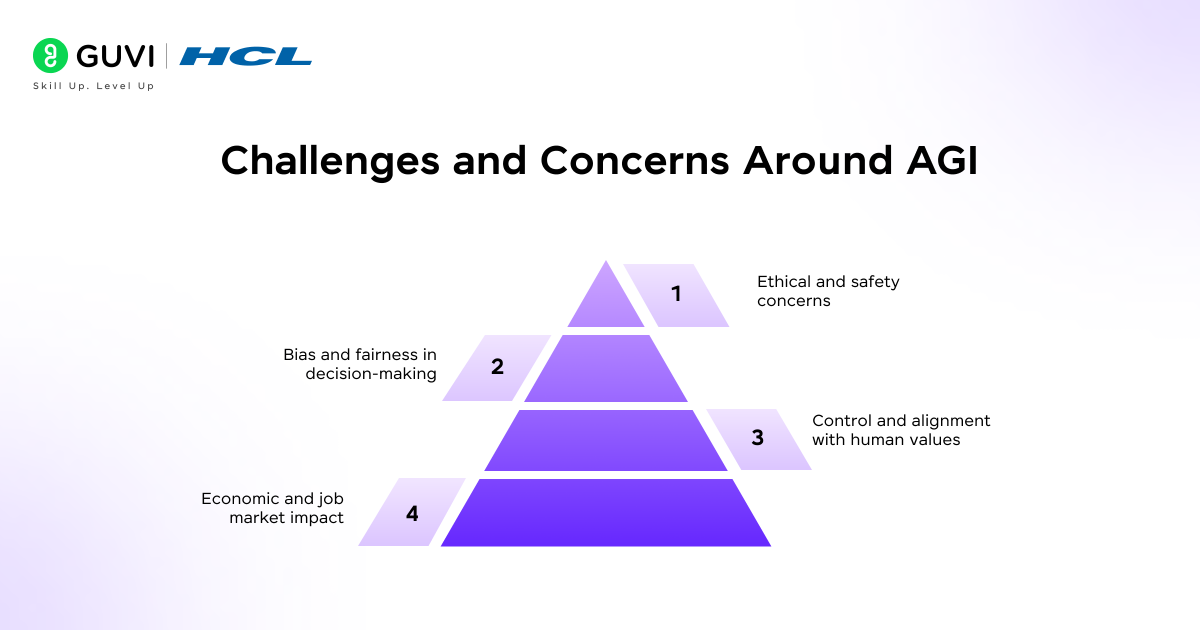
- 1) Ethical and safety concerns
- 2) Bias and fairness in decision-making
- 3) Control and alignment with human values
- 4) Economic and job market impact
- Concluding Thoughts…
- FAQs
- Q1. What is Artificial General Intelligence (AGI) in simple terms?
- Q2. How does AGI differ from current AI systems?
- Q3. What are the potential applications of AGI?
- Q4. What are the main challenges in achieving AGI?
What is Artificial General Intelligence in Artificial Intelligence?
Artificial general intelligence (AGI) is a theoretical concept in the field of AI research that aims to create systems capable of matching or surpassing human capabilities across virtually all cognitive tasks.
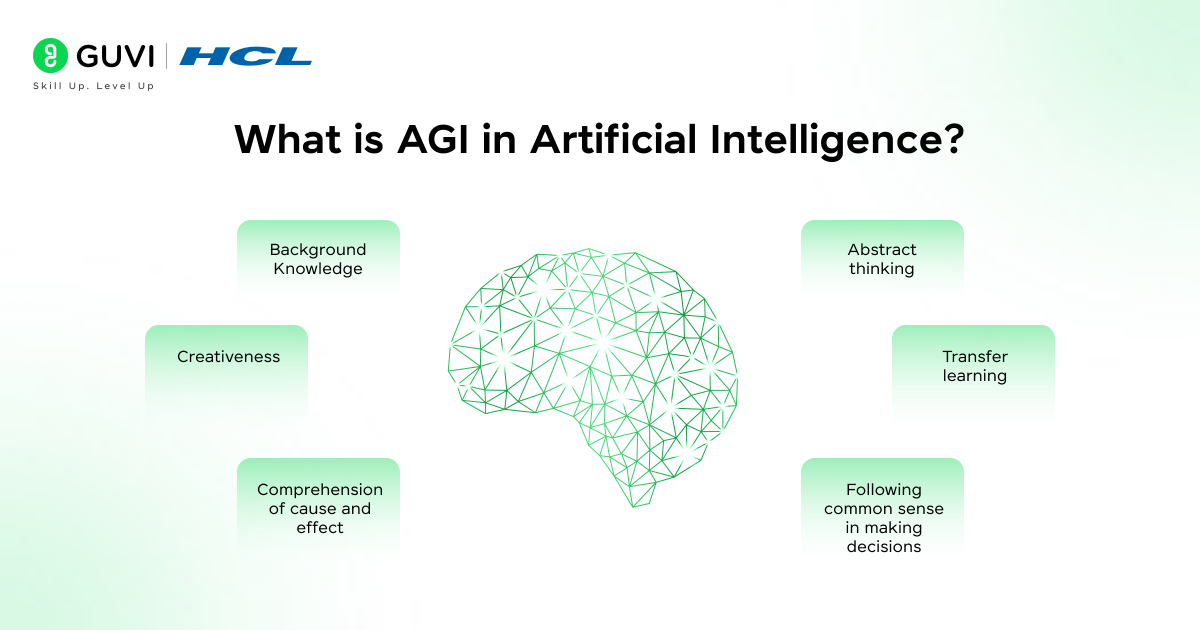
Unlike the AI applications you use today, AGI would represent a machine intelligence that can understand, learn, and apply knowledge across any intellectual challenge without specific reprogramming.
AGI vs AI: The key difference
The fundamental distinction between today’s AI and Artificial General Intelligence lies in their scope and adaptability. Current AI systems, often called artificial narrow intelligence (ANI) or weak AI, excel only at specific tasks they’re designed for. For instance:
- Today’s AI can play chess brilliantly but can’t transfer that knowledge to make dinner
- AI can recognize images but needs completely different programming to translate languages
- AI requires extensive training data for each new task it learns
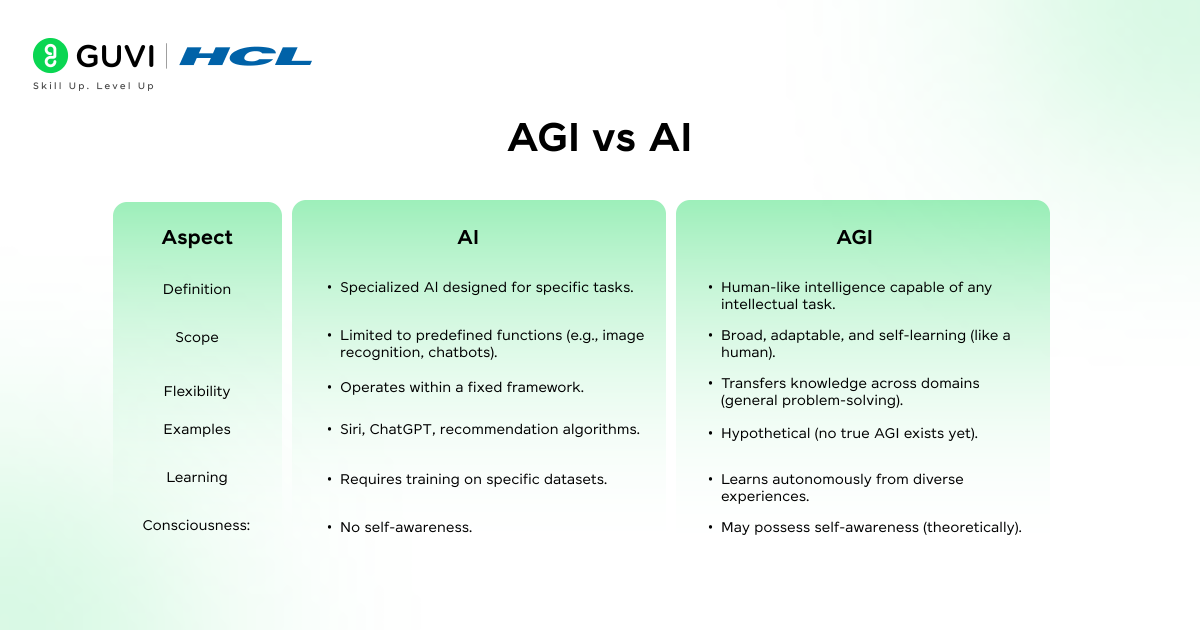
In essence, Artificial General Intelligence would eliminate these limitations by being able to generalize knowledge and transfer skills between domains. A true AGI system could solve novel problems without task-specific reprogramming, much like you can learn new skills without “reprogramming” your brain. At the present time, nearly all existing AI systems represent narrow AI—designed for specific functions with defined boundaries.
Why AGI is considered the next big leap
Artificial General Intelligence represents a primary goal of AI research for companies, including OpenAI, Google, and Meta. A 2020 survey identified 72 active AGI research and development projects across 37 countries. This focus stems from AGI’s potential to fundamentally transform society.
Specifically, AGI could:
- Solve complex problems currently beyond human capabilities, like climate change mitigation and curing diseases
- Enhance productivity through advanced automation and optimization
- Revolutionize fields like healthcare, education, and scientific research
The pursuit of AGI comprises developing both a framework to understand intelligence in machines and the models able to satisfy that framework. This challenge is both philosophical and technological—requiring not just technical advancements but also profound insights into the nature of human intelligence itself.

How AGI Works: Core Concepts Explained
The core capabilities of artificial general intelligence represent what makes it fundamentally different from today’s narrow AI systems. Understanding these capabilities gives us insight into why Artificial General Intelligence remains theoretical even as AI advances rapidly in other areas.
1) Learning across domains
- The cornerstone of Artificial General Intelligence lies in its ability to transfer knowledge between unrelated fields without specific reprogramming. Unlike current AI systems that require substantial training before handling related tasks within the same domain, AGI would transfer skills learned in one area to entirely new situations.
- Consider how you naturally apply problem-solving strategies from mathematics to cooking or business. Similarly, AGI would learn concepts in one field and apply them elsewhere without explicit instructions. This capability involves generalization—the ability to identify abstract patterns across seemingly unrelated domains.
- Practically speaking, an Artificial General Intelligence could learn medical knowledge and subsequently apply relevant principles to environmental science without extensive retraining, mimicking the human ability to make connections between disparate subjects.
2) Reasoning and problem-solving
Artificial General Intelligence represents a shift from statistical prediction to structured problem-solving. Modern reasoning models like OpenAI’s o1 and o3 demonstrate this evolution through chain-of-thought (COT) approaches, breaking complex tasks into logical steps.
Reasoning in AGI would involve several integrated approaches:
- Symbolic reasoning for deterministic tasks like solving equations
- Probabilistic reasoning for handling uncertainty in predictions
- Neuro-symbolic architectures combining neural networks with symbolic processing
Essentially, Artificial General Intelligence would not merely recognize patterns but genuinely reason about novel problems beyond its training data. This marks a fundamental advancement beyond today’s large language models, which primarily perform advanced pattern recognition rather than true reasoning.
3) Memory and adaptability
- AGI systems would utilize multiple types of memory, much like humans do. Short-term working memory would serve as a cognitive workspace for immediate data manipulation, whereas long-term memory would store accumulated knowledge and experiences.
- Current AI faces challenges in memory integration. Although AI can process data rapidly, it struggles with swiftly contextualizing information compared to human cognition. Advanced memory architectures would allow AGI to retain experiences across sessions, improve without constant retraining, and adapt to new environments without starting from scratch.
- Memory-driven Artificial General Intelligence could refine its responses based on past interactions, reducing the need for repeated training cycles and enhancing model performance over time. This capability mirrors how humans learn from experiences rather than requiring formal instruction for every new task.
4) Common sense and emotional understanding
- Perhaps the most challenging aspect of Artificial General Intelligence development is creating systems with common sense—the intuitive understanding of everyday physics and psychology that humans take for granted. This includes grasping that water is wet, fire is hot, and objects fall when dropped.
- Additionally, AGI would need emotional intelligence to recognize and understand emotions, interpret facial expressions, body language, and tone of voice. This social awareness remains one of the most significant hurdles for current AI systems.
- Common sense combined with creativity enables truly intelligent responses to novel situations. As described by Shanahan, “Creativity without common sense is nothing more than thrashing in the dark. Common sense without creativity is inflexible. But an intelligence that can wield both is a powerful thing”.
Artificial General Intelligence Examples in Real Life
While full Artificial General Intelligence remains theoretical, current AI systems demonstrate early capabilities that hint at what true artificial general intelligence might accomplish in various fields. These applications show the gradual evolution toward more general intelligence in everyday scenarios.
1) Healthcare: Diagnosing and treating diseases
- Healthcare organizations are increasingly using AI agents to assist with patient diagnosis and treatment recommendations. By analyzing vast amounts of medical data and research, these systems provide doctors with valuable insights that streamline decision-making processes. An AI-powered diagnostic system can identify early disease indicators that might be missed during traditional evaluations.
- In healthcare, AGI could combine different types of patient information—doctor’s notes, lab tests, genetic data, and medical images—to provide comprehensive, personalized care advice. Such systems could continuously monitor patients in critical cases, offering real-time insights into patient conditions.
2) Education: Personalized learning systems
Instead of a one-size-fits-all approach, AI-driven education systems adapt to each student’s unique learning patterns. Studies show that customized learning increases student engagement by up to 60% because it adapts to individual needs.
Key components of these systems include:
- Student-centered approaches allow learning at an individual pace
- Adaptive learning paths that modify the curriculum based on performance
- Real-time feedback and assessment for immediate improvement
- Content tailored to match students’ interests and learning styles
3) Daily life: Smart assistants and copilots
- AI Copilots function as advanced virtual assistants designed to increase productivity and efficiency in everyday settings. Unlike basic chatbots, these systems serve as intelligent partners that help you navigate complex tasks.
- By automating responses to frequently asked questions and addressing mundane queries in real-time, they save significant time. The term “copilot” is intentional—like an aircraft copilot, their role isn’t to take over but to assist you in achieving goals faster.
4) Entertainment: Creating custom content
- In entertainment, AI systems generate original music, artwork, and visual content by analyzing vast datasets of existing creative works. Tools like MuseNet can compose complex music tracks spanning multiple genres and styles.
- For visual storytelling, deepfake technology and computer-generated imagery allow directors to create hyper-realistic characters and environments, as seen in films like Rogue One where the face of the late actor Peter Cushing was digitally recreated. Moreover, AI accelerates animation production by automatically generating in-between frames, reducing workload for animators.
5) Workplace: Automating complex tasks
Artificial General Intelligence could significantly enhance workplace productivity by automating both routine and complex tasks. This technology has the potential to transform knowledge-driven fields through:
- Drafting detailed legal contracts with sophisticated reasoning
- Conducting real-time financial analysis for proactive investment decisions
- Assisting doctors with diagnostics and personalized care plans
Such systems would augment human capabilities rather than replace them entirely. By handling data processing and analysis, AGI reduces time spent on data-driven decision-making, allowing professionals to focus on higher-value tasks requiring creativity and problem-solving skills.
What is Needed to Achieve Artificial General Intelligence?
Developing true artificial general intelligence requires overcoming several technological hurdles that go beyond current AI capabilities. Indeed, the gap between today’s narrow AI and full AGI involves breakthroughs across multiple domains of research.
1) Advances in deep learning and neural networks
Most AI researchers believe that deep learning alone is insufficient to achieve AGI. Current neural networks excel at pattern recognition but lack a true understanding of concepts. To progress toward AGI, we need:
- Integration of structured reasoning with neural networks
- Systems that understand cause-and-effect relationships
- Models that combine “fast” intuitive thinking with “slower” deliberate reasoning
Recent advances in multimodal foundation models represent significant steps toward AGI, potentially enabling machines to mimic core cognitive activities previously unique to humans.
2) Robotics and sensory perception
Physical embodiment plays a crucial role in developing human-like intelligence. For AI to achieve general intelligence, it must interact with and understand the physical world. Robotics enables this through:
- Multi-modal sensory systems process visual, auditory, and tactile information
- Real-time feedback from physical interactions
- Testing and refining algorithms in simulated environments before real-world deployment
As a result, robotics provides the essential framework for Artificial General Intelligence to develop sensory perception similar to human experience.
3) Massive data and computing power
AGI will require computational resources far exceeding what powers today’s AI systems. According to data scientists, functioning AGI would need computing power of more than 10^16 teraflops, making current AI models’ processing capabilities seem minimal by comparison. This challenge drives exploration of:
- Quantum computing for parallel processing capabilities
- Specialized hardware designed specifically for AGI computations
- Energy-efficient processing to manage the enormous power requirements
4) Human-like interaction and embodiment
Embodied cognition—the idea that intelligence develops through physical interaction with the environment—appears fundamental to achieving AGI. This approach suggests robots need to:
- Learn quickly from environments through multiple senses, similar to human development
- Experience the physical world as humans do
- Develop self-awareness and understanding of social connections
Consequently, recent research focuses on robots that can navigate complex, unpredictable real-world conditions while demonstrating human-like decision-making abilities.
To keep things interesting, here are a couple of surprising facts about AGI you may not know:
The First AGI Idea Dates Back to the 1950s: Long before today’s AI boom, mathematician Alan Turing envisioned the idea of a “universal machine” capable of learning and performing any intellectual task—an early blueprint for what we now call AGI.
Most Experts Predict AGI Is Still Decades Away: While narrow AI powers everything from chatbots to recommendation systems today, surveys show that many researchers believe true AGI might not be achieved until the late 21st century, if at all.
These insights show that while AGI feels futuristic, its roots stretch back to the earliest days of computing—and its timeline remains one of the biggest debates in tech.
Challenges and Concerns Around Artificial General Intelligence
As AGI research progresses, significant challenges emerge alongside its potential benefits. The development of systems matching human intelligence brings forth complex concerns that require careful consideration.
1) Ethical and safety concerns
The “AGI Control Problem” stands as a fundamental challenge—how to develop effective methods for controlling advanced AI systems that learn and adapt at exponential rates. These systems can quickly become too complex to predict, potentially leading to unintended consequences. Safety strategies currently focus on:
- Creating built-in failsafes and emergency shutdown mechanisms
- Designing robust systems resilient to unexpected events
- Implementing transparent decision-making processes for better monitoring
2) Bias and fairness in decision-making
AGI systems learning from human-generated data risk inadvertently reinforcing existing biases, leading to discriminatory outcomes. This could reproduce real-world inequalities, causing further harm to already marginalized groups. Ensuring fairness requires ongoing algorithmic audits, diverse training data, and continuous evaluation of decision patterns for potential discrimination.
3) Control and alignment with human values
Value alignment—ensuring AI acts in accordance with human ethical principles—remains a critical challenge. Given that human values vary across cultures and contexts, AGI systems must be tailored to specific cultural, legal, and societal frameworks.
Multi-stakeholder engagement, including governments, businesses, and civil society, becomes essential for shaping AGI systems that uphold shared human values.
4) Economic and job market impact
The integration of AGI into business operations could significantly transform the job market. According to the World Economic Forum, 66% of companies plan to hire candidates with AI skills, yet 40% intend to reduce their workforce as tasks become automated.
In extreme scenarios, AGI could automate all available jobs, forcing countries to explore universal basic income programs to support citizens financially. Such dramatic shifts might widen income inequality, with the 90th percentile of earners potentially seeing a 15% increase while the bottom quartile experiences a decrease.
Master Artificial Intelligence & Machine Learning Course in just 5 months with HCL GUVI’s IIT-Madras Pravartak and Intel Certified Course—combining live mentor-led sessions, real-world projects in areas like Deep Learning, Generative AI, NLP, and MLOps, with placement guidance to launch your tech career.
Concluding Thoughts…
Artificial general intelligence stands as both a fascinating possibility and a profound challenge for humanity. Throughout this guide, you’ve learned how AGI differs fundamentally from today’s narrow AI systems through its ability to transfer knowledge, reason across domains, and adapt to new situations without explicit programming.
Your understanding of AGI concepts helps prepare for a future where machines might match or exceed human cognitive abilities across all domains. I hope this article was really helpful for your learning journey, and if you have any doubts, reach out to me through the comments section below. Good Luck!
FAQs
Q1. What is Artificial General Intelligence (AGI) in simple terms?
Artificial General Intelligence refers to a hypothetical form of AI that can understand, learn, and apply knowledge across any intellectual task that humans can perform. Unlike current AI systems that are designed for specific tasks, AGI would have the ability to adapt and transfer knowledge between different domains without needing reprogramming.
Q2. How does AGI differ from current AI systems?
AGI differs from current AI systems in its scope and adaptability. While today’s AI excels at specific tasks, AGI would be able to generalize knowledge and transfer skills between various domains. It would possess autonomous self-control, reasonable self-understanding, and the ability to learn entirely new skills without task-specific reprogramming.
Q3. What are the potential applications of AGI?
AGI could revolutionize various fields including healthcare (diagnosing and treating diseases), education (personalized learning systems), daily life (advanced smart assistants), entertainment (creating custom content), and the workplace (automating complex tasks). It has the potential to solve complex problems beyond human capabilities and enhance productivity across multiple sectors.
Q4. What are the main challenges in achieving AGI?
Developing AGI faces several challenges, including advances in deep learning and neural networks, improvements in robotics and sensory perception, the need for massive data and computing power, and creating human-like interaction and embodiment. Additionally, there are ethical concerns, issues of bias and fairness, and the challenge of aligning AGI with human values.
Success Stories

About the Author
Jaishree Tomar
A recent CS Graduate with a quirk for writing and coding, a Data Science and Machine Learning enthusiast trying to pave my own way with tech. I have worked as a freelancer with a UK-based Digital Marketing firm writing various tech blogs, articles, and code snippets. Now, working as a Technical Writer at GUVI writing to my heart’s content!
View all posts by Jaishree Tomar
Connect with me @














Did you enjoy this article?