


Data Structure Articles
What is an Algorithm? A Simple Guide for Beginners
Difference between Algorithm and Program: What Sets Them Apart
What Are the Characteristics of an Algorithm? Definition, Features, and Examples


Get In Touch For Details! Request More Information

What is a Stack DSA Made Simple: A Beginner’s First Guide
Feb 12, 2026 5 Min Read 1485 Views
(Last Updated)
Are you looking to master the Stack DSA but feeling overwhelmed? Despite its simplicity, a stack is one of the most powerful and widely used data structures in programming. Essentially, a stack follows the Last In First Out (LIFO) principle — the last item you add is the first one removed.
Stacks are everywhere in computer science, from expression evaluation and syntax parsing to function call management and undo operations in text editors. Therefore, understanding this fundamental concept is crucial if you’re preparing for technical interviews or competitive programming.
In this beginner-friendly guide, you’ll learn everything about the stack data structure, from basic operations like push() and pop() to practical applications. We’ll break down complex concepts into simple explanations and show you how to implement and use stacks effectively in your programming journey. Let’s begin!
Table of contents
- What is a Stack Data Structure?
- LIFO Principle Explained Simply
- Stack vs Other Linear Structures
- Core Stack Operations and Their Use
- 1) Push and Pop Operations
- 2) Peek and isEmpty Methods
- 3) Time Complexity of Stack Operations
- Real-World Applications of Stack
- 1) Undo/redo Functionality
- 2) Function Call Stack in Programming
- 3) Balanced Parentheses and Expression Evaluation
- 4) Browser History and Backtracking
- Solving Problems Using Stack
- 1) Reverse a String Using a Stack
- 2) Sort a Stack Using Recursion
- 3) Check for Valid Parentheses
- 4) Implement a Min Stack
- Concluding Thoughts…
- FAQs
- Q1. What is a stack data structure, and how does it work?
- Q2. What are the main operations performed on a stack?
- Q3. How is a stack different from other data structures?
- Q4. What are some real-world applications of stacks?
- Q5. How can I implement a stack in my programming language?
What is a Stack Data Structure?
A stack is a specialized linear data structure that restricts access to a single point – similar to a stack of plates or books in real life. You can only add or remove elements from one end, known as the top of the stack. Additionally, this abstract data type (ADT) is considered complex since it’s typically implemented using other data structures like arrays or linked lists.
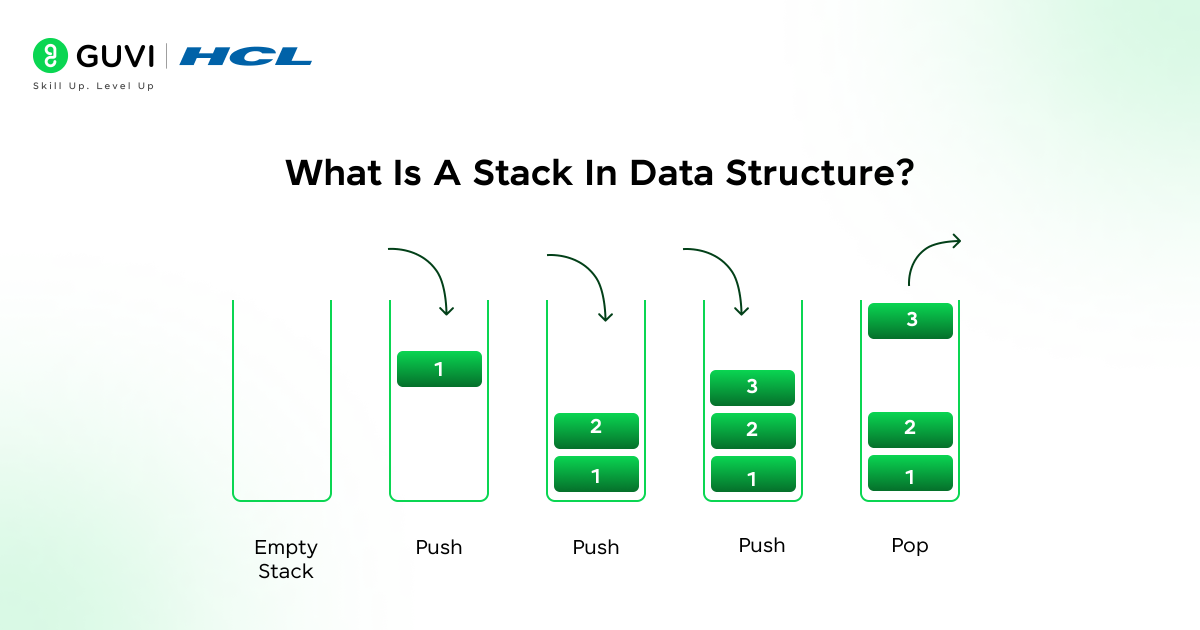
When visualizing a stack, imagine a pile of pancakes where you can only add or remove from the top. This single-point access design makes operations straightforward and efficient. Furthermore, stacks have fixed operations that maintain their structural integrity.
LIFO Principle Explained Simply
The defining characteristic of a stack is the Last-In, First-Out (LIFO) principle. This means the most recently added element is always the first one to be removed – just as the last book placed on a stack is the first one you would pick up.
To understand LIFO clearly, consider these everyday examples:
- A browser’s back button – each page you visit is placed on top, and clicking “back” removes the most recent page
- A stack of plates – you always take the topmost plate first
- The undo function in text editors – your most recent action is the first one undone
Stack vs Other Linear Structures
- Unlike arrays that allow random access to any element, stacks permit operations only at the top position. While queues follow First-In-First-Out (FIFO), stacks operate oppositely with LIFO.
- Stacks are specifically chosen when you need to process data in reverse order of input. For example, when you want to undo actions or implement backtracking in algorithms. In contrast, use queues when elements must be processed in the exact order they arrived.
- From an implementation standpoint, stacks can be built using arrays (fixed size but faster) or linked lists (dynamic size but with memory overhead). Both implementations achieve the same functionality but with different tradeoffs regarding memory usage and performance.
Core Stack Operations and Their Use
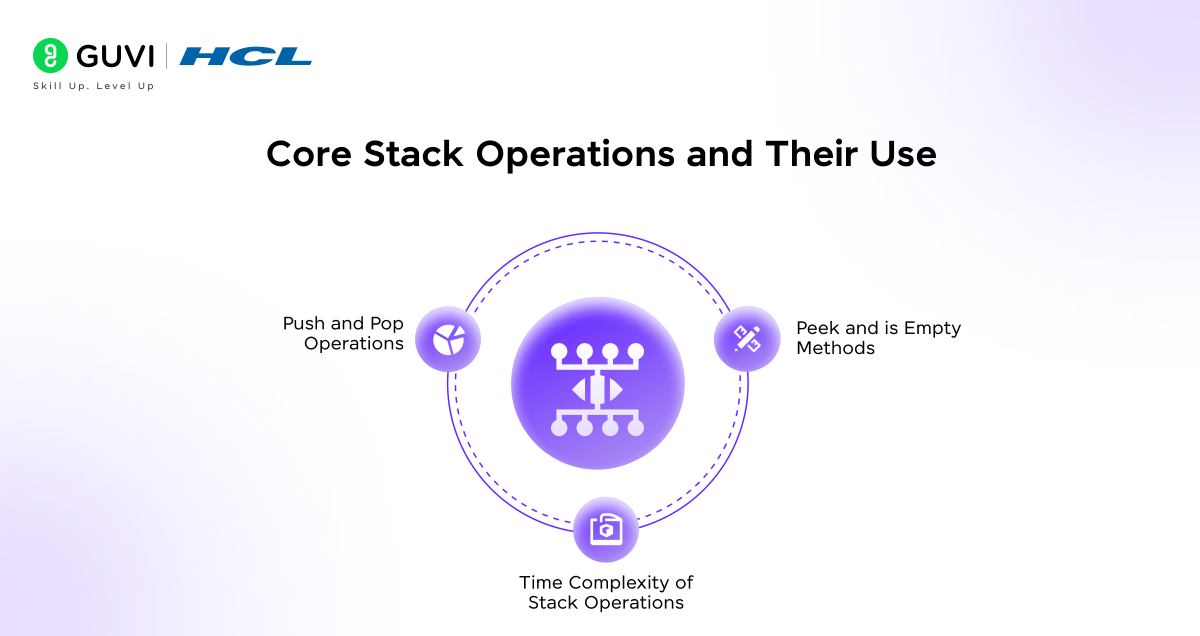
To interact with a stack data structure, you’ll need to master a few essential operations. These operations form the backbone of how you manipulate data in a stack, providing a simple yet powerful interface for solving complex problems.

1) Push and Pop Operations
The push operation adds a new element to the top of the stack. Whenever you push an item, it becomes the new topmost element, increasing the stack size by one. This operation follows this simple algorithm:
- Check if the stack is full (for fixed-size implementations)
- Increment the top pointer
- Add the new element at the position pointed by top
On the other hand, the pop operation removes and returns the element from the top of the stack. This operation performs two actions simultaneously:
- Removes the topmost element
- Returns the value of that element
Both operations follow the LIFO principle, ensuring that the most recently added element is always the first to be removed.
2) Peek and isEmpty Methods
- The peek operation (sometimes called top) allows you to view the topmost element without removing it. This read-only action is particularly useful when you need to inspect the next item before deciding whether to remove it.
- Meanwhile, the isEmpty method serves as a crucial safety check that returns true if the stack contains zero elements and false otherwise. Checking if a stack is empty before attempting pop or peek operations helps prevent underflow errors that could crash your program.
Moreover, some implementations include additional utility methods like isFull (to check if a fixed-size stack has reached capacity) and size (to count the number of elements).
3) Time Complexity of Stack Operations
- One major advantage of using stacks is their efficiency. All standard stack operations—push, pop, peek, isEmpty, and isFull—have a time complexity of O(1). This means that regardless of how many elements are in your stack, these operations always take constant time to execute.
- This remarkable efficiency occurs because stack operations only work with one end of the data structure (the top), eliminating the need to traverse through elements. Subsequently, stacks provide predictable performance even with large datasets, making them ideal for time-sensitive applications.
Throughout your programming journey, you’ll encounter stack data structures repeatedly. Mastering when and how to use it will dramatically improve your problem-solving capabilities and code efficiency and our DSA e-book will help you master it easily.
Real-World Applications of Stack
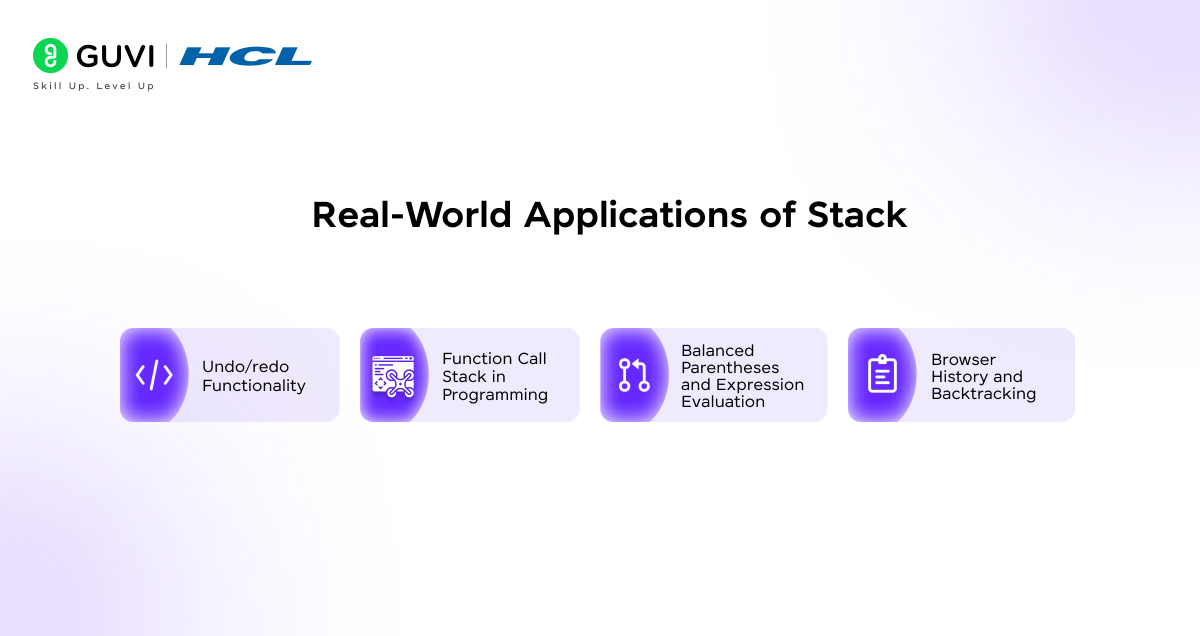
Beyond their theoretical importance, stacks find themselves at the heart of many technologies you interact with daily. Let’s explore how this simple data structure powers critical software features.
1) Undo/redo Functionality
Your favorite text editors and design applications rely on stacks to implement undo/redo features. This implementation typically uses two stacks:
- An undo stack stores previous states/actions
- A redo stack holds actions that were undone
When you make changes in applications like Microsoft Word or Adobe Photoshop, each action gets pushed onto the undo stack. Upon pressing Ctrl+Z, the top action is popped from the undo stack and pushed to the redo stack. Consequently, when you redo (Ctrl+Y), the opposite occurs. This elegant solution requires minimal memory while providing powerful functionality.
2) Function Call Stack in Programming
At the core of programming languages lies the call stack that manages function execution. As a result, when a function calls another function, the system:
- Pushes the current function’s state onto the stack
- Executes the called function
- Pops the stack to return to the original function
Each function’s stack frame contains local variables, arguments, and the return address. However, excessive recursion depth can cause a stack overflow error due to limited stack size.
3) Balanced Parentheses and Expression Evaluation
Stacks elegantly verify balanced parentheses in code expressions. The algorithm pushes opening brackets onto the stack and pops when matching closing ones are found. In fact, if the stack is empty at the end, the expression is properly balanced.
Equally important, calculators and compilers use stacks to evaluate mathematical expressions by converting infix notation (5+3) to postfix notation (53+).
4) Browser History and Backtracking
Your browser’s back button functions using stack principles, with each page visit pushed onto a history stack. Above all, backtracking algorithms in puzzle-solving use stacks to systematically explore and abandon paths that fail to satisfy constraints.
Stacks may seem simple, but their origins and applications go deeper than you think:
The Call Stack Predates Modern Programming Languages: The concept of a call stack was first introduced in the 1950s, long before languages like C or Java existed. It was used to manage function calls in early assembly languages, laying the foundation for structured programming.
“Stack Overflow” Isn’t Just a Website Name: The popular developer forum Stack Overflow takes its name from an actual programming error — when too many function calls or data pushes exceed the stack’s memory limit, causing a crash known as a stack overflow.
These fun facts show how stacks evolved from low-level computer operations to powering everything from web browsers to coding communities today.
Solving Problems Using Stack
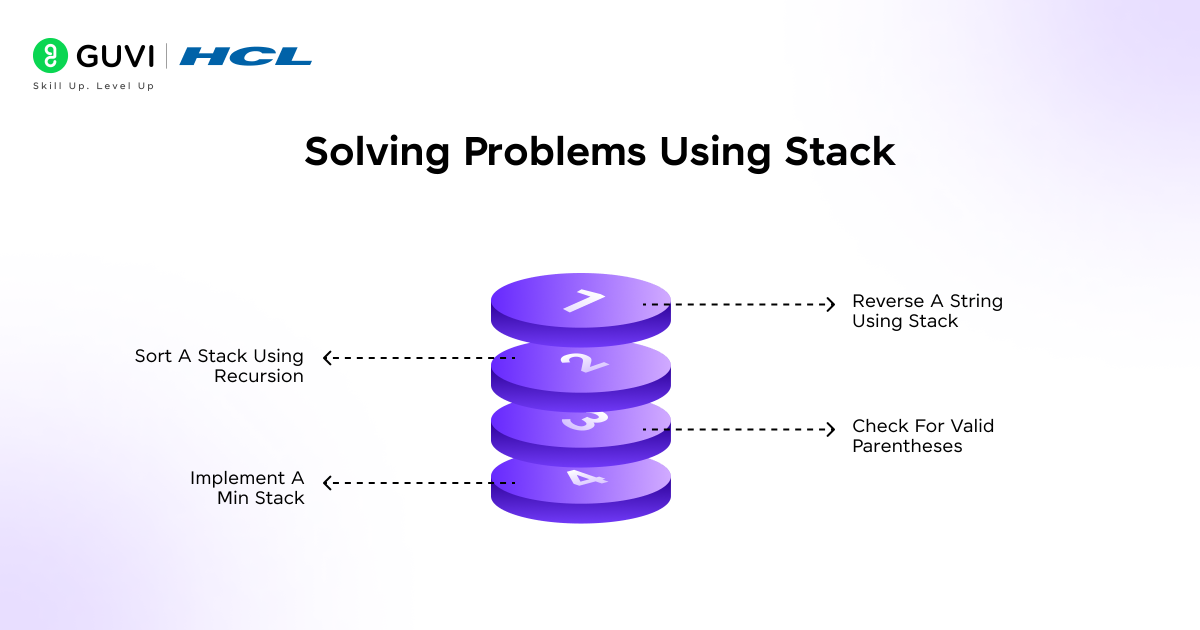
Now let’s solve some classic programming challenges using the stack data structure. These problems often appear in coding interviews and competitive programming contests, making them valuable practice for beginners.
1) Reverse a String Using a Stack
The stack’s LIFO property naturally lends itself to string reversal. Initially, push each character of the original string onto a stack. Then, pop each character and append it to a new string. This simple technique effectively reverses the input string by leveraging the stack’s inherent behavior.
def reverse_string(s):
stack = []
for char in s: stack.append(char)
result = “”
while stack: result += stack.pop()
return result
2) Sort a Stack Using Recursion
Without using additional data structures, you can sort a stack through recursion. First, remove the top element. Next, recursively sort the remaining stack. Finally, insert the removed element back in its correct sorted position. This elegant approach yields a stack with the smallest elements at the bottom and the largest at the top.
sortStack(stack):
if stack is not empty:
temp = stack.pop()
sortStack(stack)
sortedInsert(stack, temp)
3) Check for Valid Parentheses
This classic problem verifies if an expression contains balanced parentheses:
- Push opening brackets onto the stack
- When encountering a closing bracket:
- If the stack is empty, return false
- If top doesn’t match the closing bracket, return false
- Otherwise, pop the matching opening bracket
- Expression is balanced if the stack is empty at the end
4) Implement a Min Stack
Design a special stack that supports getMin() in O(1) time alongside regular operations. One approach uses two stacks: the main stack stores elements, while an auxiliary stack tracks minimum values. When pushing a new element, also push the current minimum to the auxiliary stack. For getMin(), simply return the top of the auxiliary stack.
Want to turn theory into job-ready skills? HCL GUVI’s DSA for Programmers Course bundles step-by-step algorithm, data structure, and interview prep learning that bridges your LLM chain experiments and coding mastery for real roles. Also, their e-books are really popular and a great learning source.
You can also become a job-ready AI software developer with HCL GUVI’s IITM-certified AI Software Development Course, master full-stack, DSA, Gen AI tools, and real-world projects.
Concluding Thoughts…
Mastering the stack data structure unlocks a fundamental building block used throughout software development. After all, stacks represent one of the most efficient data structures with O(1) time complexity for all operations. The LIFO principle makes stacks perfect for solving problems that require reverse order processing or backtracking.
You now understand the core stack operations—push, pop, peek, and isEmpty—along with their practical applications. Stacks power many features you use daily, such as browser history navigation, undo functionality in applications, and expression evaluation in programming languages.
FAQs
Q1. What is a stack data structure, and how does it work?
A stack is a linear data structure that follows the Last-In-First-Out (LIFO) principle. It works like a stack of plates, where you can only add or remove items from the top. The last item added is the first one to be removed.
Q2. What are the main operations performed on a stack?
The main operations on a stack are push (to add an element to the top), pop (to remove the top element), peek (to view the top element without removing it), and isEmpty (to check if the stack is empty). All these operations have a time complexity of O(1).
Q3. How is a stack different from other data structures?
Unlike arrays that allow random access, stacks only permit operations at the top. They follow the LIFO principle, unlike queues, which follow FIFO. Stacks are chosen when you need to process data in reverse order of input, such as for undo actions or backtracking algorithms.
Q4. What are some real-world applications of stacks?
Stacks are used in various applications, including undo/redo functionality in text editors, managing function calls in programming languages, checking for balanced parentheses in code, evaluating mathematical expressions, and implementing browser history navigation.
Q5. How can I implement a stack in my programming language?
You can implement a stack using arrays (for fixed size and faster performance) or linked lists (for dynamic size but with some memory overhead). Both implementations achieve the same functionality but offer different trade-offs in terms of memory usage and performance.
Success Stories

About the Author
Jaishree Tomar
A recent CS Graduate with a quirk for writing and coding, a Data Science and Machine Learning enthusiast trying to pave my own way with tech. I have worked as a freelancer with a UK-based Digital Marketing firm writing various tech blogs, articles, and code snippets. Now, working as a Technical Writer at GUVI writing to my heart’s content!
View all posts by Jaishree Tomar
Connect with me @










Did you enjoy this article?