


Career Articles
Accountant vs Data Analyst Salary in India After Switching Careers - Best Guide
Finance Managers: Could Data Science Be Your Next Career Move?
Insurance Claims Executive to Data Analyst: Is It a Good Switch?
Banking Executive (Loans, KYC) to Data Analyst: Skills and Career Path


Get In Touch For Details! Request More Information

What Is a CTC Breakup? How to Understand Your Offer Letter
Sep 02, 2026 3 Min Read 815 Views
(Last Updated)
A CTC breakup shows how your total salary package is divided into fixed pay, variable pay, deductions, benefits, and employer contributions. Many freshers look only at the final CTC amount in an offer letter, but the real question is simple: how much will you actually receive every month?
Understanding your CTC breakup helps you compare job offers better, calculate your in-hand salary, and avoid confusion after joining.
TL;DR
- CTC is the total yearly cost a company spends on you, not your monthly take-home.
- In-hand salary is usually 60-70% of CTC after PF, gratuity, and tax.
- Basic pay forms 40-50% of CTC and decides your HRA, PF, and gratuity.
- Variable pay is conditional, not guaranteed, so check if it’s performance-based.
- Always ask for a full salary breakup, not just the headline CTC figure.
- Compare offers on fixed pay and in-hand salary, not CTC alone.
Table of contents
- What Is CTC?
- CTC vs Gross Salary vs In-Hand Salary
- Common Components in a CTC Breakup
- Basic Salary
- House Rent Allowance
- Special Allowance
- Provident Fund
- Gratuity
- Variable Pay or Bonus
- Insurance and Benefits
- How to Read Your Offer Letter Salary Breakup
- Example of a Simple CTC Breakup
- Common Mistakes Freshers Make
- How to Compare Two Offer Letters
- Conclusion
- FAQs
- What is a CTC breakup?
- Is CTC the same as in-hand salary?
- Why is my in-hand salary lower than my CTC?
- Is variable pay guaranteed?
- What should I check before accepting an offer letter?
What Is CTC?
CTC stands for Cost to Company. It is the total yearly amount a company spends on an employee. It may include your salary, allowances, bonuses, provident fund contribution, gratuity, insurance, and other benefits.
CTC is different from in-hand salary. Your in-hand salary is the amount credited to your bank account after deductions.
CTC vs Gross Salary vs In-Hand Salary
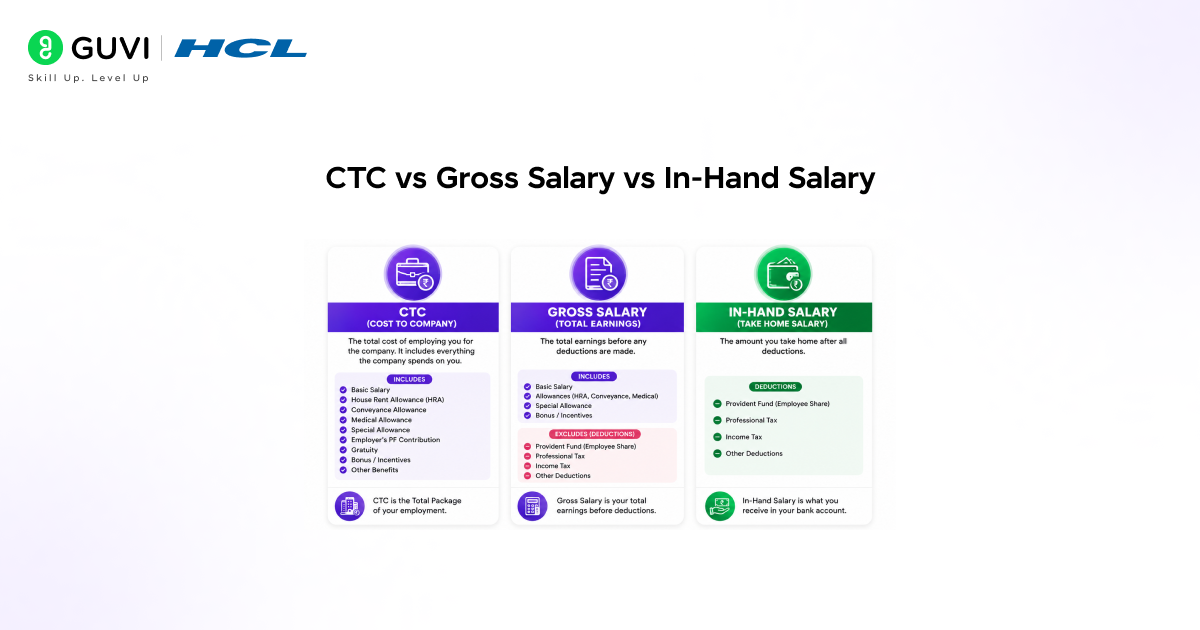
A high CTC does not always mean a high monthly salary. Some parts may be annual, variable, conditional, or non-cash benefits. Here are the key differences between CTC vs in-hand salary that every fresher should understand before accepting an offer letter.
| Term | Meaning |
| CTC | Total annual cost spent by the company |
| Gross Salary | Salary before employee-side deductions |
| Net Salary | Final take-home salary after deductions |
| Fixed Pay | Guaranteed salary component |
| Variable Pay | Performance-based or condition-based amount |
In-hand salary typically works out to only 60-70% of CTC for most salaried professionals in India. The rest goes into PF, gratuity, and tax, money you never actually see hit your bank account.
Common Components in a CTC Breakup
1. Basic Salary
Basic salary is the core part of your salary structure. Many other components, such as PF and gratuity, are calculated using basic salary. A very low basic salary can reduce your statutory benefits.
2. House Rent Allowance
HRA is given to support rent-related expenses. It is common in most salary structures and may offer tax benefits based on your rent, city, and tax regime.
3. Special Allowance
Special allowance is usually the balancing amount in a salary breakup. It helps the employer complete the promised CTC after adding basic pay, HRA, and other components.
4. Provident Fund
PF is a retirement savings benefit. Both employee and employer contributions may appear in your salary structure. Employee PF is deducted from your salary, while employer PF is counted as part of CTC.
5. Gratuity
Gratuity is a long-term benefit paid after eligible service. Many companies include gratuity in CTC, but it is not paid every month as in-hand salary.
6. Variable Pay or Bonus
Variable pay depends on performance, company policy, targets, or appraisal cycles. Always check whether it is guaranteed or conditional.
7. Insurance and Benefits
Some companies include health insurance, wellness benefits, meal cards, learning budgets, or transport benefits in CTC. These improve overall value but may not increase monthly take-home salary.
Also, Read: Top 25 HR Interview Questions and Answers
Understand your offer letter better with HCL GUVI’s Interview Preparation Course. Learn salary negotiation, HR interview skills, communication, and job-readiness strategies to make smarter career decisions.
How to Read Your Offer Letter Salary Breakup
Check these points before accepting an offer:
- What is the total CTC?
- What is the fixed annual pay?
- What is the monthly in-hand salary?
- How much is variable pay?
- Is the bonus guaranteed or performance-based?
- What deductions apply every month?
- Is gratuity included in CTC?
- Are insurance and benefits part of the salary package?
- Is there any bond, notice period, or recovery clause?
A good offer letter should clearly mention salary components, joining date, designation, work location, probation period, notice period, and employment conditions.
Basic salary is usually just 40-50% of your total CTC. Since HRA, PF, and gratuity are all calculated from this number, a lower basic can quietly shrink your retirement savings too.

Example of a Simple CTC Breakup
Assume your annual CTC is ₹5,00,000 for a fresher-level digital marketing role.
| Component | Annual Amount |
| Basic Salary | ₹2,00,000 |
| HRA | ₹1,00,000 |
| Special Allowance | ₹1,20,000 |
| Employer PF | ₹24,000 |
| Gratuity | ₹10,000 |
| Variable Pay | ₹46,000 |
| Total CTC | ₹5,00,000 |
Your monthly in-hand salary will not be ₹41,666. It will be lower after deductions and after removing annual or conditional components.
Common Mistakes Freshers Make
- Looking Only at the CTC Amount: Many freshers focus only on the annual CTC and ignore the actual monthly in-hand salary.
- Ignoring Variable Pay: Candidates often assume variable pay is guaranteed, even when it depends on performance, targets, or company policy.
- Confusing CTC With Take-Home Salary: CTC is the company’s total cost, while take-home salary is the amount credited after deductions.
- Not Checking PF Deductions: Freshers may miss employee PF deductions and employer PF contributions while calculating monthly salary.
- Assuming Gratuity Is Paid Monthly: Gratuity is usually included in CTC but is paid only after meeting eligibility conditions.
- Skipping the Fixed Pay Details: A high CTC can look attractive, but the fixed salary may be much lower than expected.
- Not Reading the Offer Letter Carefully: Some candidates accept offers without checking probation, notice period, bond, deductions, and joining conditions.
- Ignoring Non-Cash Benefits: Insurance, meal cards, transport, and learning benefits may be part of CTC but may not increase monthly salary.
- Not Asking for a Salary Breakup: Freshers may avoid asking questions and later feel confused after receiving the first salary.
- Comparing Offers Only by CTC: Two offers with similar CTCs can have very different fixed pay, deductions, benefits, and in-hand salaries.
How to Compare Two Offer Letters
Compare the fixed salary first. Then check variable pay, deductions, insurance, work location, probation terms, and growth scope. For example, a fresher applying for a software developer role may receive a ₹6 LPA offer with high variable pay, but the monthly income can still be lower than a ₹5.5 LPA offer with stronger fixed pay. That is why the CTC breakup matters more than the headline salary.
Conclusion
A CTC breakup helps you understand the real value of your offer letter. It explains what you will earn, what will be deducted, and what benefits are included in your total package.
Before accepting any offer, ask for the complete salary breakup. Focus on fixed pay, in-hand salary, variable pay, PF, gratuity, deductions, and joining conditions. A clear offer letter protects you from salary confusion and helps you make a better career decision.
FAQs
What is a CTC breakup?
A CTC breakup is the detailed division of your annual salary package into basic pay, allowances, deductions, employer contributions, benefits, and variable pay.
Is CTC the same as in-hand salary?
No. CTC is the total company cost, while in-hand salary is the amount you receive after deductions.
Why is my in-hand salary lower than my CTC?
Your in-hand salary is lower because CTC may include PF, gratuity, tax deductions, insurance, and variable pay.
Is variable pay guaranteed?
Variable pay is usually not fully guaranteed. It may depend on performance, company policy, targets, or appraisal rules.
What should I check before accepting an offer letter?
Check fixed pay, monthly in-hand salary, variable pay, deductions, PF, gratuity, notice period, probation period, and joining terms.
Success Stories

About the Author
Vaishali
I'm a seasoned writer with four years of experience across technical, non-technical, and just about every genre or niche you can imagine. Adaptable and curious, I enjoy exploring new topics and making information engaging and easy to understand. Fueled by a steady stream of tea, I approach each project with creativity, reliability, and genuine enthusiasm for storytelling.
View all posts by Vaishali
Connect with me @
















Did you enjoy this article?