


Data Structure Articles
What is an Algorithm? A Simple Guide for Beginners
Difference between Algorithm and Program: What Sets Them Apart
What Are the Characteristics of an Algorithm? Definition, Features, and Examples


Get In Touch For Details! Request More Information
Sorting in Data Structure: Categories & Types [With Examples]
Nov 26, 2025 4 Min Read 735 Views
(Last Updated)
When we talk about data structure, one of the most common tasks we perform is sorting, i.e., arranging or organizing data in a specific order. It can be organizing the list of students by name and marks or sorting names alphabetically, or arranging a file by year or date. Sorting plays a crucial role in how we can efficiently access and process the data.
In simple words: Sorting is a data structure is arranges elements such as numbers, strings or records in ascending or descending order
Sorting makes searching faster, improves the organization of data, and allows algorithms to run efficiently. This is one of the reasons why it is considered so important to understand the different sorting methods for both programmers and students.
Table of contents
- What is Sorting in Data Structure?
- Why Sorting Matters?
- Quick Searching
- Easier Data Analysis
- Supports Other Algorithms
- Improved Readability
- Categories of Sorting in Data Structure
- Internal Sorting
- External Sorting
- Types of Sorting Algorithms in Data Structures
- Bubble Sort
- Selection Sort
- Insertion Sort
- Merge Sort
- Quick Sort
- Heap Sort
- Counting Sort
- Radix Sort
- Comparison of Sorting Algorithms
- Wrapping it Up
- FAQs
- What is Sorting in Data Structure?
- What are the main categories of sorting?
- Which sorting algorithm is the most efficient?
- Which sorting algorithm is the least complex to perform?
What is Sorting in Data Structure?
Sorting in a Data Structure is the process of arranging values or elements of a list or array in a specific sequence.
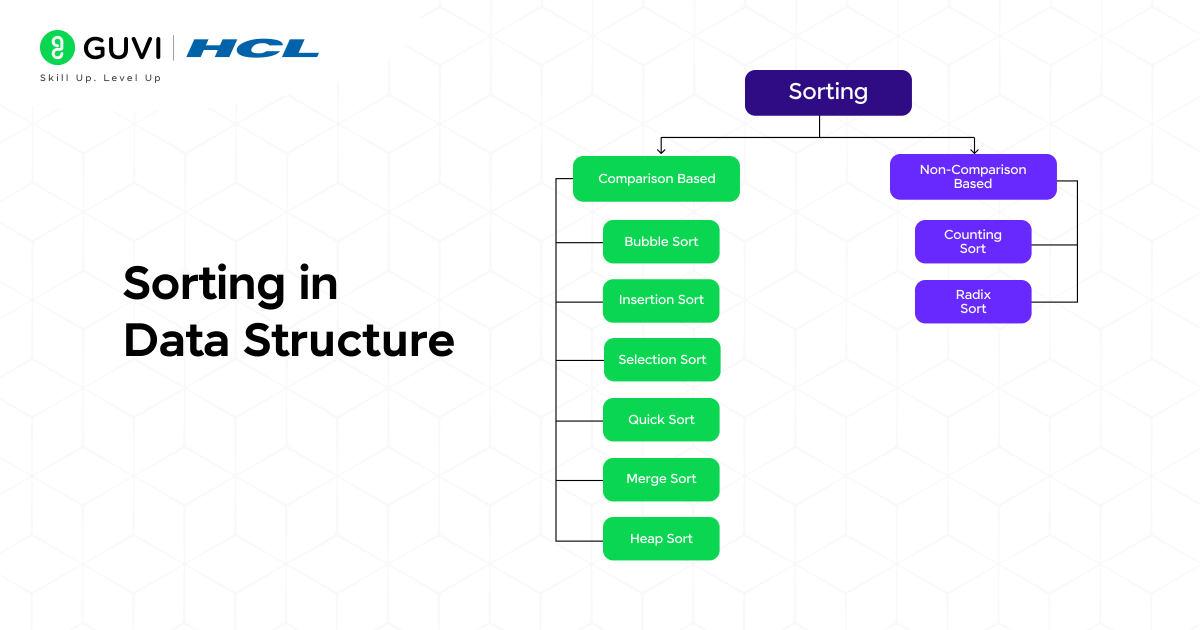
Data can be sorted by:
- Numerical value (ex: 1, 2, 3…)
- Alphabetical order (ex: A – Z or Z – A)
- Date or priority
Data can be primarily sorted in two ways:
- Ascending order: (order from smallest to largest) (1 → 10, A → Z)
- Descending order: (order from largest to smallest) (10 → 1, Z → A)
For Example:
Input – [8, 2, 4, 9, 3]
Output (in ascending) – [2, 3, 4, 8, 9]
Why Sorting Matters?
Although sorting may seem a small task, it play a key role in making data to be analyzed and used effectively. Here is why sorting is important.
1. Quick Searching
If data is sorted, it will give a quicker search. For example in searching a sorted list, binary search can be used which finds items in the O(log n) time, instead of searching one by one.
Example: Searching for a roll number in a sorted list of students is significantly quicker than searching an unsorted list of students.
2. Easier Data Analysis
It is easier to notice patterns, trends, and outliers in sorted data. For example business can quickly spot their best performing employees, their best-selling items or their highest grossing months.
3. Supports Other Algorithms
Algorithms often perform well when the data is sorted, for example merge operations in databases or binary search trees. Often, sorting is the first step for carrying out other operations efficiently.
4. Improved Readability
It allows for better readability for us humans, think of how data is sorted in phone contacts are always sorted alphabetically, or your file store is always sorted alphabetically.
Categories of Sorting in Data Structure
Sorting algorithms can primarily be classified into two categories according to how they process data:
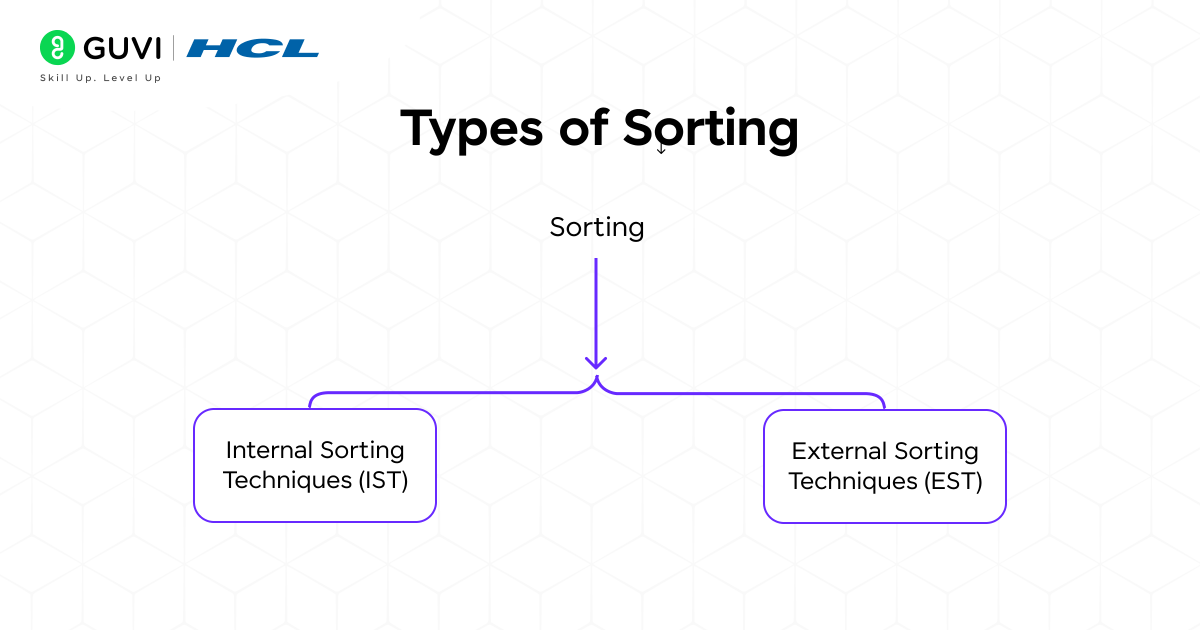
1. Internal Sorting
When all sorted data can be kept in main storage (RAM) it is called internal sorting. This is used for small or medium datasets.
For example,
- Bubble Sort
- Insertion Sort
- Selection Sort
- Quick Sort
- Merge Sort
2. External Sorting
When data is so large it cannot be kept in main storage and must be kept in external storage (e.g., hard disk).
For example,
- Multiway Merge Sort
- External Merge Sort
Also Explore: 5 Best Reasons to Learn Data Structures and Algorithms [DSA]

Types of Sorting Algorithms in Data Structures
1. Bubble Sort
Bubble sort is one of the easiest sorting algorithms to understand. The sorting criteria simply determine if adjacent elements need to be swapped, which performs a sort of swap to arrange them in the right order, similar to arranging cards by swapping elements.
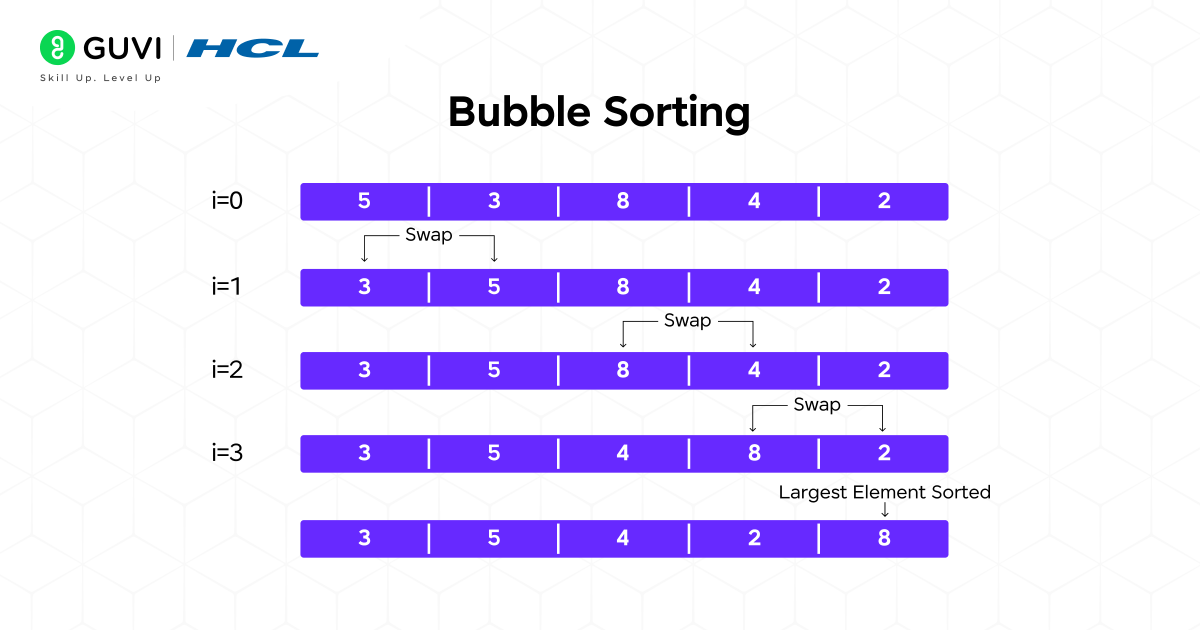
For example:
List: [5, 3, 8, 4, 2]
Step-by-step process:
- Compare 5 and 3 and determine the need to swap them, resulting in an intermediate sort of [3, 5, 8, 4, 2]
- Compare 5 and 8 and see that they are already in the correct order [3, 5, 8, 4, 2]
- Compare 8 and 4 and swap, resulting in [3, 5, 4, 8, 2]
- Compare 8 and 2 and swap, resulting in [3, 5, 4, 2, 8]
After the first pass, the largest element (8) is at the end. Repeat this for the remaining elements until all are sorted.
Result: [2, 3, 4, 5, 8]
Best for: Small datasets or learning purposes.
2. Selection Sort
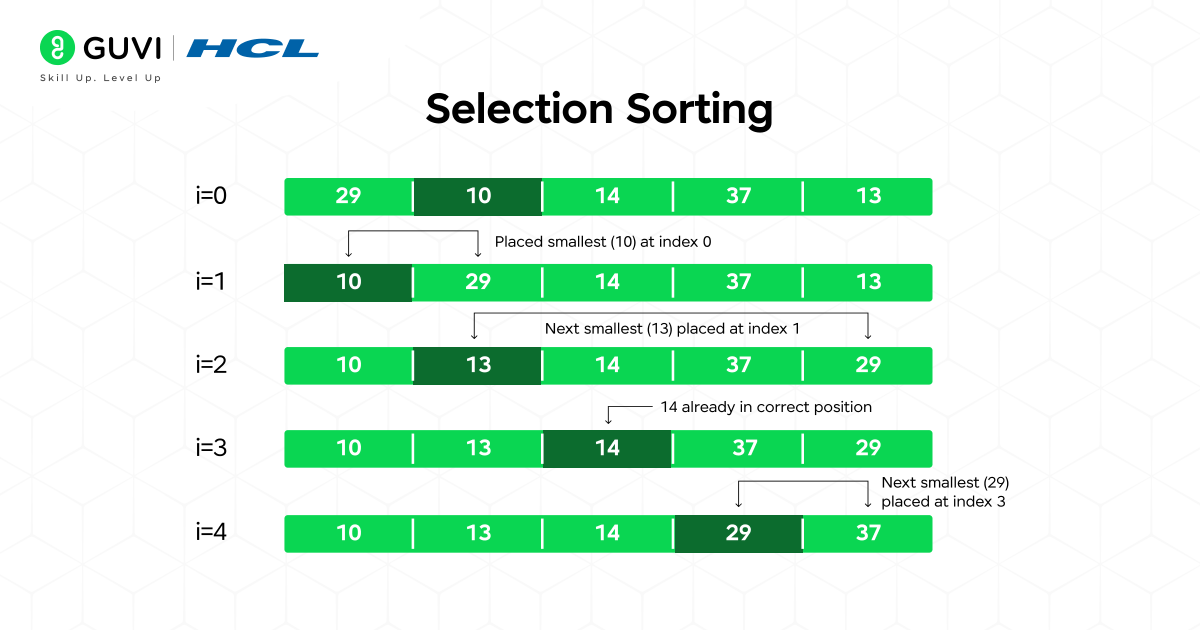
Selection Sort works like picking the smallest card from a shuffled deck and placing it in order one by one.
For example:
List: [29, 10, 14, 37, 13]
Steps by step process:
- Find the smallest element (10) – place it first – [10, 29, 14, 37, 13]
- Next smallest is 13 – [10, 13, 14, 37, 29]
- Next smallest is 14 – [10, 13, 14, 37, 29] (already in place)
- Next smallest is 29 – [10, 13, 14, 29, 37]
Result: [10, 13, 14, 29, 37]
It’s simple but not very efficient for large datasets since it always scans the entire list for the next smallest element.
Download HCL GUVI’s free Data Structures & Algorithms e-book and start mastering problem-solving skills that every top developer needs!
3. Insertion Sort
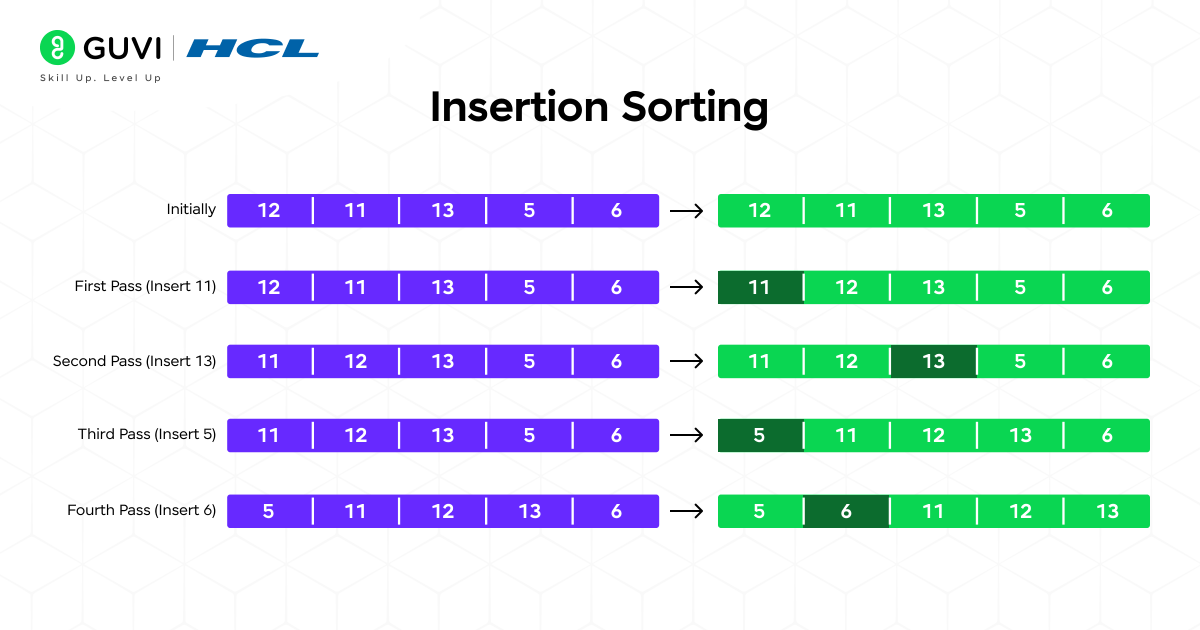
You can think of insertion sort as how one might organize cards in hand, simply picking up one card at a time and placing it where it belongs amongst the sorted cards.
For example:
List = [12, 11, 13, 5, 6]
Step-by-Step Process:
- Start with 12 – already sorted.
- Insert – 1 before 12 – [11, 12, 13, 5, 6]
- Insert 13 – stays the same.
- Insert 5 – [5, 11, 12, 13, 6]
- Insert 6 – [5, 6, 11, 12, 13]
Result: [5, 6, 11, 12, 13]
Best for: Small lists or partially sorted.
- The concept of sorting dates back to the early days of computing — the first sorting algorithm was developed in the 1950s!
- Merge Sort was invented by John von Neumann in 1945 — the same visionary who helped design modern computer architecture.
- Quick Sort, one of the fastest sorting algorithms, was created by Tony Hoare in 1959 and is still widely used in programming libraries today.
- Google’s search engine indexes billions of web pages — and sorting algorithms play a key role in organizing and ranking them efficiently.
4. Merge Sort
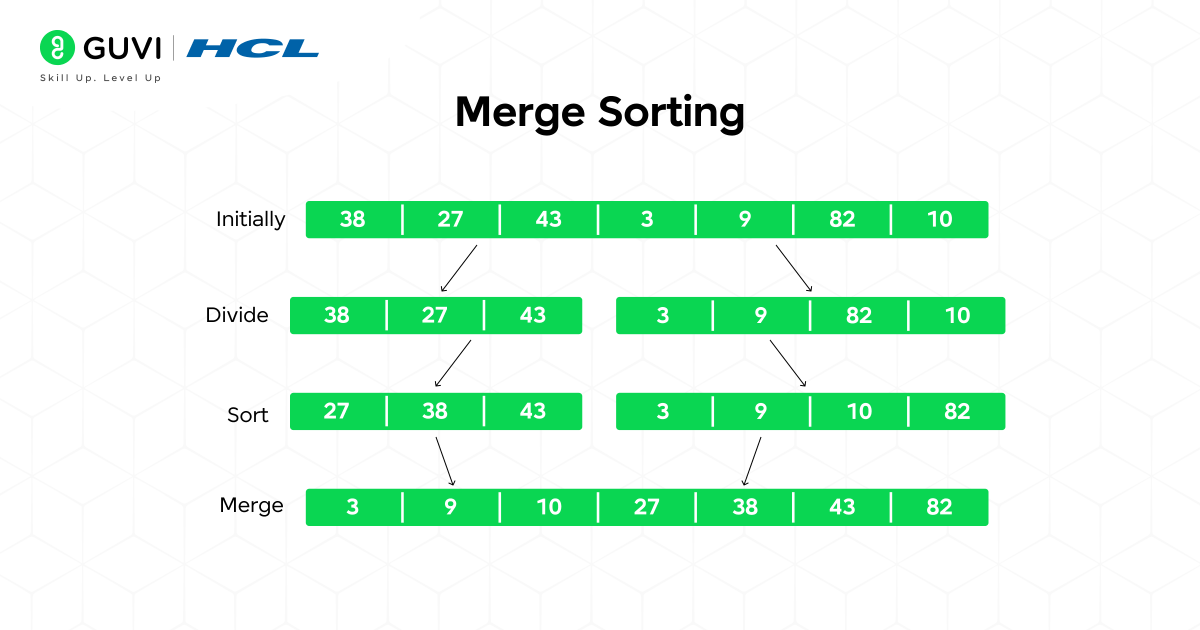
Merge Sort employs a “divide and conquer” approach. It takes the list, breaks it into smaller sections, sorts it, and then merges it back together into one sorted list.
For example:
List: [38, 27, 43, 3, 9, 82, 10]
Step-by-Step Process:
- You break the list down into halves until there is only one element in each half.
- You merge it back into a sorted nature.
Here is how that would process:
[38, 27, 43, 3, 9, 82, 10] – split – [38, 27, 43] [3, 9, 82, 10]
– [27, 38, 43] [3, 9, 10, 82]
– [27, 38, 43] [3, 9, 10, 82] – merge – [3, 9, 10, 27, 38, 43, 82]
Result: [3, 9, 10, 27, 38, 43, 82]
Best For: A large data set. It is not the most efficient, but it is a reliable solution.
Also Read: Is DSA Important for Placement in 2025?
5. Quick Sort
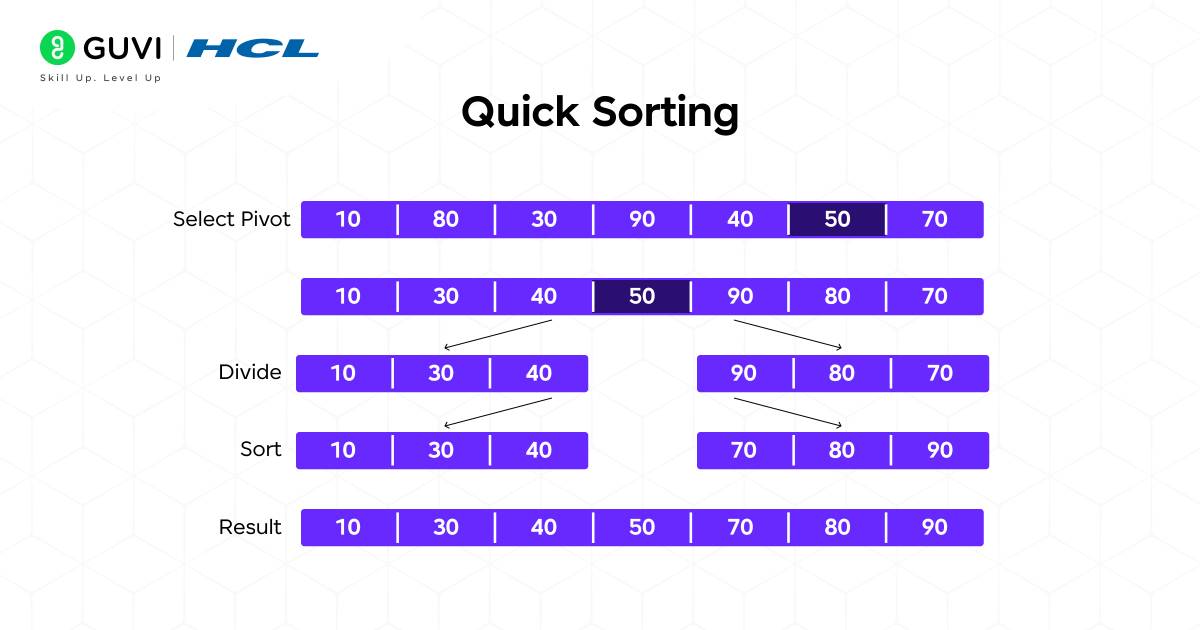
Like Merge Sort, Quick Sort uses divide-and-conquer but does so in a slightly different manner. The algorithm selects an element to be the “pivot,” then moves smaller elements of the list before the pivot and larger elements after the pivot.
For example,
List: [10, 80, 30, 90, 40, 50, 70].
The steps in this process would include:
1. Choosing a pivot (in this example, we will choose 50)
2. Rearranging the numbers such that smaller elements are before the pivot and larger elements are after the pivot.
- [10, 30, 40, 50, 90, 80, 70].
3. Repeat this process for each half at the pivot for both the original list into a left and right stack.
Result : [10, 30, 40, 50, 70, 80, 90].
Best for: Typically, Quick Sort works well with larger datasets where average performance is more relevant.
6. Heap Sort
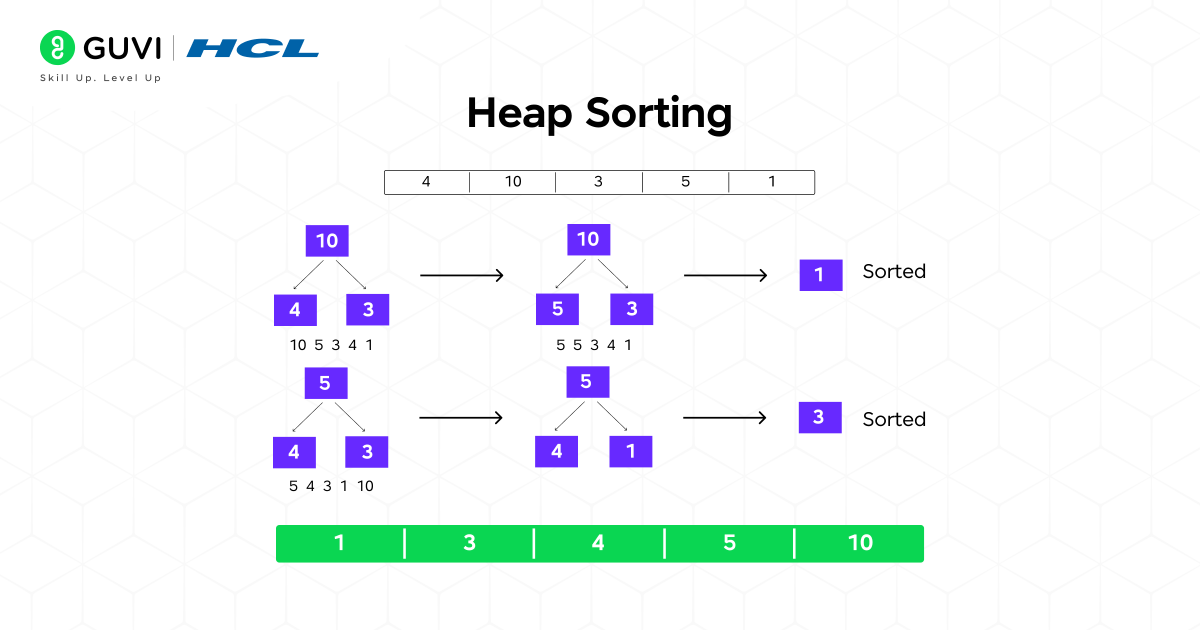
Heap Sort first creates a heap data structure (a kind of binary tree) from the list, then removes the largest item and rebuilds the heap, repeatedly, until the items are sorted.
For example:
List: [4, 10, 3, 5, 1]
Step-by-Step Process:
1. Create a max heap → [10, 5, 3, 4, 1]
2. Remove max (10) and recreate a max heap → [5, 4, 3, 1, 10]
3. Repeat until sorted.
Sorted: [1, 3, 4, 5, 10]
Best For: Large data sets where stability is not an issue.
Also Read: Best DSA Roadmap Beginners Should Know 2025
7. Counting Sort
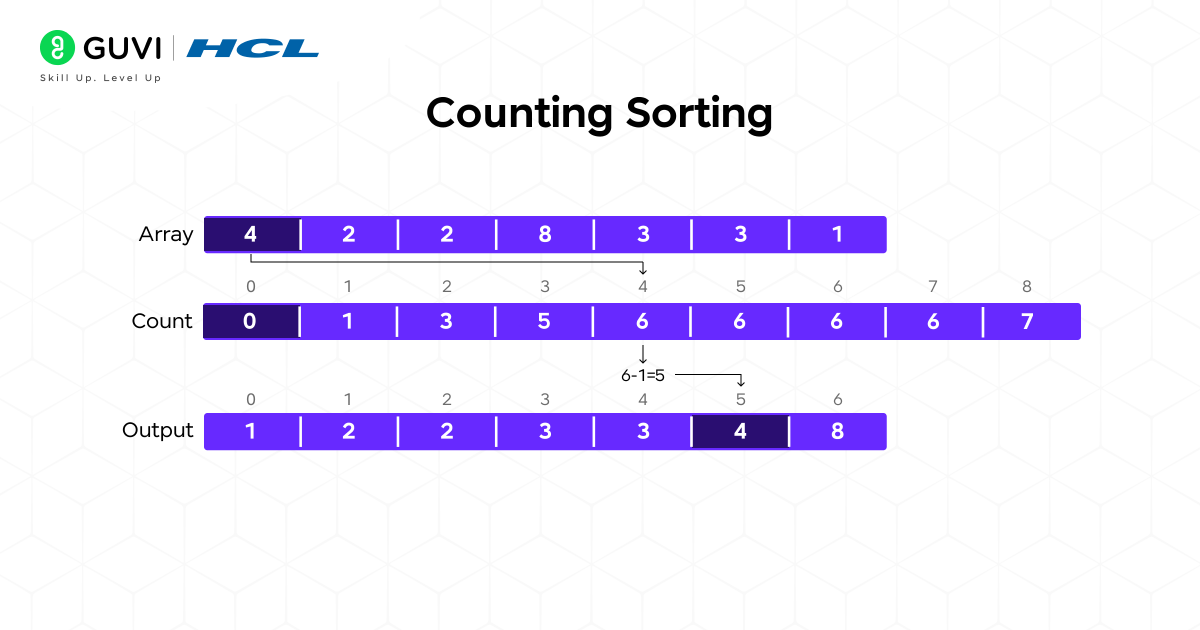
Counting Sort is not a comparing sort, as it does not compare elements directly. Instead, it counts how many times each value occurs and uses that for sorting the data.
For example:
[4, 2, 2, 8, 3, 3, 1]
Step-by-Step Process:
- Count the number of instances per number.
- Use the counts to place elements.
Result: [1, 2, 2, 3, 3, 4, 8]
Best for: Used for sorting integers when you have an understanding of values in a small range.
8. Radix Sort
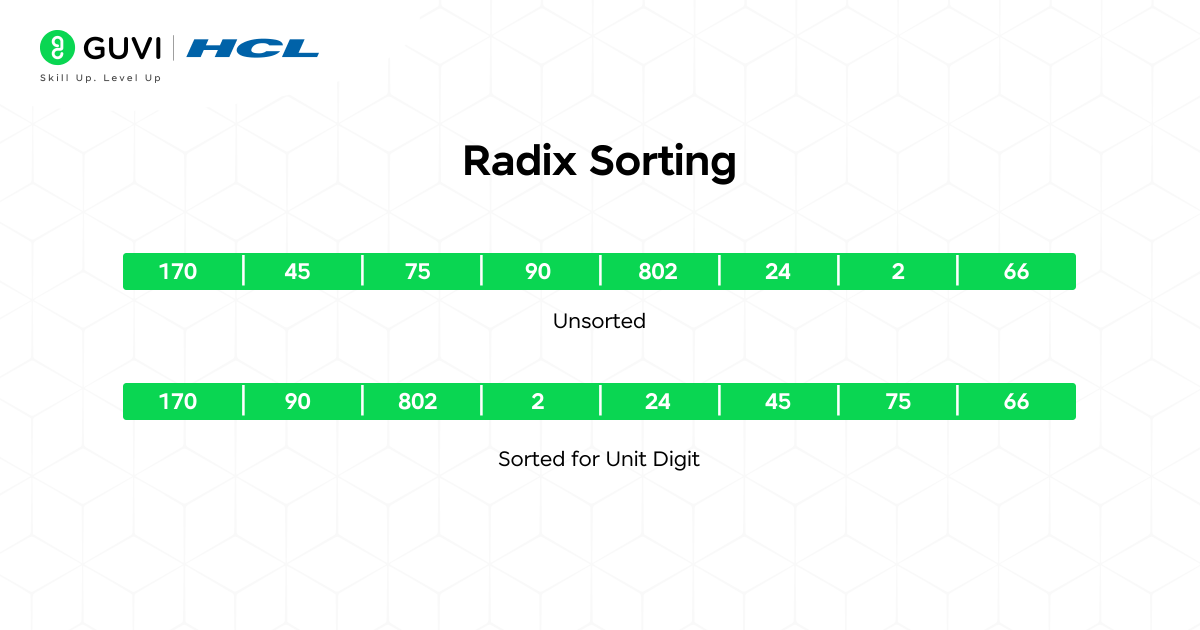
Radix sort sorts numbers based on their digits; it starts with the least significant digit (rightmost) to the most significant digit (leftmost).
For example:
[170, 45, 75, 90, 802, 24, 2, 66]
Step-by-Step Process:
Sort all numbers by their units place – then their tens place – then their hundreds.
Result: [2, 24, 45, 66, 75, 90, 170, 802]
Best for: Large sets of integers or strings of shorter sorts when sorting by digits works well.
Also, Explore About 10 Best Data Structures and Algorithms Courses [2025]
Comparison of Sorting Algorithms
| Algorithm | Approach | Best For | Stability | Efficiency |
| Bubble Sort | Compare & Swap | Small data | yes | Slow |
| Selection Sort | Select minimum | Learning | no | Slow |
| Insertion Sort | Insert one by one | Small / nearly sorted | yes | Moderate |
| Merge Sort | Divide & Conquer | Large data | yes | Fast |
| Quick Sort | Divide & Conquer | Large data | no | Very Fast |
| Heap Sort | Tree-based | Large data | no | Fast |
| Counting Sort | Counting elements | Integers | yes | Very Fast |
| Radix Sort | Digit-based | Large numbers | yes | Fast |
You now have the concepts of Sorting in Data Structure, now it’s time to put that knowledge into action! Join GUVI’s Artificial Intelligence & Software Development Course with Python IIT-M Pravartak Certified and gain real-world coding experience, expert mentorship, and job-ready skills that top companies are looking for.
Wrapping it Up
In computer science, sorting in data structures is one of the most essential principles. Sorting organizes data, provides optimal search time, and serves as the basis for advanced algorithms.
Whether comparing basic algorithms such as Bubble Sort or complex algorithms such as Merge Sort and Quick Sort, all algorithms will have their use case depending on input size, type, and situation.
If you know the concepts of how sorting works, it will help you tackle algorithms, data analytics, and the challenges of coding.
FAQs
1. What is Sorting in Data Structure?
Sorting refers to the process of organizing data in a specified order, either in ascending or descending order, to improve search and analysis efficiencies.
2. What are the main categories of sorting?
There are primarily two categories of sorting: Internal Sorting (sorting that occurs in memory) and External Sorting (sorting that occurs on a large amount of data stored externally).
3. Which sorting algorithm is the most efficient?
In general, the Quick Sort sorting algorithm is the most efficient; however, the Merge Sort sorting algorithm is generally more stable and consistently accurate.
4. Which sorting algorithm is the least complex to perform?
The Bubble Sort sorting algorithm and the Selection Sort sorting algorithm are the least complex for beginners to sort with.
Success Stories

About the Author
Vishalini Devarajan
An Aerospace Engineer turned content writer, I focus on making complex concepts easy to understand through well-structured, reader-friendly blogs. Whether it’s a technical topic or a non-technical one, I love creating content that is clear, engaging, and impactful.
View all posts by Vishalini Devarajan
Connect with me @















Did you enjoy this article?