


Artificial Intelligence and Machine Learning Articles
Google Jules Tutorial: Real Examples & Implementation
Docling AI Explained: A Comprehensive Guide to Parsing
Detecting Hallucinations in Generative AI: Types, Examples, Methods, and Best Practices


Get In Touch For Details! Request More Information
Scope of Artificial Intelligence: The Future is Here
Aug 30, 2025 6 Min Read 2926 Views
(Last Updated)
What if machines could think, learn, and make decisions just like humans? That’s no longer science fiction; it’s the world of artificial intelligence, or AI, and it’s already shaping how we live, work, and learn.
From voice assistants and recommendation systems to self-driving cars and medical diagnosis, AI is everywhere. But what exactly is AI, and more importantly, what does it mean for you as a student stepping into the future?
In this article, we’ll break down the scope of Artificial Intelligence, especially in the Indian context, and show you why understanding it now could open the doors to some of the most exciting opportunities of your lifetime.
Table of contents
- What is Artificial Intelligence?
- Applications and Scope of Artificial Intelligence Across Sectors
- AI in India: Growth, Initiatives, and Opportunities
- Rapid Adoption
- Government Initiatives – AI for All
- Skilling and Education
- Startup Ecosystem and Industry Growth
- AI Careers and Opportunities for Students
- High Demand for AI Skills
- Career Paths and Roles
- Lucrative Salaries
- Career Growth and Impact
- Challenges and Concerns in AI
- Data Privacy & Security
- Ethical Issues & Bias
- Regulation and Governance
- Future Outlook of AI
- Quick Quiz: Test Your AI Knowledge
- Conclusion
- FAQs
- What is the scope of artificial intelligence in the future?
- Is artificial intelligence a good career in India?
- What are the main applications of AI today?
- What qualifications do I need for a career in AI?
- What are the challenges of adopting AI in India?
What is Artificial Intelligence?
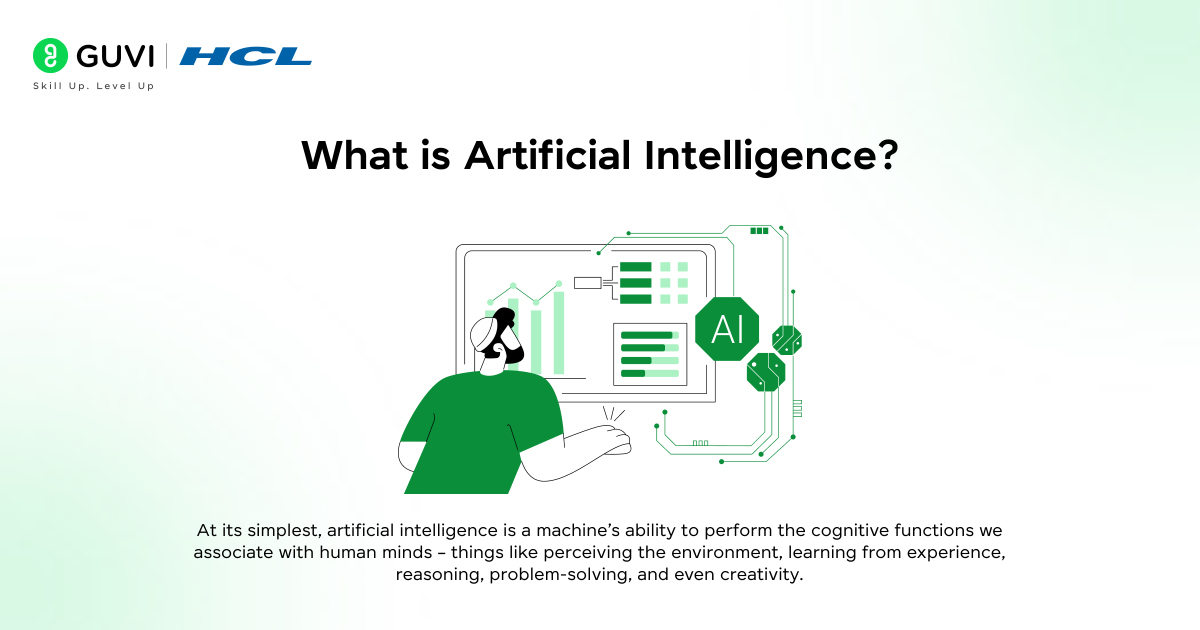
At its simplest, artificial intelligence is a machine’s ability to perform the cognitive functions we associate with human minds – things like perceiving the environment, learning from experience, reasoning, problem-solving, and even creativity.
It’s important to note that AI isn’t a single technology but an umbrella term covering a range of approaches. One of the most common approaches is machine learning, where algorithms find patterns in data and learn to make predictions or decisions.
A specialized subset of this is deep learning, which uses neural networks (inspired by the human brain’s interconnected neurons) to handle complex tasks and large amounts of data.
Applications and Scope of Artificial Intelligence Across Sectors
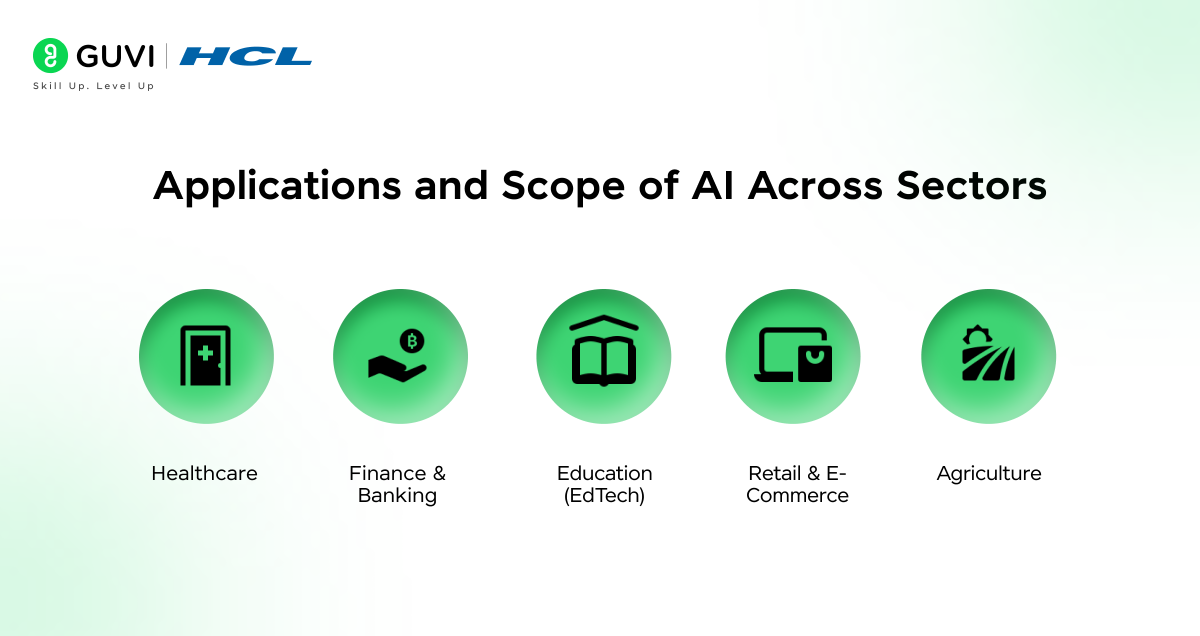
One of the most exciting aspects of AI is its versatility. The scope of artificial intelligence spans virtually every industry and domain. Let’s look at some of the major areas where AI is making an impact (with a special focus on India):
- Healthcare: AI is revolutionizing healthcare by improving diagnostics and treatment. For example, AI-driven systems can analyze medical images (like X-rays, MRIs) to detect diseases such as cancer at an early stage with high accuracy.
- Finance & Banking: The finance sector was an early adopter of AI, using it for tasks that require analyzing large amounts of data rapidly. Fraud detection is a prime example – AI algorithms can monitor transactions in real-time and flag suspicious activities far more effectively than manual methods.
- Education (EdTech): AI is making learning more personalized and effective. Intelligent tutoring systems can adapt to a student’s learning pace and style, offering extra practice on topics they struggle with and accelerating when they grasp concepts quickly.
- Retail & E-Commerce: Ever wonder how Amazon or Flipkart seems to know exactly what you’d like to buy next? AI plays a big role in product recommendations, analyzing your browsing and purchase history to suggest items you’re likely interested in.
- Agriculture: Even farming is getting smarter with AI. This is particularly important for a country like India, where agriculture is a major part of the economy and livelihood for millions.
AI in India: Growth, Initiatives, and Opportunities
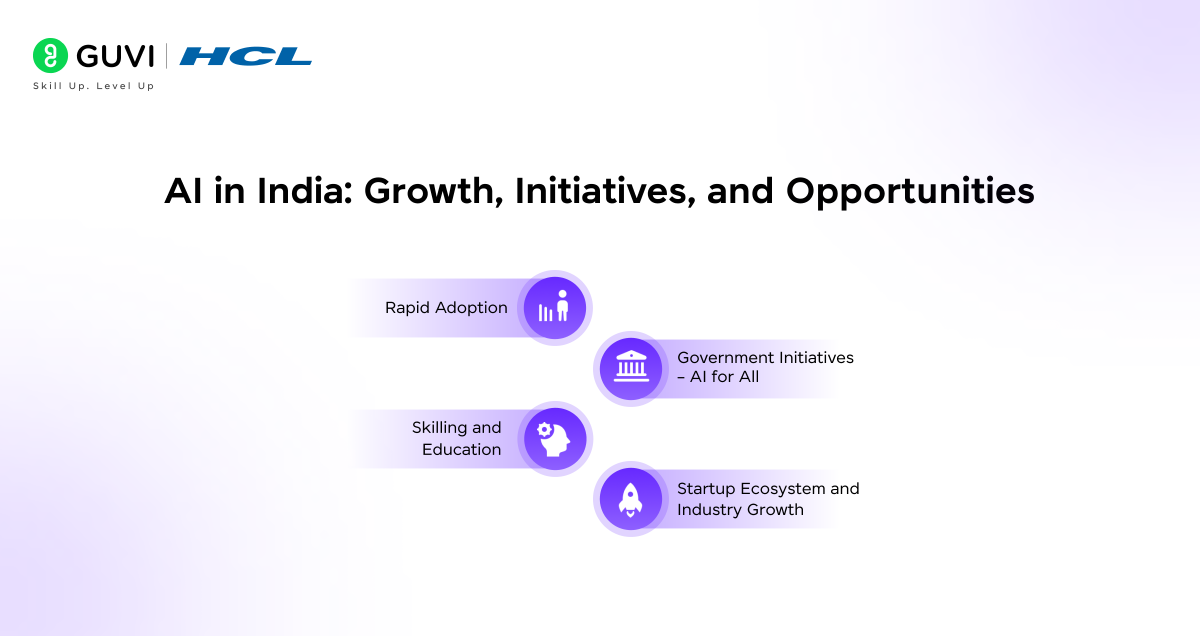
AI is a global phenomenon, but it’s worth zooming in on India, which has emerged as a significant player in the AI landscape. For a country of India’s size and population, AI presents both big opportunities and unique challenges. Here’s an overview of how AI is expanding in India:

Rapid Adoption
India is enthusiastically embracing AI. A recent Boston Consulting Group (BCG) report found that India is leading the world in AI adoption with a 30% adoption rate, surpassing the global average of 26%.
This means a lot of Indian organizations have either implemented or are experimenting with AI solutions. In sectors like banking, telecom, and IT services, India is on par with or even ahead of many developed countries in deploying AI for business.
Government Initiatives – AI for All
The Indian government recognizes AI’s transformative potential and has launched a National Strategy for AI, often dubbed “AI for All.” The policy, formulated by NITI Aayog (a government think tank), outlines a vision to leverage AI for inclusive growth in areas of societal importance. It specifically identifies five priority sectors to focus on: healthcare, agriculture, education, smart cities/infrastructure, and smart mobility (transportation).
In 2020, India set up a dedicated National AI Mission as part of the Digital India initiative. This mission provides funding for AI research, encourages startups, and facilitates collaboration between industry, academia, and government.
Skilling and Education
To truly harness AI, India needs skilled AI professionals. Recognizing this, both government bodies and the tech industry have launched major skilling initiatives. A great example is NASSCOM’s “FutureSkills” program, which aims to upskill 2 million technology professionals and students in AI and related technologies.
Similarly, the All India Council for Technical Education (AICTE) – which regulates engineering colleges – has introduced AI and machine learning courses into the curriculum of many engineering programs.
Startup Ecosystem and Industry Growth
India’s tech industry, known for software services, is quickly expanding into AI. Indian IT giants – Infosys, TCS, Wipro, HCL, etc. – have set up dedicated AI divisions that build solutions for global clients, such as AI-driven analytics, automation tools, and consulting services in AI adoption.
On the startup front, India is buzzing with AI startups. As of the mid-2020s, estimates suggested 300+ AI startups operating in India, making India rank among the top countries globally for AI entrepreneurship. These startups are working on diverse problems: some build chatbots for customer service, some use AI for medical diagnostics, others for improving retail supply chains, and so on.
AI Careers and Opportunities for Students
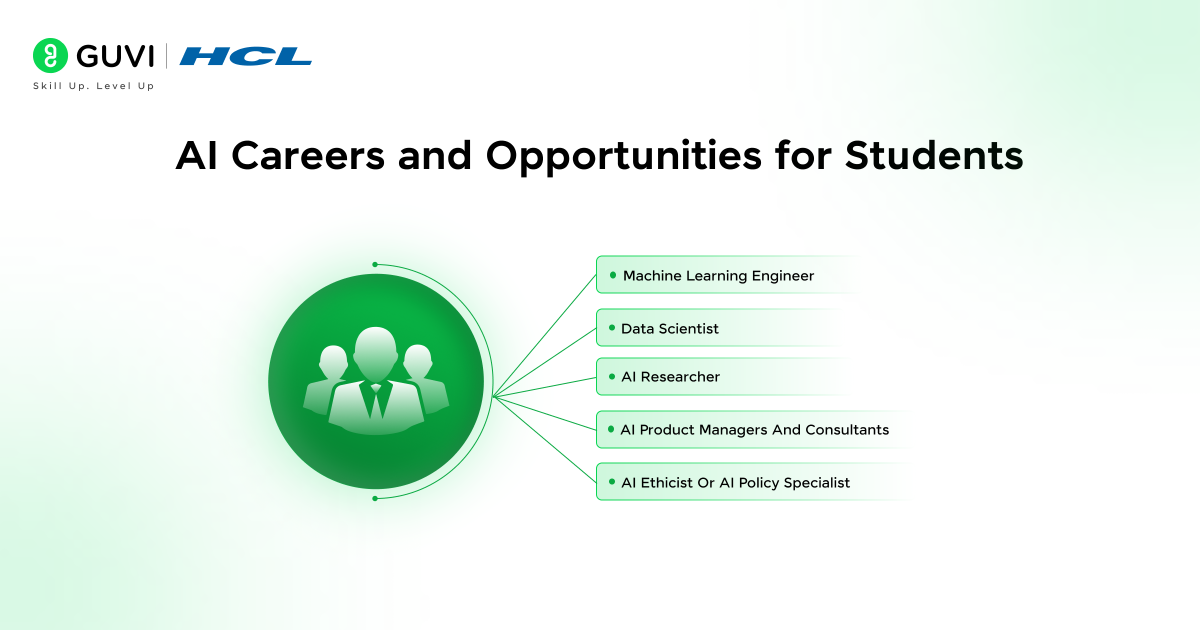
One of the most common questions among students is: “What is the career scope in AI?” The answer: immense. As AI continues to penetrate various sectors, the need for professionals who understand AI is skyrocketing. Here’s a look at AI careers and why getting into AI is a promising move, especially in India:
High Demand for AI Skills
Almost every industry now needs AI talent – whether it’s an e-commerce company wanting to improve its recommendation engine, a hospital looking to implement an AI diagnostic tool, or a bank automating its credit analysis.
This cross-industry adoption means job opportunities in AI are abundant. Roles in the AI field come with various titles, for example: AI Engineer, Machine Learning Engineer, Data Scientist, AI Analyst, AI Research Scientist, Computer Vision Engineer, NLP Specialist, and so on.
Career Paths and Roles
To give you an idea of what AI professionals do, here are a few common roles:
- A Machine Learning Engineer builds and fine-tunes AI models or algorithms. They often come from a software engineering background but specialize in ML frameworks and techniques.
- A Data Scientist overlaps with AI – they gather and analyze data, build predictive models (often using machine learning), and help derive business insights from data.
- An AI Researcher (often found in R&D labs or academia) pushes the boundaries of what AI can do, developing new algorithms or improving existing ones.
- AI Product Managers and Consultants help translate business problems into AI solutions – they need to understand AI enough to see what’s feasible and manage AI projects.
- We even have emerging roles like AI Ethicist or AI Policy Specialist as companies and governments grapple with the ethical implications of AI deployments.
Lucrative Salaries
One big attraction of AI careers is that they are well-paid. Because the skill set is specialized and currently in short supply, companies offer competitive salaries to attract AI talent.
In India, for instance, an entry-level AI engineer (fresher) can earn around ₹5,00,000 per annum, while those with a few years of experience (mid-level) earn roughly ₹10,00,000 per annum. Highly experienced AI professionals and specialists can command salaries up to ₹50,00,000 (50 lakhs) or more per year in India.
Career Growth and Impact
Besides pay, AI careers offer the chance to work on exciting and impactful projects. You could be part of a team building a diagnostic AI that saves lives, or creating an AI system that optimizes energy use and helps the environment, or developing the next big AI-driven app that millions will use.
Challenges and Concerns in AI
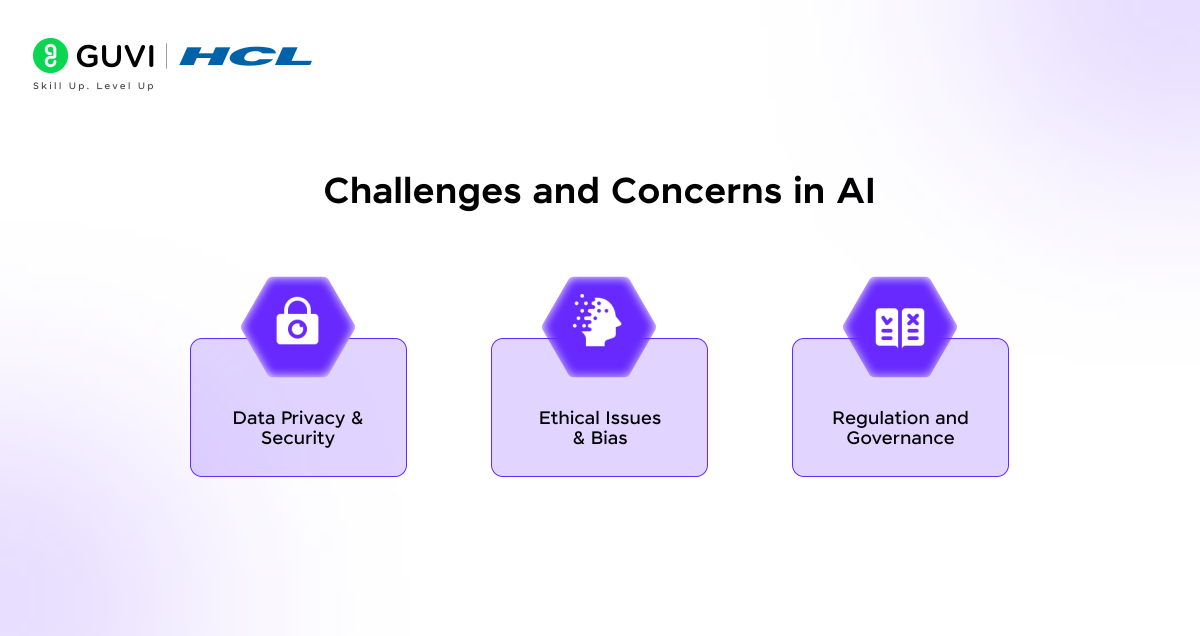
While the scope of AI is vast and exciting, it’s also important to be aware of the challenges and issues that come along with AI’s rise. Like any powerful technology, AI brings certain risks and concerns that society and industry are grappling with:
Data Privacy & Security
A recent study noted that 60% of Indian companies cite data privacy as their top concern in AI adoption. High-profile cases of data breaches or misuse (like the Facebook-Cambridge Analytica scandal globally) have put a spotlight on this challenge.
Ethical Issues & Bias
AI algorithms are created by humans and learn from historical data, which means they can inadvertently pick up human biases. There have been cases where AI systems showed bias in hiring (favoring certain genders or backgrounds) or in criminal justice (misjudging risk scores for offenders), because the training data reflected past prejudices.
This is a serious concern: if AI is used in decision-making for college admissions, loans, or job screening, biased AI could discriminate unfairly.
Regulation and Governance
AI is advancing faster than laws and guidelines can keep up. There’s a challenge in regulating AI without stifling innovation. Issues like autonomous vehicles (who is liable if a self-driving car crashes?), autonomous weapons, deepfakes (AI-generated fake videos), and privacy need frameworks and laws.
Different countries are approaching this differently – the EU, for example, is working on comprehensive AI regulation. In India, the government has been relatively proactive: NITI Aayog and MeitY have released papers on AI ethics, and there’s talk of an upcoming AI law or guidelines.
Future Outlook of AI
Given the rapid progress in AI so far, what does the future hold? Simply put, we can expect AI to become even more pervasive, powerful, and perhaps more normalized in society. Here are some trends and thoughts on the future scope of AI:
- Generative AI and Creativity: One of the hottest developments recently is generative AI – AI that can create new content.
- AI + Other Emerging Tech (5G, IoT, Robotics): AI will increasingly converge with other technologies. For example, the rollout of 5G networks (which offer very high speed and low latency) will empower AI applications that require real-time responsiveness or handle massive data in real time.
- AI in Science and Research: AI is increasingly becoming a tool for scientific discovery. It’s being used to simulate complex physics, discover new materials, and even in pharmaceutical research (as seen during the COVID-19 pandemic, where AI helped in drug repurposing and vaccine research).
- Responsible AI and Regulation: We touched on the challenges of ethics and regulation – in the future, we can expect more concrete frameworks to govern AI.
- Collaboration Between Humans and AI: Rather than AI replacing humans, the emerging consensus is that the most effective setups will be human-AI collaboration.
It’s exciting to think about these possibilities, but important to remain grounded.
Quick Quiz: Test Your AI Knowledge
Ready to check what you’ve learned? Try answering these questions:
- Who coined the term “Artificial Intelligence”?
a. Alan Turing
b. John McCarthy
c. Elon Musk
d. Isaac Asimov - Which of the following is an example of AI you likely use in everyday life?
a. Voice assistants like Siri or Alexa
b. Movie/TV show recommendations on streaming platforms
c. Customer service chatbots on websites
d. All of the above - AI is currently being used in which sectors?
a. Healthcare
b. Finance
c. Education
d. All of the above
Answer Key: 1. b) John McCarthy; 2. d) All of the above (these are all AI-driven applications); 3. d) All of the above (AI has applications in all the listed sectors and more!).
If you’re serious about mastering artificial intelligence and want to apply it in real-world scenarios, don’t miss the chance to enroll in HCL GUVI’s Intel & IITM Pravartak Certified Artificial Intelligence & Machine Learning course. Endorsed with Intel certification, this course adds a globally recognized credential to your resume, a powerful edge that sets you apart in the competitive AI job market.
Conclusion
In conclusion, artificial Intelligence is a transformative force of our time – its scope is vast and ever-expanding. We started by defining what AI is, and we saw that it’s essentially about machines doing things that only minds could do.
Remember that AI is a tool for humanity. The goal is not to create technology for its own sake, but to improve lives and society. With the right mindset and ethics, you can be part of shaping an AI-driven future that is innovative, equitable, and inclusive. The journey is just beginning, and you have the chance to contribute to this exciting narrative.
FAQs
1. What is the scope of artificial intelligence in the future?
The future scope of AI is massive. It’s expected to impact every industry—from healthcare and education to finance, agriculture, and entertainment. As AI continues to evolve, it will create new job roles, automate repetitive tasks, and improve how we make decisions and interact with technology.
2. Is artificial intelligence a good career in India?
Yes, AI is one of the most promising career paths in India right now. With government initiatives, startup growth, and rising demand across sectors, there’s a strong need for AI professionals. Entry-level salaries are higher than average, and companies are actively investing in AI talent.
3. What are the main applications of AI today?
AI is used in many real-world applications like voice assistants (Siri, Alexa), recommendation engines (Netflix, Amazon), medical diagnosis, fraud detection in banking, chatbots for customer service, and even precision farming in agriculture.
4. What qualifications do I need for a career in AI?
To start a career in AI, you typically need a background in computer science, engineering, or mathematics. Skills in programming (especially Python), data analysis, statistics, and machine learning are essential. Online courses and certifications can also help beginners build strong foundations.
5. What are the challenges of adopting AI in India?
Some key challenges include lack of skilled professionals, limited digital infrastructure in rural areas, ethical concerns around data privacy and bias, and the need for clear regulations. However, ongoing initiatives aim to address these and make AI more inclusive and accessible.
Success Stories

About the Author
Lukesh S
A professional content writer who has experience in freelancing and now working as a Technical Content Writer at HCL GUVI having sound knowledge in Blog Writing and Creative Writing!
View all posts by Lukesh S
Connect with me @














Did you enjoy this article?