


Salesforce Articles
Top Salesforce Jobs in 2026: High‑Paying Roles & Career Growth
Comprehensive Guide to Salesforce Certifications in 2026
Best Salesforce Courses for Beginners & Professionals in 2026: Your Complete Learning Guide
Top 10 Salesforce Projects for Beginners in 2026 [With Source Code]


Get In Touch For Details! Request More Information

Salesforce Developer Resume: The Ultimate Guide to Get Hired Faster
Mar 11, 2026 5 Min Read 2698 Views
(Last Updated)
What if your resume could open doors at every top employer on your list? Crafting a compelling Salesforce developer resume is the first critical step to turning that possibility into reality. In this comprehensive Salesforce developer resume guide, you’ll learn how to present your skills and achievements in a format that hiring managers and applicant‐tracking systems both respect. Keep reading to convert your credentials into interview invitations.
Table of contents
- Who is a Salesforce Developer?
- Why Is a Solid Salesforce Developer Resume Important?
- Key Components of an Effective Salesforce Developer Resume
- Education and Ongoing Training
- Writing Your Salesforce Developer Resume: Best Practices
- Top Mistakes to Avoid on Your Salesforce Developer Resume
- Optimizing Your Salesforce Developer Resume for ATS and Recruiters
- Sample Salesforce Developer Resume Example
- Preparing for Your Salesforce Developer Resume Next Step: Interview Preparation
- Common Salesforce Developer Interview Topics
- Projects and Code Samples to Keep Handy
- Practice Whiteboarding
- Sharpen Behavioral Responses
- Conclusion
- FAQs
Who is a Salesforce Developer?

A Salesforce Developer specializes in building and extending the Salesforce platform to meet unique business requirements. Beyond pure coding, they collaborate with admins and stakeholders to gather requirements and perform system testing. They also debug complex issues by analyzing logs and implementing exception handling. Plus, they enforce security through sharing rules and field‑level access controls.
Why Is a Solid Salesforce Developer Resume Important?
Demand for certified Salesforce talent continues to rise as organizations seek to harness Salesforce for sales, service, marketing, and beyond. A well‑crafted Salesforce developer resume example:
- Demonstrates your mastery of core platform capabilities, from Apex and LWC to declarative automation and integration patterns.
- Highlights real‑world impact through quantifiable results, showing how you improved processes or increased user adoption.
- Signals’ dedication to continuous learning via certifications and Trailhead Superbadges further proving you stay current with three annual platform releases.
- Ensures you pass automated screening by including the right terms in the right places without overwhelming the reader.
- Builds credibility with recruiters who see clear evidence of hands‑on experience rather than generic statements.
When hiring managers sift through hundreds of applications, a Salesforce developer resume that balances clarity and relevance stands out. It positions you as a confident expert who can deliver immediate value.
Want a Job-Ready Resume? Start Our Salesforce Course and Get Certified! Gain hands-on skills that employers look for and earn a certificate to showcase on your resume.
Key Components of an Effective Salesforce Developer Resume
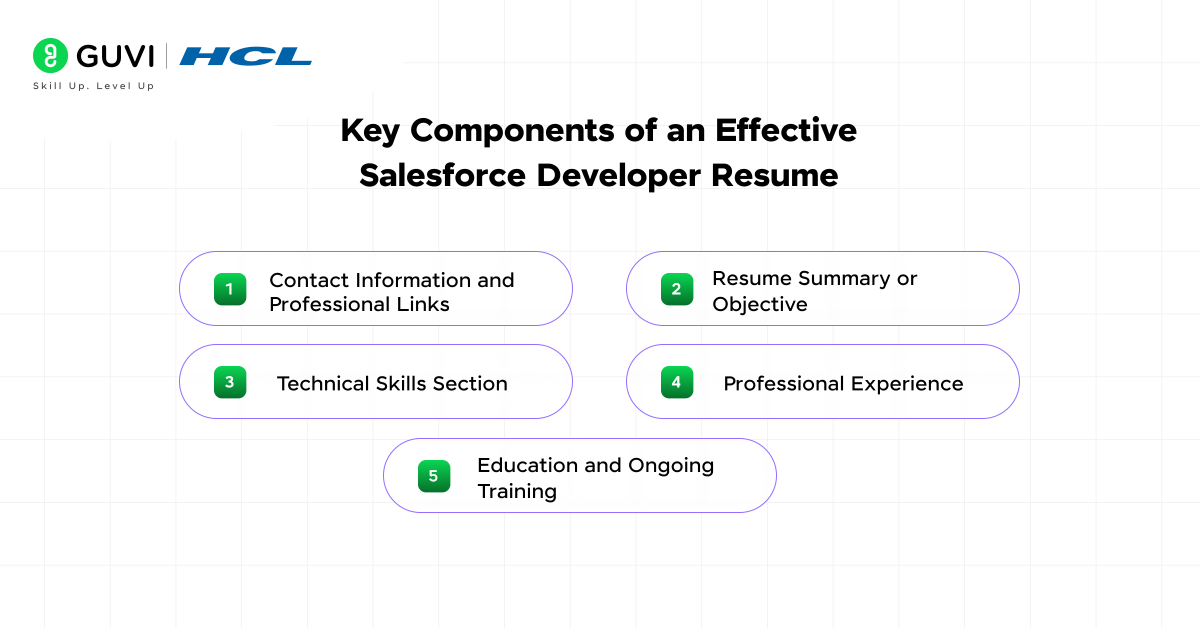
- Contact Information and Professional Links
- Full Name in a prominent position
- Professional Email Address that uses your name rather than nicknames
- Phone Number formatted for easy international dialing (e.g., +1 123‑456‑7890)
- LinkedIn Profile link with a custom URL and an up‑to‑date headline
- GitHub or Personal Portfolio showcasing code samples, Trailhead projects or open‑source contributions
- Optional: Personal website or blog with articles on Salesforce topics
Including professional links demonstrates transparency and allows hiring teams to verify your skills quickly.
- Resume Summary or Objective
Craft two or three sentences that:
- Position yourself as a Salesforce specialist (e.g., “Experienced Apex developer with a track record of delivering scalable integrations”).
- Reference top skills such as LWC, CI/CD pipelines, and governor‑limit optimization.
- Mention key certifications or achievements (for example, “Platform Developer I certified, completed 20+ Trailhead Superbadges”).
Avoid generic phrases such as “hardworking professional” and instead lead with your unique value proposition.
- Technical Skills Section
Organize skills by category and keep the list scannable:
- Salesforce Languages & Frameworks: Apex, Visualforce, Lightning Web Components, Aura
- Data Access & Query: SOQL, SOSL, Bulk API, Data Loader
- Integration: REST API, SOAP API, Named Credentials, External Services, MuleSoft basics
- DevOps & Tools: Salesforce CLI, Git, Jenkins/CircleCI, VS Code, GitHub Actions
- Testing & Quality: Apex test classes, PMD, ESLint for LWC, code coverage metrics
- Certifications & Badges: Salesforce Certified Platform Developer I, Certified Administrator, Trailhead Superbadges (e.g., Security Specialist, Integration Patterns)
Highlight both technical and tool‑related proficiencies to show you can work across the full lifecycle of a Salesforce implementation.
Take your development career to the next level! Master REST API fundamentals, authentication, and real-world integrations in our hands-on course. Join now and get certified!
- Professional Experience
For each role, include:
- Job Title, Company & Dates
- Context: Brief description of the business or team
- Key Achievements: Bullet points emphasizing impact and specific Salesforce features
Example:
Senior Salesforce Developer, Acme Solutions (2021 – Present)
- Led development of a custom LWC dashboard that cut report generation time by 60 percent and increased user adoption by 25 percent.
- Architected Apex schedulable classes and batch jobs to process over 3 million records nightly with 99.9 percent data accuracy.
- Established an automated CI/CD pipeline using GitHub Actions and Salesforce CLI, reducing manual deployment errors by 80 percent.
- Mentored a team of four junior developers, introducing coding standards that improved code quality metrics by 40 percent.

5. Education and Ongoing Training
- Degree and institution (e.g., BSc in Computer Science, State University, 2018)
- Relevant Coursework: Database systems, software engineering or cloud architecture
- Salesforce Certifications (include dates)
- Trailhead Superbadges: List your most advanced badges to demonstrate continuous learning
- Workshops or Conferences: Salesforce World Tour, Dreamforce participation
If you want to build your resume in minutes and also check the ATS score for it, then use HCL GUVI’s Free Resume Builder Tool – Create and Check ATS Score For Free
Writing Your Salesforce Developer Resume: Best Practices
- Customize for Each Job Description
Tailor your summary and experience bullets to echo the exact technologies and responsibilities listed in the posting. If the role emphasizes integration expertise, lead with your most complex API project.
- Showcase Metrics and Achievements
Numbers offer concrete proof of success. Replace vague language like “improved processes” with specifics: “reduced manual approval steps by 50 percent, saving 20 hours of admin work weekly.”
- Keep Format Simple, Clean, and ATS‑Friendly
- Choose a standard, legible font such as Calibri or Arial at 10 – 12 pt.
- Use H2 for major sections and H3 for subsections.
- Employ bullet points rather than paragraphs for clarity.
- Avoid tables or complex layouts that may confuse ATS parsers.
- Highlight Hands‑On Experience with Salesforce Projects and Tools
Include a “Projects” subsection if you have significant personal or volunteer work. Provide links to live demos or GitHub repos and describe your contributions, technology stack, and impact.
Top Mistakes to Avoid on Your Salesforce Developer Resume

- Generic Objectives: Skip bland career goals and start with a powerful summary tailored to the role.
- Keyword Stuffing: Striking the right balance is key; overuse leads to a robotic impression, while underuse may cause ATS rejections.
- One‑Size‑Fits‑All: Submitting the same resume for every position overlooks unique role requirements.
- Omitting Maintenance: Listing certifications without noting your completion of release‑specific Trailhead modules signals stale knowledge.
- Irrelevant Technologies: Focus on Salesforce and closely related tools; remove outdated or unrelated software from your skill list.
Optimizing Your Salesforce Developer Resume for ATS and Recruiters
- Use of Salesforce‑Related Job Title Variations: Include “Salesforce Developer,” “Apex Engineer,” and “Force.com Developer” within context.
- Ensure Compatibility: Save as PDF or Word (.docx) to guarantee formatting remains intact.
- Use Bullet Points and Consistent Headings: Break down responsibilities and achievements into concise, impactful statements.
- Apply Clear Section Labels: Experience, Technical Skills, Certifications, Education.
Sample Salesforce Developer Resume Example
Jane Doe
[email protected] | +1 123‑456‑7890
LinkedIn: linkedin.com/in/janedoe | GitHub: github.com/janedoe
Summary
Certified Platform Developer I with 5 years of experience architecting custom Salesforce solutions. Expert in Apex batch processing, Lightning Web Components, and CI/CD pipelines, achieving a 50 percent faster deployment cycle.
Technical Skills
- Apex, LWC, Visualforce
- SOQL/SOSL, Bulk API, Data Loader
- REST/SOAP integrations, Named Credentials
- Salesforce CLI, Git, Jenkins, VS Code
- PMD, ESLint, Apex test frameworks
- Superbadges: Advanced Apex Specialist, Integration Architecture
Certifications
- Salesforce Certified Platform Developer I (2024)
- Salesforce Certified Administrator (2023)
- Trailhead Ranger (500 points)
Experience
Senior Salesforce Developer, Acme Solutions (2021 – Present)
- Designed a custom LWC CRM dashboard that cut report generation time by 60 percent and increased sales team productivity by 20 percent.
- Wrote Apex schedulable classes and batch jobs to process 3 million records nightly, achieving 99.9 percent data accuracy.
- Established a GitHub Actions CI/CD pipeline, reducing manual deployment steps from 12 to 2 and cutting release errors by 80 percent.
- Mentored junior developers and led code reviews, improving overall code coverage from 60 percent to 90 percent.
Salesforce Developer, Beta Technologies (2019 – 2021)
- Integrated Salesforce with a legacy ERP via REST API, syncing customer and order data every 15 minutes with error‑handling mechanisms.
- Built custom approval processes, validation rules, and flows that improved data quality and compliance across three business units.
- Developed Experience Cloud community portals, increasing partner self‑registration by 35 percent.
Education
BSc Computer Science, State University (2018)
If you want to build your resume in minutes and also check the ATS score for it, then use HCL GUVI’s Free Resume Builder Tool – Create and Check ATS Score For Free
Preparing for Your Salesforce Developer Resume Next Step: Interview Preparation
Common Salesforce Developer Interview Topics
- Apex design patterns and governor‑limit best practices
- Lightning Web Components architecture and performance optimization
- Integration strategies, authentication mechanisms, and error‑handling patterns
Projects and Code Samples to Keep Handy
- Keep clean, well‑documented code in a public GitHub repository
- Highlight projects where you solved real business problems
Practice Whiteboarding
- Explain data models and object relationships visually
- Sketch integration flows between Salesforce and external systems
Sharpen Behavioral Responses
- Recall examples of troubleshooting in production
- Share stories of collaborating with admins, testers, and business stakeholders
- Emphasize how you learned from failures and improved processes
Conclusion
A standout Salesforce developer resume showcases your technical understanding and real‑world impact in a concise package. This Salesforce developer resume guide provides the structure and examples you need to pass ATS filters and convince hiring managers of your readiness. Use these Salesforce developer resume tips. Sincerely, follow the Salesforce developer resume template structure and refine your content with concrete metrics. With a polished resume in hand, you’ll accelerate your path to interviews and job offers. Start crafting yours today.
FAQs
1. What Should Be Included in a Salesforce Developer Resume?
Summary, technical skills, certifications, detailed project achievements and education.
2. How Do I Make My Salesforce Resume Stand Out?
Quantify your impact and list recent Trailhead Superbadges.
3. Do I Need Salesforce Certification on My Resume?
Yes, certifications validate your expertise and often form a baseline requirement.
4. What Keywords Should I Include?
Use terms like Apex, Lightning Web Components, SOQL, CI/CD, governor limits and job titles such as “Salesforce Developer.”
5. Should I Mention Trailhead?
Absolutely. Listing Superbadges demonstrates hands-on expertise and commitment to continuous learning.
6. How Long Should a Salesforce Developer Resume Be?
One to two pages focusing on the last five to seven years of experience.
7. Can I Use a Resume Builder?
Yes, but ensure the result remains simple, ATS‑friendly, and free of complex formatting.
8. How Do I Highlight Project Experience Without Formal Work History?
Include volunteer or personal projects, open‑source contributions, and Trailhead challenge solutions, specifying your role and impact.
Success Stories

About the Author
Vaishali
I'm a seasoned writer with four years of experience across technical, non-technical, and just about every genre or niche you can imagine. Adaptable and curious, I enjoy exploring new topics and making information engaging and easy to understand. Fueled by a steady stream of tea, I approach each project with creativity, reliability, and genuine enthusiasm for storytelling.
View all posts by Vaishali
Connect with me @










Did you enjoy this article?