


Artificial Intelligence and Machine Learning Articles
AI/ML Skills Gap 2026: Why Companies Can't Find Job-Ready Talent
20 AI/ML Interview Questions Recruiters Can Use Without a Tech Background - Best Guide
How Industry-Backed AI/ML Bootcamps Are Changing the AI/ML Hiring Pipeline - Best Guide 2026
From IT Support to AI Engineer: A Realistic Career Switch Guide 2026


Get In Touch For Details! Request More Information
Model-Based Reflex Agent: Making Smarter Decisions with Memory
Jun 05, 2026 6 Min Read 669 Views
(Last Updated)
AI systems are no longer meant to just react to their environment, as they’re increasingly needed to understand changing worlds, context, and incomplete information.
This is where the Model-Based Reflex Agent comes into play. It’s an agent architecture that allows for machines to maintain an internal notion of the world as opposed to purely rule-based machines.
From self-driving cars, AI copilots to robotic arms and modern agentic AI systems, these are the core building blocks of today’s AI.
In this guide, let’s explore how model-based reflex agents use memory and environmental understanding to make smarter decisions.
Table of contents
- TL;DR
- Understanding AI Agents
- Why do traditional reflex agents fail?
- What makes a Model-Based Reflex Agent different?
- Core Components of a Model-Based Reflex Agent
- Sensors
- Internal State
- World Model
- Condition-Action Rules
- Actuators
- How is the internal state of an AI agent maintained?
- Understanding Partially Observable Environments
- How does an AI agent make its decision?
- Example of a Model-Based Reflex Agent in the real world
- Simple Model-Based Agent in Python
- Model-Based Reflex Agent Advantages
- Better decision-making
- Increased adaptability
- Increased reliability
- Higher efficacy in complex environments
- Scalability in the real world
- Model-Based Reflex Agent Challenges
- Greater computational complexity
- The difficulty of environment modeling
- Higher engineering cost
- Memory management
- Model-Based Reflex Agent Applications
- Autonomous vehicles
- Robotics
- AI Assistants
- Healthcare Monitoring Systems
- Smart Manufacturing
- Drone navigation systems
- Model-Based Reflex Agent vs. Simple Reflex Agent
- Conclusion
- FAQs
- What is a Model-Based Reflex Agent?
- Why is the internal state important in AI agents?
- What is a partially observable environment?
- Where are Model-Based Reflex Agents used?
- How is a Model-Based Reflex Agent different from a simple reflex agent?
- Why are Model-Based Reflex Agents important in modern AI?
TL;DR
- A Model-Based Reflex Agent is an AI system that can intelligently determine what action to take by utilizing its internal state and model of the environment.
- Instead of only relying on sensor data, these agents use memory and past experiences to form conclusions about what’s happening around them.
- These are utilized by robots, autonomous vehicles, AI assistants, and modern agentic AI systems.
- These agents are the combination of sensors, condition-action rules, internal memory, and a model of the world, all of which work together to help an AI learn what to do.
- Model-based architectures are becoming essential in modern AI because intelligent systems must now operate in dynamic, unpredictable, and partially observable environments.
What is a Model-Based Reflex Agent?
A Model-Based Reflex Agent is an AI system that maintains an internal model of its environment to make more informed decisions. Unlike simple reflex agents that react only to current sensory input, a model-based reflex agent uses past experiences and knowledge about how the environment changes over time to update its internal state continuously. This allows the agent to operate effectively in dynamic and partially observable environments where all information may not be immediately available.
Understanding AI Agents

An AI agent is a system that perceives its environment and can independently take actions in order to achieve a certain goal.
An agent takes the perceptions that it gets from sensors, applies internal logic to process the information, and then acts through actuators or actions. Simple AI agents only have a single function of acting based on what is directly perceived, while advanced AI agents have memory and can reason about what is going on in their environments.
As today’s environment is a dynamic state, artificial intelligence agents are necessary as the software used before was not able to handle such issues.
To understand where model-based reflex agents fit within the broader AI ecosystem, it’s helpful to explore the different types of AI agents and how they operate in various environments.
Why do traditional reflex agents fail?
A simple reflex agent works off a simple condition-action rule. If the environment meets certain conditions, it will take a specified action. This might be very effective in controlled environments, but it is a very weak approach for the unpredictable real world.
For instance, imagine a delivery robot in a busy street. The simple reflex agent will act based on what it currently perceives; however, this robot might miss moving pedestrians, upcoming vehicles, and obstructed paths.
The failure becomes much more apparent when trying to control a partially observable environment.
What makes a Model-Based Reflex Agent different?

The one major differentiator is the addition of memory.
A Model-Based Reflex Agent will always have stored data about the world in a sequence that it is constantly updating. By having the capacity to observe and build an understanding of how the environment is likely to be in the future, it is able to deal with problems in an efficient way.
These agents can:
- Track the evolution of the environment.
- Make predictions of future states of the environment.
- Cope with the absence of necessary data.
- Achieve more context-aware decisions.
- Improve consistency over time.
Core Components of a Model-Based Reflex Agent
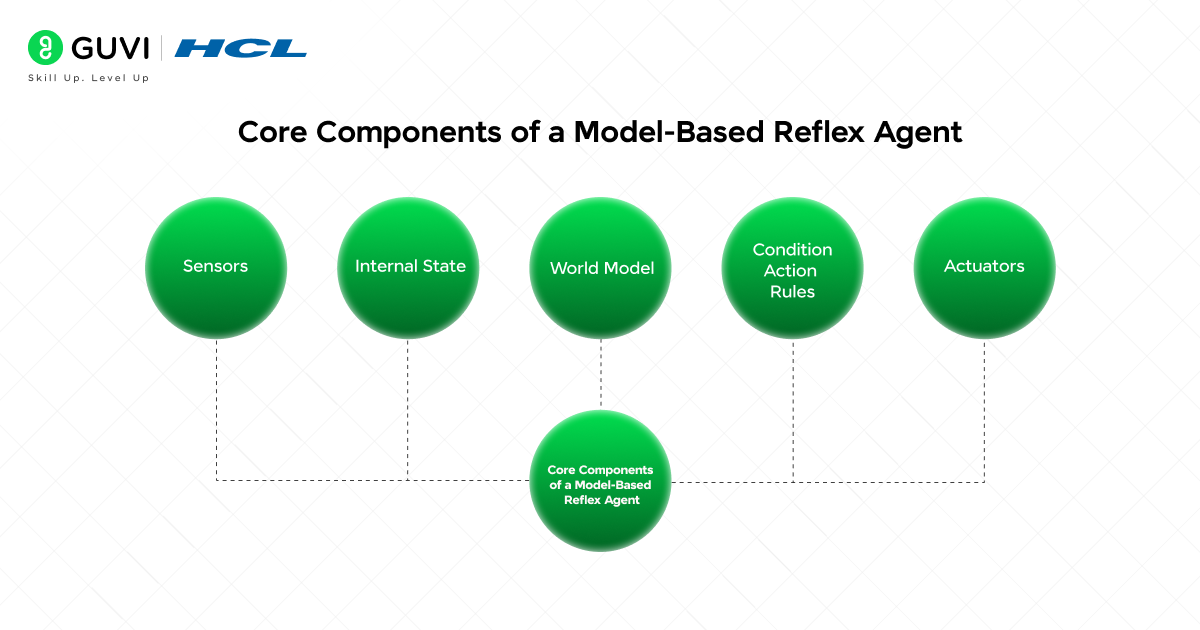
These are the four components of a model-based reflex agent:
1. Sensors
The purpose of a sensor is to detect current stimuli from the environment. Some of the key sensors used in real-world AI agents are cameras, microphones, GPS systems, and motion sensors.
2. Internal State
This is what stores the perception of the environment based on the previous and current data received from the sensors. This component can be viewed as the memory of the agent.
3. World Model
The world model helps predict the behavior of the environment and the implications of each action taken on the environment. In essence, it allows the agent to determine how to proceed even without direct perceptions of it.
4. Condition-Action Rules
The agent must have conditions that allow it to take an action depending on what the perceived environment state is. In the model-based system, these are determined on the basis of previous and current states as opposed to just the current perceived state, like that of the simple reflex agent.
5. Actuators
These are devices that allow the agent to act on the environment. Examples of actuators in robotics include the arms of robotic arms that move an object, and, in self-driving cars, braking mechanisms are also considered actuators.
If you want to explore how memory, perception, reasoning, and decision-making work together in intelligent systems, understanding AI agent architecture provides a deeper foundation.
How is the internal state of an AI agent maintained?
The internal state of an AI agent is one of its most important features.
Without a continuously maintained state, the agent becomes more like a memoryless machine that may end up having the same result even if it takes two different pathways to get there.
For instance, a warehouse robot traveling along a path will recognize a path as blocked when it meets an obstacle. If it passes this blocked path at another time but without seeing an obstacle, it may attempt to travel down that pathway, even if the obstacle remains in place.
The internal state ensures the agent remembers where that blocked path is and takes measures accordingly, even if there is no obstacle in its direct view.
Understanding Partially Observable Environments
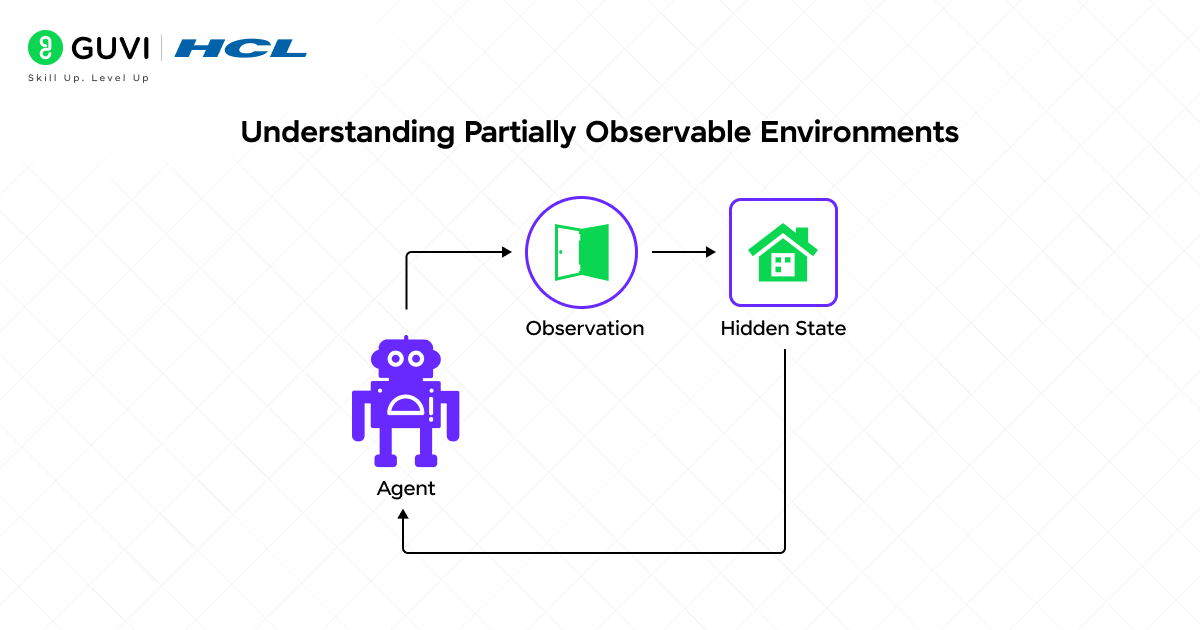
A partially observable environment is when an AI agent has to operate without complete information about the environment.
Real-world AI agents deal with partial observability more often than not, and so understanding it is a vital concept in agent design.
Examples are:
- Autonomous driving during heavy traffic or fog.
- AI trading algorithms and incomplete market signals.
- Human command interpretation with limited information.
- Navigation within confined or unknown environments.
- Robots functioning in unpredictable weather conditions.
Model-based reflex agents have the ideal architecture for these scenarios.
How does an AI agent make its decision?
The entire process is essentially a continuous loop:
- Observe: Collect data from the surrounding environment.
- Update: Integrate new data into its existing model and knowledge base.
- Act: Based on the current model and conditions, decide the most effective action to take.
- Execute: Implement the chosen action.
This cycle constantly repeats, enabling the agent to adapt to its environment in real time.
Example of a Model-Based Reflex Agent in the real world
Let’s consider an automated airport cleaner. There is constant movement and changes in the environment. Busy airports have crowds, luggage moving around, and makeshift barriers being put in place.

A simple reflex agent would become confused as its actions and decisions would only be based on rapidly changing information.
On the other hand, a model-based reflex agent will store information about obstacles and previously cleaned zones; it will even predict movements of busy commuters, allowing it to navigate safely and efficiently through the airport terminal.
Simple Model-Based Agent in Python
The following is a simple illustration of a model-based agent that remembers a state.
Class ModelBasedAgent:
def init(self):
self.internal_state = {
“obstacle_detected”: False
}
def updatestate(self, sensorinput):
if sensor_input == “obstacle”:
self.internalstate[“obstacledetected”] = True
else:
self.internalstate[“obstacledetected”] = False
def act(self):
if self.internalstate[“obstacledetected”]:
return “Turn Left”
return “Move Forward”
agent = ModelBasedAgent()
agent.update_state(“obstacle”)
print(agent.act())
This example is simple, but it demonstrates the core idea behind model-based architectures. The agent updates its memory before selecting an action. After understanding the basics of model-based agents, you can start building more advanced AI agents using modern frameworks like LangChain.
If you want to understand AI agent architectures, reinforcement learning, and intelligent automation systems in depth, explore ebooks focused on modern AI agent design and autonomous systems engineering.
Enterprise AI systems in 2025 and 2026 increasingly adopted model-based reflex agents with persistent memory, allowing AI systems to maintain context across long workflows instead of treating every interaction as completely independent. Unlike traditional stateless assistants, these agents can remember previous actions, user preferences, intermediate decisions, and workflow history over time, enabling more reliable automation for tasks such as customer support, software development, research assistance, and business operations. This shift toward persistent contextual reasoning became a major step in making AI systems behave more like long-running collaborators rather than isolated chat interfaces.
Model-Based Reflex Agent Advantages
Model-based reflex agents represent a major improvement over traditional reactive agent architectures.
1. Better decision-making
The agent understands context as opposed to simple reactive behavior.
2. Increased adaptability
The model allows the agent to adjust to environmental changes in real time.
3. Increased reliability
The memory-based reasoning of the agent prevents it from making the same mistakes multiple times.
4. Higher efficacy in complex environments
Model-based reflex agents perform at a high level even with partial observability of their environment.
5. Scalability in the real world
Model-based reflex agents are highly applicable to enterprise systems, automation, and robotic contexts.
Model-Based Reflex Agent Challenges
1. Greater computational complexity
Maintaining an internal world model requires much more processing power compared to the simple reflex agent.
2. The difficulty of environment modeling
It is incredibly difficult to build an accurate world model in practice.
3. Higher engineering cost
This type of agent architecture is more difficult to develop.
4. Memory management
Scaling this architecture for an entire system of agent tasks involves the difficulty of tracking potentially infinite state in a world model.
These drawbacks are exacerbated as environments become more unpredictable.
Model-Based Reflex Agent Applications
Model-based reflex agents are now being widely applied in industry and research:
1. Autonomous vehicles
Self-driving systems create detailed world models and use the model to predict the movements of other cars.
2. Robotics
An industrial robot may create and maintain an internal map of the working environment in order to adjust to dynamic changes, such as the placement of a tool or a human worker.
3. AI Assistants
AI copilots use conversation memory across different exchanges with users.
4. Healthcare Monitoring Systems
AI systems are designed to maintain an understanding of patient vital signs rather than just responding to a particular data point.
5. Smart Manufacturing
Intelligent agents within a smart factory maintain information regarding machine health and workflow performance to optimize manufacturing processes.
6. Drone navigation systems
The AI model maintains a representation of the environment as it flies.
Modern AI agent frameworks are making it easier for developers to build scalable systems that combine memory, reasoning, workflows, and autonomous decision-making.
Model-Based Reflex Agent vs. Simple Reflex Agent
A simple reflex agent:
- Responds solely to current sensory inputs.
- Relies on hand-coded rules.
- Does not maintain an internal state.
A model-based reflex agent:
- Reacts to the current percept but takes into account the agent’s internal knowledge of the world.
- Uses the world model to determine what the agent should do based on the current percept.
- Maintains internal memory/state about the environment.
Simple reflex agents are generally faster and simpler to develop, but do not work well in complex environments. To better understand how intelligent systems are designed and classified, explore agents in artificial intelligence. Model-based reflex agents offer more intelligent behavior due to context awareness and world knowledge.
If you want to build practical expertise in AI systems, intelligent agents, machine learning, and modern automation workflows, explore HCL GUVI’s AI & Machine Learning Course designed for beginners and working professionals.
Conclusion
The Model-Based Reflex Agent represents one of the most important evolutions in artificial intelligence architecture.
Instead of reacting only to isolated inputs, these agents maintain memory, track environmental changes, and make context-aware decisions. This enables AI systems to operate more effectively in dynamic and partially observable environments.
As AI moves toward autonomous workflows and agentic intelligence, model-based architectures will continue playing a major role in shaping the future of intelligent systems.
FAQs
1. What is a Model-Based Reflex Agent?
A Model-Based Reflex Agent is an AI agent that maintains an internal state and uses a world model to make decisions based on both current and past observations.
2. Why is the internal state important in AI agents?
Internal state allows the agent to remember previous observations and make context-aware decisions instead of reacting only to immediate inputs.
3. What is a partially observable environment?
A partially observable environment is a situation where the AI agent cannot access complete information about the environment at all times.
4. Where are Model-Based Reflex Agents used?
They are used in robotics, autonomous vehicles, AI assistants, healthcare systems, smart factories, and drone navigation systems.
5. How is a Model-Based Reflex Agent different from a simple reflex agent?
A simple reflex agent reacts only to current input, while a model-based reflex agent also uses memory and environmental understanding.
6. Why are Model-Based Reflex Agents important in modern AI?
They enable context-aware reasoning, persistent memory, adaptive behavior, and autonomous decision-making required in modern AI systems.
Success Stories

About the Author
Vishalini Devarajan
An Aerospace Engineer turned content writer, I focus on making complex concepts easy to understand through well-structured, reader-friendly blogs. Whether it’s a technical topic or a non-technical one, I love creating content that is clear, engaging, and impactful.
View all posts by Vishalini Devarajan
Connect with me @












Did you enjoy this article?