


Artificial Intelligence and Machine Learning Articles
AI/ML Skills Gap 2026: Why Companies Can't Find Job-Ready Talent
20 AI/ML Interview Questions Recruiters Can Use Without a Tech Background - Best Guide
How Industry-Backed AI/ML Bootcamps Are Changing the AI/ML Hiring Pipeline - Best Guide 2026
From IT Support to AI Engineer: A Realistic Career Switch Guide 2026
Get In Touch For Details! Request More Information
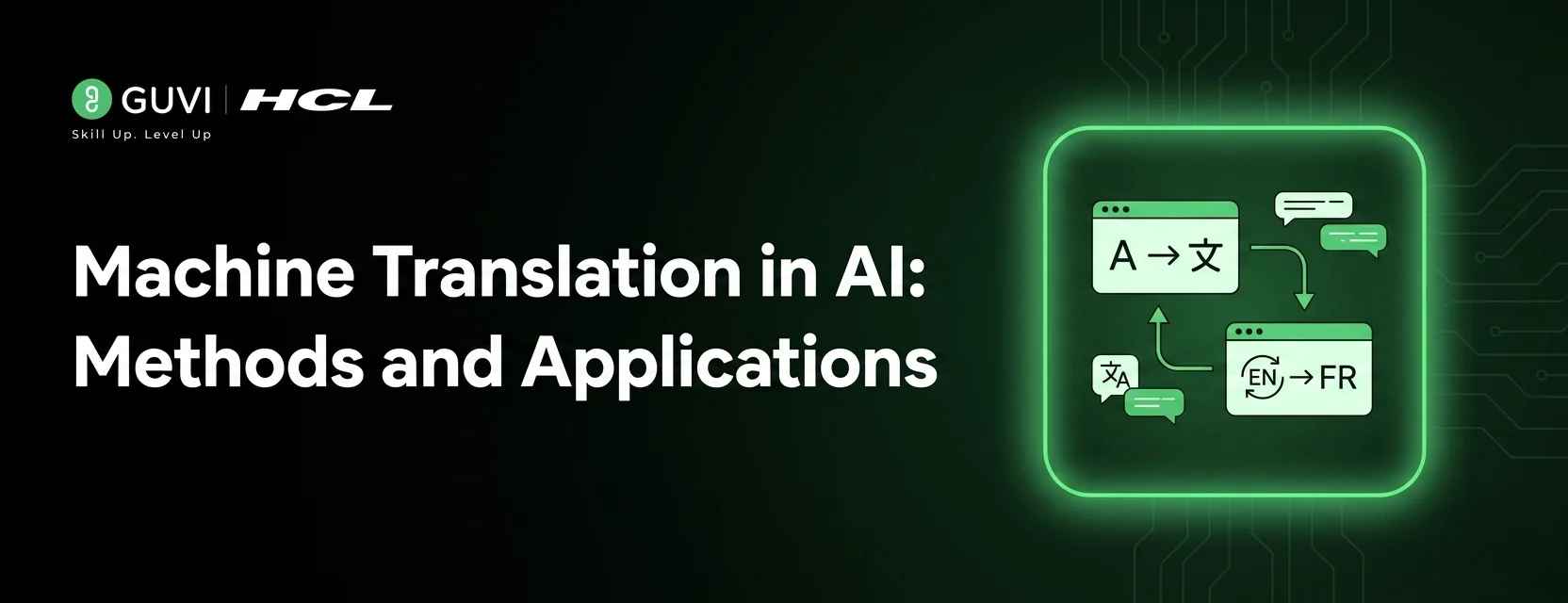
Machine Translation in AI: Methods and Applications
May 04, 2026 4 Min Read 436 Views
(Last Updated)
Have you ever scrolled through social media and seen a post in a language you don’t recognize, but with one click on “See Translation,” you suddenly understand the whole story? Or maybe you’ve pointed your phone camera at a menu in a foreign country and watched the words change instantly.
It feels like a small bit of magic. Behind that “magic” is one of the most powerful branches of Artificial Intelligence: Machine Translation (MT).
For a long time, the language barrier was like a physical wall. Today, thanks to AI-driven Machine Translation, that wall is turning into a bridge. Whether it’s helping a student in Tamil Nadu learn Python from English docs or a doctor treating a patient who speaks a different dialect, MT is changing how we connect.
In this blog, we’ll break down how these systems “think,” how they’ve evolved, and why the human touch remains the most important part of the equation.
TL;DR Summary
- This blog helps you understand what Machine Translation in AI is and how it translates text and speech using AI rather than simple word-for-word conversion.
- It helps you learn the full journey of Machine Translation from Rule-Based and Statistical methods to modern Neural Machine Translation, which improves context and accuracy.
- You can understand where Machine Translation is used in real life, such as education, healthcare, business, software development, and customer support, along with its current limitations.
- The blog also helps beginners get started with Machine Translation using Python, Hugging Face, Transformers, and the OPUS dataset, while explaining why human review is still important.
Warren Weaver helped spark modern Machine Translation in 1949 with his famous memo, and today tools like Google Translate support over 100 languages for billions of users worldwide.
Table of contents
- What Exactly is Machine Translation
- Why is Machine Translation a Game Changer?
- The Evolution: From Rigid Rules to "AI Brains"
- Rule-Based Machine Translation (RBMT)
- Statistical Machine Translation (SMT)
- Neural Machine Translation (NMT)
- My Personal Experience: The "Human" Side of AI
- Real-World Applications of Machine Translation
- The Big Challenges: Why AI Isn't Perfect (Yet)
- How to Get Started with Machine Translation in AI
- Learn Python
- Explore Hugging Face
- Practice with OPUS Dataset
- Use AI Translation Like a Pro
- The Future of Machine Translation in AI
- Conclusion
- FAQs
- Is Machine Translation in AI 100% accurate?
- Which is the best method for translation?
- Will AI replace human translators?
- How can I improve AI for regional languages?
What Exactly is Machine Translation
At its core, Machine Translation is the use of software to automatically translate text or speech from one language to another. It is a key part of Natural Language Processing (NLP), the field of AI that teaches computers to understand and generate human language.
In the past, translation was a slow, manual process requiring human experts for every sentence. While humans are still the “gold standard” for poetry or legal contracts, AI has made translation instant and accessible for everyone.
Instead of acting like a digital dictionary that swaps words—which usually results in nonsense—modern AI attempts to understand the intent and context of a sentence. It looks at the “big picture” of a paragraph to ensure the meaning survives the transition.
Explore our free 5-day AI/ML program and discover how it’s applied in various fields: AI/ML Email Course
Why is Machine Translation a Game Changer?
These are the actual reasons why Machine Translation is a game-changer:
- Democratizing Knowledge:
Most high-quality technical research is authored in English. MT allows students who are comfortable in regional languages to access global knowledge without being left behind.
- Global Business Reach:
A small business in Chennai selling handmade jewellery can now have a website that speaks Spanish or Japanese, reaching customers across oceans.
- Emergency Response:
In healthcare, every second counts. MT allows workers to communicate life-saving information to patients instantly, removing the delay of waiting for a human interpreter.
The Evolution: From Rigid Rules to “AI Brains”
Machine Translation in AI didn’t happen overnight; it moved through three major eras.
1. Rule-Based Machine Translation (RBMT)
In the 1950s, scientists thought language was just a set of mathematical rules. They tried to “program” grammar directly into computers.
- How it worked:
If the computer saw an English sentence, it followed a rigid “map” to rearrange words into the target language.
- The Problem:
Language is messy and full of slang. RBMT was too stiff; it couldn’t handle the “feeling” or “flow” of natural speech.
2. Statistical Machine Translation (SMT)
In the 90s, the strategy shifted to probability. We showed computers millions of examples of human-translated text, like United Nations documents.
- How it worked:
The computer looked for patterns. If “Apple” matched a specific word 99% of the time in the data, it picked that.
- The Problem:
It didn’t actually “understand” the words. This often led to sentences that were grammatically okay but made zero sense in context.
3. Neural Machine Translation (NMT)
This is the modern era of Machine Translation. NMT uses Deep Learning and neural networks designed to process language more closely to how the human brain works.
- The Breakthrough:
Instead of looking at words one by one, NMT looks at the entire sentence at once. It realizes “bank” in “river bank” is different from “investment bank” because it sees the surrounding words.
- The Result:
This is why translations today sound significantly more natural than they did a decade ago.
My Personal Experience: The “Human” Side of AI
I recently worked on a project through the ChennaiPy community, translating Python documentation into Tamil. I initially thought the AI would do almost all the work. I was wrong.
While the AI handled the basic structure, it struggled with technical terms.

In coding, “Execute” means to run a program, but the AI sometimes translates it as “to kill”! This taught me that while AI is a fast worker, it needs a human “editor.”
Especially for students, one small mistranslation can cause massive confusion. This is why “Human-in-the-Loop” is the standard for high-quality translation.
Real-World Applications of Machine Translation
Machine Translation in AI is now embedded in our daily lives:
- Education: Coursera and YouTube use it for instant multilingual subtitles.
- Healthcare: Apps help doctors translate symptoms for patients in rural areas.
- Software Development: Translating GitHub “README” files so global developers can collaborate.
- Customer Support: Real-time chatbots that handle queries in dozens of languages.
The Big Challenges: Why AI Isn’t Perfect (Yet)
Despite the progress, several hurdles remain:
- The “Context” Problem: Words with multiple meanings still confuse AI. Without additional sentences, the AI often just guesses.
- Low-Resource Languages: AI needs data to grow. There is a massive amount of English data online, but far less for regional languages like Tamil or Malayalam. This makes English-to-Spanish translation much smoother than English-to-Tamil.
- Culture & Slang: Language is tied to local culture. A joke or idiom in English might sound nonsensical or even insulting when translated literally.
How to Get Started with Machine Translation in AI
The following are the vital points to get started with Machine Translation in AI:
1. Learn Python
Start by learning Python, as it is the primary programming language used in AI and Machine Translation. It helps you build models, process text, and work with AI tools easily.
2. Explore Hugging Face
Visit Hugging Face, a platform that provides many free pre-trained translation models. You can test different models, understand how they work, and even use them in your own projects.
3. Study Transformers
Learn about Transformers, the technology behind modern Machine Translation. Reading the “Attention is All You Need” paper will help you understand how today’s advanced translation systems work.
4. Practice with OPUS Dataset
Use the OPUS dataset, which contains millions of translated sentences in many languages. This helps you train and test your own translation models with real-world language data.
Use AI Translation Like a Pro
- Back-Translate: Translate your text to the target language, then translate it back to your original language. If the meaning stays consistent, the translation is likely accurate.
- Keep it Simple: AI performs much better with short, direct sentences than long, flowery ones.
- Audit Technical Terms: Always manually verify words with specific technical meanings.
The Future of Machine Translation in AI
The next frontier is Real-Time Speech Translation—wearable earbuds that translate conversations as they happen, like a “Universal Translator” from sci-fi. We are also seeing Multimodal Translation, where the AI uses images to understand context (like seeing a picture of a river to correctly translate “bank”). The goal is to make communication so seamless that the language barrier effectively disappears.
In the future, Machine Translation will become faster, smarter, and more natural. It will help people in travel, business, education, and healthcare by making communication easier across different languages. As AI keeps improving, translations will feel more human and accurate than ever before.
Future-proof your career with HCL GUVI’s Intel & IITM Pravartak Certified AI/ML course. Master Python, SQL, data, automation, and intelligent systems through hands-on projects, real-world learning, expert mentorship, flexible schedules, and dedicated placement support. Build in-demand AI/ML skills and get ready for the tech roles shaping tomorrow.
Conclusion
Machine Translation in AI is a vital tool for making knowledge accessible. From rigid rules to neural “brains,” we have made incredible leaps. However, the human element remains the soul of it all. AI provides the speed, but we provide the nuance. Understanding these systems is the first step toward using them to truly connect with the global community.
FAQs
Is Machine Translation in AI 100% accurate?
Not yet. It excels at general meaning but still struggles with deep context, technical jargon, and culture.
Which is the best method for translation?
Neural Machine Translation (NMT) is currently the best because it understands the context of an entire sentence.
Will AI replace human translators?
For basic manuals, yes. But for creative writing and high-stakes legal work, human expertise is irreplaceable.
How can I improve AI for regional languages?
Contribute to “open datasets.” The more high-quality Tamil or regional text we provide, the more accurately the AI can learn.
Success Stories








Did you enjoy this article?