


Javascript Articles
Arrow Functions in JavaScript: A Complete Guide
What Is Currying in JavaScript?


Get In Touch For Details! Request More Information
From Tutorials To Real Code: Building While You Learn JavaScript
Feb 17, 2026 3 Min Read 550 Views
(Last Updated)
Learning JavaScript has changed over the years. Earlier, learners spent weeks watching tutorials before writing real code. Today, the most effective way to learn JavaScript by building is to write code from day one while understanding how things work.
This blog explores why building projects help you learn JavaScript faster, how learning has evolved, and who this approach is best suited for, particularly beginners and non-technical learners.
Quick Answer
To learn JavaScript effectively, start by building small projects alongside tutorials. By working on simple projects like buttons, forms, and mini apps while learning concepts, you understand JavaScript faster, retain knowledge better, and gain real confidence through hands-on practice.
Do check out – JavaScript tutorials, an all-in-one course to start your JavaScript learning journey.
Table of contents
- How JavaScript Was Traditionally Learned
- Learning JavaScript By Building
- Why Building While Learning Works Better
- Key Skills You Gain When You Build
- Who Should Learn JavaScript This Way
- Projects You Can Build While Learning JavaScript
- Beginner-Level Projects
- Intermediate-Level Projects
- Advanced-Level Projects
- 💡 Did You Know?
- Conclusion
- FAQs
- Can beginners really learn JavaScript by building?
- Is it okay to make mistakes while learning JavaScript?
- How much JavaScript should I know before building projects?
- Does building projects help with jobs?
How JavaScript Was Traditionally Learned
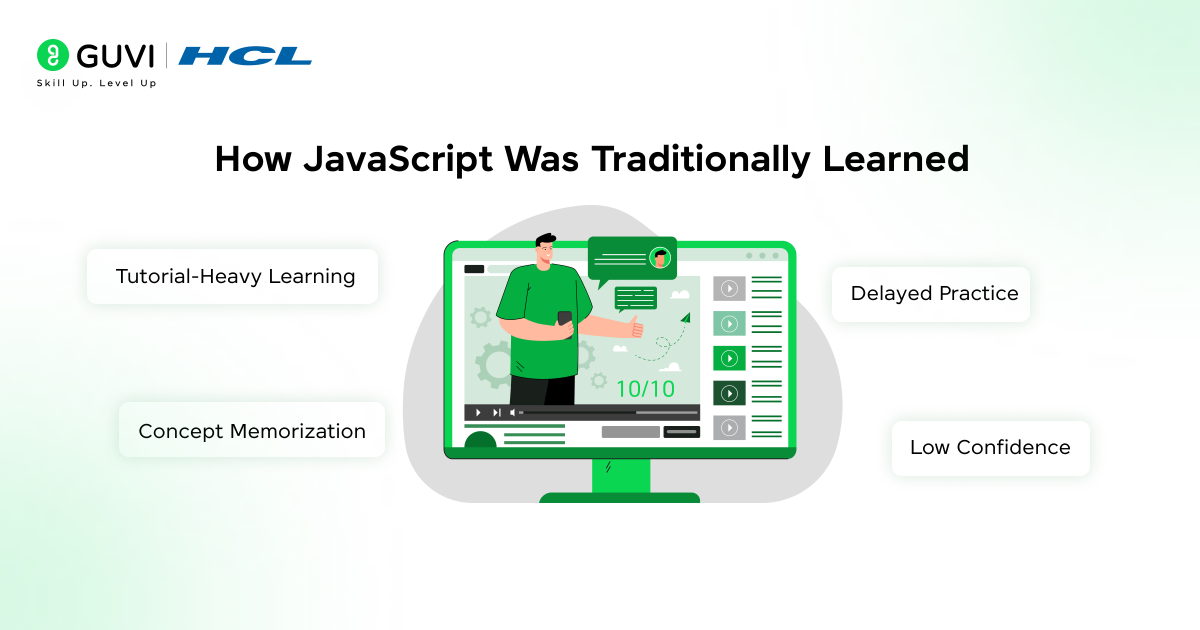
Earlier, most people learned JavaScript by watching long tutorials and reading documentation before writing any real code. While this method explained concepts well, it often left learners confused when trying to build something on their own.
Key aspects of traditional JavaScript learning included:
- Tutorial-Heavy Learning: Spending hours watching videos before practicing.
- Concept Memorization: Remembering syntax without understanding real use cases.
- Delayed Practice: Writing code only after completing lessons.
- Low Confidence: Struggling to build projects independently.
Learning JavaScript By Building
The idea to learn JavaScript by building focuses on practical experience from the start. Instead of waiting to master every concept, learners write code immediately and improve as they go.
This approach involves:
- Hands-On Coding: Writing JavaScript while learning new concepts.
- Small Projects: Building simple features like forms, buttons, and calculators.
- Learning By Errors: Understanding mistakes through debugging.
- Immediate Feedback: Seeing results instantly in the browser.
Do check out – CodeKata, a practice-based platform where you can strengthen your coding skills by solving real problems while learning.
Why Building While Learning Works Better
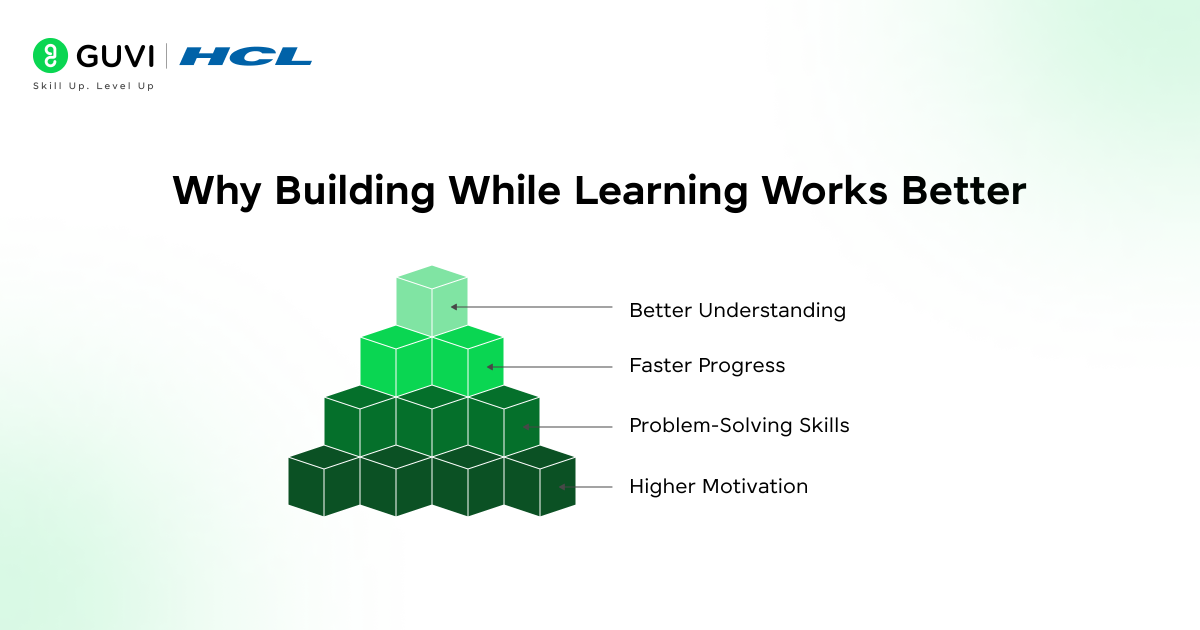
Building projects helps learners connect JavaScript concepts with real outcomes. It turns abstract ideas into visible actions, making learning more engaging and memorable.
Benefits of this method include:
- Better Understanding: Concepts make sense when used practically.
- Faster Progress: Less time spent rewatching tutorials.
- Problem-Solving Skills: Learning how to think like a developer.
- Higher Motivation: Visible progress keeps learners engaged.
The HCL GUVI JavaScript eBook is designed to help learners build strong JavaScript fundamentals through simple explanations and practical examples and it is completely free! It focuses on real-world usage of JavaScript concepts such as logic building, DOM handling, and interactive features, making it ideal for beginners and front-end learners.
Key Skills You Gain When You Build
When you learn JavaScript by building, you develop skills that go beyond syntax. These skills are essential for real-world development and long-term growth.
Important skills gained include:
- Logical Thinking: Breaking problems into smaller steps.
- Debugging Ability: Finding and fixing issues independently.
- Code Confidence: Writing JavaScript without fear.
- Project Readiness: Preparing for real development tasks.

Who Should Learn JavaScript This Way
This learning style is suitable for a wide range of learners. It works especially well for those who want practical results rather than just theoretical knowledge.
This approach is ideal for:
- Beginners: Those starting JavaScript from scratch.
- Non-Technical Learners: People without a coding background.
- Career Switchers: Professionals moving into tech roles.
- Students: Learners aiming to build strong fundamentals.
Projects You Can Build While Learning JavaScript
Building projects alongside learning helps you apply concepts immediately and track your progress clearly. By working on projects at different stages, you can strengthen fundamentals first, then move toward more complex real-world applications.
Check out JavaScript project ideas that help you apply concepts through real-world, hands-on practice.
1. Beginner-Level Projects
These projects focus on understanding JavaScript basics like variables, conditions, and events.
- Interactive Buttons: Uses event listeners, functions, and basic DOM manipulation.
- Simple Calculator: Uses variables, operators, conditional logic, and functions.
- Form Validation: Uses input handling, conditions, string methods, and events.
- To-Do List: Uses arrays, loops, DOM manipulation, and basic state updates.
2. Intermediate-Level Projects
At this stage, projects help you combine multiple concepts and improve structure.
- Weather App: Uses APIs, fetch requests, JSON handling, and asynchronous JavaScript.
- Quiz Application: Uses conditions, loops, arrays, and score logic.
- Expense Tracker: Uses data structures, DOM updates, and browser storage.
- Image Slider: Uses DOM manipulation, timing functions, and event handling.
3. Advanced-Level Projects
Advanced projects prepare you for real-world development scenarios.
- Full Dashboard App: Uses a modular code structure, advanced DOM handling, and data flow.
- Authentication System: Uses form handling, validation logic, and basic security concepts.
- E-Commerce Front-End: Uses complex UI logic, cart management, and dynamic rendering.
- Single-Page Application: Uses routing concepts, state management, and component-based thinking.
By the time you complete learning JavaScript, these projects ensure you have a strong portfolio that shows real, practical skills.
Do check out the HCL GUVI Zen Class FullStack Development Course, a mentor-led course designed to help learners learn JavaScript by building real-world projects. It focuses on practical learning, guided support, and industry-relevant skills, making it suitable for beginners and career switchers.
💡 Did You Know?
- Most developers learn faster when they build projects early.
- JavaScript is one of the most widely used programming languages today.
- Real coding experience improves job readiness more than tutorials alone.
Conclusion
Learning JavaScript is no longer about finishing endless tutorials. The shift toward building while learning helps learners understand concepts deeply and apply them confidently.
To take this knowledge to the next level, start with small JavaScript projects, practice consistently, and gradually challenge yourself with real-world problems.
FAQs
1. Can beginners really learn JavaScript by building?
Yes. Starting with small projects helps beginners understand concepts faster.
2. Is it okay to make mistakes while learning JavaScript?
Absolutely. Making mistakes is a key part of learning effectively.
3. How much JavaScript should I know before building projects?
Basic concepts are enough to start building simple projects.
4. Does building projects help with jobs?
Yes. Projects show practical skills and real understanding.
Success Stories

About the Author
Jebasta
I translate the language of data into stories that anyone can understand. As a writer with a data science background, I simplify analytics, AI, and decision-making so beginners and enthusiasts can confidently explore the world of data.
View all posts by Jebasta
Connect with me @















Did you enjoy this article?