


Career Articles
How I Switched from Web Developer to ML Engineer (A Web Developer's Real Story)
PHP Developer Resume: Writing Guide & Key to Landing Your Dream Job
My Frontend Developer Interview at Google: What Really Happens Behind Closed Doors
Future of Electric Vehicle Course: Fast-Track Your EV Career


Get In Touch For Details! Request More Information
Are you one of those who learned R programming but still wonder where it can actually take you? Or maybe you’ve heard that R is great for statistics but aren’t sure how it translates into real-world jobs? You’re not alone! Many beginners start their R journey with curiosity but struggle to connect it with actual career paths.
In today’s data-driven world, every industry starting from healthcare to finance and marketing , depends on data to make informed decisions. This has made R one of the most in-demand tools for professionals who can turn numbers into meaningful insights. Its ability to handle complex data analysis, visualization, and predictive modeling gives it an edge in solving real-world business problems and driving innovation.
The truth is, R isn’t just another programming language , it’s the backbone of modern analytics, data science, and research. From predicting stock prices to optimizing marketing campaigns, R’s impact is everywhere. In this blog, we’ll explore the top R programming jobs, essential skills, industry tools, real-world applications, challenges, and future trends – giving you a complete roadmap to build and grow a successful career in R programming.
Table of contents
- Importance Of R Programming In Today’s Job Market
- Key Roles/Jobs Related To R Programming
- Data Analyst
- Data Scientist
- Statistician
- Machine Learning Engineer
- Business Intelligence Analyst
- Quantitative Analyst (Finance)
- Academic Researcher
- How To Build A Career In R Programming
- Essential Tools And Libraries Used In R Programming Jobs
- Real-World Applications Of R Programming
- Future Trends In R Programming Careers
- Conclusion
- FAQs
- Is R programming still in demand in 2025?
- What are the best jobs for R programmers?
- How much salary can I earn with R programming skills?
- Which industries hire R programmers the most?
- Can I learn R without any prior programming experience?
Importance Of R Programming In Today’s Job Market
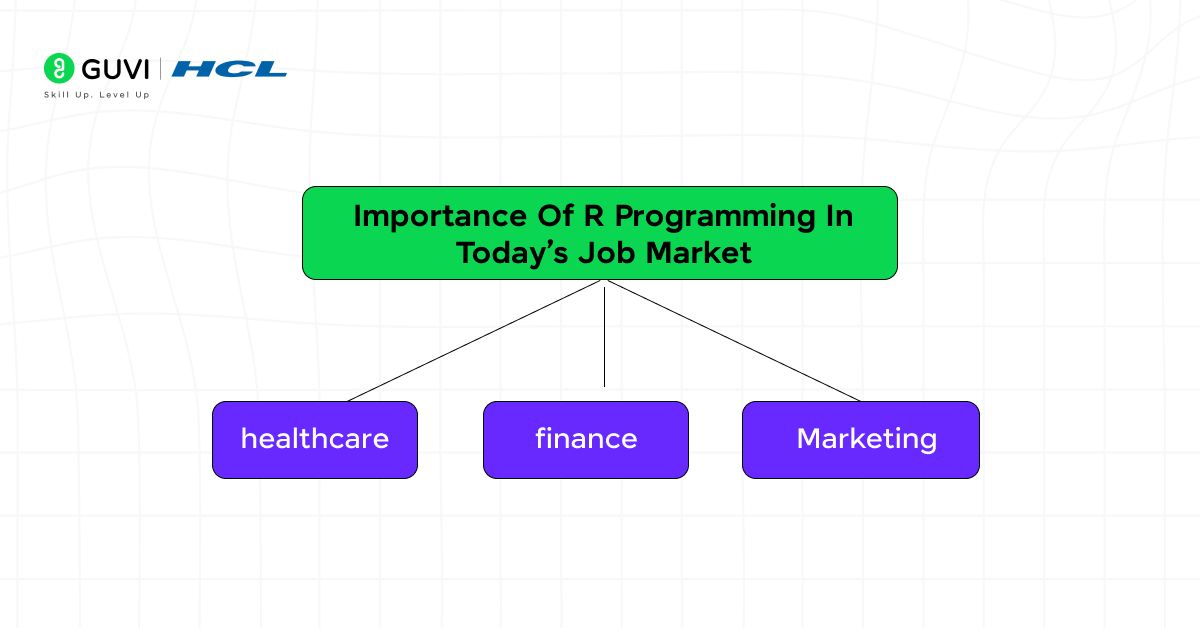
In today’s data-driven world, businesses rely on statistical insights to make smarter decisions and the R programming language plays a key role. Its open-source flexibility and powerful statistical capabilities make it essential for analyzing data, creating visualizations, and building predictive models.
The importance of the R programming language in today’s job market includes:
- Open-source and versatile, accessible for beginners and professionals.
- Powerful statistical and visualization tools for modeling and interpreting data.
- Extensive libraries like ggplot2, dplyr, and caret for advanced analytics.
- Widely used in healthcare, finance and marketing
- Enables real-time analysis and forecasting, e.g., during the COVID-19 pandemic.
- Offers strong career growth and high-demand job opportunities.
Boost your data skills with HCL GUVI’s 5-day free Data Science Email Series. Learn key concepts in data analysis, machine learning, and visualization at your own pace through structured lessons and practical exercises
Key Roles/Jobs Related To R Programming
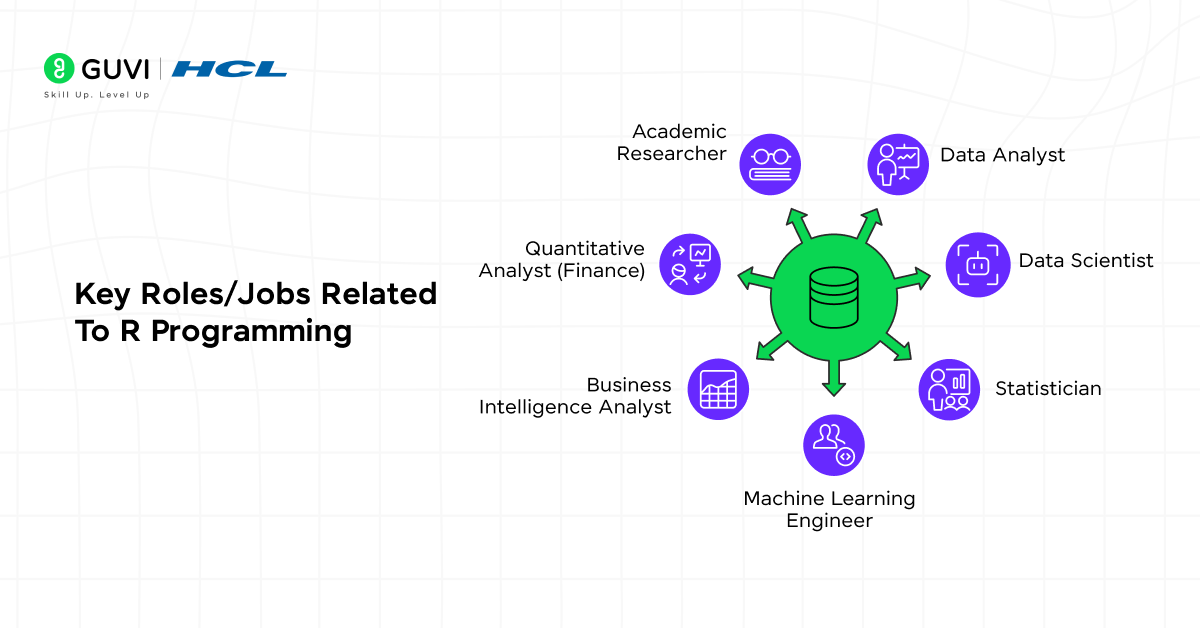
R programming is not just a language; it’s a gateway to multiple rewarding career paths across industries. Whether you enjoy analyzing data, building predictive models, or conducting research, R offers roles that match diverse skill sets. In this blog, we will explore the most sought-after R programming jobs, detailing each role’s key functions, real-world examples, and salary insights to give you a comprehensive understanding of career opportunities in this field.
Some of the top positions we’ll cover include:
- Data Analyst
- Data Scientist
- Statistician
- Machine Learning Engineer
- Business Intelligence Analyst
- Quantitative Analyst (Finance)
- Academic Researcher
1. Data Analyst

Role Overview:
A Data Analyst is a professional who collects, processes, and interprets data to help organizations make informed business decisions. They transform raw data into actionable insights that guide strategy, operations, and performance improvements.
Key Responsibilities:
- Cleaning and preprocessing data for analysis
- Performing statistical analysis and identifying trends
- Creating visualizations and interactive dashboards
- Generating reports and presenting findings to stakeholders
Essential Skills and Knowledge:
- Strong foundation in statistics and probability
- Proficiency in R programming and libraries such as ggplot2 and dplyr
- Understanding of data visualization techniques
- Basic knowledge of SQL and Excel for data handling
Salary Overview:
Fresher: ₹3–5 LPA | Mid-level: ₹6–9 LPA | Senior: ₹10–15 LPA
Reference: Glassdoor
Example:
A retail company hires a Data Analyst to study monthly sales data. Using R’s ggplot2, the analyst visualizes sales trends across regions, helping the management identify underperforming areas and optimize inventory for better profitability.

2. Data Scientist

Role Overview:
A Data Scientist is a professional who leverages statistical models, programming, and analytical techniques to extract insights from complex datasets. They help organizations make data-driven decisions, build predictive models, and automate processes to improve efficiency and outcomes.
Key Responsibilities:
- Performing data mining and exploration to identify patterns
- Building predictive and machine learning models using R
- Cleaning, processing, and analyzing large datasets
- Communicating insights and recommendations to stakeholders
Essential Skills and Knowledge:
- Strong knowledge of statistics, probability, and mathematics
- Proficiency in R programming and packages like caret and randomForest
- Machine learning algorithms and predictive modeling
- Data visualization and reporting techniques
Salary Overview:
Fresher: ₹5–8 LPA | Mid-level: ₹9–14 LPA | Senior: ₹15–25 LPA
Reference: Glassdoor
Example:
An e-commerce company employs a Data Scientist to reduce customer churn. Using R’s caret and randomForest packages, they build a predictive model that identifies customers likely to leave, enabling targeted retention strategies.
3. Statistician
Role Overview:
A Statistician is a professional who uses mathematical and statistical techniques to analyze data, identify patterns, and test hypotheses. They provide the foundation for data-driven decisions in research, business, and policy-making by interpreting complex datasets accurately.
Key Responsibilities:
- Designing experiments and surveys for data collection
- Performing probability modeling and regression analysis
- Interpreting survey and experimental data to extract insights
- Communicating findings through reports and visualizations
Essential Skills and Knowledge:
- Strong foundation in statistics and probability
- Proficiency in R programming for data analysis
- Knowledge of regression, hypothesis testing, and data modeling
- Ability to visualize and present data effectively
Salary Overview:
Fresher: ₹3–5 LPA | Mid-level: ₹6–10 LPA | Senior: ₹12–18 LPA
Reference: Glassdoor
Example:
A research organization hires a Statistician to study population trends. Using R, they analyze demographic data from surveys to identify age, income, and education patterns, supporting policy and planning decisions.
4. Machine Learning Engineer
Role Overview:
A Machine Learning Engineer is a professional who designs, develops, and implements algorithms that allow systems to learn from data and make predictions. They use R to build models that automate analysis, uncover patterns, and support strategic decision-making across industries.
Key Responsibilities:
- Performing feature engineering to prepare data for modeling
- Developing, tuning, and validating machine learning algorithms
- Deploying models for real-world applications
- Monitoring and optimizing model performance over time
Essential Skills and Knowledge:
- Strong understanding of machine learning algorithms and techniques
- Proficiency in R programming and libraries such as xgboost and caret
- Knowledge of data preprocessing, feature selection, and model evaluation
- Ability to interpret and communicate model results effectively
Salary Overview:
Fresher: ₹6–9 LPA | Mid-level: ₹10–16 LPA | Senior: ₹18–30 LPA
Reference: Glassdoor
Example:
A retail company hires a Machine Learning Engineer to forecast product demand. Using R’s xgboost library, the engineer builds a predictive model that helps optimize inventory and improve supply chain efficiency.
5. Business Intelligence Analyst
Role Overview:
A Business Intelligence (BI) Analyst is a professional who transforms data into actionable insights through reporting and visualization. They help organizations make informed strategic decisions by analyzing performance metrics and presenting findings in an understandable format.
Key Responsibilities:
- Developing interactive dashboards and reports
- Tracking key performance indicators (KPIs) and metrics
- Interpreting data to identify trends and opportunities
- Collaborating with teams to provide insights for decision-making
Essential Skills and Knowledge:
- Proficiency in R programming and visualization tools such as Shiny
- Strong understanding of data analysis and reporting techniques
- Knowledge of business metrics, KPIs, and performance tracking
- Ability to communicate insights effectively to stakeholders
Salary Overview:
Fresher: ₹4–6 LPA | Mid-level: ₹7–11 LPA | Senior: ₹12–18 LPA
Reference: Glassdoor
Example:
A marketing team hires a BI Analyst to monitor campaign performance. Using R’s Shiny package, the analyst builds interactive dashboards that display real-time metrics, enabling managers to optimize strategies and improve ROI.
6. Quantitative Analyst (Finance)
Role Overview:
A Quantitative Analyst, or “Quant,” is a finance professional who uses statistical models and programming to analyze financial data, manage risk, and optimize investment strategies. They leverage R to perform complex calculations and build predictive models that guide trading and portfolio decisions.
Key Responsibilities:
- Performing derivative pricing and financial modeling
- Conducting risk analysis and portfolio optimization
- Developing predictive models for market trends
- Communicating insights to traders, portfolio managers, and stakeholders
Essential Skills and Knowledge:
- Strong background in mathematics, statistics, and finance
- Proficiency in R programming and packages like quantmod
- Knowledge of financial instruments, risk modeling, and market analytics
- Ability to interpret complex financial data and present actionable insights
Salary Overview:
Fresher: ₹5–8 LPA | Mid-level: ₹10–16 LPA | Senior: ₹18–30 LPA
Reference: Glassdoor
Example:
A financial firm employs a Quant to forecast stock volatility. Using R’s quantmod package, the analyst builds predictive models that help manage risk and guide investment strategies effectively.
7. Academic Researcher

Role Overview:
An Academic Researcher uses R programming to analyze data, uncover patterns, and present findings clearly and accurately. They play a vital role in scientific and academic studies by transforming raw data into insights that support research conclusions and publications.
Key Responsibilities:
- Collecting and organizing research data
- Performing statistical analysis and modeling
- Creating visualizations to represent findings effectively
- Preparing publication-ready reports and presentations
Essential Skills and Knowledge:
- Strong foundation in statistics and research methodologies
- Proficiency in R programming and relevant libraries for analysis and visualization
- Knowledge of data interpretation and scientific reporting
- Ability to communicate results clearly for academic or research purposes
Salary Overview:
Fresher: ₹3–5 LPA | Mid-level: ₹6–10 LPA | Senior: ₹12–20 LPA
Reference: Glassdoor
Example:
A climate research institute hires an Academic Researcher to study global temperature trends. Using R’s statistical modeling tools, the researcher analyzes historical climate data and visualizes changes over time, supporting policy recommendations and scientific publications.
How To Build A Career In R Programming
Building a successful career in R programming requires a structured approach that combines learning, practical experience, and professional exposure. Here’s a step-by-step roadmap to help you grow from a beginner to a job-ready professional:
Step 1: Learn The Basics
Start with understanding R syntax, data types, control structures, and basic programming concepts. A strong foundation is essential before moving to advanced topics.
Step 2: Work On Projects
Apply your knowledge by analyzing real datasets in RStudio. Hands-on projects help you understand practical challenges and build problem-solving skills.
Step 3: Master Libraries
Become proficient in key R packages like ggplot2, dplyr, tidyverse, and caret to perform data manipulation, visualization and machine learning efficiently.
Step 4: Build A Portfolio
Showcase your projects on GitHub or LinkedIn. A strong portfolio demonstrates your skills to potential employers and increases your job readiness.
Step 5: Earn Certifications
Validate your expertise by earning certifications from reputable platforms. Certifications add credibility to your skills and can improve career opportunities.
Step 6: Network And Apply
Join R programming communities, participate in webinars, and connect with professionals. Apply for internships or entry-level roles to gain real-world experience and kickstart your career.
This step-by-step approach ensures you develop both the technical knowledge and practical experience needed to succeed in R-related roles across industries.
Enhance your learning with HCL GUVI’s Data Science eBook. Get a comprehensive guide covering data analysis, machine learning, and visualization techniques to strengthen your practical knowledge
Essential Tools And Libraries Used In R Programming Jobs
R’s power comes from its rich ecosystem of tools and packages that make data analysis, visualization, and modeling more efficient. To excel in R programming, mastering the following tools and skills is essential:
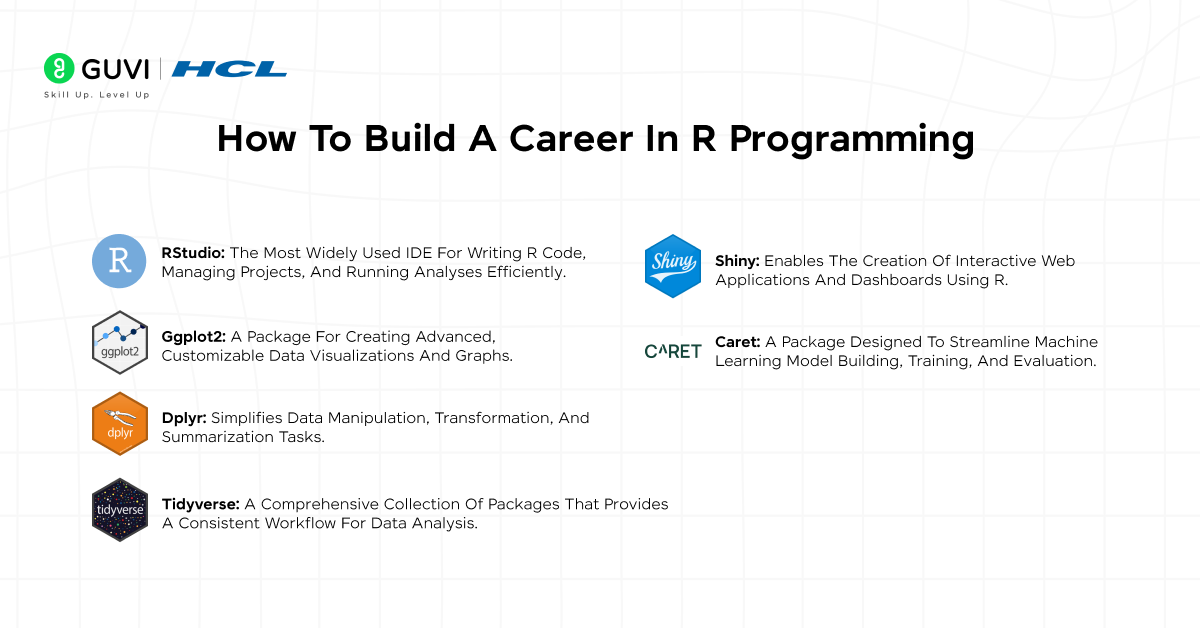
- RStudio: The most widely used IDE for writing R code, managing projects, and running analyses efficiently.
- ggplot2: A package for creating advanced, customizable data visualizations and graphs.
- dplyr: Simplifies data manipulation, transformation, and summarization tasks.
- tidyverse: A comprehensive collection of packages that provides a consistent workflow for data analysis.
- Shiny: Enables the creation of interactive web applications and dashboards using R.
- caret: A package designed to streamline machine learning model building, training, and evaluation.
Mastering these tools not only enhances your productivity but also equips you with the skills needed to handle complex datasets, perform advanced analytics, and deliver actionable insights across industries.
Real-World Applications Of R Programming
R is widely used across industries where data drives strategy and decision-making. Its versatility allows professionals to analyze complex datasets, uncover insights, and support critical business or research decisions. Some key applications include:
- Healthcare: Predicting disease trends, analyzing patient outcomes, and improving treatment strategies.
- Finance: Performing risk analysis, forecasting stock trends, and building investment models.
- Marketing: Segmenting customers, tracking campaign performance, and optimizing marketing strategies.
- Academia: Conducting research studies, modeling experiments, and interpreting data for publications.
- Government: Assessing policies, analyzing census data, and supporting data-driven governance.
Future Trends In R Programming Careers
The future of R programming is bright, as data-driven decision-making continues to grow across industries. Staying updated with emerging trends can help professionals remain in high demand and secure competitive roles. Key trends include:
- AI & ML Integration: R is increasingly used for advanced predictive analytics and machine learning applications.
- Cross-Language Collaboration: R can be integrated with Python and other languages to create hybrid workflows for complex projects.
- Cloud Integration: R is being adopted on cloud platforms like AWS and Azure, enabling large-scale analytics and scalable solutions.
- Data Storytelling: Advanced visualization and interactive tools in R enhance the communication of insights, improving decision-making impact.
Professionals who adapt to these trends and continuously upgrade their skills will remain highly sought-after in the evolving data landscape.
Conclusion
R Programming opens a world of opportunities for professionals passionate about data and analytics. Its powerful statistical capabilities, extensive libraries, and versatile applications make it an essential tool across industries like healthcare, finance, marketing, and research.
Whether you’re visualizing trends, performing statistical modeling, or developing predictive algorithms, R equips you with the ability to extract meaningful insights from complex datasets. Its open-source ecosystem, combined with strong community support, makes it one of the most valuable skills for anyone aiming to enter the analytics and data science domain.
By mastering R, building hands-on experience, and staying updated with emerging trends, you can pursue rewarding roles such as Data Analyst, Data Scientist, Statistician, Machine Learning Engineer, or Quantitative Analyst. With the right skills and practical exposure, R can be your gateway to a successful, future-ready career in the ever-growing field of data science and analytics.
If you’re ready to turn your skills into a successful career, HCL GUVI’s Data Science Course is the perfect choice. Through expert mentorship, live sessions, and real-world projects, you’ll learn data analysis, machine learning, and visualization to become a job-ready data professional.
FAQs
1. Is R programming still in demand in 2025?
Yes, R remains highly sought-after in analytics, statistics, and research roles due to its strong visualization and modeling capabilities.
2. What are the best jobs for R programmers?
Top roles include Data Analyst, Data Scientist, Statistician, Business Intelligence Analyst, and Quantitative Analyst.
3. How much salary can I earn with R programming skills?
Entry-level professionals earn ₹3–5 LPA, while experienced experts can make up to ₹30 LPA depending on industry and specialization.
4. Which industries hire R programmers the most?
Finance, healthcare, marketing, academia, and public sector organizations hire R programmers frequently.
5. Can I learn R without any prior programming experience?
Absolutely! R is beginner-friendly and can be learned step by step through structured courses and real-world practice.
Success Stories

About the Author
Jebasta
I translate the language of data into stories that anyone can understand. As a writer with a data science background, I simplify analytics, AI, and decision-making so beginners and enthusiasts can confidently explore the world of data.
View all posts by Jebasta
Connect with me @

















Did you enjoy this article?