


Interview Articles
Technical Interview Questions Commonly Asked in Startups
Technical Interview vs HR Interview: 7 Key Differences
Advanced DNS Interview Questions for Senior Engineers: What to Expect in 2026
How to Handle a Technical Interview When the HR Interviewer Isn’t Technical


Get In Touch For Details! Request More Information
How to Handle Complex Technical Interview Questions
Feb 06, 2026 6 Min Read 408 Views
(Last Updated)
Technical interviews do not just test your technical skills only but also your thinking process, problem-solving approach, style of communication, and how to handle yourself and be calm under pressure. Most applicants begin with a lot of confidence, but become panicky as the interviewer continues testing their levels of difficulty.
But how to handle complex technical interview questions, and when the questions become more and more difficult? And more to the point, how do you remain confident, straight, and calm down when everything seems overwhelming?
We are taking technical interview survival tips apart in this comprehensive blog to know how to remain calm, how to answer tough technical interview questions, and how our respond to not knowing the answer during interviews. You will also know practical ways of tackling unpleasant technical interview questions, besides trying to present yourself as a good, competent candidate.
Table of contents
- Why Do Interviewers Keep Increasing the Difficulty?
- How to Handle Complex Technical Interview Questions
- Stay Calm When Questions Get Harder
- Understand What the Interviewer Is Really Testing
- Break the Problem Down: The Most Important Strategy
- Think Out Loud: Your Secret Weapon
- Use the “Structured Approach” for Every Answer
- What To Do When You Don’t Know the Answer
- Handling Pressure in Technical Interviews
- Ask Clarifying Questions (It is not a Weakness)
- Use Examples, Edge Cases & Trial Runs
- Practice a Growth Mindset
- Wrapping it up:
- FAQs
- What do I do when technical interviewing becomes more difficult?
- What should I do if I don’t know the answer to a hard technical question?
- What can I do to manage more and more difficult technical interview questions?
- Why is it that interviewers continue to raise the level of difficulty of question?
Why Do Interviewers Keep Increasing the Difficulty?
Before learning how to handle increasingly complex technical interview questions, you must understand why interviewers do this.
Here are the real reasons:
- To push your thinking limits
- They want to see how you behave when a question becomes unfamiliar or tricky.
- To evaluate problem-solving depth
- Easy questions show basic understanding. Hard questions reveal your analytical abilities.
- To check resilience and emotional control
- Handling pressure in technical interviews is itself a test.
- To simulate real-world engineering problems
- At work, challenges rarely stay simple. Companies want people who can grow with the complexity.
Once you understand their intention, it becomes much easier to stay calm and adapt.
How to Handle Complex Technical Interview Questions
1. Stay Calm When Questions Get Harder
One of the lBiggest skills during technical interviews is to remain calm despite being uncertain. Being relaxed also makes you think clearly, not make any errors and demonstrate to the interviewer that you are able to handle pressure as a professional.
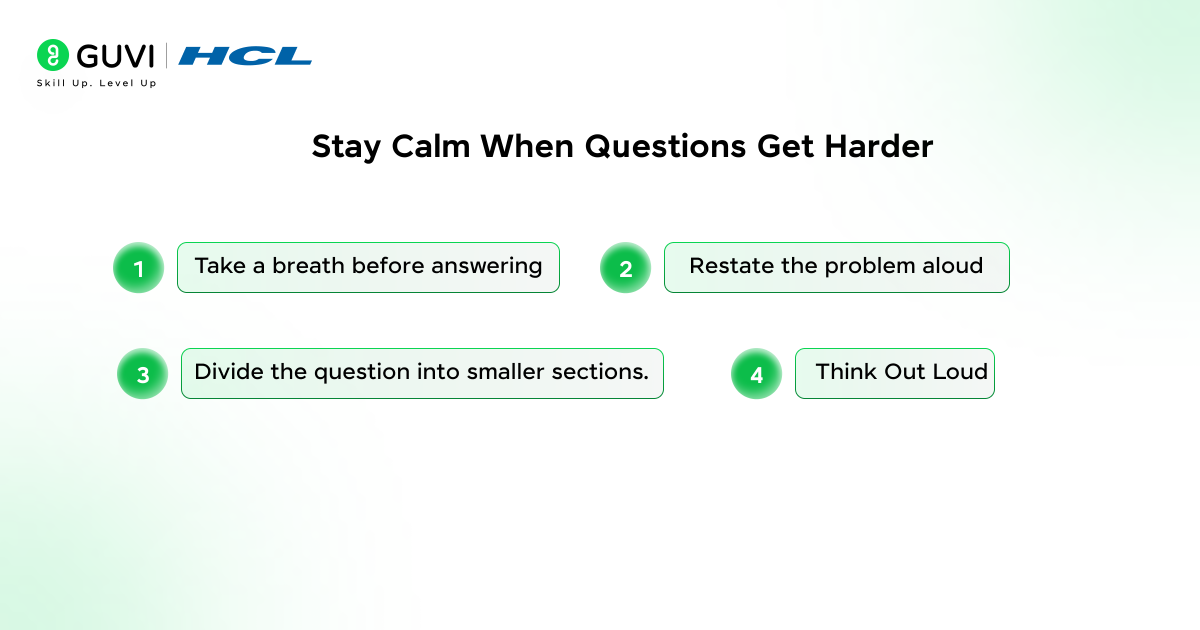
The following are the tips on how to remain calm during complex coding interviews:
- Take a breath before answering
- There is nothing abnormal about a couple of seconds of silence. This little gap allows your brain to recharge and also allows you time to strategize on how to go about it rather than panicking.
- Restate the problem aloud
- This provides you with visibility and gives you time. It also reveals to the interviewer that you have got the question right and you are thinking in a coherent manner.
- Divide the question into smaller sections.
- Difficult questions are easy when they are broken down. The simplification of the problem bit by bit can help you to alleviate the sense of being overwhelmed and simplify your logic so that the interviewer can understand it more easily.
- Think Out Loud
- Interviewers are fond of knowing how you think.
This is among the best techniques in a technical interview since it will make them know how you think although your solution is not ideal.
Also read: What to Expect in a Job Interview: Proven Tips From Real Hiring Managers
2. Understand What the Interviewer Is Really Testing
The interviewer is usually judging when the questions become more difficult:
- Your ability to analyze
- Your ability to adapt
- How are you able to remain calm during stress?
- Your mental powers of thinking
- How can you think logically?
- How well you can communicate your approach.
They do not want the answer to all difficult questions. They prefer structured thinking.
So when you are overwhelmed, you should not try to answer perfectly, but you should be smart.
Also read: Top IT Interview Questions Every Beginner Should Prepare For (With Simple Answers)

3. Break the Problem Down: The Most Important Strategy
In case you are confused about what to do in a technical interview where the questions become more and more complex, you should not forget about the following rule:
“Break the problem into smaller chunks, attack each chunk step-by-step.”
This trick will ease the load on the mind and make you look at the logic better. By dividing a huge task into small tasks, solving it is less difficult, and explaining it is less difficult.
Here’s how to do it:
- Identify the inputs
- Know what you are getting with the problem. Being aware of the inputs will prevent you not mistakenly assuming and begin the problem with all clarity.
- Identify the outputs
- Know what the interviewer wants as the end product. This avoids confusion in the future and makes your solution be on the right track with what is expected.
- Ask clarifying questions
- These questions are used to eliminate ambiguity and demonstrate that you do not make leaps into an answer. This is also valuable to interviewers since real-world engineering involves the need to be clarified as well.
- List possible approaches
- Imagine all the means that you can use, even simple ones. This demonstrates your scope of problem-solving and how the interviewer can know your line of thinking.
- Choose the best one
- Choose the most effective or rational method according to limitations. Being able to justify why you have made the choice is mature and confident.
- Explain why
- Being able to explain your logic is an indication that you are not only doing something, but you know why you are doing it. The interviewer will see this as being more valuable than the final answer.
- Most companies don’t expect you to solve every difficult question. They evaluate your reasoning, clarity, and problem-breaking approach more than the final answer.
- Candidates who think out loud are 40% more likely to pass technical interviews because interviewers can understand their logic even when the solution isn’t perfect.
- Asking clarifying questions is viewed as a strength, not a weakness — showing maturity, analytical thinking, attention to detail, and real-world problem-solving ability.
4. Think Out Loud: Your Secret Weapon
Your biggest strength is also a major secondary keyword:
how to think aloud during technical interviews.
The benefits of thinking aloud are:
- Your reasoning is understood by the interviewer.
- You don’t appear stuck.
- They can lead you in case you are moving in the right direction.
- It demonstrates the ability to be confident even when the questions become difficult.
Thinking aloud (example):
- One is… but that can be inefficient since…
- Allow me to attempt their division into less significant cases.
- I am thinking of a HashMap due to the reason that it is based on a HashMap.
This method is all you need for interviewing with challenging technical questions.
Also read: Guide to Crack Technical Interviews
5. Use the “Structured Approach” for Every Answer
The following is a naive method of how to answer hard technical interview questions:
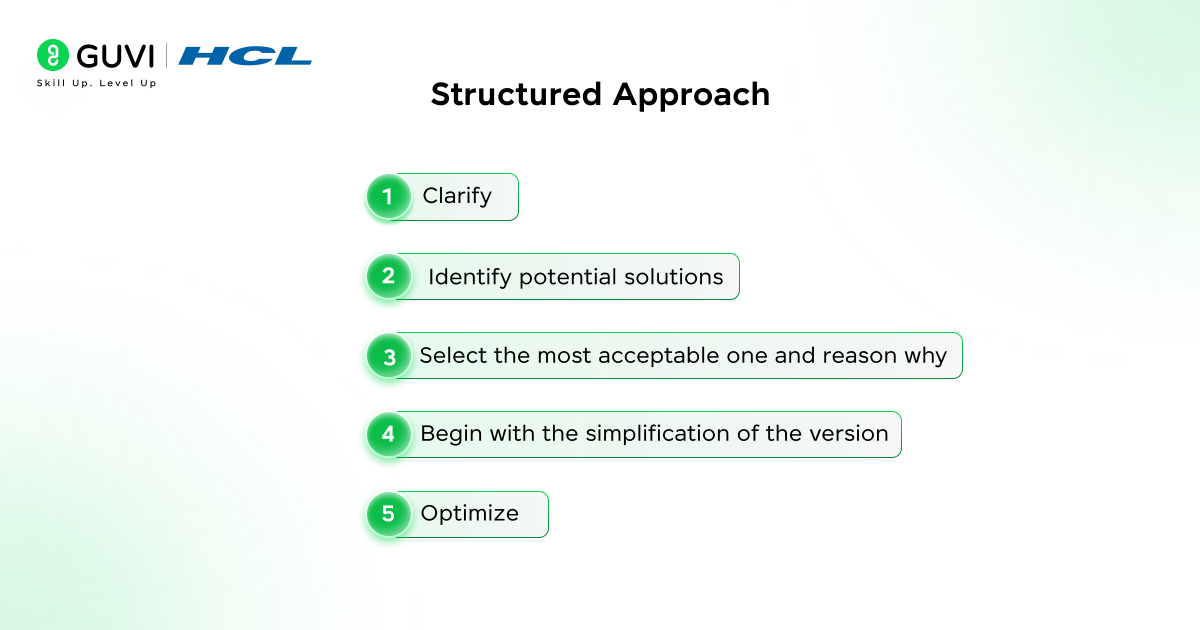
Step 1: Clarify
Ask questions to make it clear on the problem. This will avoid any irrelevant errors and demonstrate to the interviewer that you do not dive into coding without having the best idea of the requirements.
Step 2: Identify potential solutions
Give different approaches. This will help the interviewer to view how broad your thinking is, and it will demonstrate to the interviewer that you can be able to compare various paths before settling on one.
Step 3: Select the most acceptable one and reason why
Show trade-offs. Being able to explain why you made this choice is an indicator that you know about efficiency, constraints, and real-world factors.
Step 4: Begin with the simplification of the version
Do not at once jump into the most elaborate code. Starting to be straightforward will give you confidence, and the interviewer will be able to track your line of thinking step by step.
Step 5: Optimize
Use this when the interview continues to become more difficult. Optimization demonstrates maturity, increased knowledge, and preparedness of actual engineering problems.
This approach will make you come out as relaxed, organized, and rational. It also allows you to be in control of the conversation even when the questions have been made more difficult.
Also read: 17 Tips to Stand Out in Entry-Level Tech Interviews
6. What To Do When You Don’t Know the Answer
This is the stage that all people dread.
The question is, what should I do when I do not know how to answer questions in interviews?
A response can be given in the right way that will impress the interviewer.
Be honest and demonstrate logic.

Example:
I am not quite certain as to the best answer, but such is the manner in which I would begin to deconstruct it…
This helps you appear sincere and considerate as opposed to nervous or disoriented.
Demonstrate that you can Google in the real world
During interviews, you cannot Google, but they check your ability to learn in the real world. Demonstrating the way you would handle research or debugging goes to show that you can work out problems on your own.
Walk through your assumptions
Engineers make assumptions regularly. Elaborating on your assumptions will make the interviewer realize your reasoning and ensure that you are thinking over the problem intelligently.
Give a partial solution
A partial solution is better than silence. Improvements and organization are more important to interviewers than perfection.
Avoid guessing blindly
This is irresponsible. One may appear as a careless or unprepared person when one makes guesses without justification.
Interviewers need not be perfect, just honest + logical. It is actually what you do in such situations that counts more than the response.
Also read: AI Tools for Resume Building: Unlock ATS-Friendly Resumes
7. Handling Pressure in Technical Interviews
The fear of failure is normal.
But you require strategies of emotional control. The trick to remaining composed during complicated coding interviews:
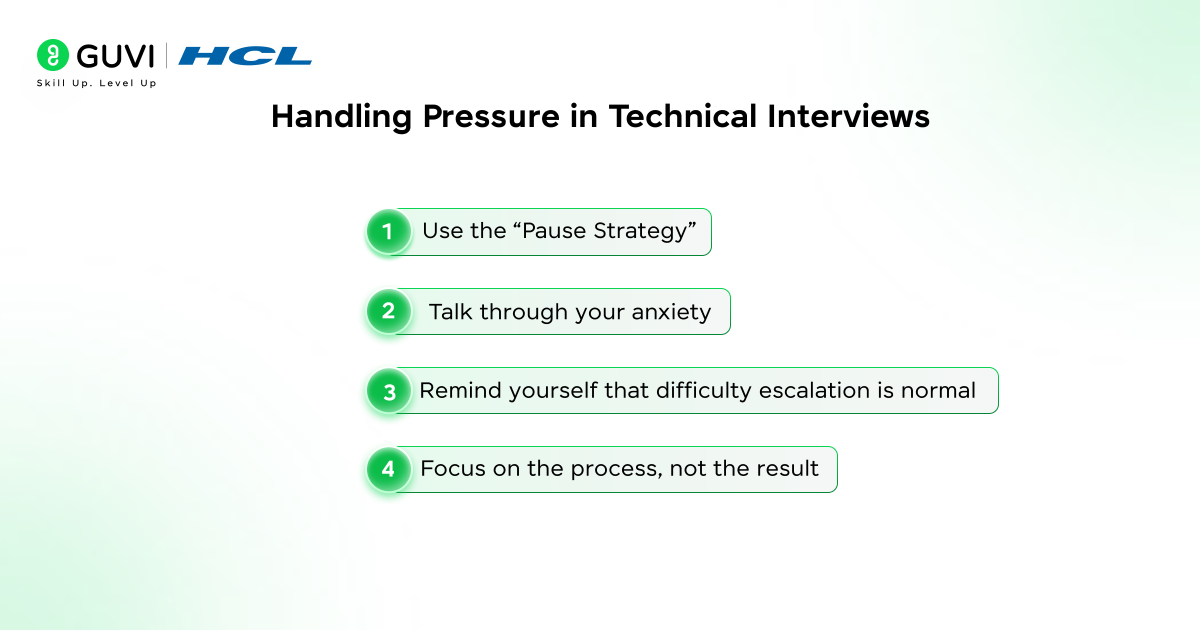
Use the “Pause Strategy”
Take a little break and then answer. It looks confident, as well as it provides your brain time to process the question.
Talk through your anxiety
Example: “Give me a chance to get myself together.
This is an emotionally mature thing to say aloud and helps to keep the mood easy.
Remind yourself that difficulty escalation is normal
You are not failing, they are just putting your in-depth knowledge to the test. Interviewers push the limits of everyone, and do not think that this is a bad sign.
Focus on the process, not the result
The good reasoning rather than the ideal solutions is rewarded by the interviews. The pressure will simply reduce when you concentrate on the way you are handling the problem.
Also read: Why YouTube Tutorials Aren’t Enough for Interview Success (And What Actually Works)
8. Ask Clarifying Questions (It is not a Weakness)
Intelligence is demonstrated by asking questions.
It teaches you not to make assumptions and be concerned with accuracy.
For example:
- Should time be maximized or space?
- Is it assumed that the input is sorted?
- What limitations are to be taken into consideration?
By asking clarifying questions, one makes things simpler and proves to be mature. When you pose intelligent questions to the interviewers, they tend to provide additional clues.
Also read: Top 10 Most Asked Full Stack Developer Interview Questions
9. Use Examples, Edge Cases & Trial Runs
In solving hard technical interviewing questions, simplify the questions by giving examples.
Why examples help:
- They expose logical gaps.
- They demonstrate to the interviewer that you are comprehensive.
- They give guidance to your code.
- They help uncover edge cases.
Examples also helps you to test whether your approach has been working even before you write code. This is further handy where the interviewer continues to get more challenging.
Also read: How to Make a Great First Impression in an Interview (Proven Tips & Techniques)
10. Practice a Growth Mindset
Even the most careful attempt in some cases does not fully address the most difficult question.
But interviewers can see how you acted.
A growth mindset looks like:
- Curiosity
- Willingness to learn
- Positive reception of feedback.
- Being innovative when in a jam.
You can still be hired even when you are not able to complete the problem, having a good mindset. Companies are not only looking for raw technical skill but also potential and the desire to develop.
Ready to level up your technical interview performance? Join HCL GUVI’s Interview Mastery Course and gain the confidence, skills, and strategies you need to crack even the toughest engineering interviews with ease!
Wrapping it up:
Learning to deal with a technical interview when the questions start to get more challenging is all about balancing composing yourself, talking through problems, breaking them down into small steps and demonstrating to the interviewer how you can solve problems when there is no obvious answer.
Once you understand how to address more and more challenging technical interview questions, you will no longer perceive them as a challenge, but rather as a chance to demonstrate your attitude to problem-solving and flexibility. It does not matter whether you know the best way or you just realize the beginning point, the most important thing is your reasoning, sincerity, and the desire to learn. The most difficult interview can be turned into a highlight with the correct strategy in place and walk out of the interview knowing that you have done a good job.
FAQs
1. What do I do when technical interviewing becomes more difficult?
Make a little break, relax and divide the problem into bits. Remaining organized is a way of minimizing panic.
2. What should I do if I don’t know the answer to a hard technical question?
Tell the truth, justify your answers, scratch out your assumptions. Interviewers prefer speculation to conjecture.
3. What can I do to manage more and more difficult technical interview questions?
Explain the issue, discuss possible solutions, select one, and discuss what you are planning as you solve it.
4. Why is it that interviewers continue to raise the level of difficulty of question?
They would like to observe your thoughts under stress, how you can adjust to new problems and cope with the complexity of real life.
Success Stories

About the Author
Vishalini Devarajan
An Aerospace Engineer turned content writer, I focus on making complex concepts easy to understand through well-structured, reader-friendly blogs. Whether it’s a technical topic or a non-technical one, I love creating content that is clear, engaging, and impactful.
View all posts by Vishalini Devarajan
Connect with me @











Did you enjoy this article?