


Data Structure Articles
What is an Algorithm? A Simple Guide for Beginners
Difference between Algorithm and Program: What Sets Them Apart
What Are the Characteristics of an Algorithm? Definition, Features, and Examples


Get In Touch For Details! Request More Information

Maths for DSA: What Most Beginners Get Wrong [2025 Guide]
Nov 25, 2025 6 Min Read 1942 Views
(Last Updated)
Maths for DSA might seem intimidating, but it’s actually a fundamental component of learning programming, just like the code itself. Many beginners make the mistake of underestimating its importance or skipping it altogether.
Understanding the mathematical foundations of data structures and algorithms is crucial for designing efficient computational solutions. In fact, maths is primarily used to evaluate the effectiveness of different algorithms. When you explore essential mathematical concepts like prime numbers, the Sieve of Eratosthenes, and the Euclidean algorithm, you build a stronger foundation for your programming skills.
This guide addresses the common question: Do you need maths for DSA? We’ll cover all the core maths topics for DSA in a beginner-friendly way, from basic concepts like GCD/HCF to more advanced principles of discrete mathematics for DSA. Let’s begin!
Table of contents
- Do You Need Maths For DSA?
- How maths helps in solving algorithmic problems
- Core Maths Topics for DSA
- GCD and HCF (Euclidean Algorithm)
- Prime Numbers and Sieve of Eratosthenes
- Square Root using Binary Search
- Divisors and Factorization
- Modular Arithmetic and Inverse
- Fast Power (Exponentiation by Squaring)
- Fibonacci and Factorial
- Euler's Totient Function
- How to Learn These Maths for DSA Concepts Effectively
- Step 1: Start with basic maths for DSA
- Step 2: Use visualizations and dry runs
- Step 3: Practice with real DSA problems
- Recommended resources and playlists
- Where Beginners Often Go Wrong With Maths for DSA
- 1) Skipping maths and jumping to code
- 2) Not understanding time complexity math
- 3) Ignoring edge cases in number theory problems
- Advanced Maths for DSA Concepts to Explore Later
- 1) Chinese Remainder Theorem
- 2) Catalan Numbers
- 3) Discrete mathematics for DSA
- 4) Probability and combinatorics in algorithms
- Concluding Thoughts…
- FAQs
- Q1. Do I need to learn mathematics for data structures and algorithms (DSA)?
- Q2. What are the core mathematical topics I should focus on for DSA?
- Q3. How can I effectively learn the mathematical concepts required for DSA?
- Q4. What are common mistakes beginners make when learning DSA mathematics?
- Q5. Are there advanced mathematical concepts I should explore for DSA?
Do You Need Maths For DSA?
The short answer is yes. While you don’t need an advanced degree in mathematics, having a solid foundation in specific mathematical concepts is crucial for understanding and optimizing algorithms.
Procedural languages like C++, Java, and Python for problem-solving require basic mathematical concepts, including functions, variables, and fundamental operations. Moreover, data structures deal with the organization of data, while algorithms focus on procedures for manipulating that data—both concepts rooted in mathematical principles.
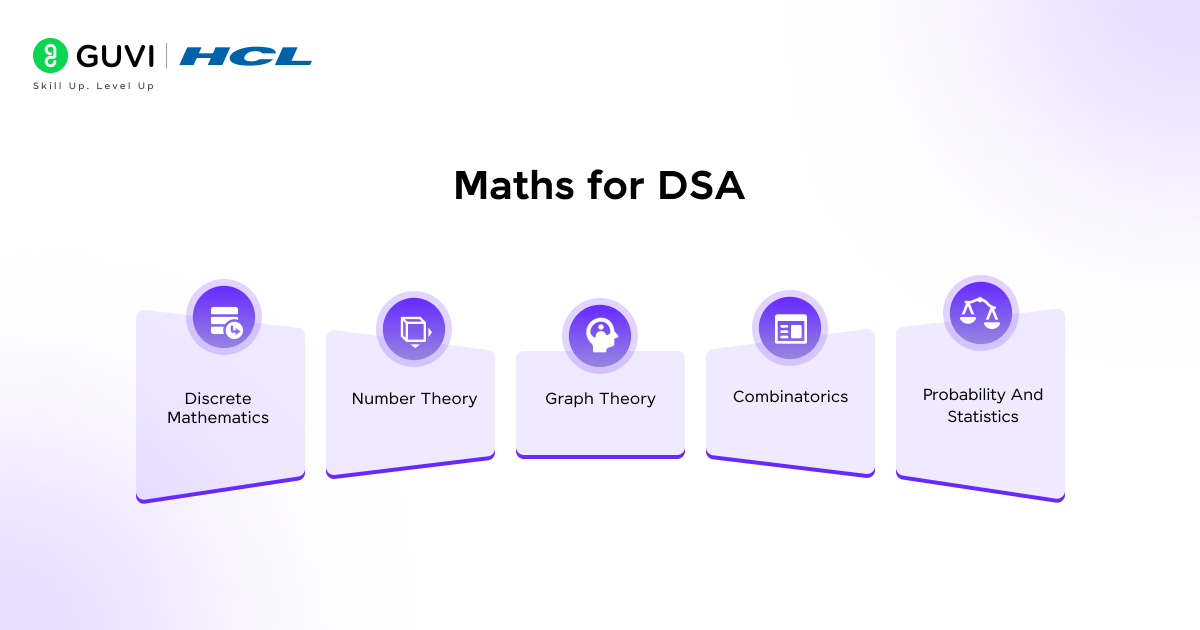
Core mathematical topics you need for DSA include:
- Discrete Mathematics: Sets, functions, relations, and basic proof techniques
- Number Theory: Concepts like GCD, LCM, prime numbers, and factorization
- Graph Theory: Essential for networking, AI, and optimization problems
- Combinatorics: Used for counting problems and permutations
- Probability and Statistics: Important for randomized algorithms
How maths helps in solving algorithmic problems
- Mathematics provides the tools to analyze algorithm complexity, optimize performance, and solve computational problems efficiently. For instance, when solving sorting problems, mathematical concepts like divide and conquer are essential for understanding algorithms such as quicksort and merge sort.
- Furthermore, when analyzing an algorithm’s efficiency, we use Big O notation—a mathematical concept that monitors runtime and space usage as input size increases. This helps identify and resolve performance bottlenecks, allowing you to optimize your code for better performance.
- Number theory concepts like the Euclidean algorithm for finding GCD and the extended Euclidean algorithm help solve modular linear equations. Similarly, understanding recurrence relations is vital for analyzing recursive algorithms and their time complexity.
- Consequently, having mathematical knowledge enables you to break down complex problems into manageable parts, understand algorithms thoroughly, and reason about how different pieces of code will interact.
Core Maths Topics for DSA
Let’s explore the essential mathematical concepts that form the foundation of efficient algorithm design and analysis. These core topics will help you understand how algorithms work and enable you to design your own solutions.
1. GCD and HCF (Euclidean Algorithm)
The Greatest Common Divisor (GCD) or Highest Common Factor (HCF) is the largest positive integer that divides two numbers without a remainder. The Euclidean algorithm provides an efficient method to calculate GCD.
Instead of finding factors of both numbers, this algorithm uses a recursive approach based on the principle: gcd(a,b) = gcd(b, a%b) when b≠0, and gcd(a,0) = a. For example, to find the GCD of 48 and 18:
- gcd(48, 18) = gcd(18, 12) = gcd(12, 6) = gcd(6, 0) = 6
The time complexity is O(log(min(a,b))), making it remarkably efficient even for large numbers.
2. Prime Numbers and Sieve of Eratosthenes
A prime number has exactly two factors: 1 and itself. The Sieve of Eratosthenes is an ancient yet powerful algorithm for finding all primes up to a given limit.
How it works:
- Create a list of numbers from 2 to your limit
- Mark the first number (2) as prime
- Cross out all its multiples
- Find the next unmarked number and repeat
This algorithm has a time complexity of O(n log log n), making it significantly faster than checking each number individually.

3. Square Root using Binary Search
Finding a square root can be efficiently done using binary search. Since the square root of a number must lie between 0 and the number itself, we can apply binary search in this range.
The approach works because if mid²>n, the square root must be smaller, and if mid²≤n, the square root could be that number or greater. The time complexity is O(log n), making it suitable for large numbers.
4. Divisors and Factorization
A divisor of a number divides it evenly without leaving a remainder. Finding all divisors efficiently requires understanding that they come in pairs.
For example, to find divisors of n:
- Iterate from 1 to √n
- If n is divisible by i, both i and n/i are divisors
This approach reduces time complexity from O(n) to O(√n).
5. Modular Arithmetic and Inverse
Modular arithmetic deals with remainders after division. Its importance in DSA stems from handling large numbers and preventing overflow.
Key properties:
- (a + b) mod m = ((a mod m) + (b mod m)) mod m
- (a × b) mod m = ((a mod m) × (b mod m)) mod m
A modular multiplicative inverse of a number ‘a’ is another number ‘x’ such that (a × x) ≡ 1 (mod m). This inverse exists only when a and m are coprime, meaning their GCD is 1.
6. Fast Power (Exponentiation by Squaring)
Computing large exponents efficiently is crucial in cryptography and many algorithms. Exponentiation by squaring divides the work using the binary representation of the exponent.
The key insight: x^n can be calculated as:
- x × (x²)^((n-1)/2) if n is odd
- (x²)^(n/2) if n is even
This reduces complexity from O(n) to O(log n).
7. Fibonacci and Factorial
Fibonacci sequence (0,1,1,2,3,5,8…) is where each number is the sum of the previous two. The factorial of n (n!) is the product of all positive integers less than or equal to n.
Both concepts demonstrate:
- Recursive definitions
- Dynamic programming applications
- Various time complexity optimizations
8. Euler’s Totient Function
Euler’s totient function φ(n) counts positive integers up to n that are coprime to n. For example, φ(9)=6 as 1,2,4,5,7,8 are all relatively prime to 9.
For a prime number p, φ(p)=p-1. For two coprime numbers m and n, φ(m×n)=φ(m)×φ(n). This function is crucial in number theory and cryptography applications like RSA.
Understanding these mathematical concepts will significantly improve your ability to design efficient algorithms and solve complex problems in DSA.
Mathematics has shaped the very foundation of modern computing and algorithm design in surprising ways:
1. The Euclidean Algorithm is over 2,300 years old: One of the oldest algorithms still in use today, it was developed by the ancient Greek mathematician Euclid around 300 BCE—and it remains the backbone of modern GCD computation in programming.
2. Prime Numbers Power Modern Cryptography: Concepts like modular arithmetic and large prime factorization—once pure mathematical curiosities—now secure everything from online banking to encrypted messaging.
3. Fibonacci in Everyday Algorithms: The Fibonacci sequence isn’t just mathematical trivia—it appears in sorting algorithms, dynamic programming problems, and even nature-inspired algorithm designs.
These facts show how timeless mathematical ideas continue to drive innovation in today’s data structures and algorithms.
How to Learn These Maths for DSA Concepts Effectively
Mastering the mathematical concepts behind DSA requires a structured approach rather than random practice. By following these steps, you can build a solid foundation without feeling overwhelmed.
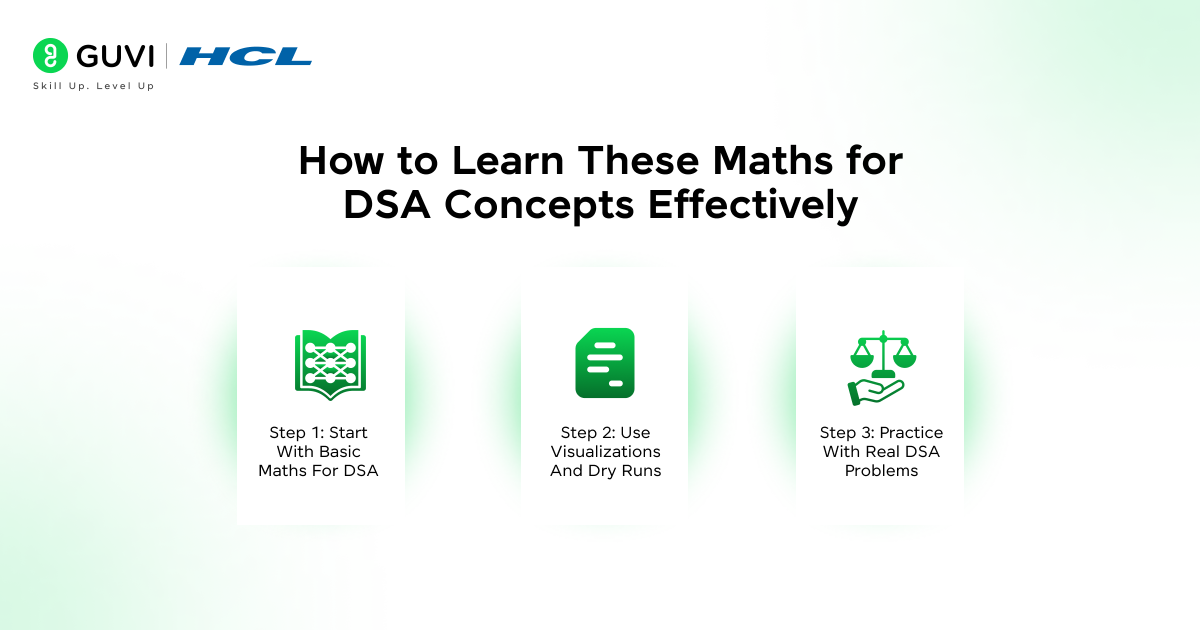
Step 1: Start with basic maths for DSA
Begin by strengthening your comfort with fundamental mathematical concepts. Focus on:
- Arithmetic operations and basic algebraic manipulations
- Number theory basics, including prime numbers, divisibility, and modular arithmetic
- Logarithms and exponents, which are essential for analyzing algorithm efficiency
Procedural knowledge alone isn’t enough. Research shows that conceptual understanding provides a stronger foundation for learning. Indeed, students with stronger conceptual knowledge often experience less math anxiety and develop more flexible problem-solving skills.
Step 2: Use visualizations and dry runs
Visual learning dramatically improves your understanding of abstract mathematical concepts. Consider these approaches:
- Visualization tools: Platforms like VisuAlgo offer interactive visualizations of data structures and algorithms with step-by-step walkthroughs. These tools are especially helpful for visual learners trying to grasp complex concepts like graph algorithms or sorting methods.
- Dry runs: Before coding, manually trace algorithms on paper. This underrated technique helps identify edge cases and logical errors early. For instance, when learning binary search, trace through each step with a sample array to internalize how the algorithm narrows down possibilities.
- Memory diagrams: Drawing representations of data structures helps visualize how data is stored and manipulated. This makes abstract concepts like pointers in linked lists much clearer.
Step 3: Practice with real DSA problems
Theory without application won’t stick. Therefore:
- Start with simple implementation problems for each concept
- Gradually tackle more complex challenges that combine multiple concepts
- Apply spaced practice—revisiting concepts periodically rather than cramming
When learning modular arithmetic, for example, implement problems like fast exponentiation before moving to advanced applications in cryptography.
Recommended resources and playlists
HCL GUVI offers a comprehensive DSA Course covering essential mathematical concepts with practical applications. Their self-paced course provides:
- In-depth explanations from basic to advanced concepts, like Dijkstra’s and Kruskal’s algorithms
- Quizzes after each concept to test understanding
- Certification upon completion from an IIT-M incubated company
Other valuable resources include HCL GUVI’s DSA e-book, visualization platforms like HackerEarth’s sorting visualizer, and practice platforms like LeetCode for applying mathematical concepts to real coding challenges.
Remember that both conceptual understanding and procedural fluency are essential—they’re mutually reinforcing aspects of mathematical proficiency. By following these steps, you’ll develop a robust foundation in the mathematical principles underpinning DSA.
Where Beginners Often Go Wrong With Maths for DSA
Even with the best resources available, many beginners make critical mistakes when learning the mathematical aspects of DSA. Understanding these common pitfalls can help you avoid wasting time and build stronger algorithmic skills.
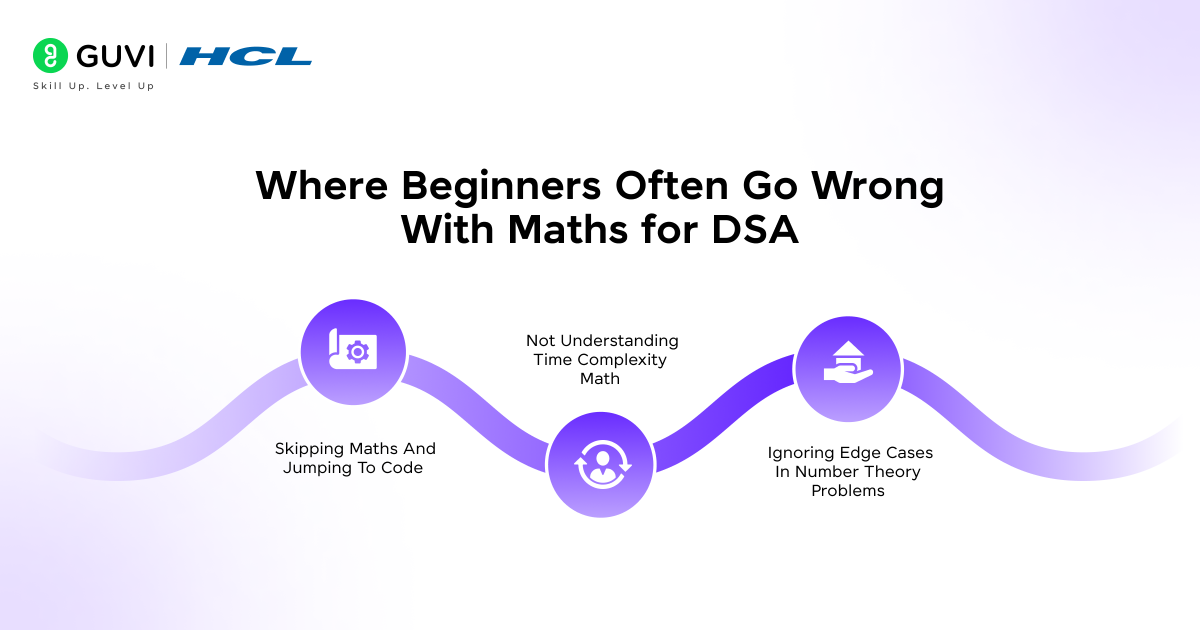
1) Skipping maths and jumping to code
A fundamental mistake beginners make is rushing to implementation without understanding the mathematical principles. This approach is problematic because:
- Weak foundations lead to confusion – Without understanding core mathematical concepts, you’ll struggle to grasp why certain algorithms work. Unfortunately, many students prioritize coding without realizing that maths provides the reasoning behind algorithmic choices.
- Random question grinding doesn’t work – Many beginners solve 500+ random questions without mastering core patterns. Yet, research shows that a solid mathematical foundation leads to better pattern recognition in problem-solving.
- Surface-level understanding – Without mathematical reasoning, you might copy-paste code without truly understanding it. This leads to difficulties when facing variations of similar problems.
2) Not understanding time complexity math
Time complexity analysis is often misunderstood despite being crucial for efficient algorithm design:
Common misconceptions about Big O notation:
- Treating complexity as a menu item to memorize rather than understand
- Forgetting that different input sizes require different algorithmic approaches
- Misinterpreting what O(n²) or O(n log n) actually means in practical terms
According to studies, algorithm efficiency becomes critical as input sizes grow, with O(n²) algorithms becoming impractical beyond 10K elements.
Overlooking edge cases in calculations can lead to integer overflow. For instance, when multiplying large numbers like 10⁹ × 10⁹, failing to typecast properly can cause incorrect results.
3) Ignoring edge cases in number theory problems
Number theory problems are particularly susceptible to edge cases that beginners often miss:
- Zero and boundary values – Many algorithms fail when handling zero, negative numbers, or values at the extremes of the input range.
- Memory management issues – Failing to reset arrays between test cases is a classic mistake in competitive programming involving number theory.
- Modular arithmetic precision – When working with large numbers and modular arithmetic, seemingly minor precision errors can lead to completely wrong results.
To improve your approach to mathematical aspects of DSA, focus on understanding underlying principles before coding, analyze time complexity thoroughly, and always test your solutions with edge cases. This methodical approach will strengthen your problem-solving abilities and prevent common mistakes that plague beginners.
Advanced Maths for DSA Concepts to Explore Later
Once you’ve mastered the core mathematical concepts for DSA, several advanced topics await your exploration. These provide powerful tools for solving complex algorithmic problems.
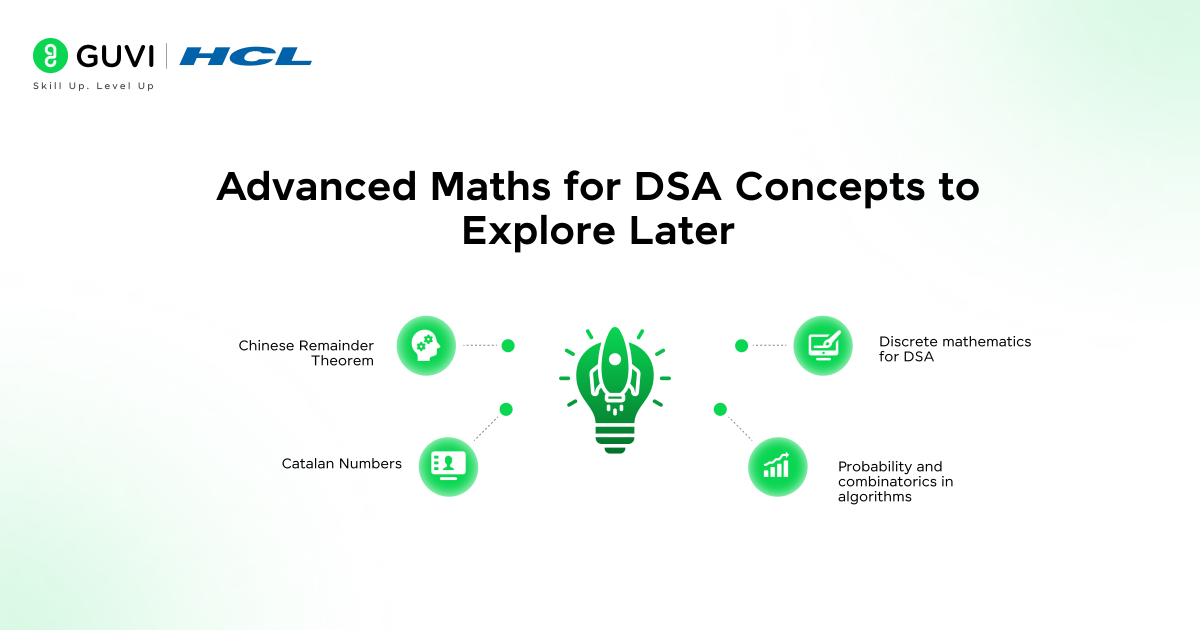
1) Chinese Remainder Theorem
This theorem helps solve systems of congruence equations efficiently. When given several divisors and remainders, it finds the unique solution modulo the product of coprime moduli. Its applications include:
- Handling large numbers in cryptography
- Solving modular equations in number theory
- Implementation with O(1) time complexity for lookups
2) Catalan Numbers
This sequence (1, 1, 2, 5, 14, 42…) appears throughout combinatorial mathematics. Catalan numbers count:
- Correctly parenthesized expressions
- Different binary tree arrangements
- Triangulations of polygons
- Non-crossing partitions
3) Discrete mathematics for DSA
Discrete math forms the backbone of computer science. Key areas include:
- Set theory and logic for algorithm correctness
- Graph theory for tree structures and network algorithms
- Functions and recursion for algorithm design
- Asymptotic analysis for evaluating efficiency
4) Probability and combinatorics in algorithms
These fields are essential for analyzing algorithm performance. They’re particularly important for:
- Randomized algorithms analysis
- Average-case complexity evaluation
- Machine learning algorithm development
- Counting problems in computational solutions
Nevertheless, focus on mastering core concepts first before diving into these advanced topics.
You can also become a job-ready AI software developer with HCL GUVI’s IITM-certified AI Software Development Course, master full-stack, DSA, Gen AI tools, and real-world projects.
Concluding Thoughts…
Mathematics serves as the foundation of effective DSA learning, rather than an optional supplement. Throughout this guide, you’ve seen how mathematical concepts like the Euclidean Algorithm, Sieve of Eratosthenes, and modular arithmetic directly influence algorithm design and efficiency. Consequently, skipping these fundamentals often leads to significant knowledge gaps that hinder your progress with complex problems.
While this guide covers essential mathematics for DSA beginners, further growth awaits through advanced topics like the Chinese Remainder Theorem and Catalan Numbers. Still, mastering the fundamentals remains your priority.
Mathematical understanding ultimately transforms you from someone who merely copies code to a programmer who designs efficient algorithms for complex problems. Start building this foundation today, and watch your DSA skills reach new heights.
FAQs
Q1. Do I need to learn mathematics for data structures and algorithms (DSA)?
Yes, a solid foundation in specific mathematical concepts is crucial for understanding and optimizing algorithms. While you don’t need an advanced degree, topics like discrete mathematics, number theory, and graph theory are essential for mastering DSA fundamentals.
Q2. What are the core mathematical topics I should focus on for DSA?
Key topics include the Greatest Common Divisor (GCD), prime numbers, square root calculations, modular arithmetic, fast exponentiation, Fibonacci sequences, and Euler’s totient function. These concepts form the foundation for efficient algorithm design and analysis.
Q3. How can I effectively learn the mathematical concepts required for DSA?
Start with basic math concepts, use visualizations and dry runs to understand algorithms, and practice with real DSA problems. Utilize resources like online courses, textbooks, and coding platforms to reinforce your learning.
Q4. What are common mistakes beginners make when learning DSA mathematics?
Common pitfalls include skipping mathematical foundations and jumping straight to coding, misunderstanding time complexity analysis, and overlooking edge cases in number theory problems. It’s important to build a strong conceptual understanding before implementation.
Q5. Are there advanced mathematical concepts I should explore for DSA?
Yes, once you’ve mastered the basics, you can delve into advanced topics like the Chinese Remainder Theorem, Catalan Numbers, discrete mathematics, and probability in algorithms. These concepts are powerful tools for solving complex algorithmic problems.
Success Stories

About the Author
Jaishree Tomar
A recent CS Graduate with a quirk for writing and coding, a Data Science and Machine Learning enthusiast trying to pave my own way with tech. I have worked as a freelancer with a UK-based Digital Marketing firm writing various tech blogs, articles, and code snippets. Now, working as a Technical Writer at GUVI writing to my heart’s content!
View all posts by Jaishree Tomar
Connect with me @













Did you enjoy this article?