


Data Science Articles
Reporting Analyst to Data Scientist: Is It the Natural Next Step?
Can an Insurance Underwriter Become a Data Analyst?


Get In Touch For Details! Request More Information
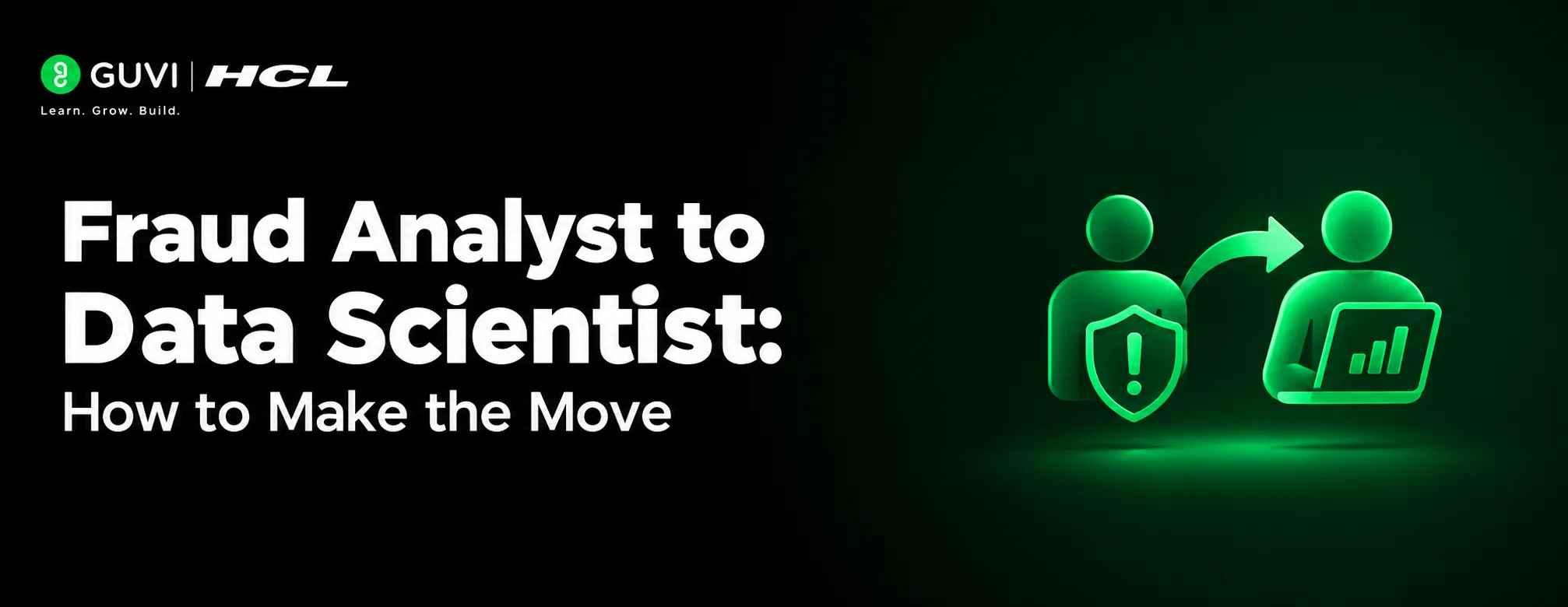
Fraud Analyst to Data Scientist: How to Make the Move
Oct 29, 2026 6 Min Read 18 Views
(Last Updated)
Moving from fraud analyst to data scientist means changing what you own. Instead of reviewing cases one by one, you build the models and systems that decide which cases get reviewed. That shift requires new tools, a different way of working, and proof you can deliver.
This blog starts by comparing the two roles and the skills you can reuse. It then lays out the steps to follow, followed by portfolio projects, interview questions and the mistakes that slow people down.
Table of contents
- TL;DR Summary
- Can a Fraud Analyst Become a Data Scientist?
- Fraud Analyst vs Data Scientist: Key Differences
- Fraud Analyst Skills That Help You Become a Data Scientist
- Spotting Unusual Behavior
- Writing Detection Rules
- Weighing False Positives Against Missed Fraud
- Knowing How Fraud Actually Happens
- Working With Investigation and Business Teams
- How to Move From Fraud Analyst to Data Scientist Step by Step
- Step 1: Learn Python for Data Work
- Step 2: Move From Basic to Advanced SQL
- Step 3: Study Statistics and Machine Learning
- Step 4: Learn How to Evaluate Models
- Step 5: Use Data Science Methods in Your Current Role
- Step 6: Apply for the Right Roles
- Fraud Detection Projects to Build for Your Portfolio
- Project 1: Anomaly Detection Without Labels
- Project 2: Rules vs Model Comparison
- Project 3: Alert Ranking Score
- Project 4: Linked Account Detection
- Data Science Interview Questions for Fraud Analysts
- Technical Questions
- Scenario-based Questions
- Behavioral Question
- Mistakes to Avoid When Moving From Fraud Analyst to Data Scientist
- Collecting Courses Instead of Finishing Projects
- Relying Only on Fraud Knowledge
- Using Information the Model Would Not Have at Decision Time
- Jumping to Deep Learning Too Early
- Listing Tools Without Results on Your Resume
- Conclusion
- FAQs
- Can a fraud analyst become a data scientist?
- How long does it take to go from fraud analyst to data scientist?
- What skills does a fraud analyst need to become a data scientist?
- Does fraud analyst experience count for data science jobs?
- Which projects should a fraud analyst build to become a data scientist?
TL;DR Summary
- This blog covers the move from fraud analyst to data scientist, including how the two roles differ in daily responsibilities.
- It identifies fraud analysis skills that apply to data science, such as spotting anomalies, writing rules, and balancing false alerts against missed fraud.
- It outlines six steps for the transition: Python, advanced SQL, statistics and machine learning, model evaluation, applying new methods in your current role and targeting suitable job openings.
- It presents four portfolio projects: anomaly detection, a rules-versus-model comparison, alert ranking, and linked account detection.
- It also lists common interview questions and five mistakes to avoid during the transition.
Can a Fraud Analyst Become a Data Scientist?
Yes, a fraud analyst can become a data scientist. Employers look at what you can build, so your current job title matters less than your ability to write code, train models and explain the results.
How hard the switch is depends on where you start. If you already use SQL on large transaction data, the gap is small. If most of your day goes to manual case review, you will need more time to pick up the technical side.
Six months of guided learning can leave you with real data science projects to show employers. HCL GUVI’s Data Science and Generative AI program offers live online classes, 1:1 doubt support, placement assistance and mock interviews. Learn in English, Hindi, Telugu or Tamil, with no coding background needed. Reserve your seat today!
Fraud Analyst vs Data Scientist: Key Differences
Both roles work with the same kind of data. What changes is the job you do with it.
- Main task: A fraud analyst investigates alerts and decides whether a transaction is genuine. A data scientist builds the models that produce and rank those alerts.
- Tools: Fraud analysts rely on case management systems, SQL and Excel. Data scientists work in Python, SQL and machine learning libraries.
- Scale: Analysts review cases one at a time. Data scientists handle millions of records together.
- Output: Analysts deliver decisions and reports. Data scientists deliver models, experiments and measurable gains in detection accuracy.
Also Read: AI in Fraud Detection: How Banks Use Machine Learning
Fraud Analyst Skills That Help You Become a Data Scientist
Each of the following skills from your fraud analyst role has a clear use in building and judging data science models.
1. Spotting Unusual Behavior
Noticing a login from a new device or a spending jump on a dormant account is manual anomaly detection. In data science, the same instinct guides which signals you feed into a model.
2. Writing Detection Rules
Every rule you have set, such as flagging a high-value purchase right after a password change, is a candidate feature for a machine learning model. You already know which conditions matter, which saves time during feature engineering.
3. Weighing False Positives Against Missed Fraud
Tightening a rule catches more fraud but blocks more genuine customers. Data scientists face the same trade-off when they pick a model threshold and choose between precision and recall.
4. Knowing How Fraud Actually Happens
Account takeover, card testing and synthetic identities each leave different traces. This domain knowledge helps you judge whether a model result makes sense, something many data scientists new to the field lack.
5. Working With Investigation and Business Teams
Analysts regularly explain to colleagues in other functions why something was blocked or approved. That habit carries over when you present a model’s findings to people who need to act on them.
How to Move From Fraud Analyst to Data Scientist Step by Step
The steps below follow the order in which most fraud analysts build the skills for this move:
Step 1: Learn Python for Data Work
Python is the main language of data science, and everything else in this plan depends on it. Spreadsheets and case tools stop working once the data grows past a few thousand rows, while Python handles millions without trouble.
Begin with the basics and move to data handling once you can write short programs without looking things up.
What to Learn
- Variables, loops and functions
- Pandas for working with tables
- Matplotlib for charts
How to Apply It: Redo a report you already produce, such as alert rates by week, using Python instead of Excel.
Step 2: Move From Basic to Advanced SQL
Most fraud analysts already pull data with simple queries. Data science needs more, because model inputs are usually built inside the database before any code runs. Advanced SQL lets you turn raw transactions into useful signals without exporting anything.
What to Learn
- Joins and subqueries
- Window functions
How to Apply It: Write a query that shows each customer’s total spending over the last 30 days, then compare it with their usual average.
Step 3: Study Statistics and Machine Learning
Statistics explains why a model works, and machine learning is how you build one. Start with the basics so you can judge whether a result is reliable. Then move to the classification models used for fraud, which learn from past cases labeled as genuine or fraudulent.
What to Learn
- Probability, hypothesis testing and regression
- Logistic regression, random forests and gradient boosting
How to Apply It: Train a logistic regression model on a public fraud dataset, then compare its results with a random forest.
Step 4: Learn How to Evaluate Models
A fraud model can look excellent on paper and still be useless. When only a tiny share of transactions are fraudulent, a model that approves everything can score over 99% accuracy.
Evaluation methods built for rare events show whether the model finds real fraud without flooding reviewers with false alerts.
What to Learn
- Precision, recall and the F1 score
- The precision-recall curve
- Resampling methods for imbalanced data
How to Apply It: Try several score thresholds and note how the number of alerts and the fraud caught change at each one.
Step 5: Use Data Science Methods in Your Current Role
You do not need a new job title to start doing data science. Small improvements at work give you real experience and results you can quote later. They also show your manager that you can deliver technical work, which can open the door to an internal move.
What to Do
- Test a new detection rule against historical data
- Automate a recurring report with Python
How to Show It: Record results in numbers, such as hours saved or a drop in false alerts.
Step 6: Apply for the Right Roles
Your first data science job does not have to carry the data scientist title. Roles that sit close to fraud analysis let you use your experience while you grow your modeling skills. Once you have a few finished models under your belt, applying for data scientist openings becomes much easier.
Where to Apply
- Fraud analytics or risk analytics roles that include modeling
- Data analyst roles with a data science focus
- Data scientist openings
How to Start: If your company has a data science function, ask about an internal transfer first, or apply directly to external openings that match the skills you have built so far.

Fraud Detection Projects to Build for Your Portfolio
Each of the four projects below shows a hiring manager a different ability, and all of them use data you can download for free.
Project 1: Anomaly Detection Without Labels
Goal
Find suspicious transactions from their patterns alone, without telling the model which ones were fraud.
Dataset
The Kaggle credit card fraud dataset contains about 285,000 European card transactions and a small number of fraud cases.
Approach
Train an Isolation Forest while ignoring the fraud column, then rank every transaction by anomaly score. Use the labels only at the end to check how many of the top-ranked records are real fraud.
Why It Matters
Fraud labels often arrive weeks late or never exist at all. This project proves you can still surface suspicious activity in that situation.
Project 2: Rules vs Model Comparison
Goal
Test whether a trained model beats the detection rules you would normally write by hand.
Dataset
PaySim, a simulated mobile money transfer dataset with readable fields such as transaction type, amount and account balances.
Approach
Write three rules, such as flagging a transfer that empties an account, and measure the precision and recall of each. Then train a gradient boosting model and compare the same measures.
Why It Matters
Reporting where the model wins and where the rules still hold up shows balanced judgment, which employers value more than a claim that machine learning is always better.
Project 3: Alert Ranking Score
Goal
Give every alert a risk score so reviewers can work through the riskiest ones first.
Dataset
The IEEE-CIS Fraud Detection dataset from Kaggle, which includes transaction, card and device details.
Approach
Train a model, score each transaction, and measure how much fraud falls in the top 10% of scores. Report how much fraud would be caught if reviewers checked only that slice.
Why It Matters
It ties model output to reviewer workload, which is how data science work is judged on the job.
Project 4: Linked Account Detection
Goal
Find groups of connected accounts that may be operating together.
Dataset
The Elliptic Bitcoin dataset, where transactions are already linked into a graph, and some are labelled illicit.
Approach
Load the graph with NetworkX and look for tightly connected clusters, then check whether illicit labels concentrate inside them. Add cluster-level features to a standard model and see whether its results improve.
Why It Matters
Models built on plain tables miss the relationships between records. Handling those links sets your portfolio apart from the usual credit card fraud projects.
Publish each project on GitHub with a short README covering the problem, the data, the method and the result.
Data Science Interview Questions for Fraud Analysts
Interviewers test your technical knowledge, your reasoning on realistic cases, and your reasons for moving. Expect questions like these.
Technical Questions
1. How does a random forest differ from a single decision tree?
A random forest averages many trees trained on random samples of rows and features, which reduces overfitting.
2. How would you build features to detect account takeover?
Mention device changes, location jumps, failed login attempts and the time between a password reset and the next transaction.
3. Write a query to find customers with more than three transactions within one hour.
Group by customer, apply a time window and explain your logic out loud as you write it.
Scenario-based Questions
4. A model performed well in testing but poorly after launch. What could explain it?
Cover changing fraud patterns over time and inputs that were not available at the moment of the transaction.
5. How would you choose the score at which a transaction gets blocked?
Compare the cost of a missed fraud with the cost of blocking a genuine customer, and factor in how many alerts reviewers can handle.
Behavioral Question
6. Why are you moving from fraud analysis to data science?
Point to a specific task where you wanted to build the solution instead of only reviewing cases.
Mistakes to Avoid When Moving From Fraud Analyst to Data Scientist
The following are the most common mistakes fraud analysts make when moving into data science:
1. Collecting Courses Instead of Finishing Projects
Watching lessons feels like progress, but employers hire on proof. Take one course at a time and build something after each topic.
2. Relying Only on Fraud Knowledge
Domain expertise helps, but it will not get you hired on its own. Coding and modeling skills must be visible in your portfolio.
3. Using Information the Model Would Not Have at Decision Time
A chargeback flag, for example, is known only weeks after a transaction. Including it makes test results look excellent and production results poor. Check every input against what is known at the moment of the decision.
4. Jumping to Deep Learning Too Early
Gradient boosting solves most fraud problems well and is easier to explain to stakeholders. Learn it thoroughly before trying neural networks.
5. Listing Tools Without Results on Your Resume
A skills line reading Python, SQL and Scikit-learn says little on its own. Add what you did with each, with a number attached wherever possible.
Conclusion
The path from fraud analyst to data scientist is shaped less by one big decision and more by the work you finish along the way. A tested query, a published project, or an improved detection rule each adds evidence employers can verify themselves. Pick one small technical task in your current role and complete it this week, then build on it.
FAQs
1. Can a fraud analyst become a data scientist?
Yes, as long as you can code in Python, build machine learning models and back them with finished projects.
2. How long does it take to go from fraud analyst to data scientist?
Most people need around 6 to 12 months of regular study, depending on how much coding they already know.
3. What skills does a fraud analyst need to become a data scientist?
Python, SQL, statistics and machine learning are the core skills, along with methods for evaluating models on rare events.
4. Does fraud analyst experience count for data science jobs?
Yes, because knowing how fraud works helps you build better model inputs and judge whether results make sense.
5. Which projects should a fraud analyst build to become a data scientist?
Fraud detection projects, such as anomaly detection and alert ranking, work best because they match the roles you will apply for.
Success Stories







Did you enjoy this article?