


Artificial Intelligence and Machine Learning Articles
AI/ML Skills Gap 2026: Why Companies Can't Find Job-Ready Talent
20 AI/ML Interview Questions Recruiters Can Use Without a Tech Background - Best Guide
How Industry-Backed AI/ML Bootcamps Are Changing the AI/ML Hiring Pipeline - Best Guide 2026
From IT Support to AI Engineer: A Realistic Career Switch Guide 2026


Get In Touch For Details! Request More Information

FactSet Financial Research with Claude: Complete Guide
Jun 20, 2026 5 Min Read 897 Views
(Last Updated)
The traditional method of financial research has required researchers to navigate between several applications, pull out data in specific segments, and take a long time to analyze the data to find insights.
New data-driven platforms, such as FactSet, provide financial institutions with market data, financials, and analytics all in a single platform. Concurrently, AI-powered tools such as Claude are transforming the way researchers interact with this data through their ability to carry out reasoning, summarize, and analyze financial information via chat.
In this article, you will discover how FactSet financial research works with Claude, the advantages of using the combined workflow, practical use cases, and the important considerations to bear in mind before using it.
TL;DR
- FactSet is a financial research platform that aggregates market data, financial statement data, and analytics tools.
- Claude is an AI model that aids in conversational analysis and enables users to analyze data more rapidly.
- This integrated workflow removes the need for manual data extraction from spreadsheets and allows users to probe financial information through direct conversation with the model.
- By combining these platforms, researchers can reduce research time and streamline the various analysis processes required to generate insights.
- AI can boost productivity, but it is important to note that human oversight and verification are necessary for financial accuracy and analysis.
Table of contents
- What is FactSet Financial Research
- How Claude is Used in Financial Research
- FactSet Financial Research with Claude
- Key Features of the Workflow
- AI-Ready Financial Data
- Generative AI Capabilities
- LLM Integration
- Real-Time and Historical Data Analysis
- Inside the Workflow:
- Investment Research
- Support for Financial Modeling
- Due Diligence
- Portfolio Analysis
- Benefits of Using FactSet with Claude
- Limitations to Keep in Mind
- Best Practices for Effective Utilization
- Conclusion
- FAQs
- What is FactSet financial research?
- How does Claude support financial research?
- Can FactSet and Claude replace traditional analysis?
- What are the limitations of using Claude with FactSet?
- Is this workflow suitable for beginners?
- What is the biggest advantage of this integration?
What is FactSet Financial Research
FactSet is a widely used financial data and analytics platform built around core data science concepts used in modern analytics for investment professionals, analysts, and financial institutions. It offers a variety of data sources, including equity data, fixed income data, company fundamentals, earnings estimates, and macroeconomic data.
A key strength of FactSet is that it allows users to integrate multiple sources of information into a single platform. Instead of accessing different systems and tools for various analytical tasks (e.g., finding historical stock prices, identifying revenue growth trends, analyzing institutional ownership of stock), FactSet users can carry out research, tracking of performance, and trend analysis in one platform.
FactSet has progressively evolved to be much more than simply a data provider, incorporating advanced analytics, workflow tools, and AI-powered features to facilitate predictive analysis and automate research processes.
How Claude is Used in Financial Research
Claude is an AI system that can perform tasks requiring complex reasoning and analysis, such as examining documents and synthesizing information to produce structured outputs. This is an excellent application for financial research and analysis by helping in interpreting data and improving the financial analysis workflow.
The natural language interface offered by Claude allows users to interact with data more easily, reflecting how AI systems are being adopted across financial services.
Claude is best at tasks involving large amounts of data or unstructured content, such as earnings reports, research documents, and financial statements. It is highly adept at identifying key trends and providing easier ways to interpret and respond to raw data.
FactSet Financial Research with Claude
FactSet has integrated with Claude to combine structured financial data with artificial intelligence capabilities for improved analysis. One primary advantage of this new integration is the access to directly usable data. Claude will now be able to directly query FactSet’s wealth of financial metrics, company fundamentals, and market data without manual exporting. This ensures the research is built upon reliable and real-time data sources.
A crucial aspect is the ability to interact in conversational ways. Instead of wading through dashboards or building spreadsheets, users can formulate questions in natural language and receive answers in a structured format.
Automation is also a crucial part of the process. Simple data processing, summaries, and the beginning of a research project can be more easily performed, saving financial professionals considerable time. It streamlines laborious tasks and frees up professionals for high-level analysis and interpretation.
Analysts can now interact with financial datasets using natural language instead of complex queries or spreadsheets. This shift reduces analysis time and lowers the technical barrier, enabling faster and more accessible decision-making across teams.
Key Features of the Workflow
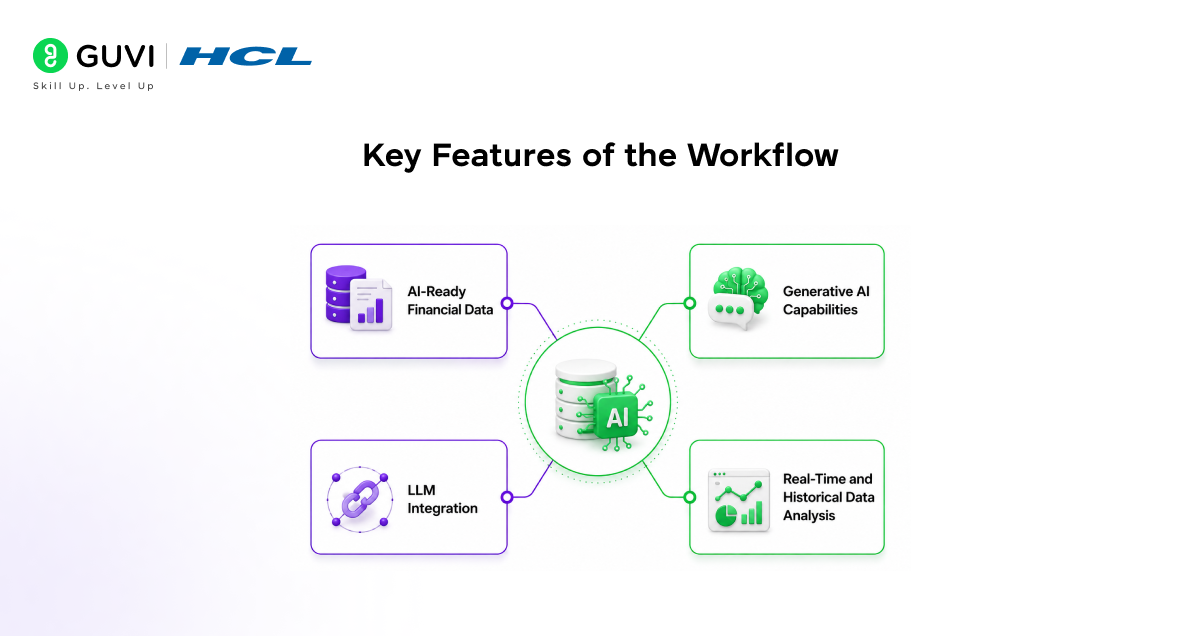
These features demonstrate how structured financial data and AI capabilities combine to create a more efficient research workflow.
AI-Ready Financial Data
FactSet offers an array of structured datasets specifically tailored for analytical purposes. These datasets include financial statements, market data, and consensus estimates that are well organized and error-free.
Generative AI Capabilities
FactSet has implemented conversational interface mechanisms that enable an intuitive interaction with financial data. This reduces the complexity traditionally associated with financial research workflows and makes data more easily accessible to everyone involved in research and decision-making.
Users can now gain quick access to insights, generate summaries of financial performance, and analyze financial trends without being a skilled coder or database expert.
LLM Integration
Having the capacity to integrate with LLMs streamlines communication between the data systems and the AI tools. AI responses will therefore be based on solid data rather than assumptions, improving the accuracy and decreasing the probability of wrong or confusing interpretations.
Real-Time and Historical Data Analysis
The real-time data generated by FactSet, combined with historical data, gives you a complete overview of performance. This is vital for the analysis of trends and risks.
Inside the Workflow:
Let’s analyze a simple financial research scenario.
First, the user will select a data set (in our case, a specific stock, industry data, or financial data) within FactSet.
Then, the user will interact with Claude and ask questions such as a report of revenue growth in the last 5 years or a comparison of financial metrics of one company against a competitor.
Claude will then take this information, analyze the data from FactSet, and provide the user with a summarized analysis that may include findings, trends, observations, or key points from the data. After that, the user may check and revise the analysis

In a typical workflow, users can quickly pull company data, compare financial metrics, and generate summaries to support data-driven decision making, reducing the need to switch between multiple tools.
Real-World Use Cases
These use cases show how FactSet and Claude can be applied across different financial research tasks to improve speed and analytical efficiency.
Investment Research
Analysts could use this tool to analyze companies or compare performance more rapidly.
Support for Financial Modeling
Claude might help in creating financial models and clarifying assumptions, although this does not replace modeling tools.
Due Diligence
Analyzing large volumes of documents quickly is essential in due diligence projects.
Portfolio Analysis
Users can monitor their portfolios, track their performance, and identify trends. Using a structured and AI-driven platform allows users to track their investments and change investment strategies as needed.
Want to see how AI-driven automation and workflow-based systems are applied in practice? This GenAI ebook provides a practical, hands-on guide to building and integrating AI into real-world applications.
Benefits of Using FactSet with Claude
- Efficiency: By automating manual data extraction and analysis, this workflow reduces the time spent on repetitive tasks and allows analysts to focus more on interpreting results and making decisions.
- Accessibility: Interacting with data through a natural language model makes it easier for users to explore financial information without needing advanced technical or query-building skills.
- Consistency: Since the data is sourced from FactSet, the outputs are more structured and standardized, which helps reduce inconsistencies during analysis.
This workflow also reflects a broader shift in financial operations, where AI tools and finance plugins are used to streamline reporting, tracking, and analysis processes.
Limitations to Keep in Mind
While this workflow is beneficial, there are a few drawbacks to be considered.
- Accuracy: AI models still have a risk of errors and a lack of understanding when dealing with nuances in complex financial data; thus, human review and verification of output are critical.
- Automation Reliance: While AI can assist with tasks and analysis, users must avoid excessive automation that can prevent them from engaging in critical thinking and drawing upon domain knowledge.
- Data Quality: A solid platform, such as FactSet, is a necessity, but users also must be careful when interpreting the output provided by the AI.
Best Practices for Effective Utilization
- Asking Good Questions: Users should attempt to ask specific, targeted questions to their AI.
- Verify Your Output: Before making decisions based on your output, ensure that you are reviewing the data provided carefully.
- Use as a Tool, Not a Replacement: AI should always be used as support rather than as a replacement for domain knowledge and expertise.
- Consistent Workflow: Following a workflow ensures consistency and overall quality of the research.
To build practical skills in AI-driven financial workflows and system-level integrations, it is important to go beyond theory and work with real-world tools and data. Programs such as the Artificial Intelligence and Machine Learning Course by HCL GUVI can help learners understand how to build and integrate scalable systems, manage data workflows, and implement automation in real-world applications.
Conclusion
FactSet financial research, combined with Claude, is a major step forward for financial analysis processes. This combination of financial data and AI reasoning makes workflows more efficient and helps generate insights faster.
While AI improves productivity, the role of human analysts remains essential for accurate interpretation and decision-making.
In the future, this blend of data and intelligence will grow in importance in financial analysis, shaping how researchers approach data, generate insights, and make informed decisions.
FAQs
1. What is FactSet financial research?
FactSet financial research involves using FactSet to access and analyze financial data like company performance and market trends. It combines multiple datasets into one platform for easier research and insights.
2. How does Claude support financial research?
Claude helps interpret financial data by generating summaries, comparisons, and insights through natural language queries. It reduces manual effort but may require prompt refinement for accurate results.
3. Can FactSet and Claude replace traditional analysis?
No, they support analysis but do not replace it completely. Human validation and tools like Excel are still needed for final decisions and detailed modeling.
4. What are the limitations of using Claude with FactSet?
AI outputs can sometimes lack context or accuracy, especially in complex scenarios. Users must review results and may need multiple prompts to refine insights.
5. Is this workflow suitable for beginners?
Yes, it simplifies financial data access and makes analysis easier to understand. However, basic financial knowledge is still important to interpret results correctly.
6. What is the biggest advantage of this integration?
It speeds up the process from data access to insight generation. This allows analysts to focus more on decision-making rather than manual data handling.
Success Stories

About the Author
Vishalini Devarajan
An Aerospace Engineer turned content writer, I focus on making complex concepts easy to understand through well-structured, reader-friendly blogs. Whether it’s a technical topic or a non-technical one, I love creating content that is clear, engaging, and impactful.
View all posts by Vishalini Devarajan
Connect with me @












Did you enjoy this article?