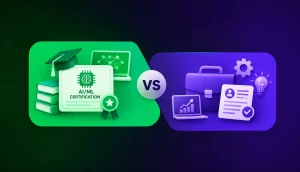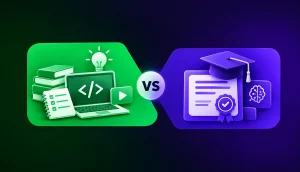
TL;DR — Quick Answer
If your priority is getting job-ready AI/ML skills faster, an AI/ML bootcamp generally has the advantage because it focuses on practical tools, projects, and applied skills within a shorter learning period. A traditional AI/ML master’s degree is the stronger choice if you want deeper mathematical foundations, academic research, or advanced research-oriented roles.
Best for speed: AI/ML bootcamp
Best for academic depth: AI/ML master’s degree
Best for AI research: Master’s degree
Best for faster career switching: AI/ML bootcamp
Best long-term approach: Choose based on your target AI/ML role, not the credential alone.
Who this comparison is for: College students, freshers, working professionals, career switchers, and aspiring AI/ML engineers in India who are deciding between an AI/ML bootcamp and a traditional master’s degree.
What Are an AI/ML Bootcamp and an AI/ML Master’s Degree?
An AI/ML bootcamp is an intensive, skills-focused learning program designed to teach learners the technologies and workflows needed to work with artificial intelligence and machine learning.
Instead of spending several semesters studying a broad academic curriculum, learners typically focus on practical areas such as:
- Python programming
- NumPy and Pandas
- SQL
- Statistics and probability
- Data preprocessing
- Machine learning algorithms
- Deep learning
- Natural language processing
- Computer vision
- Generative AI
- Model evaluation
- Model deployment
- AI/ML projects
The exact curriculum varies significantly between providers. A good AI/ML bootcamp should therefore be judged by what you build and can demonstrate, not simply by its duration or certificate.
For example, a software developer with a bachelor’s degree can use an AI/ML bootcamp to learn Python, SQL, model building, and deployment in months instead of spending two years on a master’s degree. By building projects like churn prediction and document Q&A apps, they can create a portfolio and apply for entry-level AI/ML roles faster.
AI/ML Bootcamp vs Master’s Degree: Side-by-Side Comparison
| Criteria | AI/ML Bootcamp | AI/ML Master’s Degree | Better Choice |
|---|---|---|---|
| Typical Duration | A few months to about a year | Usually 1–2+ years | Bootcamp |
| Learning Style | Practical and intensive | Academic and structured | Depends |
| Curriculum Depth | Focused | Broad and deep | Master’s |
| Hands-on Projects | Usually high | Varies by university | Bootcamp |
| Mathematics | Applied fundamentals | Usually deeper | Master’s |
| Research Exposure | Limited to moderate | Stronger | Master’s |
| Industry Tools | Usually current and practical | Depends on curriculum | Bootcamp |
| Thesis/Dissertation | Usually no | Usually possible or required | Master’s |
| Career Switching | Strong fit | Longer transition | Bootcamp |
| AI Research | Limited | Strong fit | Master’s |
| Faster Job Readiness | Strong advantage | Longer runway | Bootcamp |
| Academic Credential | Certificate | Postgraduate degree | Master’s |
| Portfolio Development | Usually central | Depends on program | Bootcamp |
| Networking | Cohort/industry focused | University/alumni focused | Depends |
| Best For | Job-focused learners | Advanced academic/research paths | Depends |
Find Your Best AI/ML Learning Path
Answer 3 quick questions to discover whether an AI/ML Bootcamp or Master’s Degree better matches your career goals, learning style, and timeline.
What is your main goal for learning AI/ML?
Think about what you want to achieve first.
How do you prefer to learn?
Choose the learning style that suits you best.
What matters most in your AI/ML career?
Think about your biggest priority.
The Key Difference Between an AI/ML Bootcamp and Master’s Degree
The biggest difference is simple:
An AI/ML bootcamp focuses on faster practical skill development, while a master’s degree focuses on deeper academic and technical learning.
Learning Speed: A bootcamp helps you build job-ready AI/ML skills in a shorter time, while a master’s degree requires a longer commitment.
Practical Training: A bootcamp emphasizes coding, tools, projects, and deployment, while a master’s degree combines practical work with advanced theory.
Technical Depth: A master’s degree usually provides deeper knowledge of mathematics, algorithms, optimization, and machine learning concepts.
Career Focus: A bootcamp is better suited for applied AI/ML roles and career switching, while a master’s degree is more suitable for research-oriented and advanced technical careers.
Research Opportunities: A master’s degree typically offers stronger exposure to research, academic papers, thesis work, and advanced experimentation.
Job Readiness: A bootcamp can help you become job-ready faster, but a master’s degree may provide stronger long-term academic and technical foundations.
In Practical Terms
Imagine two learners want to become machine learning professionals.
Learner A already has a bachelor’s degree and basic programming knowledge. They want to switch into an AI/ML role within the next year.
A structured AI/ML bootcamp may allow them to concentrate on Python, data processing, machine learning, deep learning, projects, and deployment.
Learner B wants to work on new learning algorithms or eventually enter AI research.
A master’s degree may provide a stronger foundation in mathematics, optimization, research methodology, and advanced machine learning.
The destination determines which road makes more sense.
Artificial Intelligence and Machine Learning Programme
AI/ML Bootcamp vs Master’s Degree for Getting Job-Ready Faster
If the specific goal is speed, an AI/ML bootcamp usually has the advantage.
A traditional master’s degree takes longer because learners cover a broader academic curriculum. A bootcamp can compress the learning journey around skills that employers commonly expect for applied roles.
That distinction matters because AI hiring is increasingly tied to practical technical capabilities.
What a Faster Job-Ready Path Should Cover
A practical AI/ML curriculum should ideally take you through:
- Programming foundations: Python and basic software development.
- Data skills: NumPy, Pandas, SQL and data cleaning.
- Statistics: Probability, distributions, hypothesis testing and model evaluation.
- Machine learning: Regression, classification, clustering and ensemble methods.
- Deep learning: Neural networks and frameworks such as PyTorch or TensorFlow.
- Specializations: NLP, computer vision or generative AI.
- Deployment: APIs, cloud basics and model serving.
- Projects: End-to-end applications using realistic datasets.
- Portfolio development: GitHub, documentation and project explanations.
- Interview preparation: Coding, ML concepts, projects and problem-solving.
The more of this journey a program integrates, the less additional work you may need before applying for jobs.
AI/ML Bootcamp vs Master’s Degree for Freshers
Freshers need to think beyond the credential.
A master’s degree can provide a structured academic environment, internships, university networks, and deeper theoretical exposure. It can also be valuable if your undergraduate degree does not provide enough technical depth.
An AI/ML bootcamp can be attractive when a fresher already has a suitable degree and wants to build practical skills quickly.
Choose a Master’s If You Are a Fresher Who:
- Wants advanced academic learning.
- Enjoys mathematics and theoretical computer science.
- Is considering research or a PhD.
- Wants university-based internships and research opportunities.
- Needs a postgraduate credential for a specific career goal.
- Can invest one or more additional years in formal education.
Choose a Bootcamp If You Are a Fresher Who:
- Already has basic programming knowledge.
- Wants to start building projects quickly.
- Wants a focused AI/ML curriculum.
- Prefers hands-on learning.
- Wants to create a portfolio alongside learning.
- Wants to enter the job market sooner.
One Important Reality for Freshers
A certificate alone will not make you an AI/ML engineer.
You should be able to explain:
- Why you selected a particular model.
- How you cleaned your dataset.
- How you handled missing or imbalanced data.
- Which evaluation metrics you used.
- Why your model performed well or poorly.
- How you would deploy or improve the solution.
That is what turns job-ready AI skills into demonstrable capability.
AI/ML Bootcamp vs Master’s Degree for Working Professionals
Working professionals have a different constraint: opportunity cost.
Spending one or two years studying full-time may mean giving up income, work experience, or career momentum.
A flexible AI ML bootcamp can allow professionals to build skills while continuing to work.
AI/ML Bootcamp vs Master’s Degree for AI Research
If your ambition is AI research, a master’s degree generally offers stronger preparation.
Research-oriented work may require deeper understanding of:
- Advanced mathematics
- Probability and statistics
- Optimization
- Algorithms
- Research methodology
- Experimental design
- Academic literature
- Scientific communication
A bootcamp can introduce these concepts, but it typically does not provide the same academic environment as a university research program.
This distinction matters for roles involving the development of new algorithms, fundamental research, or highly specialized AI systems.
Roles Where a Master’s Can Be More Valuable
A postgraduate degree can be especially useful for:
- AI Research Scientist
- Machine Learning Researcher
- Research Engineer
- Advanced Computer Vision Researcher
- NLP Researcher
- University Researcher
- PhD-track careers
However, the exact education requirement varies by employer, geography, specialization, and experience.
AI/ML Bootcamp vs Master’s Degree for Building Practical Skills
Practical learning is one of the strongest reasons learners choose bootcamps.
A good program should make you repeatedly move through this cycle:
Learn → Build → Test → Debug → Explain → Improve → Deploy
For example, instead of simply studying classification algorithms, you could build a customer-churn prediction model.
Instead of only studying NLP, you could create a text-classification application.
Instead of learning computer vision theoretically, you could build an image-classification system and evaluate its performance.
What Makes a Project Job-Ready?
A strong AI/ML project should demonstrate more than a Jupyter Notebook.
Try to include:
- A clearly defined business problem.
- Data collection or a credible dataset.
- Data cleaning.
- Exploratory analysis.
- Feature engineering.
- Model selection.
- Evaluation.
- Error analysis.
- Documentation.
- A usable interface or API where appropriate.
- Deployment when feasible.
- GitHub documentation.
This is particularly important because AI job requirements are expanding beyond traditional machine learning.
Artificial Intelligence and Machine Learning Programme
AI/ML Bootcamp vs Master’s Degree: Cost and Time Investment
| Factor | AI/ML Bootcamp | AI/ML Master’s Degree |
|---|---|---|
| Time Commitment | Usually shorter | Usually longer |
| Opportunity Cost | Lower | Higher |
| Tuition | Varies | Varies significantly |
| Income While Studying | Often possible | Depends on format |
| Practical Focus | Usually high | Program-dependent |
| Academic Credential | Certificate | Master’s degree |
| Research Exposure | Limited/moderate | Usually stronger |
| Career Transition Speed | Faster | Slower |
Which Path Builds Better Job-Ready AI Skills?
The honest answer is:
The program with the stronger combination of practical curriculum, projects, mentorship, current tools, and career preparation builds better job-ready AI skills, regardless of whether it is called a bootcamp or degree.
A learner can finish a master’s degree without building a strong portfolio.
A learner can finish a bootcamp without understanding the fundamentals deeply enough.
The credential is only one part of the equation.
Recommendation — Which Path Should You Choose?
There is no universal winner in the AI ML bootcamp vs masters debate. The better option depends on your destination.
Choose an AI/ML Bootcamp If:
- Your priority is speed.
- You already have a degree.
- You want to switch careers.
- You prefer hands-on learning.
- You want to build a portfolio quickly.
- You want to learn practical AI/ML tools.
- You want to continue working while learning.
- You are targeting applied AI/ML roles.
Choose an AI/ML Master’s Degree If:
- You want deep academic knowledge.
- You are interested in AI research.
- You want to pursue a PhD.
- You enjoy mathematics and theory.
- You want university-based research opportunities.
- Your target role strongly values postgraduate education.
- You are comfortable making a longer educational investment.
Should You Do Both?
Not necessarily. If you already have a relevant technical degree, jumping directly into another long academic program may not be the most efficient route.
A more practical sequence can be:
Degree → AI/ML specialization → Projects → Portfolio → Internship/Job → Continuous upskilling
For research-oriented careers, the sequence could instead be:
Degree → Master’s → Research/Thesis → Publications/Projects → Research Role or PhD
The important thing is to avoid collecting credentials without building capability.
Which AI/ML Path Fits You Best?
Answer 3 quick questions to find out whether an AI/ML Bootcamp or Master’s Degree better matches your career goals, learning preferences, and future plans.
Where do you want to be in the next 2 years?
Think about the kind of progress you want to make.
What kind of learning experience sounds best to you?
Choose what feels most natural to you.
What would make you feel most career-ready?
Think about what you would value most after completing your learning journey.
Conclusion
The AI/ML bootcamp vs master’s degree decision ultimately comes down to what you want from your AI career.
If your priority is speed, practical exposure, projects, and faster entry into applied AI/ML roles, an AI/ML bootcamp can be the more efficient choice.
If you want deeper theory, research experience, or a pathway toward advanced academic roles, an AI/ML master’s degree can justify the longer investment.
Neither credential automatically creates job-ready talent. Your ability to code, work with data, build and evaluate models, deploy solutions, explain your decisions, and maintain a strong portfolio matters enormously.
Choose the path that matches your target role, learning style, timeline, and long-term AI/ML career path.
Frequently Asked Questions
1. Is an AI/ML bootcamp better than a master’s degree?
An AI/ML bootcamp is better when your priority is faster, practical skill development, while a master’s degree is better for academic depth and research-oriented careers. Your target role should determine the choice.
2. Which is faster: an AI ML bootcamp or master’s degree?
An AI ML bootcamp is generally faster because it concentrates learning into a shorter, skills-focused program. However, speed alone does not guarantee job readiness; you still need projects, technical fundamentals, and interview preparation.
3. Can an AI/ML bootcamp help me get a job?
Yes, an AI/ML bootcamp can help you prepare for applied roles when it includes practical projects, relevant tools, mentorship, portfolio development, and career preparation. The certificate itself does not guarantee employment.
4. Is an AI/ML master’s degree necessary to become a machine learning engineer?
No, a master’s degree is not universally necessary to become a machine learning engineer. Requirements vary by company and role, and many applied positions evaluate programming, machine learning knowledge, projects, and professional experience alongside formal education.
5. Is an AI/ML master’s degree better for AI research?
Generally, yes. A master’s degree usually provides stronger exposure to advanced mathematics, research methodology, academic literature, and thesis-based work, making it more suitable for research-oriented AI careers.
6. What are the most important job-ready AI skills?
Important job-ready AI skills include Python, SQL, statistics, data preprocessing, machine learning, deep learning, model evaluation, software development, deployment, and problem-solving. Depending on the role, generative AI, LLMs, computer vision, NLP, or MLOps can also be important.
7. Can working professionals learn AI/ML without doing a master’s degree?
Yes. Working professionals can build AI/ML skills through structured bootcamps, professional programs, individual courses, projects, and continuous practice. A flexible program can be useful when maintaining employment is important.
8. Should I do an AI ML bootcamp after my bachelor’s degree?
You can consider an AI ML bootcamp after a bachelor’s degree if you want to specialize quickly and already have or are willing to build the necessary programming and mathematical foundations. Compare the curriculum and project depth before enrolling.
9. Which is more expensive: an AI ML bootcamp or master’s degree?
There is no universal answer because costs vary by institution, country, program, and learning format. Compare total tuition, living expenses, opportunity cost, and the time required before you can realistically enter the workforce.
10. Can I do both an AI ML bootcamp and a master’s degree?
Yes, but you do not necessarily need both. A bootcamp can complement a degree when you need practical skills, while a master’s can provide deeper academic preparation; choose the combination only when it supports a specific career objective.