


Career Articles
How I Switched from Web Developer to ML Engineer (A Web Developer's Real Story)
PHP Developer Resume: Writing Guide & Key to Landing Your Dream Job
My Frontend Developer Interview at Google: What Really Happens Behind Closed Doors
Future of Electric Vehicle Course: Fast-Track Your EV Career


Get In Touch For Details! Request More Information
IT Certification Roadmap 2026: What Most Career Guides Get Wrong
Jan 09, 2026 5 Min Read 1611 Views
(Last Updated)
Your IT certification roadmap can make or break your tech career advancement in 2026. From 2022 to 2023, the average number of certifications an IT professional holds has nearly doubled, highlighting how crucial proper certification planning has become.
According to Global Knowledge’s IT Skills and Salary Report, certified professionals earn an average of 12% more than their non-certified peers. Furthermore, 21 per cent of IT professionals who obtained a salary increase attribute it directly to new skill development.
However, most IT certification pathways and guides miss the mark. They often follow rigid templates that ignore your specific career goals and the most in-demand IT certifications that employers actually value. This guide will show you how to create a smarter certification strategy that aligns with real-world job roles and helps you navigate the complex landscape of IT security certification roadmaps and other specialised paths. Let’s begin!
Quick Answer:
Most IT certification roadmaps fail because they follow generic, one-size-fits-all paths that ignore real job roles, hands-on skills, and employer-driven demand—leading many professionals to pursue certifications that don’t actually advance their careers.
Table of contents
- Why Most IT Certification Roadmaps Fall Short
- One-size-fits-all approach
- Ignoring real-world job roles
- Overemphasis on vendor-specific paths
- Understanding the Core IT Certification Pathways
- Foundational certifications: Where to begin
- Core certifications: Building technical depth
- Advanced certifications: Specialising with purpose
- Mapping Certifications to Career Goals
- IT support and help desk roles
- Network and system administration
- Cybersecurity career tracks
- Cloud and DevOps roles
- Project management and governance
- How to Build a Smarter IT Certification Roadmap
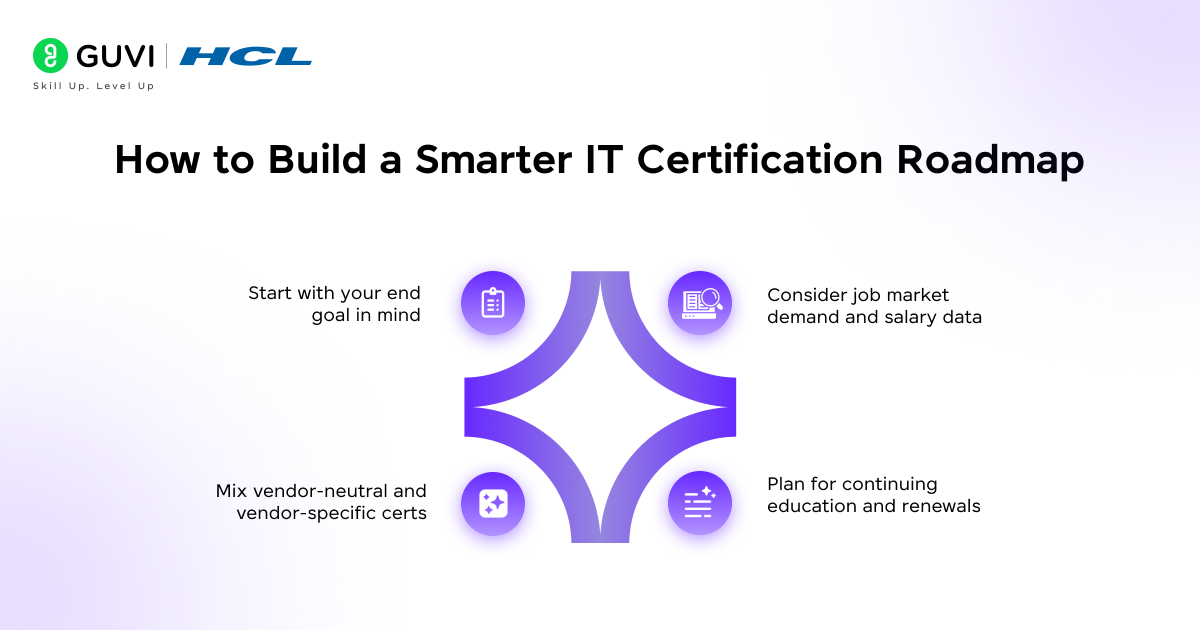
- Start with your end goal in mind
- Mix vendor-neutral and vendor-specific certs
- Consider job market demand and salary data
- Plan for continuing education and renewals
- Concluding Thoughts…
- FAQs
- Q1. What are the key components of a successful IT certification roadmap?
- Q2. How do certifications impact IT professionals' salaries?
- Q3. Which IT career paths are showing the most growth?
- Q4. What are some foundational IT certifications for beginners?
- Q5. How often do IT certifications need to be renewed?
Why Most IT Certification Roadmaps Fall Short
Many IT professionals rush to collect certifications without a strategic plan, eventually finding their efforts misaligned with career goals. Traditional IT certification roadmaps often lead candidates astray for several critical reasons.
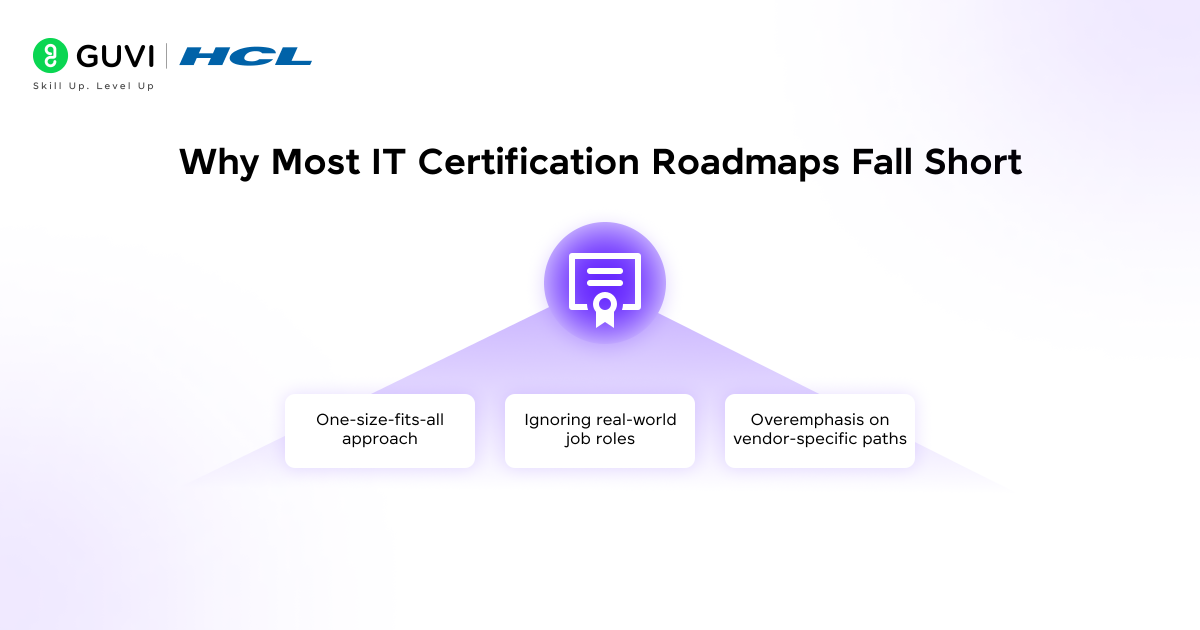
1. One-size-fits-all approach
Standard certification paths frequently assume all IT professionals have identical career goals, which couldn’t be further from reality. Research shows that choosing the wrong certification for your specific objective is a common pitfall, with many professionals chasing “hot” certifications without verifying their relevance to desired positions.
Different IT management certifications serve different career goals. Some professionals build teams, others manage infrastructure, and some shape business strategy—making generic roadmaps ineffective. The most successful certification strategies are personalised, considering:
- Your specific technical interests
- Target job market requirements
- Long-term career objectives
2. Ignoring real-world job roles
Certifications primarily test theoretical knowledge, yet real IT work involves practical application and problem-solving in real time. This disconnect creates a significant gap between certification and job readiness.
Many certified professionals still fail technical screening tests because:
- They lack hands-on experience applying theoretical knowledge
- Skills developed during certification fade without continued use
- They haven’t developed critical soft skills like teamwork and communication
Notably, many successful IT professionals prioritise gaining hands-on experience through home labs, bug bounty hunting, or online practice environments over pursuing multiple certifications.
3. Overemphasis on vendor-specific paths
Vendor-specific certifications create several limitations for IT professionals. Essentially, these certifications make you part of a vendor’s sales effort rather than focusing on your personal growth.
The 2021 ISC Cybersecurity Workforce Study found industry demand is almost evenly split between vendor-neutral and vendor-specific certifications. Nevertheless, an overreliance on vendor-specific paths creates several disadvantages:
- Limited strategic understanding beyond single-vendor solutions
- Dependency on specific platforms, restricting career mobility
- Resource-intensive recertification requirements as technologies update
- Potential bias toward recommending familiar vendor solutions
Instead of following rigid certification paths, successful IT professionals typically build broader knowledge bases that remain relevant regardless of platform changes.
Understanding the Core IT Certification Pathways
Building an effective IT certification roadmap requires understanding how certifications are structured in progressive levels. Unlike one-size-fits-all approaches, strategic certification planning follows a logical pathway that builds competencies systematically.
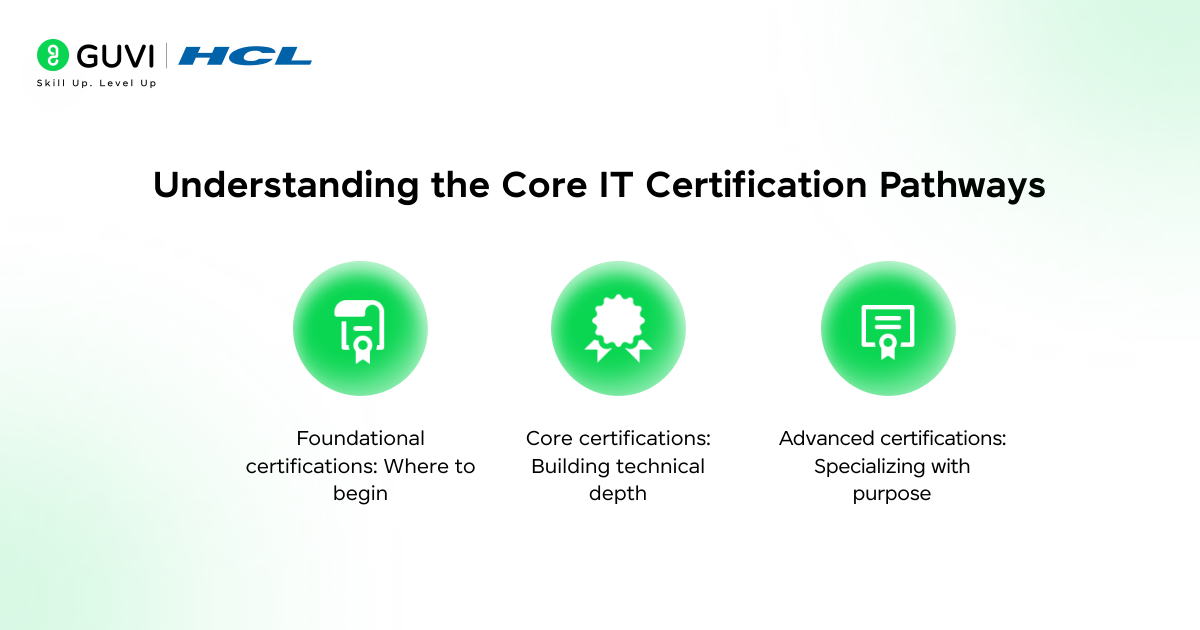

1. Foundational certifications: Where to begin
Foundational certifications establish basic knowledge and require minimal experience, making them perfect entry points. These credentials introduce key concepts and validate fundamental IT skills:
- CompTIA A+: Widely recognised as the gold standard for beginning IT careers, covering hardware, software troubleshooting, networking, and security fundamentals
- CompTIA Tech+ (formerly ITF+): Designed for absolute beginners with no prior experience
- Microsoft Certified Fundamentals: Role-based certifications covering basic technology skills for specific job functions
- Google IT Support Professional Certificate: Prepares candidates for entry-level roles and aligns with CompTIA A+ exam content
These initial credentials demonstrate basic competency and prepare you for tier-one support positions, help desk roles, and junior technician positions.
2. Core certifications: Building technical depth
Once you’ve established a foundation, core certifications develop specialised knowledge in specific technology domains:
- CompTIA Network+ validates networking skills, including managing connectivity, routing principles, and configuring network hardware. Similarly, CompTIA Security+ confirms the ability to identify vulnerabilities and implement risk management practices.
- Cisco Certified Network Associate (CCNA) covers networking fundamentals, IP connectivity, and services—ideal for network administration roles.
According to industry surveys, 99% of organisations use technical certifications when making hiring decisions. Core certifications demonstrate professional-level competency, positioning you for intermediate roles with increased responsibility.
3. Advanced certifications: Specialising with purpose
Advanced certifications validate expertise in specialised domains and typically require significant experience:
- The Certified Information Systems Security Professional (CISSP) remains one of the most respected cybersecurity certifications, while CompTIA CySA+ focuses specifically on security analytics and incident response.
- For cloud specialists, certifications like AWS Solutions Architect or Microsoft Azure Certifications demonstrate platform-specific expertise.
Advanced credentials qualify professionals for senior roles, with 63% of certified professionals receiving job promotions after certification.
By following this structured pathway—starting with foundational knowledge, building core technical skills, then specialising—you create a roadmap that aligns with natural career progression in IT.
Mapping Certifications to Career Goals
First and foremost, aligning your IT certification roadmap with specific career goals maximises your return on investment. Different roles require different skill sets, making targeted certification planning essential for career advancement.
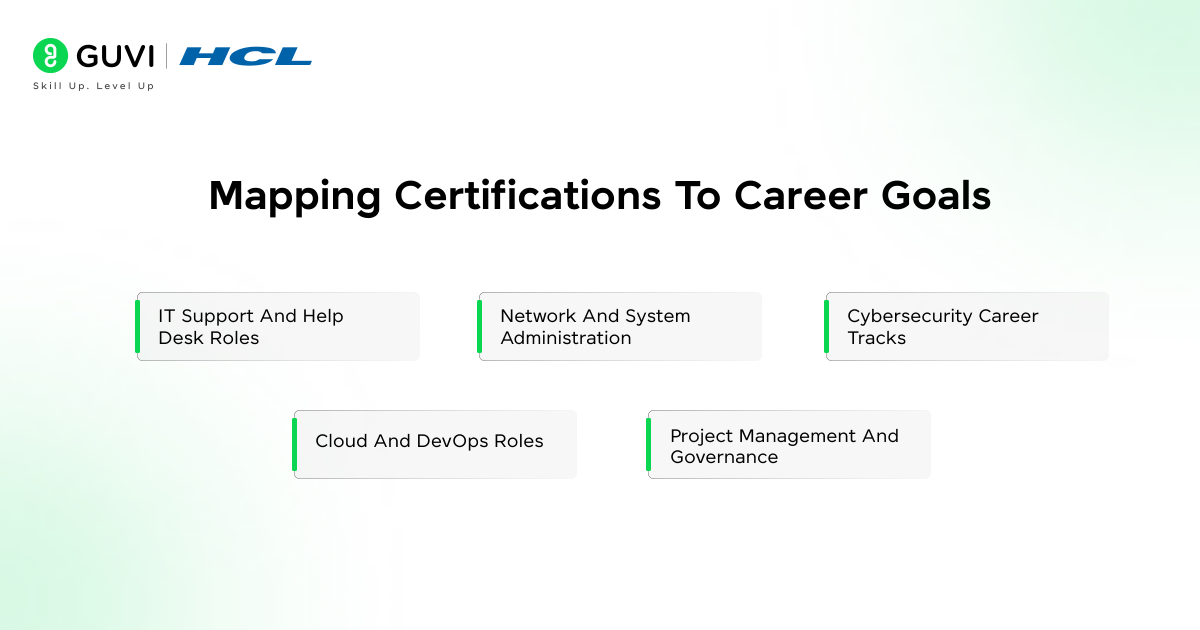
1. IT support and help desk roles
- For entry-level IT positions, CompTIA A+ remains the ideal starting point, validating fundamental troubleshooting skills and technical knowledge. HR professionals in medium and large organisations frequently prioritise this certification during hiring processes, with 79% relying on industry-recognised technical certifications.
- Additionally, the Google IT Support Certificate provides a solid foundation for beginners seeking help desk positions. For Microsoft-focused environments, Microsoft 365 Certified: Modern Desktop Administrator Associate certification demonstrates proficiency in Microsoft’s widespread technologies—currently running on 1.6 billion active devices.
2. Network and system administration
- The network administration track typically begins with CompTIA Network+, which covers vendor-neutral networking fundamentals. As you advance, the Cisco Certified Network Associate (CCNA) certification validates your ability to install, configure, and troubleshoot small to medium-sized networks.
- In India, network/system administrator roles typically earn between roughly ₹9.5 lakh to ₹43.9 lakh per annum (average ~ ₹14.4 lakh) according to recent salary data.
3. Cybersecurity career tracks
Cybersecurity positions are projected to grow by 33% between 2023 and 2033, making this career path particularly promising. Key certifications include:
- CompTIA Security+: An entry-level security credential covering essential cybersecurity skills
- Certified Information Systems Security Professional (CISSP): A respected advanced certification for experienced professionals
- Certified Ethical Hacker (CEH): Validates offensive security capabilities for roles like penetration testers
4. Cloud and DevOps roles
For cloud computing careers, consider AWS Certified Cloud Practitioner or Microsoft Azure Fundamentals to establish baseline knowledge. More advanced roles like DevOps engineers (entry level ~ ₹4 lakh–₹15 lakh, mid-level ~ ₹7 lakh–₹15 lakh, senior roles ~ ₹12 lakh–₹25 lakh and in rare cases higher) benefit from the AWS Certified DevOps Engineer certification, which ranks among 2023’s top-paying certifications in North America.
5. Project management and governance
The Project Management Professional (PMP) certification remains the gold standard, with 66% of PMP holders reporting increased compensation. For IT governance, certifications like Certified in Governance of Enterprise IT (CGEIT) validate expertise in aligning IT with business objectives.
To add some perspective, here are a few lesser-known facts about IT certifications that reveal how much they influence career growth today:
Certification Value Surge: Between 2022 and 2023, the average number of certifications held by IT professionals nearly doubled, indicating how rapidly certifications have become a competitive requirement rather than an optional bonus.
First Major IT Certification: CompTIA A+, introduced in 1993, was the first widely recognized IT certification and is still considered the foundational entry point for beginners.
Certification and Salary Link: According to industry salary reports, certified IT professionals consistently earn higher compensation, with measurable increases tied directly to newly acquired certifications and skills.
How to Build a Smarter IT Certification Roadmap
Creating a strategic IT certification roadmap begins with planning. Research indicates 93% of IT professionals have at least one certification, highlighting the importance of certification planning. Here’s how to build your personalised roadmap:
1. Start with your end goal in mind
Developing an effective IT certification roadmap requires clarity about your career destination. Above all, identify your specific career objectives before pursuing any certification. Ask yourself:
- What roles interest you most?
- Which technical areas align with your strengths?
- What timeline works for your career progression?
This approach prevents wasting time on certifications that don’t advance your career goals.
2. Mix vendor-neutral and vendor-specific certs
Industry demand is almost evenly split between vendor-neutral and vendor-specific certifications. Vendor-neutral certifications provide broad knowledge applicable across platforms, whereas vendor-specific ones demonstrate expertise in particular technologies.
Begin with vendor-neutral certifications like CompTIA to establish foundational knowledge, subsequently adding vendor-specific credentials based on employer needs.
3. Consider job market demand and salary data
In reality, certified professionals earn approximately 12% more than non-certified peers. Moreover, 21% of IT professionals attribute salary increases directly to new skill development.
Focus on certifications in high-growth areas such as AI, cybersecurity, and cloud computing.
4. Plan for continuing education and renewals
Most certifications expire after three years, requiring ongoing maintenance. Create a certification calendar to track renewal deadlines. Options for maintaining certifications typically include:
- Earning continuing education units (CEUs)
- Retaking certification exams
- Obtaining higher-level certifications
This proactive approach prevents certification lapses that could damage your professional credibility.
The HCL GUVI AI Software Development Course cuts through outdated certification advice by giving you hands-on, job-ready training that aligns with how tech roles are actually evolving in 2026. Instead of stacking theory-heavy certificates, this program blends AI, software engineering, and real deployment skills—precisely what employers now benchmark for hiring. It’s a faster, smarter path to becoming industry-relevant without wasting years on the wrong certs.
Concluding Thoughts…
Building your IT certification roadmap requires thoughtful planning rather than blindly following generic advice. Throughout this guide, we’ve seen how traditional certification roadmaps often fail by using one-size-fits-all approaches, ignoring real-world job requirements, and overemphasising vendor-specific credentials.
Remember that certifications alone won’t guarantee career success. Hands-on experience remains equally important, with many employers valuing practical skills alongside theoretical knowledge. Therefore, complement your certification journey with real-world practice through labs, projects, and technical challenges.
Your certification roadmap shouldn’t follow someone else’s path—it should reflect your unique career aspirations, strengths, and market opportunities. With strategic planning and targeted certification choices, you’ll build a more efficient path to IT career success in 2026 and beyond.
FAQs
Q1. What are the key components of a successful IT certification roadmap?
A successful IT certification roadmap should start with your specific career goals, balance vendor-neutral and vendor-specific certifications, consider job market demand and salary data, and include a plan for continuing education and renewals.
Q2. How do certifications impact IT professionals’ salaries?
Certified IT professionals typically earn about 12% more than their non-certified peers. Additionally, 21% of IT professionals attribute salary increases directly to new skill development through certifications.
Q3. Which IT career paths are showing the most growth?
Cybersecurity, cloud computing, DevOps, and AI/ML are the fastest-growing IT career paths in India. Cybersecurity pays ₹6–12 LPA (mid-level) and ₹25 LPA+ senior, DevOps ₹4–15 LPA and ₹12–25 LPA+, while AI/ML roles earn ₹8–20 LPA rising to ₹25–40 LPA+.
Q4. What are some foundational IT certifications for beginners?
Foundational certifications for beginners include CompTIA A+, CompTIA Tech+ (formerly ITF+), Microsoft Certified Fundamentals, and the Google IT Support Professional Certificate. These credentials establish basic knowledge and require minimal experience.
Q5. How often do IT certifications need to be renewed?
Most IT certifications expire after three years and require ongoing maintenance. Professionals can maintain their certifications by earning continuing education units (CEUs), retaking certification exams, or obtaining higher-level certifications.
Success Stories

About the Author
Jaishree Tomar
A recent CS Graduate with a quirk for writing and coding, a Data Science and Machine Learning enthusiast trying to pave my own way with tech. I have worked as a freelancer with a UK-based Digital Marketing firm writing various tech blogs, articles, and code snippets. Now, working as a Technical Writer at GUVI writing to my heart’s content!
View all posts by Jaishree Tomar
Connect with me @















Did you enjoy this article?