


Artificial Intelligence and Machine Learning Articles
Google AI Studio: Build and Test Applications with Gemini AI Models
Getting Started with OpenAI Models: A Practical Guide
Crafting Sales Emails with ChatGPT: A Comprehensive Guide for Entrepreneurs


Get In Touch For Details! Request More Information
AI in Education 2026: A Simple Guide for Beginners
Feb 11, 2026 6 Min Read 1493 Views
(Last Updated)
AI in education is transforming classrooms faster than you might realize. Already, 86% of education organizations report using generative AI, making education the highest adopter among all industries. In fact, by January 2023, nearly 90% of college students were using ChatGPT for homework help, just two months after its launch.
You’re witnessing a revolution in how learning happens. Artificial intelligence in education isn’t just a futuristic concept—it’s actively reshaping how students learn and teachers teach. This guide will help you understand what AI in education means for 2026 and beyond. You’ll discover how AI tools are being implemented, their potential advantages, and what you need to know to prepare for an AI-enhanced learning environment. Let’s begin!
Table of contents
- What is AI in Education?
- How AI is different from traditional tools
- Examples of AI tools used in schools
- How AI is Being Used in Classrooms Today
- 1) AI for students: homework help, tutoring, brainstorming
- 2) AI for teachers: lesson planning, grading, communication
- 3) AI for school leaders: administration and data insights
- Benefits of AI in Education
- 1) Personalized learning with AI
- 2) Improved student engagement
- 3) Time-saving for educators
- 4) Real-time feedback and support
- Challenges and Concerns to Know
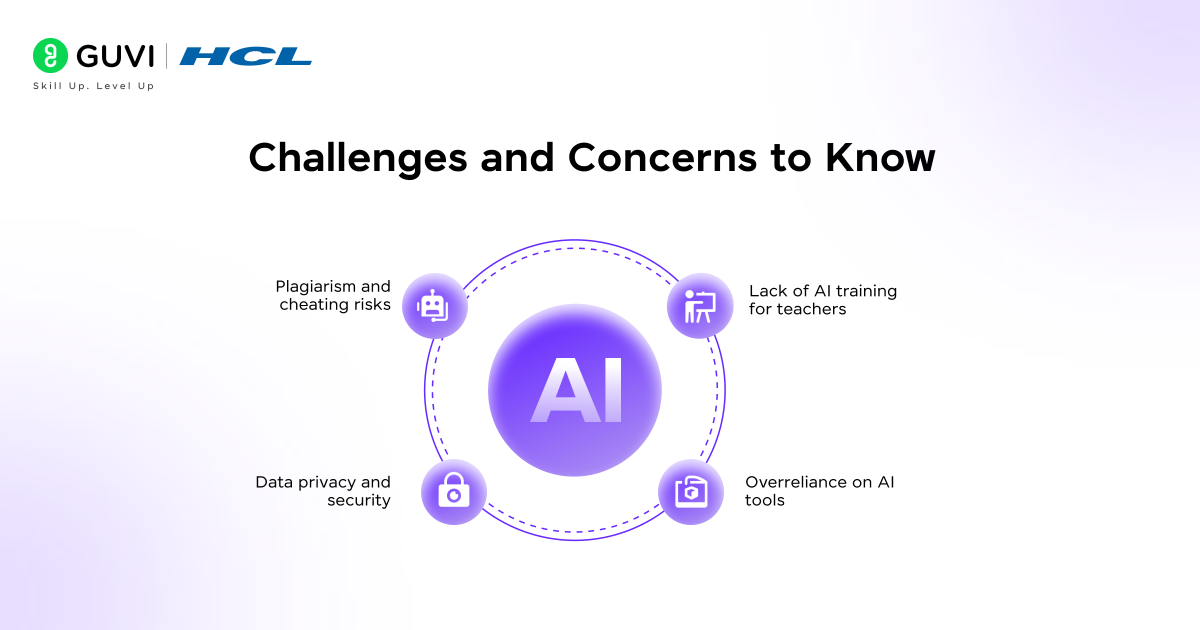
- 1) Plagiarism and cheating risks
- 2) Data privacy and security
- 3) Lack of AI training for teachers
- 4) Overreliance on AI tools
- Preparing for the Future of AI in Education
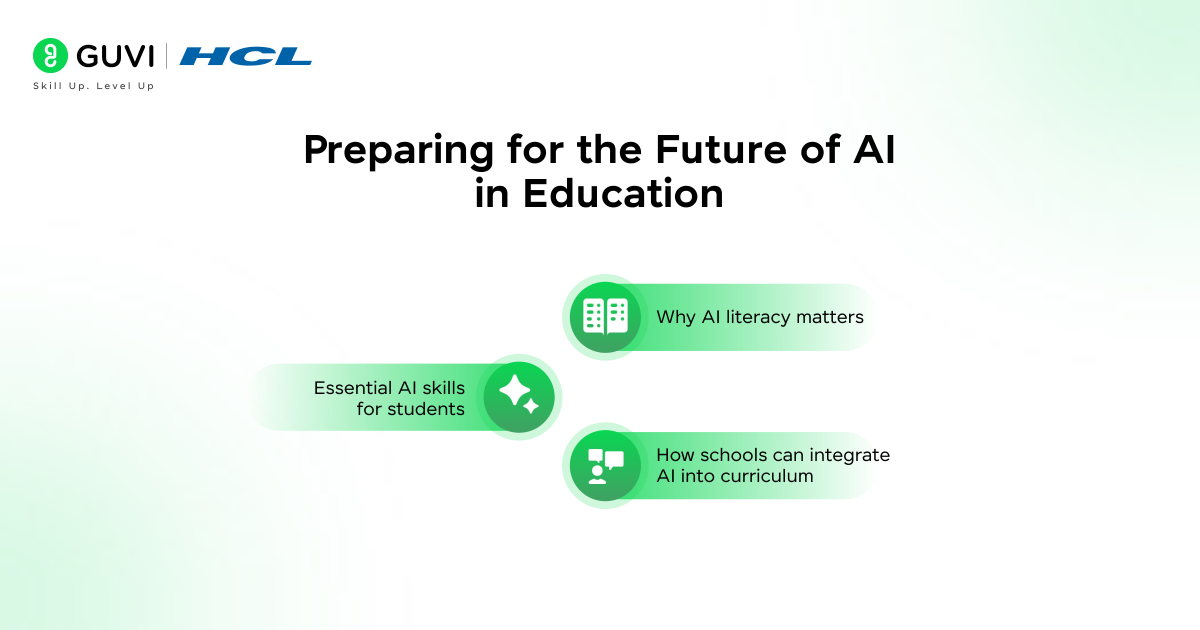
- 1) Why AI literacy matters
- 2) Essential AI skills for students
- 3) How schools can integrate AI into the curriculum
- Concluding Thoughts...
- FAQs
- Q1. How can beginners start learning AI in 2026?
- Q2. What are the essential AI skills students should develop?
- Q3. How is AI changing the role of teachers in classrooms?
- Q4. What are the main concerns about AI in education?
What is AI in Education?
AI in education encompasses the application of machine learning algorithms, adaptive systems, and intelligent software that simulate human-like decision-making to enhance teaching and learning processes.
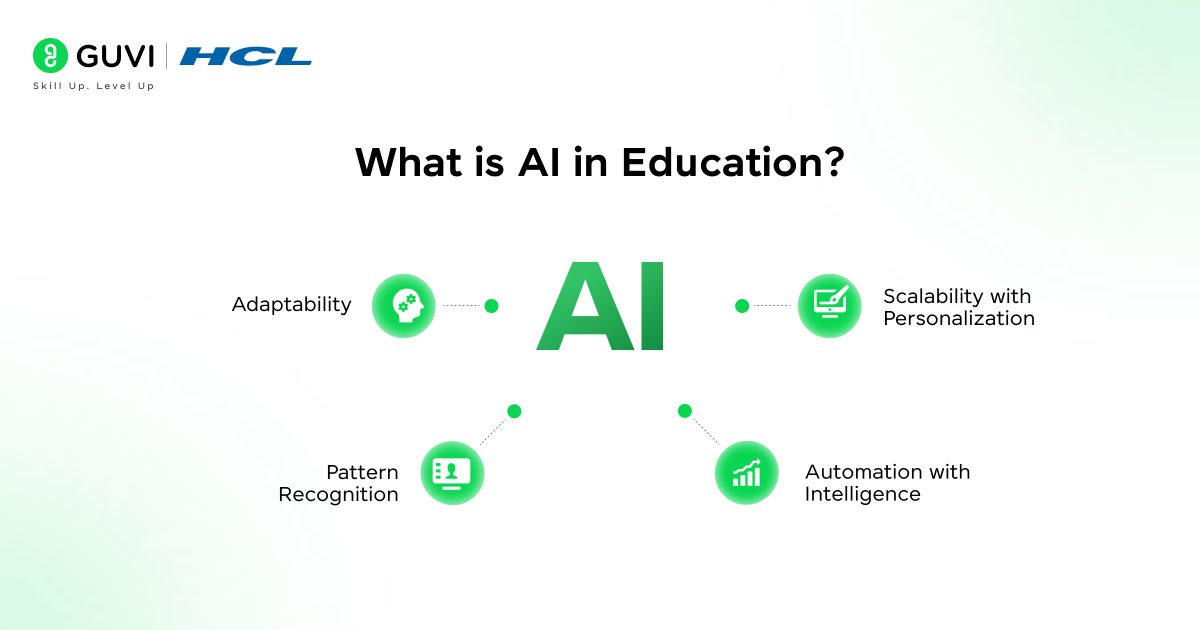
Essentially, AI in education involves two critical shifts: first, moving from simply capturing data to detecting patterns within that data, and second, transitioning from providing access to instructional resources to actually automating decisions about instruction and other educational processes.
According to researchers, artificial intelligence in education (AIED) has evolved into a substantial field with diverse applications and perspectives. Rather than just a single technology, it represents a spectrum of tools and approaches designed to make education more personalized, accessible, and efficient.
How AI is different from traditional tools
Traditional educational tools typically follow fixed programming—they do the same thing regardless of who uses them. Conversely, AI learning systems adapt based on user interaction. Here’s what makes AI fundamentally different:
- Adaptability: AI learning uses algorithms to analyze a student’s learning style, pace, and progress to create personalized experiences. Traditional tools offer the same content to all users.
- Pattern Recognition: AI can detect patterns in student performance that humans might miss, enabling more precise interventions and support.
- Automation with Intelligence: While traditional tools might automate simple tasks, AI can handle complex decisions about instruction and assessment based on real-time data analysis.
- Scalability with Personalization: AI platforms can deliver personalized lessons to thousands of students simultaneously, something impossible with traditional methods.
Examples of AI tools used in schools
Today’s classrooms are already implementing various AI tools across different educational functions:
- Intelligent Tutoring Systems: Platforms like AutoTutor and Khanmigo function as virtual tutors, adapting to student responses and providing personalized guidance.
- Personalized Learning Platforms: Systems like DreamBox analyze student progress to customize content delivery and learning paths.
- Assessment Tools: AI-powered platforms like Gradescope provide consistent, objective grading of assignments, significantly reducing teachers’ workload.
- Content Creation Assistants: Tools such as Curipod generate interactive slide decks including polls, word clouds, and open-ended questions in seconds.
- Administrative Support: AI chatbots help automate tasks like drafting emails, organizing schedules, and analyzing data for decision-making.
As these tools continue to develop, the boundary between AI and traditional educational approaches is becoming increasingly blurred, creating a hybrid learning environment that combines the best of both worlds.
How AI is Being Used in Classrooms Today
Classrooms in 2026 are already embracing AI tools at unprecedented rates, with 83% of K–12 teachers reporting they’ve used generative AI for personal or school purposes in the 2023–2024 school year. This rapid adoption is changing how learning happens across all educational levels. Let’s explore how AI is currently being used by different stakeholders in education.
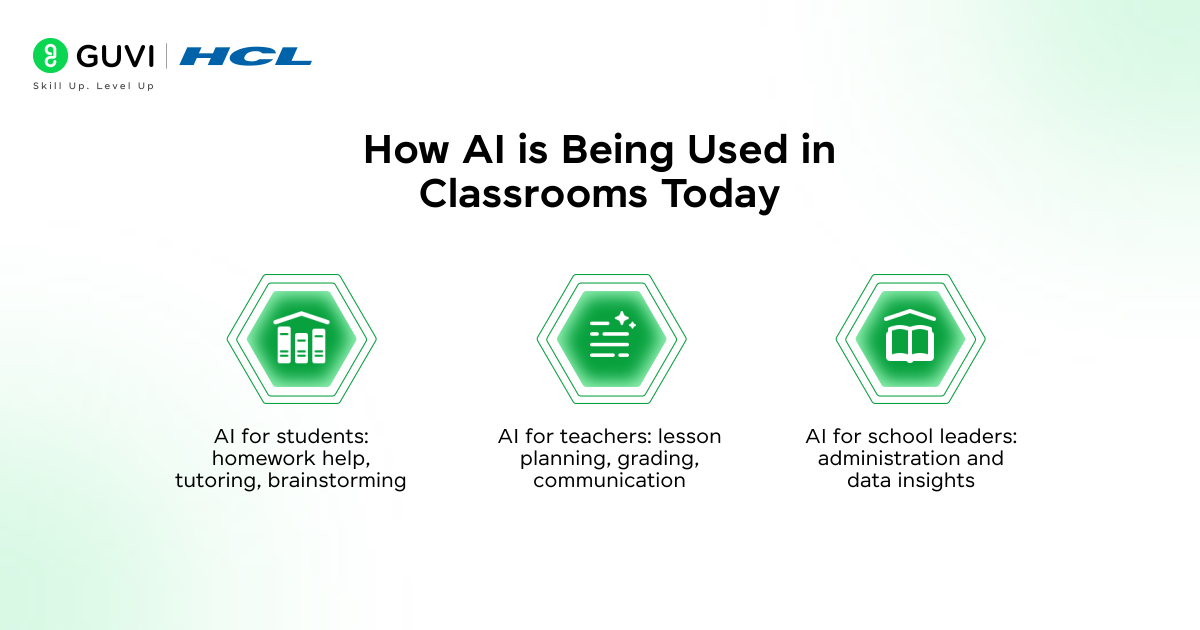

1) AI for students: homework help, tutoring, brainstorming
Students are increasingly turning to AI-powered learning companions for personalized support. Nearly 59% of teachers report certainty that at least one of their students has used generative AI for school purposes. These tools offer several advantages:
AI tutoring systems like Khanmigo don’t simply provide answers but guide students toward solutions with “limitless patience”. Unlike generic AI chatbots, education-specific tools like Khanmigo challenge students to think critically across subjects from algebra to essay writing.
Other popular tools include:
- StudyX – Offers high solution accuracy across multiple subjects with step-by-step explanations
- Edubrain.ai – Provides photo-based problem solving for handwritten notes or textbook questions
- OATutor– An open-source adaptive tutoring system developed by researchers at Berkeley
These platforms particularly excel at providing immediate feedback, allowing students to identify mistakes and correct them promptly.
2) AI for teachers: lesson planning, grading, communication
Teachers are finding relief from routine tasks through AI assistance. The adoption of AI tools helps educators focus more on human interaction and personalized teaching.
- Lesson planning has become more efficient with AI. Tools can generate high-quality lesson plans in seconds based on learning objectives and standards. For instance, Panorama Solara allows teachers to upload state standards or district materials to get customized lesson plans aligned with curriculum requirements. Similarly, NotebookLM by Google helps educators summarize materials and create structured lesson outlines quickly.
- Grading assistance is another major benefit. AI-powered platforms like Gradescope provide consistent, objective assessment of assignments, dramatically reducing the time teachers spend grading. One teacher noted that a task normally taking about an hour was completed in no more than 15 minutes using AI.
- Content creation tools help teachers develop engaging materials quickly. AI can generate visual aids for vocabulary instruction, plan interactive math lessons, and create differentiated content for diverse student needs.
3) AI for school leaders: administration and data insights
School administrators are leveraging AI to transform management and decision-making processes.
- Administrative efficiency has improved as AI automates repetitive tasks like class scheduling, attendance tracking, and report generation. AI-powered platforms scan attendance records to flag at-risk students by analyzing trends in attendance and performance.
- Data-driven decision making enables leaders to optimize resource allocation. AI analyzes information from various sources to guide administrators in making informed choices about staffing, facilities usage, and budget allocation. Tools like Tableau AI translate complex datasets into actionable insights for strategic planning.
- Communication management benefits from AI assistance with drafting emails, newsletters, and policy documents. Tools like Otter.ai provide meeting transcription services that create summaries, action items, and highlight critical decisions.
Overall, AI in education is creating a more personalized, efficient learning environment where routine tasks are automated, allowing all stakeholders to focus on what truly matters—meaningful human interactions and deeper learning experiences.
Benefits of AI in Education
The power of AI in education lies in its ability to transform learning experiences for everyone involved. As schools continue adopting these tools, four major benefits are emerging that show why AI is becoming essential in modern classrooms.
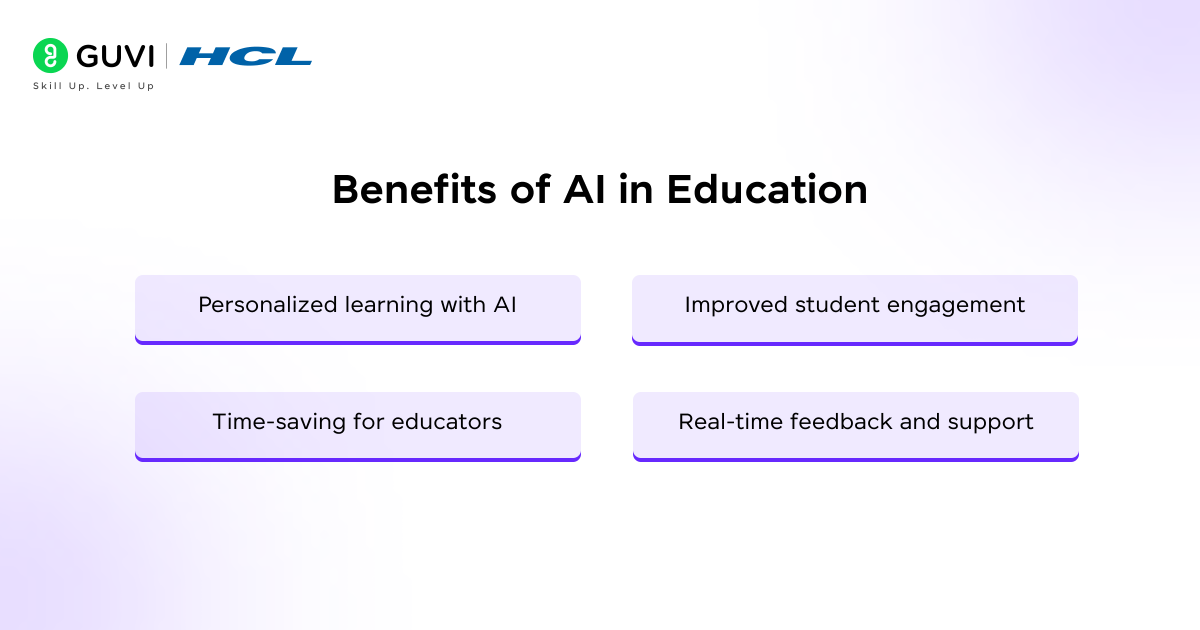
1) Personalized learning with AI
The dream of truly customized education is finally becoming a reality through AI. These systems track exactly what students know and how they learn, creating precision teaching that was previously impossible with traditional teacher-to-student ratios.
AI excels at personalizing learning in several ways:
- It analyzes individual performance data to identify knowledge gaps and create tailored learning paths
- It adapts content difficulty based on student progress, ensuring appropriate challenges
- It can handle standardized subjects like basic math skills at scale while personalizing instruction
2) Improved student engagement
Beyond personalization, AI tools create more engaging learning environments. When students feel materials speak directly to their interests and abilities, their motivation naturally increases.
AI enhances engagement through:
- Interactive learning experiences that respond to student input
- Gamification elements like rewards and challenges that motivate participation
- Dynamic content that maintains interest by adapting to student responses
3) Time-saving for educators
One of AI’s most immediate benefits is giving teachers back their time. Educators using AI weekly save an average of 5.9 hours per week—equivalent to six entire weeks per school year. This time dividend allows teachers to focus on what matters most: meaningful interactions with students.
Teachers report using AI for:
- Creating worksheets
- Modifying materials for different student needs
- Completing administrative work
- Developing assessments
4) Real-time feedback and support
Perhaps most valuable is AI’s ability to provide immediate, specific feedback. Traditional feedback often comes days or weeks after assignment submission, but AI delivers it instantly.
A Stanford-led study found that AI feedback tools improved:
- Student assignment completion rates
- Overall course satisfaction
- Instructors’ ability to acknowledge and build on student contributions
Real-time AI feedback creates a continuous improvement cycle, allowing students to correct misconceptions immediately rather than cementing incorrect understanding. This feedback process also develops metacognitive skills as students learn to evaluate their own thinking and consider different perspectives.
Challenges and Concerns to Know
While artificial intelligence in education offers exciting possibilities, several challenges need careful consideration as these tools become commonplace in learning environments.
1) Plagiarism and cheating risks
The rise of AI has created new academic integrity concerns. Approximately 70% of educators believe using AI for assignments constitutes plagiarism. More concerning still, popular plagiarism detection tools like Turnitin can only identify AI-generated content in less than 15% of cases.
Students may be tempted by AI plagiarism tools that are specifically marketed as “plagiarism free,” undermining the development of original thinking and research skills.
2) Data privacy and security
Educational AI systems collect vast amounts of sensitive information about students, sometimes including:
- Personal details and academic performance
- Behavioral patterns and online activities
- Even biometric data in some cases
This data collection creates significant privacy risks. One notable security breach involved an online exam proctoring service where hackers accessed and leaked records of roughly 444,000 students. Moreover, constant monitoring through AI tools can create a surveillance environment where students feel less safe expressing themselves freely.
3) Lack of AI training for teachers
Presently, educational institutions face a critical knowledge gap. An Education Week survey revealed that 58% of educators have received no training whatsoever on AI. Without proper guidance, teachers may unknowingly expose sensitive student information when using AI platforms.
As one expert explains, “Many of the risks posed by AI are similar to the ones other ed-tech tools already presented, but on a much larger scale”.
4) Overreliance on AI tools
The most significant concern among students is receiving incorrect or imprecise answers from AI systems. Additionally, many students worry about negative impacts on critical thinking and becoming excessively dependent on technology.
Studies indicate that students who rely heavily on AI often perform worse on assessments requiring independent thinking and problem-solving. Instead of using AI as a supplement, many students depend on it to complete work for them while still receiving credit, posing serious challenges to academic integrity.
For educational institutions to maximize AI’s potential, these concerns must be proactively addressed through clear policies, proper training, and thoughtful implementation strategies that prioritize both innovation and student well-being.
Here are some surprising insights into how AI is shaping learning around the world:
AI Tutors Have Been Around Longer Than You Think: The first intelligent tutoring system, called SCHOLAR, was developed in the early 1970s to teach geography—long before today’s ChatGPT-powered tools.
AI Adoption is Fastest in Education: With 86% of educational organizations already using generative AI, education has become the single largest adopter of AI compared to all other industries.
Students Were Quickest to Adapt: Within just two months of ChatGPT’s launch in late 2022, nearly 90% of college students had already used it for homework or study help.
These facts highlight how quickly AI is becoming an inseparable part of classrooms—making learning more adaptive, interactive, and accessible than ever before.
Preparing for the Future of AI in Education
As AI rapidly becomes embedded in educational technology, preparing for this shift requires new skills and approaches. Learning to navigate this new landscape is becoming as fundamental as reading and writing.
1) Why AI literacy matters
AI literacy has emerged as a crucial competency in today’s educational landscape. Education systems must now go beyond basic digital literacy to embrace AI literacy as a core priority.
This need has become increasingly urgent as studies reveal that almost half of Gen Z scored poorly on evaluating AI technology’s limitations, including whether AI systems can fabricate facts.
AI literacy empowers users by:
- Enhancing trust and safety in technology
- Promoting oversight and accountability in AI governance
- Upskilling the workforce for future employment demands
2) Essential AI skills for students
Preparing students for an AI-integrated world requires specific competencies organized around four practical domains:
- Engaging with AI – Understanding AI’s presence in everyday tools and critically evaluating its outputs
- Creating with AI – Collaborating with AI tools while considering ethical implications
- Managing AI’s actions – Delegating tasks responsibly with human oversight
- Designing AI solutions – Exploring how AI works to solve real-world problems
Each domain reinforces that students need both technical skills like algorithmic thinking and prompt engineering alongside uniquely human abilities that AI cannot replicate—empathy, judgment, ethical reasoning, and collaboration.
3) How schools can integrate AI into the curriculum
Schools can weave AI literacy across all subjects rather than isolating it to computer science classes. The AILit Framework offers 23 competencies and classroom-ready learning scenarios that make implementation both aspirational and practical.
Effective integration strategies include:
- Creating teacher workshops focused on AI applications in specific subjects
- Teaching students to critically evaluate AI-generated content for accuracy
- Developing assignments that push beyond what AI can easily solve
Importantly, educators should acknowledge that students are already experimenting with AI tools, often without formal guidance on limitations and risks.
Learn AI the smart way with HCL GUVI’s IIT-M Pravartak & Intel-certified AI & ML Course, offering live classes, mentorship, and real-world projects to help beginners step into high-demand AI careers.
Concluding Thoughts…
The AI revolution in education is clearly underway. Though still evolving, artificial intelligence has already established itself as a powerful force transforming how we teach and learn. Undoubtedly, the benefits of AI in education are substantial—from personalized learning experiences tailored to individual needs to significant time savings for educators who can redirect their focus toward meaningful student interactions.
Looking ahead, AI literacy will soon become as fundamental as reading and writing. You’ll need to develop skills not just for using AI effectively but also for evaluating its limitations critically. Schools that successfully integrate AI across their curriculum while maintaining human connection will prepare students best for this new reality. Good Luck!
FAQs
Q1. How can beginners start learning AI in 2026?
Start by familiarizing yourself with AI tools like ChatGPT, then learn Python programming. Progress to building simple automation projects, followed by more complex machine learning projects. Finally, work on real-world AI applications to gain practical experience.
Q2. What are the essential AI skills students should develop?
Students should focus on four key areas: engaging with AI (understanding and evaluating AI tools), creating with AI (collaborating ethically), managing AI’s actions (responsible task delegation), and designing AI solutions (problem-solving with AI). These skills combine technical knowledge with critical human abilities like empathy and ethical reasoning.
Q3. How is AI changing the role of teachers in classrooms?
AI is helping teachers save time on routine tasks like grading and lesson planning, allowing them to focus more on meaningful student interactions. Teachers using AI weekly save an average of 5.9 hours per week, which they can redirect towards building relationships and providing deeper instruction.
Q4. What are the main concerns about AI in education?
Key concerns include increased risks of plagiarism and cheating, data privacy and security issues, lack of proper AI training for educators, and the potential for students to become overly reliant on AI tools, which could negatively impact critical thinking skills.
Success Stories

About the Author
Jaishree Tomar
A recent CS Graduate with a quirk for writing and coding, a Data Science and Machine Learning enthusiast trying to pave my own way with tech. I have worked as a freelancer with a UK-based Digital Marketing firm writing various tech blogs, articles, and code snippets. Now, working as a Technical Writer at GUVI writing to my heart’s content!
View all posts by Jaishree Tomar
Connect with me @











Did you enjoy this article?