


Python Articles
Freelancing as a Python Developer: Getting Your First Client
Common Python Mistakes Beginners Make And How to Fix Them
Python Best Practices: Writing Clean, Maintainable Code Like a Pro
How to Build a Python Developer Portfolio That Gets You Hired


Get In Touch For Details! Request More Information
How to Use the Official Python Documentation When You’re Just Starting Out
Feb 23, 2026 4 Min Read 2147 Views
(Last Updated)
Learning Python becomes much easier when beginners know how to use the python official documentation correctly. Many new learners rely only on tutorials, but the python official documentation is the most accurate and up-to-date source to understand how Python actually works, straight from its creators.
This blog is for beginners who want a clear, simple way to navigate the python official documentation without feeling overwhelmed. It explains where to start, what sections matter most, and how to use the documentation as a daily learning companion instead of avoiding it.
Quick Answer
When you are just starting out, the python official documentation should be used as a guided reference rather than something you read cover to cover. Beginners should focus on beginner sections, follow examples line by line, and use the search and table of contents to look up concepts as they practice. This approach helps new learners understand Python correctly without feeling overwhelmed.
Table of contents
- What Is The Python Official Documentation?
- Who Can Use The Python Official Documentation?
- How To Use The Python Official Documentation When You’re Just Starting Out
- Step 1: Begin With The Python Tutorial
- Step 2: Use The Search Bar To Find Specific Answers
- Step 3: Refer To The Library Reference For Built-In Modules
- Step 4: Use The Language Reference To Understand Python Rules
- Step 5: Read Documentation Inside Python Using Docstrings
- Step 6: Practice Using Documentation Examples
- Step 7: Use Documentation As A Daily Reference
- 💡 Did You Know?
- Conclusion
- FAQs
- Is the Python official documentation suitable for complete beginners?
- Should I read the entire documentation to learn Python?
- How can I use the documentation while coding?
- Are examples in the documentation useful for beginners?
- Do professional developers use the Python official documentation?
What Is The Python Official Documentation?
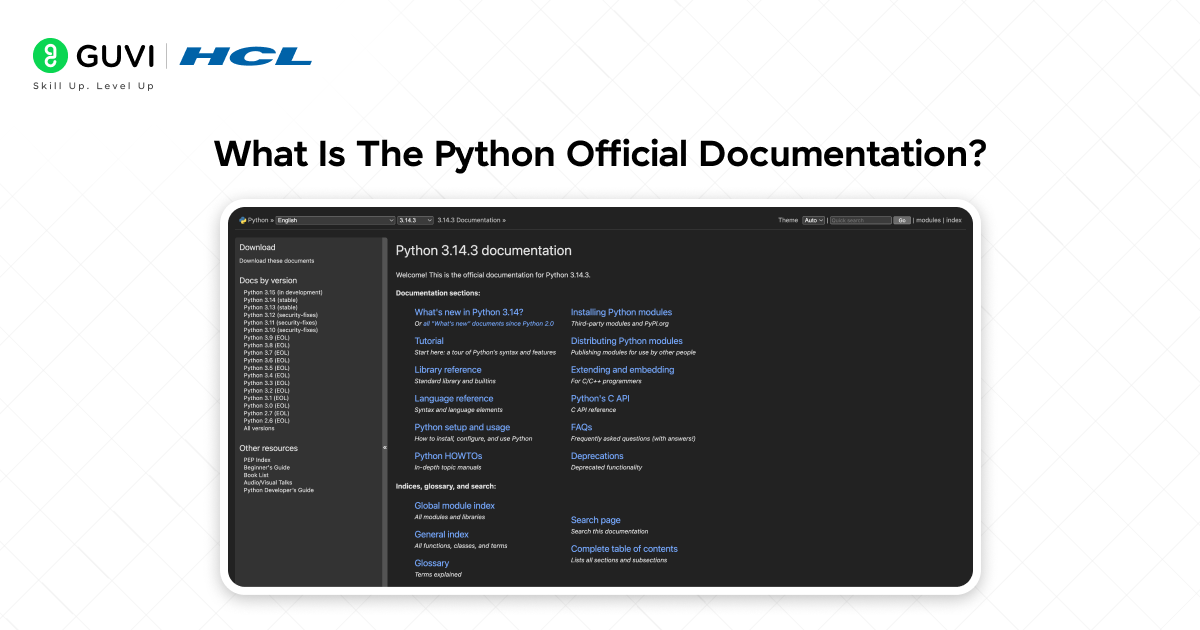
The python official documentation is the primary learning and reference resource created by the Python development team. It explains how Python works, what each feature does, and how to use built-in modules correctly. For beginners, it may look overwhelming at first, but once understood, it becomes one of the most reliable tools to learn Python the right way.
Key Points
- Official and Trusted Source: Maintained by Python’s core developers, so the information is accurate and reliable
- Covers All Skill Levels: Includes beginner tutorials, language basics, and advanced technical references
- Example-Driven Learning: Most concepts are supported with simple code examples
- Always Updated: Matches the latest Python versions and features
Official Link: Python 3.14.2 documentation
Who Can Use The Python Official Documentation?
The python official documentation is designed for a wide range of learners, not just experienced developers. While beginners may need some time to get comfortable with its structure, the documentation is useful at every stage of learning Python. From students writing their first program to professionals working on real-world applications, it serves as a dependable reference.
Key Points
- Beginners Learning Python: Helps understand basic syntax, data types, and simple programs
- Students and Self-Learners: Useful for academic learning, assignments, and concept clarification
- Working Developers: Acts as a quick reference for modules, functions, and best practices
- Teachers and Trainers: Provides accurate explanations and examples for teaching Python
For beginners who want to practice Python while referring to the python official documentation, HCL GUVI’s Python Hub is a perfect companion. It provides tutorials, exercises, and coding challenges that help learners reinforce concepts directly from the documentation. By combining structured learning from the Hub with official references, beginners can build strong fundamentals and gain confidence in writing real Python code.
How To Use The Python Official Documentation When You’re Just Starting Out
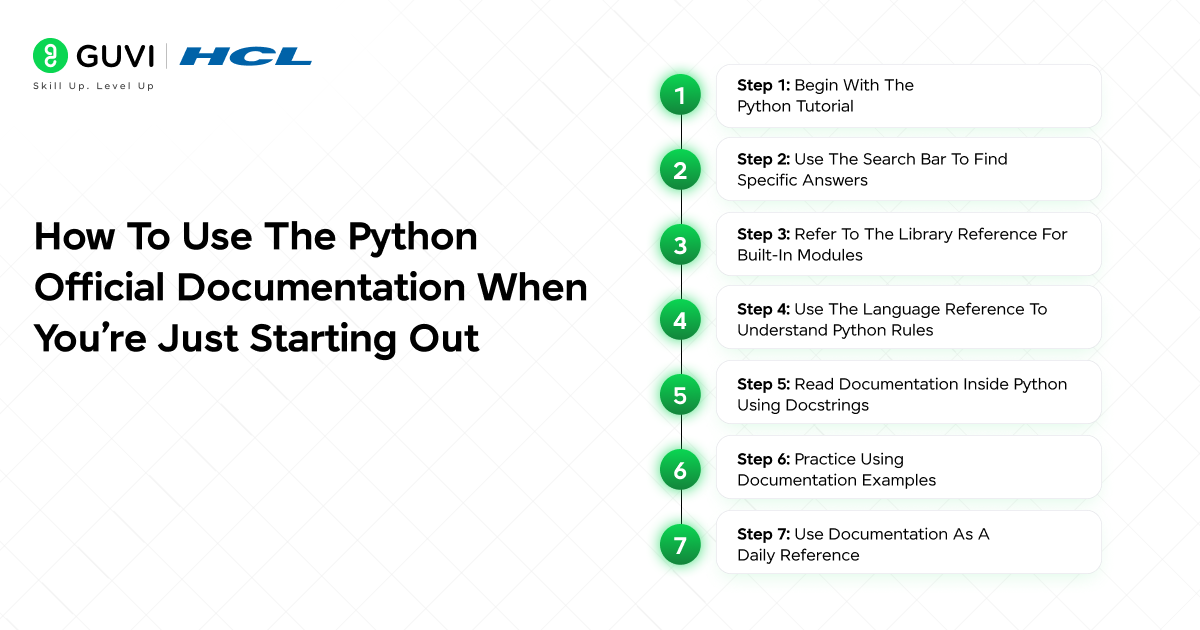
When you’re new to Python, the python official documentation works best when followed in a clear order. Each section of the documentation is meant for a specific purpose, such as learning concepts, finding answers, or verifying behavior. The steps below explain how beginners should practically use the documentation without confusion.
Step 1: Begin With The Python Tutorial
The Python Tutorial is written for beginners and introduces concepts gradually. It helps new learners understand how Python code is structured and how different concepts connect with each other. Reading this section properly builds a strong foundation before moving ahead.
- Syntax Introduction: Learn how variables, indentation, and statements are written
- Concept Flow: Follow topics in the order they are presented
- Guided Examples: Understand concepts through explained code samples
Tip: Read the tutorial in sequence and avoid jumping between topics.
Step 2: Use The Search Bar To Find Specific Answers
The search bar should be used when you have a clear question or error. Instead of browsing long pages, beginners can quickly locate exact explanations using search. This keeps learning focused and efficient.
- Error Lookup: Search exact error names to understand their meaning
- Function Lookup: Find official usage of built-in functions
- Module Lookup: Locate documentation for specific modules
Example: Search IndexError to understand why it occurs and how to avoid it.
Step 3: Refer To The Library Reference For Built-In Modules
The Library Reference explains Python’s built-in modules and how they should be used. Beginners can rely on this section when they need tools to solve real problems instead of guessing or using trial and error.

- Module Purpose: Understand what a module is designed to do
- Function List: See available functions inside the module
- Usage Details: Learn required parameters and outputs
Tip: Open the Library Reference only when you need a module for your code.
Step 4: Use The Language Reference To Understand Python Rules
The Language Reference explains how Python interprets and executes code. This section is useful when Python behaves differently than expected. Beginners should use it to clarify rules, not for casual reading.
- Execution Rules: Learn how Python processes statements
- Scope Rules: Understand variable accessibility
- Syntax Meaning: Clarify how specific syntax works
Example: Use this section to understand why a variable is not accessible outside a function.
Step 5: Read Documentation Inside Python Using Docstrings
Python allows you to read documentation directly in the interpreter. This helps beginners verify function behavior without switching tools. It also encourages learning while coding.
- help() Function: View documentation instantly
- Parameter Details: Understand input and output behavior
- Quick Checks: Confirm usage while writing code
Tip: Use this when you know the function name but need clarity.
Step 6: Practice Using Documentation Examples
Documentation examples show how Python features are meant to be used. Beginners should run and modify these examples to strengthen understanding and connect theory with practice.
- Run Examples: Execute provided code
- Modify Code: Change values to observe behavior
- Check Output: Verify results match expectations
Example: Change loop values in examples to see different outputs.
Step 7: Use Documentation As A Daily Reference
The python official documentation becomes more useful with regular use. Beginners who depend on it consistently develop better problem-solving habits and stronger fundamentals.
- First Reference: Check documentation before searching elsewhere
- Self Learning: Build confidence in reading technical content
- Correct Practices: Learn Python the official way
Tip: Keep the documentation open in a separate tab while coding.
For beginners who want to apply what they learn from the python official documentation, enrolling in a structured course can make a big difference. The Python course by HCL GUVI offers hands-on exercises, guided projects, and interactive lessons that complement your learning from the documentation. By practicing alongside official references, learners can strengthen their fundamentals, gain confidence in writing Python code, and progress faster.
💡 Did You Know?
- Python’s documentation has hidden tips that even many intermediate developers miss, like lesser-known functions in standard libraries.
- You can access Python documentation directly in your terminal using help(), without opening a browser.
- The documentation includes official how-to guides for real-world tasks, not just syntax explanations.
Conclusion
The python official documentation is more than just a reference; it is a powerful learning tool for beginners. By following a structured approach, you can understand syntax, explore modules, and practice examples confidently without feeling overwhelmed.
Using the documentation consistently builds strong fundamentals, encourages independent problem-solving, and prepares you to tackle more advanced Python topics with ease. Make it your go-to resource while coding every day.
FAQs
1. Is the Python official documentation suitable for complete beginners?
Yes. While it can look technical at first, sections like the Tutorial and Library Reference are beginner-friendly when used as a guide.
2. Should I read the entire documentation to learn Python?
No. Beginners should focus on relevant sections step by step and use it alongside practice rather than reading everything at once.
3. How can I use the documentation while coding?
You can open it in a browser or use the help() function in Python to check syntax, functions, and modules instantly.
4. Are examples in the documentation useful for beginners?
Absolutely. Running and modifying examples helps beginners understand concepts practically and reinforces learning.
5. Do professional developers use the Python official documentation?
Yes. Even experienced developers refer to it regularly to check functions, modules, or best practices.
Success Stories

About the Author
Jebasta
I translate the language of data into stories that anyone can understand. As a writer with a data science background, I simplify analytics, AI, and decision-making so beginners and enthusiasts can confidently explore the world of data.
View all posts by Jebasta
Connect with me @







Did you enjoy this article?