


Artificial Intelligence and Machine Learning Articles
Finance Manager to Data Analytics: Career Growth, Salary and Seniority
How to Evaluate LLM Outputs in Production Deployments
AI/ML Skills Gap 2026: Why Companies Can't Find Job-Ready Talent
20 AI/ML Interview Questions Recruiters Can Use Without a Tech Background - Best Guide


Get In Touch For Details! Request More Information
AI Governance & Compliance in Web Apps: Why You Can’t Ignore Data Risk When Using LLMs
Feb 27, 2026 4 Min Read 2064 Views
(Last Updated)
Are you confident that your web application is using AI responsibly and legally?
Artificial intelligence is quickly being incorporated into modern web applications to provide smarter and more personalized experiences. Features such as Automated content, recommendation systems, artificial intelligence chatbots, and smart search are common today. The majority of these capabilities are based on large language models (LLMs), which are also known as processing large volumes of data to produce human-like output.
Although the use of LLMs is fast and innovative, it is also associated with serious issues of data privacy, legal standards, and accountability. One poorly designed AI feature may reveal the sensitive information of the users, go against the rules, or generate dangerous results. This is why AI governance in web applications is no longer an option.
Table of contents
- What Is AI Governance on Web Apps?
- The Importance of AI Governance to Web Applications
- Understanding Data Risk When Using LLMs
- Common Types of Data Risk
- Exposure of Sensitive User Data
- Data Leakage Through Logs
- Prompt Injection Attacks
- Unauthorized Internal Access
- Unclear Data Usage Policies
- LLM Regulatory Compliance: What Developers Must Understand
- AI Legal Compliance for Developers
- Data Protection With LLMs in Web Apps
- AI Risk Mitigation Strategies in Web Applications
- LLM Governance Strategies for Modern Web Apps
- Enterprise AI Compliance and Management
- AI Accountability in Web Apps
- Common AI Governance Mistakes Developers Make
- The Future of AI Governance in Web Applications
- Wrapping it up:
- FAQs
- What is AI governance in web apps?
- Why is AI governance important when using LLMs?
- What are the main data risks of using LLMs in web apps?
What Is AI Governance on Web Apps?
AI governance in web apps is the structured framework that defines how artificial intelligence systems are designed, deployed, monitored, and controlled. It makes AI act in a predictable, ethical, and legally-appropriate way.
AI governance is not just a simple matter of security or code of best practices. It covers the entire ai life systems, from information gathering to model outputs.
Web app AI governance will generally involve:
- Regulations on the gathering and manipulation of user information
- Responsible use guidelines for LLMs
- Meeting local and global regulations
- Risk management and monitoring activities
- Strict responsibility for AI decisions
Unlike traditional software, AI systems are probabilistic. This means the same input can produce different outputs. Governance provides structure in an otherwise uncertain system.
The Importance of AI Governance to Web Applications
There is a greater risk of AI-related risks in web applications than in internal tools since they operate in open environments. Users can see any errors immediately.
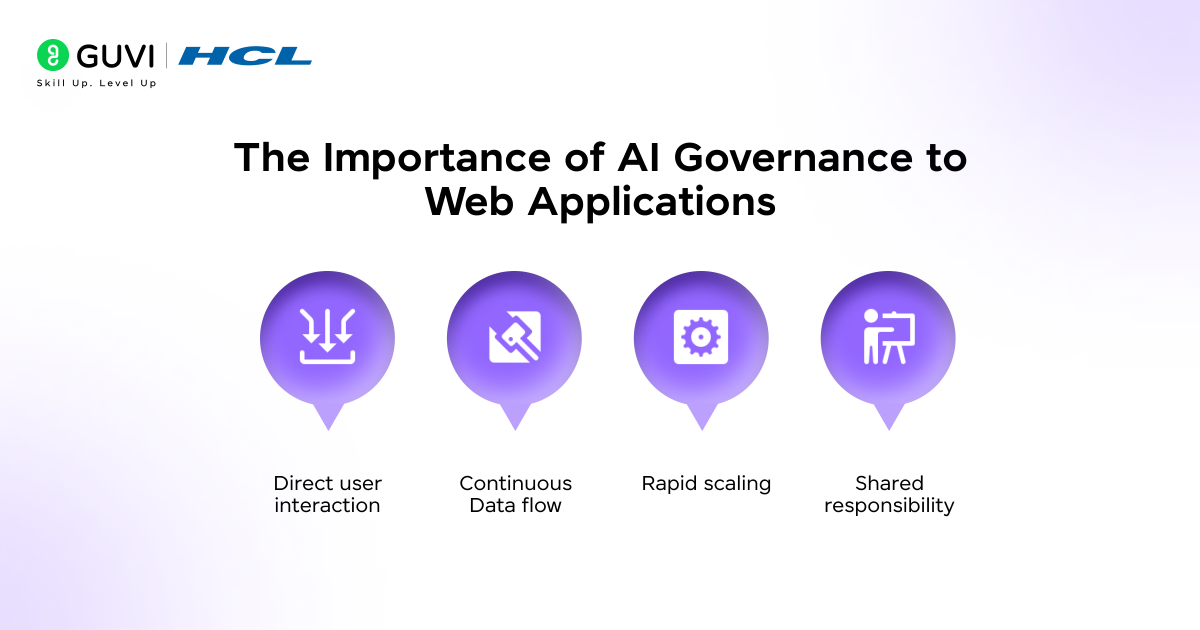
Key reasons AI governance in web apps is essential include:
- Direct user interaction: AI outputs directly affect user experience, trust, and safety.
- Continuous Data flow: Web applications generate constant data input and output, which can increase the exposure of data.
- Rapid scaling: It takes only minutes to affect thousands of users with a defective AI feature.
- Shared responsibility: Numerous web applications rely on third-party LLM providers, creating a dependency on compliance.
Even minor mistakes on AI can turn into a huge legal or reputation problem without the correct governance.
Understanding Data Risk When Using LLMs
The highest level of risk associated with incorporating LLMs in web applications is the data risk. As LLMs are based on user input to produce responses, any misuse or mismanagement of such information can have severe impacts.
Common Types of Data Risk
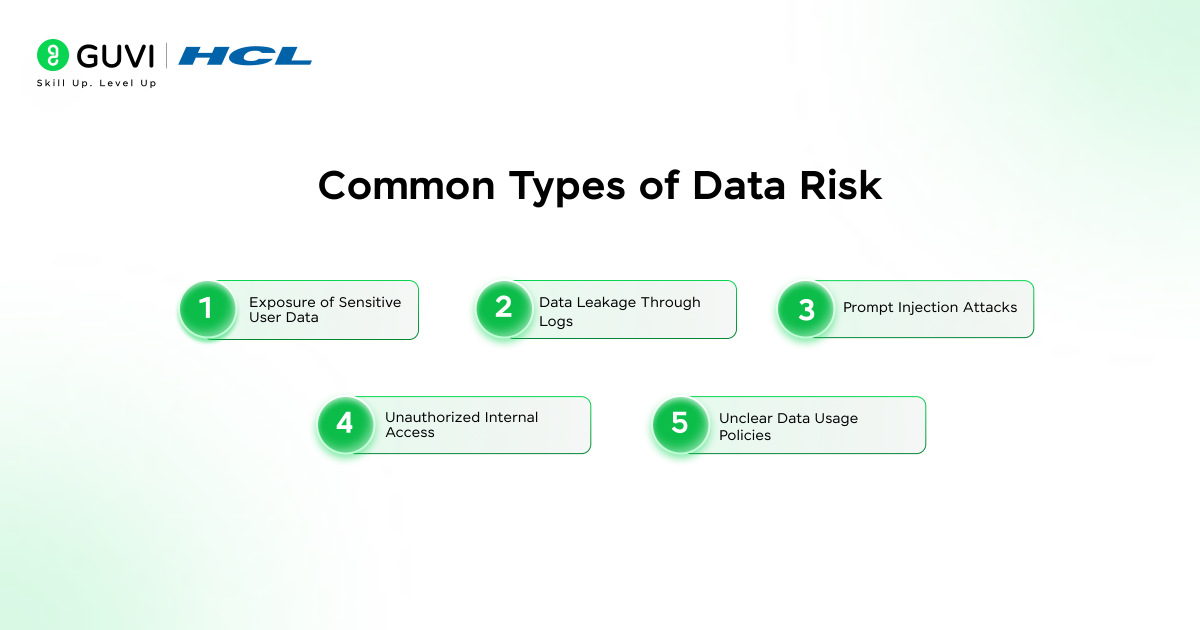
1. Exposure of Sensitive User Data
Web apps are prone to users keying in personal, financial, or confidential data. Provided that this information is transferred to LLM APIs without protection, it can be logged or stored accidentally.
2. Data Leakage Through Logs
Many systems store prompts and responses for debugging or analytics. If these logs are not secured, sensitive data may be exposed.
3. Prompt Injection Attacks
Attackers can manipulate prompts to bypass safeguards, extract system instructions, or access restricted data.
4. Unauthorized Internal Access
Employees or contractors may access AI logs or datasets without proper permissions.
5. Unclear Data Usage Policies
When developers do not clearly define how AI uses data, compliance and accountability become difficult.
Strong AI governance in web apps helps identify and reduce these risks before deployment.
Also read: The Ethics and Responsibility of Being an AI-Augmented Developer
LLM Regulatory Compliance: What Developers Must Understand
LLM regulatory compliance refers to meeting laws that govern how AI systems collect, process, store, and use data.
Depending on its users and industry, Web applications powered by LLM should be able to satisfy several regulations.
Critical Regulations that Impact Web Applications
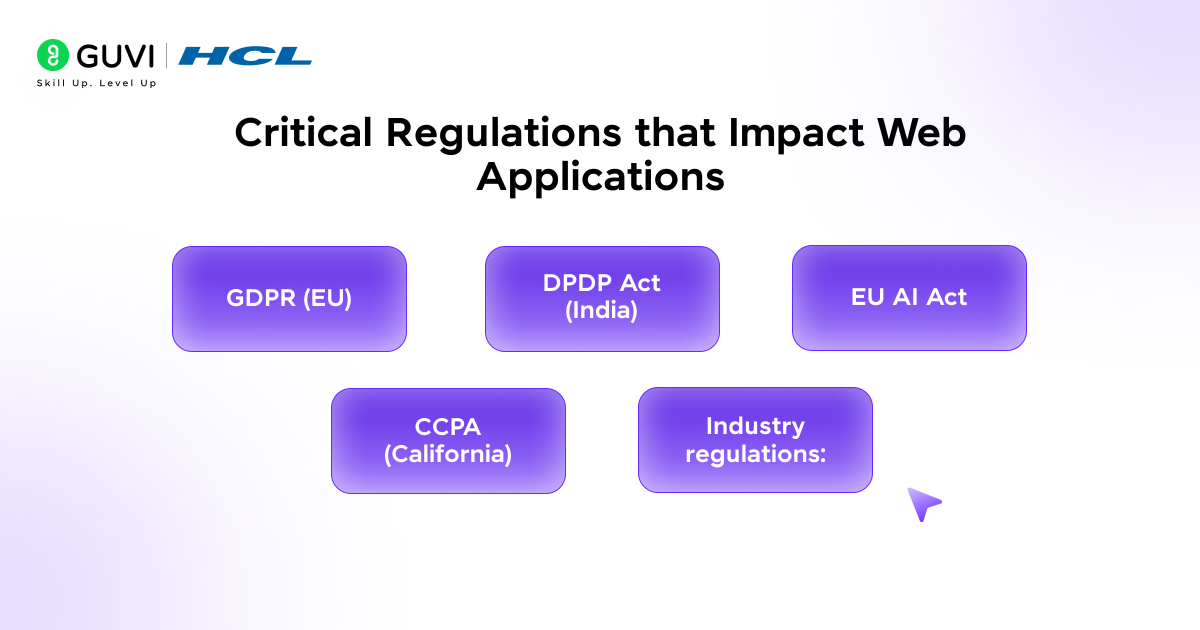
- GDPR (EU): Needs legal data processing and user consent, transparency, and data minimization.
- DPDP Act (India): Concentrates on the security of personal information and customer rights.
- EU AI Act: Introduces a risk-based classification system for AI applications.
- CCPA (California): Gives users control over how their data is collected and shared.
- Industry regulations: Healthcare, finance, and education have additional compliance requirements.
Any failure to comply with regulations of LLMs may lead to fines, lawsuits, and compelled product modifications.
AI Legal Compliance for Developers
AI legal compliance for developers starts during application design, not after deployment. Developers make architectural choices that directly affect compliance. Architectural decisions are made by developers that have a direct impact on compliance.
The responsibilities of the developers involve:
- Restricting data gathering to what is necessary
- Protecting personal information from LLMs
- Including the consent features of AI
- Giving users access to data and deletion.
- Logging AI activity for audits
Organizations end up paying a heavy price in terms of re-engineering when they fail to focus on AI compliance at the initial stages. Strong AI governance in web apps ensures compliance is built into the system from the beginning.
Also read: Is AI Making Developers Lazy? The Case for Retaining Core Skills
Data Protection With LLMs in Web Apps
The core pillar of AI governance is data protection using LLMs. The user-generated material is processed by the LLMs, and therefore, the privacy and trust of the material must be guaranteed.
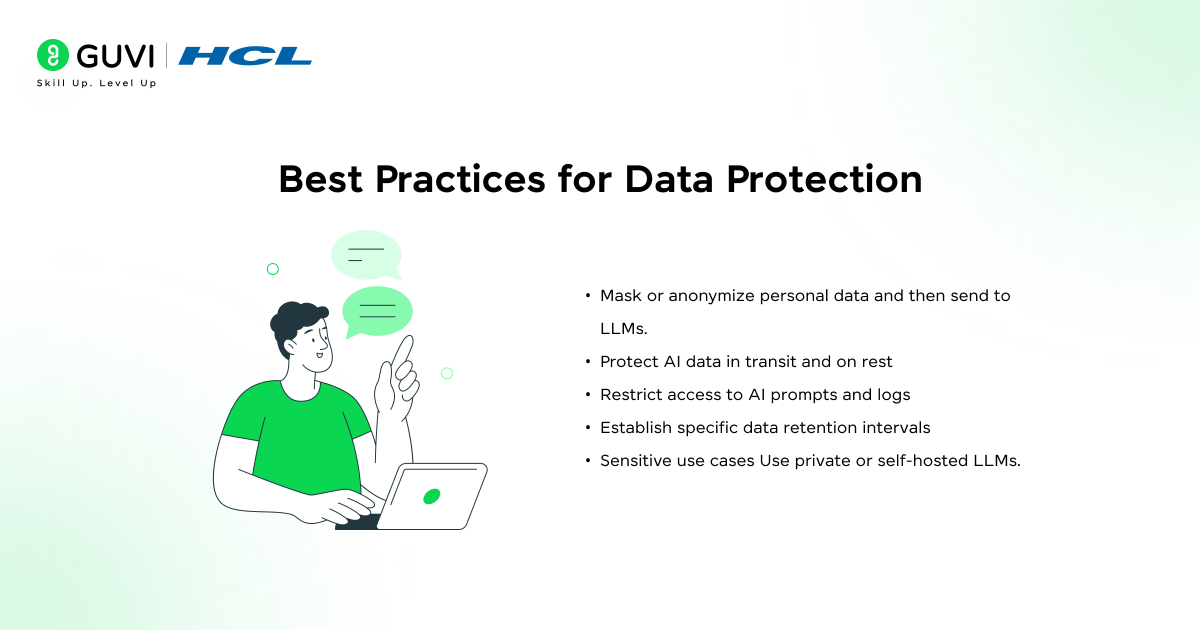
Best Practices for Data Protection
- Mask or anonymize personal data and then send it to LLMs.
- Protect AI data in transit and at rest
- Restrict access to AI prompts and logs
- Establish specific data retention intervals
- Sensitive use cases: Use private or self-hosted LLMs.
Data safety minimizes exposure and builds trust of the user in AI-enabled web applications.

Also read: The Reality Check: Why AI-Generated Code Isn’t Production-Ready
AI Risk Mitigation Strategies in Web Applications
AI risk mitigation is aimed at minimizing the effect and risk of AI-induced failures.
The most important AIs Risk Mitigation Techniques:
- Blocking of harmful or malicious prompts by input validation
- Output filtering to eliminate unsafe or misleading feedback
- Human-in-the-loop systems for any high-impact decision
- Rate limiting to prevent abuse
- Constant observation of abnormal behavior
The process of mitigation of AI should be continuous. The behavior of LLM is subject to change, and hence the need to monitor this behavior.
LLM Governance Strategies for Modern Web Apps
LLM governance strategies define how AI models are managed, evaluated, and improved throughout their lifecycle.
Effective Governance Strategies Include:
- Clear guidelines on the use of AI
- Prompt management and version control
- Regular bias and fairness evaluations
- Monitoring and testing of performance
- Incident response and rollback plans
Very robust LLM governance strategies guarantee the reliability of AI and its alined on the business and ethical objectives.
Want to learn AI and ML the right way? Join HCL GUVI’s free 5-day AI & ML email course to understand core concepts and how AI is used responsibly in real-world applications.
Enterprise AI Compliance and Management
Enterprise AI compliance becomes more complex as organizations scale AI usage across multiple teams and applications.
Common Enterprise Problems are:
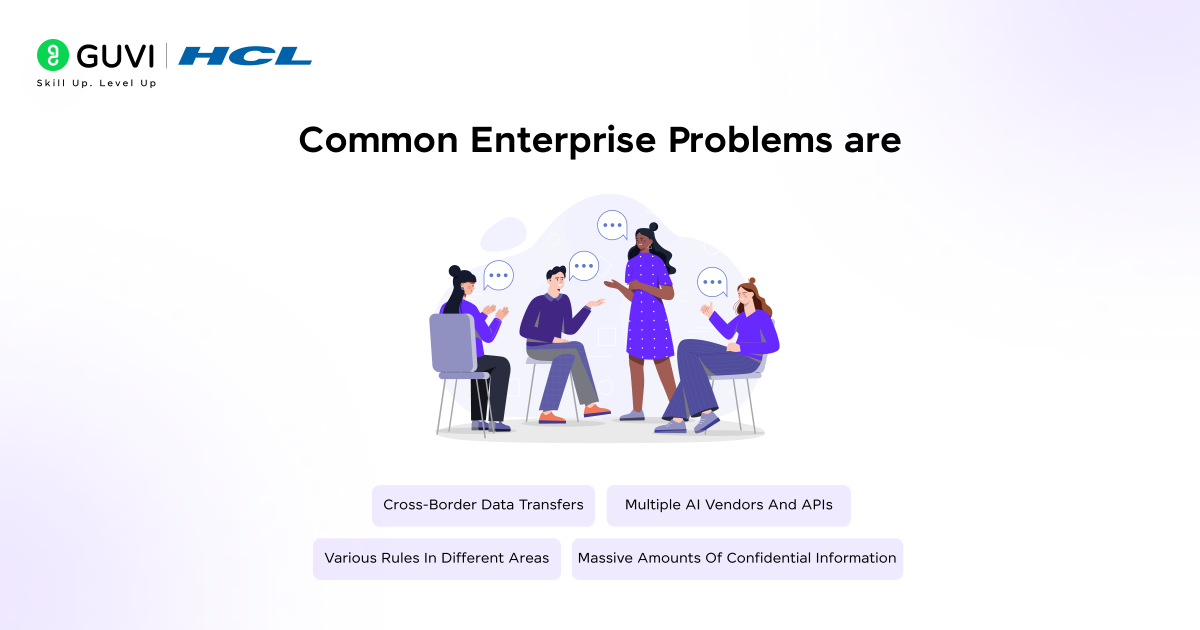
- Multiple AI vendors and APIs
- Cross-border data transfers
- Various rules in different areas
- Massive amounts of confidential information
To deal with such complexity, business organizations require centrally governed systems. The AI compliance in enterprises involves the interaction of developers, legal teams, security groups, and management.
AI Accountability in Web Apps
AI accountability in web apps answers one important question: who is responsible when AI makes a mistake?
Accountability should be clearly defined:
- Developers are responsible for implementation quality
- The usage of AI is determined by product teams
- Organizations have a legal accountability
- Humans have to control high-risk AI decisions
Clear responsibility enhances clarity and increases trust in cases where AI-related problems emerge.
Also read: How to Become a Generative AI Engineer?
Common AI Governance Mistakes Developers Make
Even senior teams make mistakes in the implementation of AI.
Common mistakes include:
- Treating LLMs like traditional APIs
- Feeding raw user information to AI models
- Not performing compliance reviews
- Absence of post-implementation monitoring
- Poor documentation of AI behavior
The prevention of this set of mistakes will enhance AI regulation in web applications and minimise risks in the long-term perspective.
Also read: How to Become an AI Engineer: A Practical Guide
The Future of AI Governance in Web Applications
The stricter AI governance will be achieved with the increasing AI adoption.
Future trends include:
- Mandatory AI audits
- Increased transparency requirements
- Industry-specific AI regulations
- Higher fines on non-compliance
Early adoption of governance in web apps will be in a better position to accommodate these changes.
Also, check out HCL GUVI’s IITM Pravartak Certified Artificial Intelligence & Machine Learning Course, designed by industry experts and backed by NSDC, to build your career in the world of intelligent systems from foundational ML concepts to hands-on LLM projects.
Wrapping it up:
With large language models being utilized broadly across web applications, there is an increasing need for organisations and developers to manage data risk, meet legal and regulatory compliance expectations, as well as be accountable for the use of these technologies when developing systems that are both reliable and trustworthy. Effective governance practices will enable organisations and developers to protect user data, minimise the risks associated with using AI, and scale the use of these technologies appropriately. Treat AI Governance as an integral component of web application development, rather than an afterthought, and enable teams to develop applications that will be safe, compliant, and prepared for future use. I hope this blog helps you to know the importance of AI governance and compliance when using LLMs.
FAQs
1. What is AI governance in web apps?
AI governance in Web applications refers to the policies, procedures, and controls that are established to ensure that ai systems are used safely, legally and responsibly within web applications.
2. Why is AI governance important when using LLMs?
Since LLMs have access to massive amounts of user data, they have significant risks of data leakage, violation of data protection laws, and generation of unpredictable output if they are not properly governed.
3. What are the main data risks of using LLMs in web apps?
The main risks include data leakage, unauthorized access, prompt injection attacks, and improper storage of sensitive user information.
Success Stories

About the Author
Vishalini Devarajan
An Aerospace Engineer turned content writer, I focus on making complex concepts easy to understand through well-structured, reader-friendly blogs. Whether it’s a technical topic or a non-technical one, I love creating content that is clear, engaging, and impactful.
View all posts by Vishalini Devarajan
Connect with me @













Did you enjoy this article?