


Full Stack Development Articles
Claude for Architecture and Engineering Documentation
Freelancing as a Python Developer: Getting Your First Client

Get In Touch For Details! Request More Information

The Evolution Of The Full-Stack Role (2015 Vs. Now)
Feb 21, 2026 3 Min Read 1426 Views
(Last Updated)
The evolution of full stack role shows how software development has grown from simple websites to complex digital systems. This blog explains how the full-stack role looked in 2015, how it has changed today, and why these changes matter in the real world.
This blog is for students, beginners, non-technical readers, career switchers, and professionals who want a clear, easy-to-understand view of how the full-stack role has evolved over time.
Quick Answer
The evolution of full-stack role shows a clear transformation. In 2015, full-stack developers mainly focused on writing front-end and back-end code. Today, they manage cloud systems, deployment, security, performance, and even AI-assisted workflows, making the role broader and more strategic.
Table of contents
- How The Full-Stack Role Looked In 2015
- What Defines A Full-Stack Developer Today
- Key Differences In Skills: 2015 Vs. Now
- Tooling And Technology Growth
- Responsibility And Ownership Over Time
- 💡 Did You Know?
- Conclusion
- FAQs
- What does the evolution of full stack role mean for beginners?
- Is the full-stack role more complex today?
- Can non-technical people understand this role?
- Is the full-stack role future-proof?
How The Full-Stack Role Looked In 2015
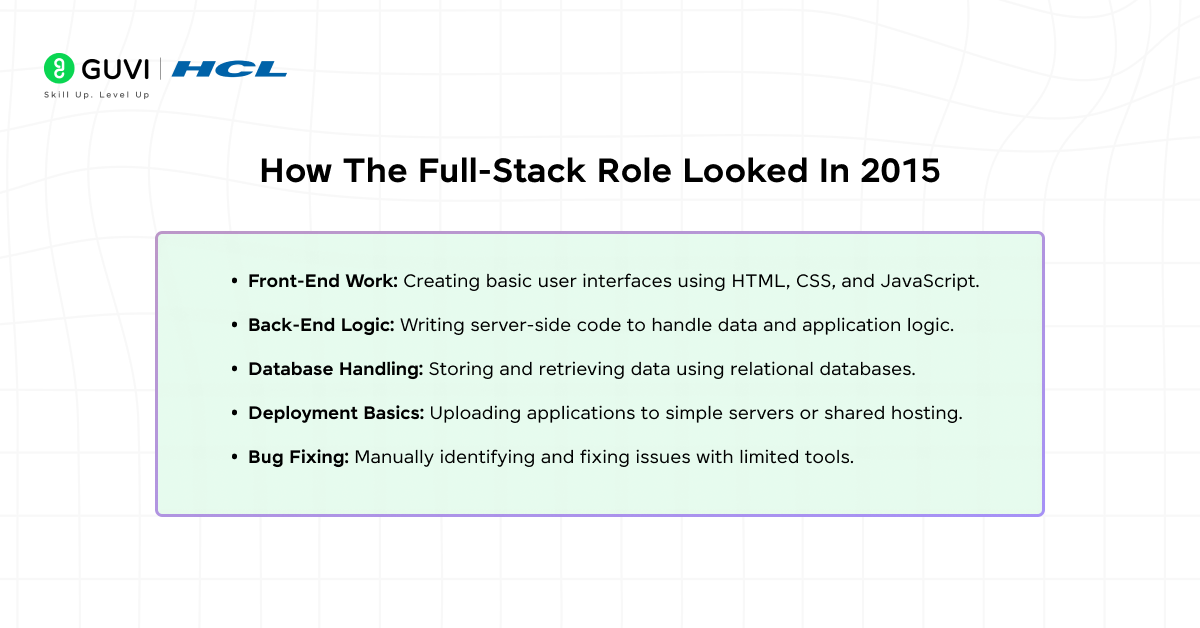
In 2015, the full-stack role was about versatility rather than depth. Applications were smaller, user expectations were lower, and teams focused mainly on getting products online quickly. Developers were expected to handle both the visible part of the website and the server logic behind it.
Key aspects of the 2015 full-stack role included:
- Front-End Work: Creating basic user interfaces using HTML, CSS, and JavaScript.
- Back-End Logic: Writing server-side code to handle data and application logic.
- Database Handling: Storing and retrieving data using relational databases.
- Deployment Basics: Uploading applications to simple servers or shared hosting.
- Bug Fixing: Manually identifying and fixing issues with limited tools.
What Defines A Full-Stack Developer Today
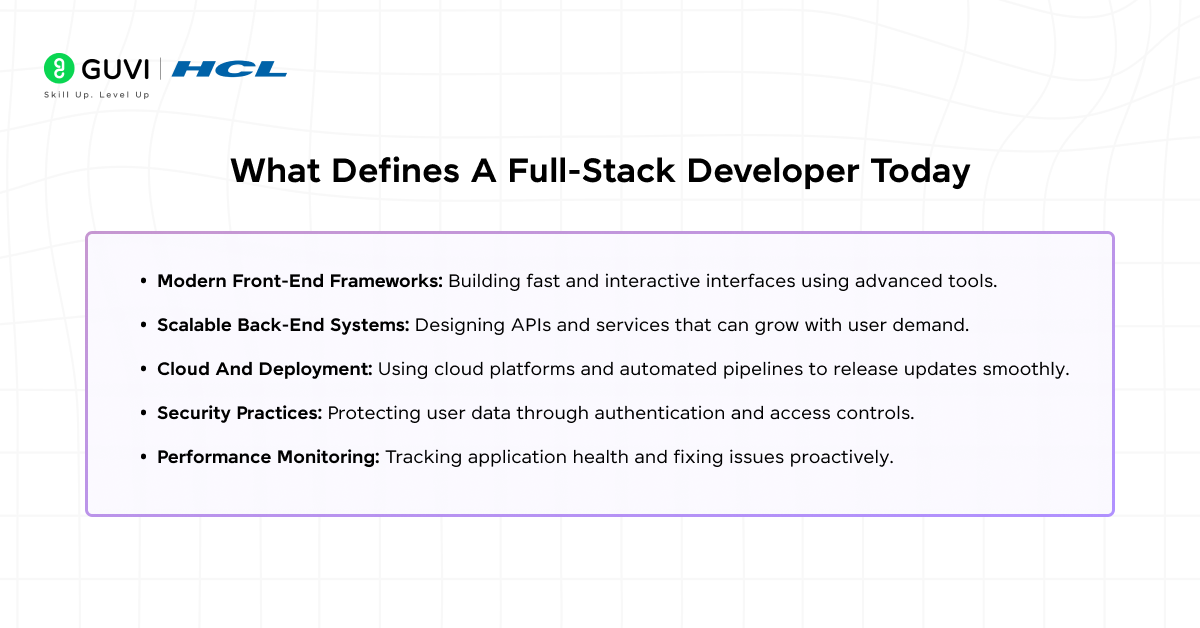
The evolution of full-stack role has significantly increased expectations from developers. Modern applications must support thousands or even millions of users while staying secure and responsive. As a result, full-stack developers now think beyond writing code and focus on the entire system.
Today’s full-stack developers are involved in:
- Modern Front-End Frameworks: Building fast and interactive interfaces using advanced tools.
- Scalable Back-End Systems: Designing APIs and services that can grow with user demand.
- Cloud And Deployment: Using cloud platforms and automated pipelines to release updates smoothly.
- Security Practices: Protecting user data through authentication and access controls.
- Performance Monitoring: Tracking application health and fixing issues proactively.
Key Differences In Skills: 2015 Vs. Now
One of the clearest signs of the evolution of full stack role is how required skills have changed. Earlier, knowing multiple programming languages was enough. Today, developers must understand how different systems work together.
Full-Stack Role Comparison: 2015 Vs. Now
| Aspect | Full-Stack Role In 2015 | Full-Stack Role Today |
| Core Focus | Writing front-end and back-end code | Owning the complete application lifecycle |
| Front-End | Basic static interfaces | Interactive and performance-optimized interfaces |
| Back-End | Single large applications | API-based and modular systems |
| Deployment | Manual setup | Automated cloud-based deployments |
| Testing | Mostly manual testing | Automated testing and monitoring |
| Responsibility | Task-based work | End-to-end ownership |
Key skill changes explained simply:
- System Thinking: Understanding how different parts of an app connect.
- Automation Knowledge: Reducing manual work using tools and workflows.
- Scalability Awareness: Preparing applications to handle growth.
- User Experience Focus: Improving speed, usability, and reliability.
For example, earlier developers focused on completing features, while modern developers focus on long-term performance and stability.

Tooling And Technology Growth
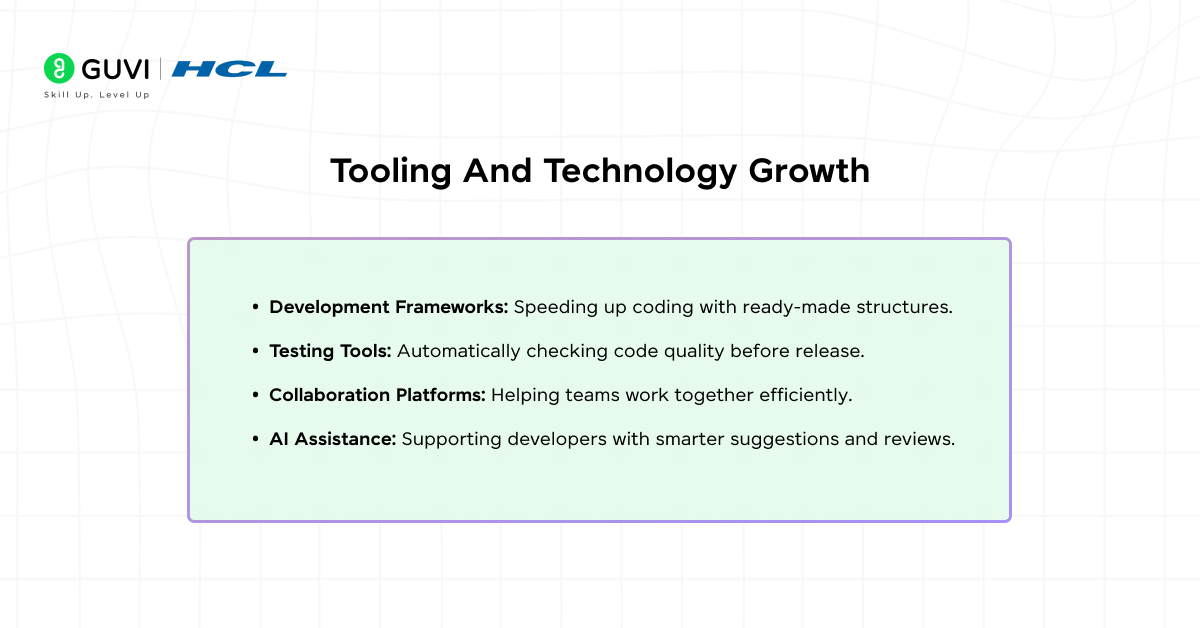
Another major part of the evolution of full stack role is the rapid growth of tools. In 2015, developers relied on fewer tools and spent more time doing repetitive tasks manually. Today, tools are designed to save time and reduce errors.
Modern tooling improvements include:
- Development Frameworks: Speeding up coding with ready-made structures.
- Testing Tools: Automatically checking code quality before release.
- Collaboration Platforms: Helping teams work together efficiently.
- AI Assistance: Supporting developers with smarter suggestions and reviews.
These features make full-stack development faster and more reliable.
Responsibility And Ownership Over Time
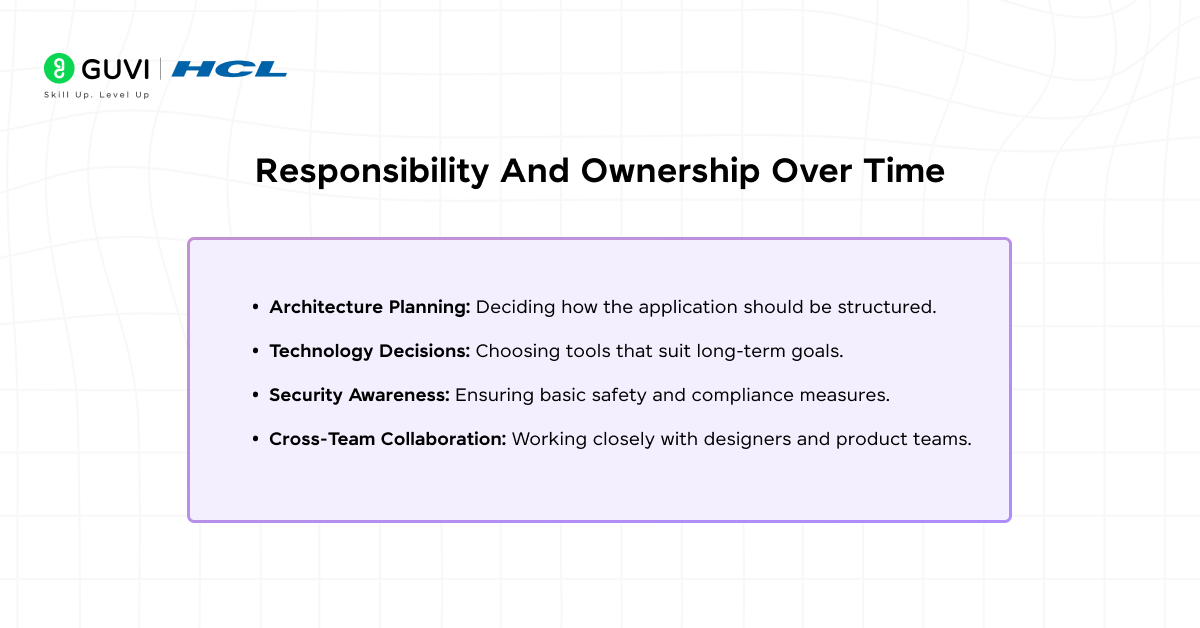
The evolution of full stack role has also changed how much responsibility developers carry. Earlier, developers worked on assigned pieces of a project. Today, they are often responsible for the entire application journey.
Modern responsibilities include:
- Architecture Planning: Deciding how the application should be structured.
- Technology Decisions: Choosing tools that suit long-term goals.
- Security Awareness: Ensuring basic safety and compliance measures.
- Cross-Team Collaboration: Working closely with designers and product teams.
Understanding these key functions shows why full-stack developers are now seen as problem solvers rather than just coders.
Do check out the HCL GUVI Zen Class Full Stack Development Course, a mentor-led course designed to build strong front-end and back-end skills through practical, real-world projects. It focuses on industry-relevant tools, guided learning, and career support, making it suitable for beginners and career switchers aiming to become job-ready full-stack developers.
💡 Did You Know?
- The term full-stack developer became widely popular around 2015.
- Many modern full-stack roles overlap with cloud and DevOps work.
- Companies now value problem-solving ability more than tool knowledge.
Conclusion
The evolution of full stack role highlights a clear shift from basic coding responsibilities to end-to-end ownership of digital products. Today’s full-stack developers are expected to understand systems, users, performance, and long-term growth.
To take this knowledge to the next level, focus on building strong fundamentals, understanding how different parts of an application connect, and gradually exploring modern tools through real projects and hands-on learning.
FAQs
1. What does the evolution of full stack role mean for beginners?
It means beginners should focus on basics first and gradually learn modern tools.
2. Is the full-stack role more complex today?
Yes, but better tools make learning and working easier.
3. Can non-technical people understand this role?
Yes. It’s about building complete digital products from start to finish.
4. Is the full-stack role future-proof?
Yes. The evolution of full stack role shows growing demand for versatile developers.
Success Stories

About the Author
Jebasta
I translate the language of data into stories that anyone can understand. As a writer with a data science background, I simplify analytics, AI, and decision-making so beginners and enthusiasts can confidently explore the world of data.
View all posts by Jebasta
Connect with me @


























Did you enjoy this article?