


Full Stack Development Articles
Claude for Architecture and Engineering Documentation
Freelancing as a Python Developer: Getting Your First Client

Get In Touch For Details! Request More Information
Why Full-Stack Skills Provide a Strong Foundation for AI
Feb 19, 2026 4 Min Read 1709 Views
(Last Updated)
Artificial Intelligence (AI) models such as GPT, Llama, and Claude are not deployed directly for general use cases; instead, they are combined with other components, such as frontends, backends, databases, APIs, and servers, to result in an end-to-end software product. For better comprehension, the GPT model, when integrated with the full-stack components, becomes ChatGPT; for the LLaMA model, it’s Meta AI; and for Claude, it’s Anthropic Chat.
Without Full-Stack Development, AI models become isolated, leaving the final output incomplete and leading to scalability issues in real-world scenarios. In the absence of full-stack skills, you will be unable to resolve technical problems such as latency, data flow bottlenecks, and security vulnerabilities.
If full-stack skills are so crucial to enhancing the performance and quality of AI models, let’s now understand why proficiency in full-stack development is essential for working with AI effectively.
Quick Answer:
Full-stack skills help you build complete AI applications by connecting the frontend, backend, database, and AI models. They make it easier to deploy, manage, and scale AI features in real-world products while improving performance, reliability, and user experience.
Table of contents
- Full-Stack AI Development: Understanding the Process
- Best Reasons Why Full-Stack Skills Are Beneficial for AI
- End-To-End Application Understanding
- Efficient AI Model Integration
- Better Data Management
- Improved Deployment And Scalability
- Enhanced User Experience
- Faster Problem-Solving And Debugging
- Cost And Performance Optimization
- Increased Career Opportunities
- Key Full-Stack Skills Needed to Work in AI
- Frontend Development
- Backend Development
- Database Management
- API Integration
- Server and Cloud Management
- AI/ML Model Understanding
- Data Processing and Analysis
- Testing and Deployment
- Conclusion
- FAQs
- What does a Full-Stack AI developer do?
- Do I need Full-Stack skills to work in AI?
- Can AI models work without Full-Stack integration?
Full-Stack AI Development: Understanding the Process
Full-Stack AI Development is essentially a journey of creating AI-driven apps that encompass not only the usual full-stack development capabilities but also AI integration.
On the one hand, it means architecting and coding the client-side to offer an intuitive interface and an interactive experience for users. On the other hand, the server-side, which is responsible for managing the core functionalities, user requests, and system operations, is also developed.
Databases serve as the storage units where large volumes of data are kept and handled in a very efficient manner. On the other hand, APIs are the middleware that frontend, backend, and AI models use to communicate with each other without any hiccup.
The AI part is basically the one that takes the data, makes the predictions, or comes up with the new ideas, and after that, it becomes part of the app.
Full-Stack AI Development is not just limited to coding but also embraces testing, deployment, and ongoing maintenance to make sure that the application is running smoothly and also provides correct AI-driven outputs in real-world situations.
____________________________________________________________________________
Expert mentorship can help you land high-paying roles in top tech companies. Enroll in HCL GUVI’s IITM Pravartak Certified MERN Full Stack Development Course with AI Integration to gain real-world project experience and expert guidance. Take the next step in your tech career today.
Best Reasons Why Full-Stack Skills Are Beneficial for AI
There are several reasons why full-stack skills are vital for AI, but we have mentioned the most pragmatic ones. Through these reasons, you can clearly understand why being a competent full-stack developer is like a cherry on top for working in the AI domain.
1. End-To-End Application Understanding
Having full-stack skills means that you have a holistic understanding of the working of any application, starting from the user interface (UI) to the server and the database. This is very useful for creating AI-powered applications that operate effortlessly in the real world.
Knowledge of the overall workflow enables developers to anticipate problems, improve performance, and ensure that the AI is fully compatible with the other components of the application.
2. Efficient AI Model Integration
Full-stack skills enable you to integrate AI models with frontend and backend systems efficiently. You can ensure that the inputs, outputs, and predictions are accurate as they flow through the app.
As a result, the number of errors is reduced, the performance is enhanced, and it is guaranteed that AI features provide precise results to users in real time.
3. Better Data Management
Full-stack developers are capable of storing, fetching, and handling data in a proper way in databases. This is an essential aspect, since AI models depend on large, carefully curated datasets to be operational.
Efficient data handling is the key to achieving a 2x increase in processing speed; it prevents storage problems and, at the same time, is instrumental in maintaining data quality, which leads to more accurate AI predictions.
4. Improved Deployment And Scalability
With full-stack skills, developers can seamlessly implement AI applications, and as the need for users increases, they can also expand them. In other words, you can oversee servers, cloud resources, and backend infrastructure to serve additional users.
Scalable deployment keeps AI applications from slowing or failing, enabling them to be used in the real world even under high demand.
Also Read: AWS vs Azure vs Google Cloud: Comparing the Top Cloud Service Providers
5. Enhanced User Experience
Full-stack developers are capable of creating interfaces through which AI functionalities appear to be very simple and natural for the users. A flawless, engaging frontend is what users need to use AI outputs as efficiently as possible.
The integration of frontend and backend competencies is instrumental in developing such applications in which AI results are not only obtainable but also significant and easy to understand for users, thereby enhancing overall user satisfaction.

6. Faster Problem-Solving And Debugging
Full-stack knowledge makes it possible to locate and correct problems swiftly throughout the whole application, which means that the problem is not necessarily in the AI model only.
It is possible to follow the error path from the frontend to the backend and the database in a very efficient way. This is an excellent time-saver and reduces the risk of AI features breaking during development and maintenance.
7. Cost And Performance Optimization
By having full-stack skills, one can tailor server usage, database queries, and API calls for AI applications to lower operational costs and improve response times.
An effective use of resources prevents AI models from slowing down, making the application not only faster but also more sustainable.
8. Increased Career Opportunities
Full-stack developers who also have AI knowledge are a great asset as they can create full-fledged AI-powered solutions. With this combination of skills, one can take on a variety of roles in tech companies.
Employers prefer professionals who can integrate AI into real applications, giving you a competitive edge in the growing AI job market.
Key Full-Stack Skills Needed to Work in AI
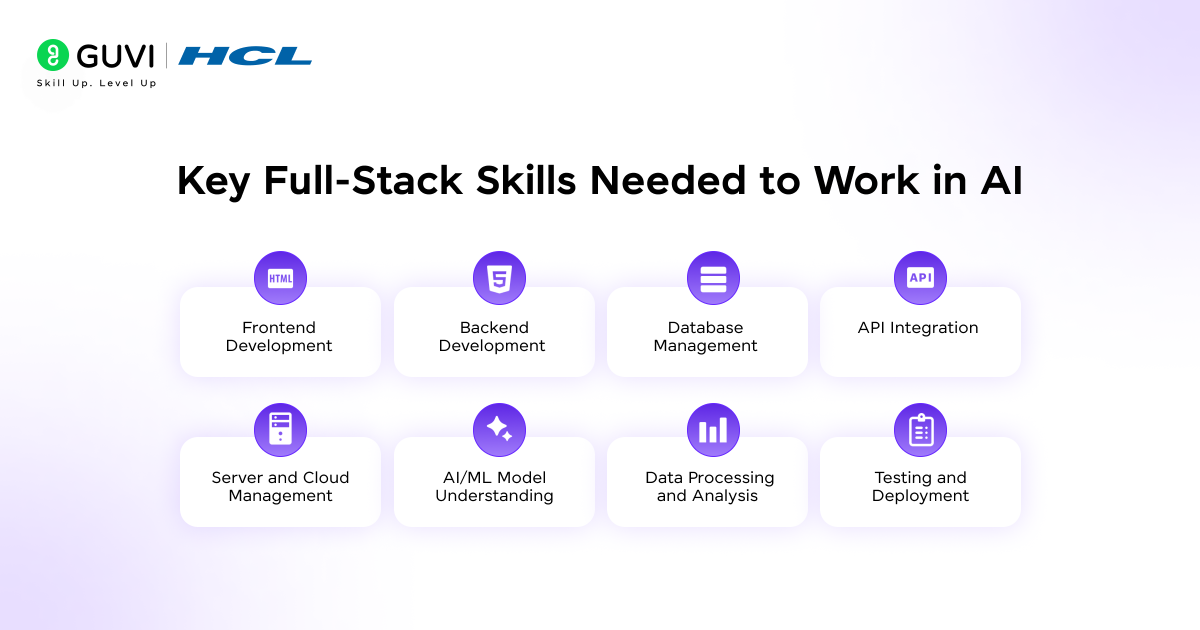
The following are the full-stack skills one should have hands-on experience with to contribute to the field of Artificial Intelligence (AI). These skills help make AI solutions more reliable, practical, and accessible to end customers.
1. Frontend Development
Frontend development focuses on creating the user interface and experience. It ensures users can interact with AI applications smoothly and intuitively.
Essential Tools Used:
React, Angular, Vue.js, HTML/CSS, Bootstrap
2. Backend Development
Backend development manages the logic, server, and operations behind the scenes. It processes user requests and connects AI models with the application.
Essential Tools Used:
Node.js, Django, Flask, Express.js, Ruby on Rails
3. Database Management
Database management systems store, organize, and retrieve data efficiently for AI applications. Proper data handling ensures AI models get accurate input.
Essential Tools Used:
MySQL, MongoDB, PostgreSQL, Firebase, SQLite
4. API Integration
API integration connects different parts of an application, including the frontend, backend, and AI models. It enables smooth communication and data exchange.
Essential Tools Used:
Postman, Swagger, REST API, GraphQL, Axios
5. Server and Cloud Management
Server and cloud management ensure AI applications run reliably and scale with user demand. It handles deployment, hosting, and resource optimization.
Essential Tools Used:
AWS, Azure, Google Cloud, Docker, Kubernetes
6. AI/ML Model Understanding
Understanding AI/ML models helps developers effectively integrate intelligent features into applications. It ensures predictions and insights work correctly.
Essential Tools Used:
TensorFlow, PyTorch, Scikit-learn, Keras, OpenCV
7. Data Processing and Analysis
Data processing cleans and prepares data for AI models, while analysis extracts insights. Both are crucial for accurate AI predictions.
Essential Tools Used:
Pandas, NumPy, Matplotlib, Jupyter Notebook, Tableau
8. Testing and Deployment
Testing ensures AI applications work correctly, while deployment makes them available to users. Both are essential for reliability and performance.
Essential Tools Used:
Selenium, Jenkins, Git, Docker, Travis CI
If you’re serious about real-world AI, enroll in HCL GUVI’s Intel & IITM Pravartak Certified Artificial Intelligence & Machine Learning course and gain a globally recognized credential that boosts your career.
Conclusion
In conclusion, Full-Stack skills are the secret sauce that turns AI from an innovative model into a real, usable product. They allow developers to connect the frontend, backend, databases, and AI models seamlessly, ensuring smooth data flow and efficient performance. With Full-Stack knowledge, AI solutions become easier to deploy, scale, and maintain, while also enhancing user experience and reliability, making them truly valuable in real-world applications.
FAQs
What does a Full-Stack AI developer do?
A Full-Stack AI developer builds AI solutions and connects them with frontend, backend, databases, and APIs to create fully functional applications.
Do I need Full-Stack skills to work in AI?
While not mandatory, Full-Stack skills make it much easier to deploy, scale, and integrate AI models into real-world products.
Can AI models work without Full-Stack integration?
Yes, but they remain limited to experiments or research; without Full-Stack integration, users cannot easily access or use them in real applications.
Success Stories




























Did you enjoy this article?