


Data Structure Articles
Sliding Window Technique: Explained with Examples
Two Pointer Technique: Problems and Applications


Get In Touch For Details! Request More Information

Arrays vs Linked Lists [2026 Guide]
Jul 27, 2026 4 Min Read 4369 Views
(Last Updated)
Quick Comparison (5 Key Differences)
| Factor | Array | Linked List |
|---|---|---|
| Memory layout | Contiguous | Scattered, linked via pointers |
| Access by index | O(1) instant | O(n) sequential |
| Insertion at start | O(n), shifts elements | O(1), just a pointer change |
| Size | Fixed (or costly to resize) | Grows and shrinks freely |
| Memory per element | Just the data | Data plus pointer overhead |
The difference between an array and a linked list becomes clear when examining their performance characteristics. Specifically, insertion at the beginning takes O(n) time for arrays but only O(1) for linked lists.
You’re probably here because you keep mixing these two up in interviews, or your code is slow and you’re not sure why. Arrays and linked lists solve the same basic problem, storing a sequence of items, in two completely different ways. Once you understand how each one actually sits in memory, picking the right one stops being a guess.
Table of contents
- TL;DR Summary
- What is an Array?
- What is a Linked List?
- Time and Space Complexity: Operation by Operation
- Array vs Linked List Operations in Python
- Dynamic Arrays (Python List) vs True Static Arrays
- When to Use Array vs Linked List: Decision Guide with Examples
- Common Mistakes
- Arrays vs Linked Lists Interview Questions
- Conclusion
- FAQs
- What is the main difference between an array and a linked list?
- Is a Python list an array or a linked list?
- Which is faster, array or linked list?
- Why do linked lists use more memory than arrays?
- Can a linked list have O(1) insertion at the end?
- Do interviewers prefer arrays or linked lists as answers?
TL;DR Summary
- Arrays store data in contiguous memory, so you get O(1) access by index but O(n) insertion at the start.
- Linked lists store data in scattered nodes connected by pointers, giving you O(1) insertion at the start but O(n) access.
- Choose arrays when you read data often and rarely change its size.
- Choose linked lists when you insert or delete frequently, especially at the front or middle.
- Python’s list isn’t a “true” array. It’s a dynamic array, and that distinction matters more than most tutorials admit.
What is an Array?
An array places every element right next to the previous one in memory. Because of this, the computer can calculate any element’s address instantly using a simple formula: base address + (index × size of one element). That’s why you get instant lookups.
The catch is size. A traditional array’s size is fixed at creation. Growing it means allocating a new block and copying everything over.
What is a Linked List?
A linked list is a chain of nodes. Each node holds a value and a pointer to the next node. Nodes live wherever there’s free memory, not next to each other, so there’s no shifting involved when you add or remove one.
You don’t get instant lookups here. To reach the fifth node, you walk through the first four. That’s the tradeoff you’re accepting in exchange for cheap insertions.
Time and Space Complexity: Operation by Operation
| Operation | Array Time | LinkedList Time | Array Space | LL Space |
|---|---|---|---|---|
| Access by index | O(1) | O(n) | O(1) extra | O(1) extra |
| Search (unsorted) | O(n) | O(n) | O(1) extra | O(1) extra |
| Insert at start | O(n) | O(1) | O(n) total | O(n) total |
| Insert at end | O(1)* | O(1)** | O(n) total | O(n) total |
| Insert in middle | O(n) | O(n)*** | O(n) total | O(n) total |
| Delete at start | O(n) | O(1) | O(n) total | O(n) total |
| Delete in middle | O(n) | O(n)*** | O(n) total | O(n) total |
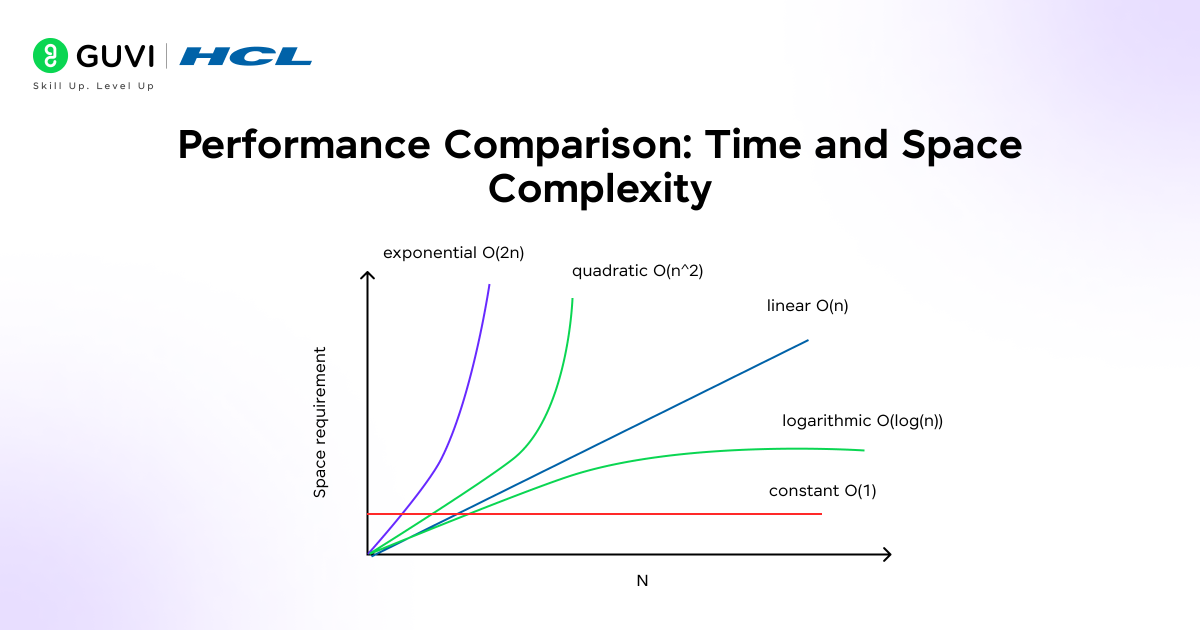
Arrays win on space per element since there’s no pointer overhead. Linked lists pay extra memory for every node, roughly one or two pointers each, on top of the data itself.
Array vs Linked List Operations in Python
Here’s the same set of operations written both ways in Python, so you can see the mechanics side by side.
# ARRAY (Python list) — insert, access, delete

arr = [10, 20, 30, 40]

# Access by index — O(1)
print(arr[2])          # 30

# Insert at start — O(n), shifts everything right
arr.insert(0, 5)        # [5, 10, 20, 30, 40]

# Delete from start — O(n), shifts everything left
arr.pop(0)               # [10, 20, 30, 40]
# LINKED LIST — insert, access, delete
class Node:
def __init__(self, data):
self.data = data
self.next = None
class LinkedList:
def __init__(self):
self.head = None
# Insert at start — O(1)
def insert_at_head(self, data):
new_node = Node(data)
new_node.next = self.head
self.head = new_node
# Access by index — O(n)
def get(self, index):
current = self.head
for _ in range(index):
current = current.next
return current.data
# Delete from start — O(1)
def delete_head(self):
if self.head:
self.head = self.head.nextNotice the pattern: whatever is cheap for the array is expensive for the linked list, and vice versa. That symmetry is the whole reason this comparison exists.
Dynamic Arrays (Python List) vs True Static Arrays
This is where a lot of learners get confused. Python’s list is not a static array in the classic computer science sense.
- True static array: fixed size, set once, cannot grow. Common in C programming or Java’s raw arrays.
- Dynamic array (Python list): starts with some capacity, and when it fills up, Python silently allocates a bigger block (usually with extra headroom) and copies everything over.
Python’s list typically over-allocates memory when it resizes, growing by roughly 12.5% more than needed. This is why append() feels like O(1) most of the time. It’s technically “amortized O(1),” because every so often, that resize-and-copy operation does cost O(n).
When to Use Array vs Linked List: Decision Guide with Examples
Ask yourself these questions before picking a structure:
- Do you look up items by position often? Go with an array. Example: storing daily stock prices you’ll graph by date.
- Are you inserting or deleting at the front constantly? Go with a linked list. Example: an undo history where the newest action always sits at the top.
- Is memory tight and predictable? Go with an array. It has no pointer overhead.
- Do you need to build a queue, stack, or graph adjacency list? Linked lists are often the natural fit here.
- Is your data size unknown and changing a lot? A dynamic array (like Python’s list) usually beats a manual linked list, thanks to cache performance.
In real production systems, arrays and their dynamic variants get used far more often. CPUs are simply faster at reading contiguous memory blocks. Linked lists earn their place mostly in scenarios with heavy front or middle insertions, or when implementing other structures internally.

Common Mistakes
- Assuming linked lists are always faster for insertion: In theory, yes. In practice, for small datasets, an array’s cache-friendliness often wins anyway.
- Forgetting pointer overhead: Developers compare raw data size and forget every node also stores one or two pointers.
- Using a linked list for random access: If you find yourself calling
get(index)often on a linked list, you’ve picked the wrong structure. - Treating Python lists as static arrays: This leads to wrong assumptions about resize costs.
Arrays vs Linked Lists Interview Questions
- Why is array access O(1) but linked list access O(n)? Arrays calculate any element’s address directly through arithmetic. Linked lists must walk node by node from the head.
- Why is inserting at the head O(1) for a linked list but O(n) for an array? A linked list just repoints the head. An array must shift every existing element one slot to the right.
- How would you reverse a linked list in place? Walk through the list, and at each node, flip its
nextpointer to point backward instead of forward, using three pointers: previous, current, and next. - When would you choose a linked list over a dynamic array despite the memory overhead? When insertions and deletions at arbitrary positions dominate your workload, and you already hold a reference to the node.
- Is a Python list implemented as a linked list? No. It’s a dynamic array, which is why indexing is O(1) in Python.
Ready to master data structures for 2026? Dive into the DSA Using Python Course by HCL GUVI and build your foundation in Python-based algorithms, boost your coding problem-solving with hands-on platform access, and get globally recognized certification that elevates your resume.
Conclusion
Arrays and linked lists represent opposite tradeoffs between access speed and flexibility. Arrays give you instant lookups and lower memory overhead, but resizing and mid-list changes are costly. Linked lists give you cheap insertions and deletions, at the cost of slower access and extra memory per node.
Neither is universally “better.” Your dataset’s access pattern, whether you’re reading more than you’re modifying, should decide which one you reach for.
FAQs
What is the main difference between an array and a linked list?
Arrays store elements in contiguous memory for instant index access. Linked lists store elements in scattered nodes connected by pointers, trading access speed for cheaper insertions.
Is a Python list an array or a linked list?
It’s a dynamic array. It offers O(1) index access and automatically resizes as you add elements, unlike a fixed-size static array.
Which is faster, array or linked list?
Arrays are faster for reading elements by index. Linked lists are faster for inserting or deleting at the beginning, assuming you already have a pointer to that spot.
Why do linked lists use more memory than arrays?
Every node in a linked list stores a pointer (or two, for doubly linked lists) in addition to the actual data, which arrays don’t need.
Can a linked list have O(1) insertion at the end?
Only if you maintain a tail pointer. Without one, you’d need to traverse the whole list first, making it O(n).
Do interviewers prefer arrays or linked lists as answers?
Neither. They want you to justify your choice based on the access pattern in the problem, not recite a default preference.
Success Stories

About the Author
Jaishree Tomar
A recent CS Graduate with a quirk for writing and coding, a Data Science and Machine Learning enthusiast trying to pave my own way with tech. I have worked as a freelancer with a UK-based Digital Marketing firm writing various tech blogs, articles, and code snippets. Now, working as a Technical Writer at GUVI writing to my heart’s content!
View all posts by Jaishree Tomar
Connect with me @

















Did you enjoy this article?