


Data Structure Articles
Sliding Window Technique: Explained with Examples
Two Pointer Technique: Problems and Applications


Get In Touch For Details! Request More Information
Recursion Algorithms in DSA? Understanding Logic, Types, and Applications
Sep 08, 2026 12 Min Read 5448 Views
(Last Updated)
Have you ever noticed how some programming problems become easier when you keep breaking them into smaller versions of the same task? That is exactly where recursion algorithms come into play. They allow a function to call itself and solve complex problems step by step, making tasks like tree traversal, sorting, and logical problem-solving much easier to structure.
In this blog, you will learn how recursion algorithms work, their key components, different types, real-world applications, and when recursion is a better choice than iteration. We will also walk through practical examples so you can understand the concept without getting lost in theory.
Quick Answer: Recursion is a programming technique where a function calls itself to solve smaller versions of the same problem until it reaches a base case.
In simple terms, the entire concept comes down to:
- Every recursive algorithm needs a base case and a recursive case.
- Recursion is useful for trees, graphs, backtracking, divide-and-conquer, and hierarchical problems.
- Common examples include factorial, Fibonacci, binary search, Tower of Hanoi, and tree traversal.
- Recursion uses the call stack, so deep recursion can increase memory usage and cause stack overflow.
- Memoization, iteration, or an explicit stack can improve efficiency when basic recursion becomes expensive.
Table of contents
- What is a Recursion Algorithms?
- Components of a Recursive Algorithm
- Base Case
- Recursive Case
- Recurrence Relation
- Mathematical Representation of a Recursive Problem
- Explanation
- Example Walkthrough
- Types of Recursion Algorithm
- Direct Recursion
- Indirect Recursion
- Tail Recursion
- Non-Tail Recursion
- Linear Recursion
- Tree Recursion
- Mutual Recursion
- Recursion vs Backtracking vs Divide-and-Conquer
- Examples of Recursive Algorithms
- lassic Recursion Problems in Python
- Factorial Using Recursion
- Fibonacci Sequence Using Recursion
- Tower of Hanoi Using Recursion
- Recursive Algorithms: Time and Space Complexity
- Step-by-Step Execution Flow of a Recursive Algorithm
- Applications of the Recursion Algorithm
- Sorting and Searching Algorithms
- Tree and Graph Traversal
- Mathematical and Combinatorial Computations
- Backtracking and Constraint Solving
- Dynamic Programming and Memoization
- Recursion vs Iteration
- Recursion vs Iteration- When to Use Which?
- Use Recursion When
- Use Iteration When
- How to Convert a Recursive Algorithm Into an Iterative Algorithm
- Common Recursion Mistakes and How to Avoid Stack Overflow
- Missing the Base Case
- Writing an Unreachable Base Case
- Failing to Reduce the Problem
- Repeating the Same Calculations
- Ignoring Large Input Sizes
- How to Avoid Stack Overflow
- Tail Recursion Optimization Explained With Code
- Does Python Optimize Tail Recursion?
- LeetCode Recursion Problems With Difficulty Ratings
- Limitations of the Recursion Algorithm
- Conclusion
- FAQs
- What is recursion in data structures and algorithms?
- What are the main components of a recursion algorithm?
- What are common examples of recursion algorithms?
- What is the difference between recursion and iteration?
- What is the time and space complexity of recursion?
- How can stack overflow be avoided in recursion?
What is a Recursion Algorithms?
A recursion algorithm is a technique where a problem is solved by breaking it into smaller versions of itself until reaching a simple case that can be handled directly. Each step calls the same function with a modified input, which creates a chain of executions that eventually resolves backward toward the final answer.
For example, calculating a factorial uses recursion because each call multiplies the current number by the factorial of the smaller one. Recursion simplifies complex logic into compact code and strengthens the connection between mathematical reasoning and programming practice.
Components of a Recursive Algorithm
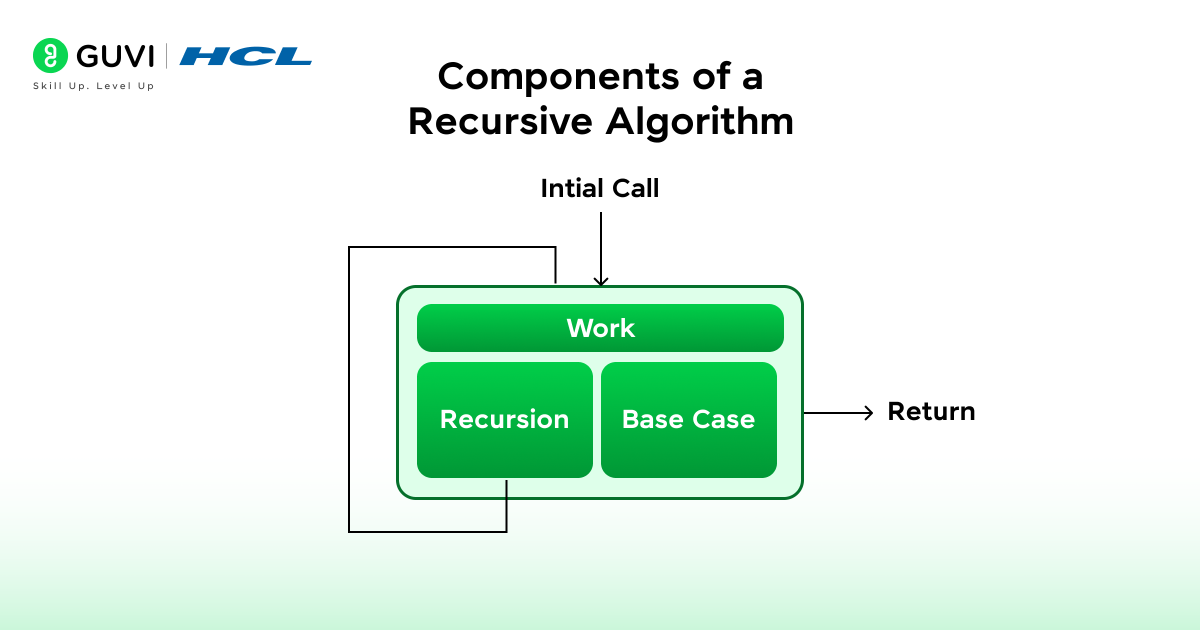
1. Base Case
The base case serves as the stopping point of recursion. It defines the smallest version of the problem that can be solved directly without further calls. Without a base case, recursion would continue indefinitely, consuming stack memory and never reaching completion. The base case ensures stability and correctness within the algorithm.
In computing factorial values, the base case is defined as factorial(1) = 1. The function halts there because the value no longer depends on any smaller computation. This stopping rule allows all previous recursive calls to return results step by step until the final answer forms.
2. Recursive Case
The recursive case represents the active process of reducing the problem into smaller parts. Each recursive call processes a simpler subproblem that moves closer to the base condition. This step gives recursion its repetitive yet structured behavior and defines how the function self-references to reach a solution.
In the factorial calculation, each recursive call multiplies the current number by the factorial of one less number. The repeated reduction process continues until the function meets the base condition, ensuring that each subsequent computation is supported by the previous one.
3. Recurrence Relation
A recurrence relation acts as the mathematical description of how each recursive step connects to the previous one. It defines the dependency between subproblems and sets the rate at which the recursion converges toward the base case. This relation is often written as an equation to represent the growth or reduction pattern in recursive algorithms.
For example, the relation for factorial can be expressed as T(n) = T(n−1) + O(1), which means each recursive call performs one constant-time operation and one smaller subproblem call. This formal definition helps analyze the time complexity and efficiency of recursive methods in DSA.
Mathematical Representation of a Recursive Problem
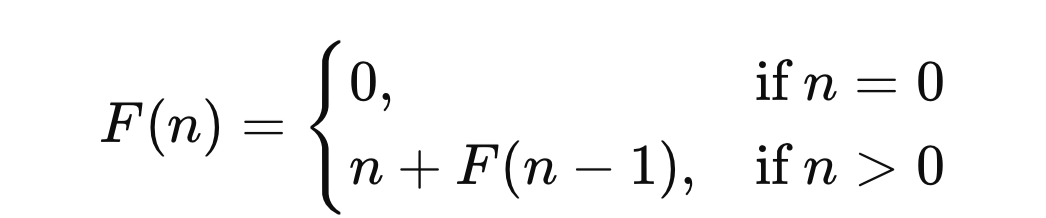
A recursive algorithm can be formally expressed using a recurrence relation that defines how a problem is divided into smaller parts. Each recursive structure contains two key elements: the base case and the recursive step, which together describe how the function progresses and terminates.
The general form can be written as:
Explanation
- Base Case: The base case handles the simplest version of the problem, where no further breakdown is needed. Here, when n=0n=0, the recursion stops and returns 0.
- Recursive Step: The recursive step reduces the problem into a smaller instance. Each call computes F(n)=n+F(n−1)F(n)=n+F(n−1), gradually simplifying until the base case is reached.
Example Walkthrough
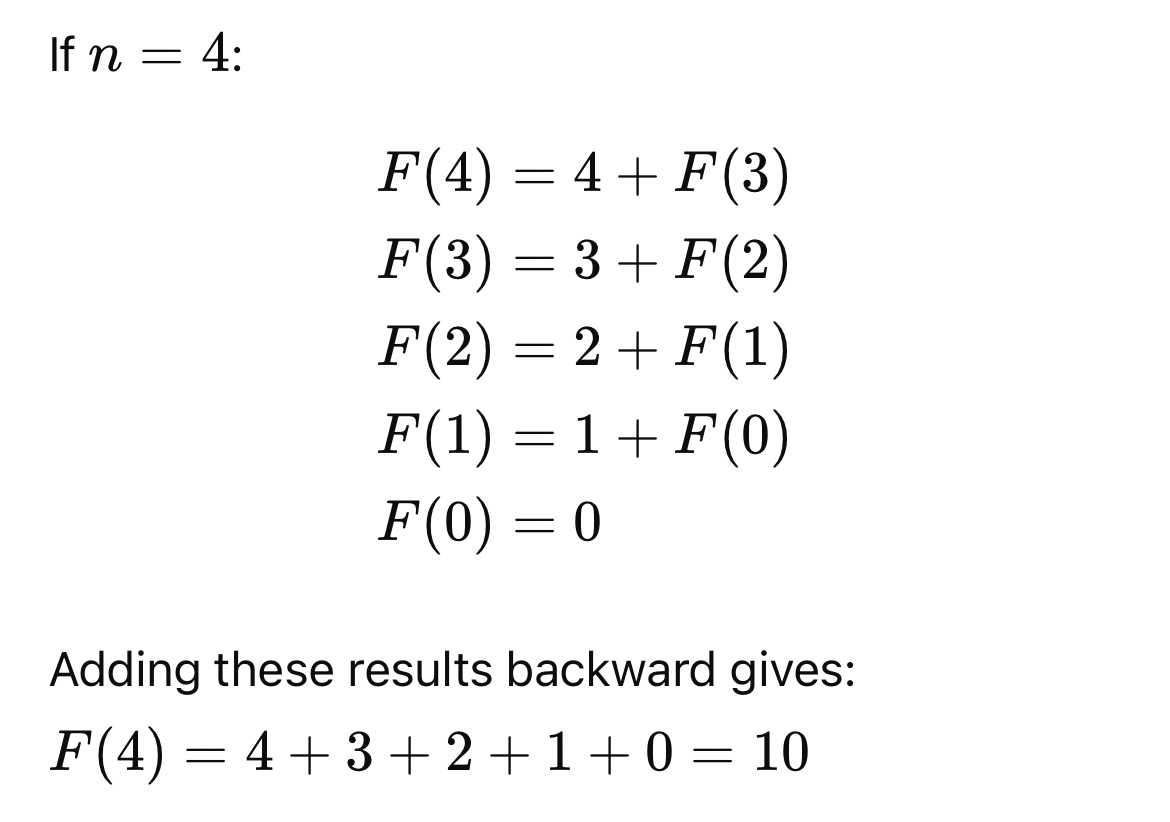
This pattern clearly illustrates how recursion builds a complete solution from smaller and repeated computations.
Types of Recursion Algorithm

1. Direct Recursion
A direct recursion occurs when a function in a data structure algorithm calls itself inside its own body. It progressively reduces the problem size with each call until the base condition halts further execution.
Key Features:
- Function directly calls itself without involving another function.
- Simple to trace and debug because the call chain follows one path.
- Commonly used for problems that naturally divide into smaller versions of themselves.
Example:
def factorial(n):
if n == 0:
return 1
return n * factorial(n – 1)
This function multiplies n by the factorial of (n-1) until it reaches 0, producing n!.
2. Indirect Recursion
Indirect recursion happens when one function calls another, and that second function calls the first one again.
Key Features:
- Involves two or more functions calling each other in sequence.
- Useful when logic separation improves readability or modularity.
- Requires careful base conditions to prevent infinite calls.
Example:
def funcA(n):
if n > 0:
print(n)
funcB(n – 1)
def funcB(n):
if n > 0:
print(n)
funcA(n – 1)
Here, funcA and funcB call each other until n becomes zero.
3. Tail Recursion
Tail recursion performs the recursive call as the last action in the function. The compiler can optimize it to reuse the current function frame.
Key Features:
- Reduces memory usage because stack frames are reused.
- Eliminates the need to wait for results after returning from recursion.
- Often used where results can be accumulated during calls.
Example:
def tail_factorial(n, result=1):
if n == 0:
return result
return tail_factorial(n – 1, n * result)
Each recursive call passes the current result, avoiding deferred multiplications.
4. Non-Tail Recursion
In non-tail recursion, the recursive call is followed by another operation, so each function waits for its child call to finish.
Key Features:
- Memory usage increases as all calls stay in the stack until completion.
- Common problems require post-processing after recursion.
- Easier to apply in hierarchical data structures.
Example:
def print_descending(n):
if n > 0:
print(n)
print_descending(n – 1)
The print statement happens before the recursive call, keeping the structure active until all calls resolve.
5. Linear Recursion
Linear recursion triggers one recursive call at each step, forming a single chain of calls.
Key Features:
- Simple control flow with predictable stack usage.
- Each call handles one smaller version of the problem.
- Works well for straightforward numerical or sequential problems.
Example:
def sum_n(n):
if n == 0:
return 0
return n + sum_n(n – 1)
Each call adds one number to the total until n becomes zero.
6. Tree Recursion
Tree recursion occurs when a function makes multiple recursive calls within one execution.
Key Features:
- Expands the recursion tree exponentially.
- Used when subproblems overlap, as in divide-and-conquer algorithms.
- Can be optimized using memoization or dynamic programming.
Example:
def fibonacci(n):
if n <= 1:
return n
return fibonacci(n – 1) + fibonacci(n – 2)
Each call splits into two more calls until the smallest cases return values.
7. Mutual Recursion
Mutual recursion involves two or more functions calling one another in a repeated cycle.
Key Features:
- A structured variant of indirect recursion with alternating function calls.
- Useful in logic-based systems and alternating task flows.
- Needs clearly defined base conditions to avoid infinite loops.
Example:
def is_even(n):
if n == 0:
return True
return is_odd(n – 1)
def is_odd(n):
if n == 0:
return False
return is_even(n – 1)
Each function delegates part of the problem to the other until the base case ends the cycle.
Recursion vs Backtracking vs Divide-and-Conquer
- Recursion: Recursion is the broader programming technique in which a function calls itself with a smaller or modified input. The process continues until a base case is reached. Factorial calculation and tree traversal are simple examples of recursive algorithms.
- Backtracking: Backtracking uses recursion to explore multiple possible solutions. When one path fails to satisfy the required conditions, the algorithm returns to an earlier decision and tries another option. Sudoku solving, N-Queens, permutations, maze solving, and combination problems commonly use recursive backtracking.
- Divide-and-Conquer: Divide-and-conquer splits one large problem into smaller independent subproblems, solves those subproblems, and combines their results. Merge sort and quicksort are common examples. Unlike backtracking, the algorithm generally needs to solve the required subproblems rather than abandon unsuccessful decision paths.
- How Their Search Patterns Differ: Basic recursion may follow a single chain of function calls. Backtracking usually explores a decision tree containing several possible choices. Divide-and-conquer creates multiple smaller subproblems that contribute to the final result.
- How Results Are Handled: A recursive function may directly return the result of a smaller problem. Backtracking builds and removes choices while searching for valid solutions. Divide-and-conquer combines results from independently solved subproblems to construct the final output.
- Relationship Between the Three: Recursion is an implementation technique, while backtracking and divide-and-conquer are algorithm design strategies. Both strategies can use recursion, but a recursive algorithm does not automatically qualify as either backtracking or divide-and-conquer.
Examples of Recursive Algorithms
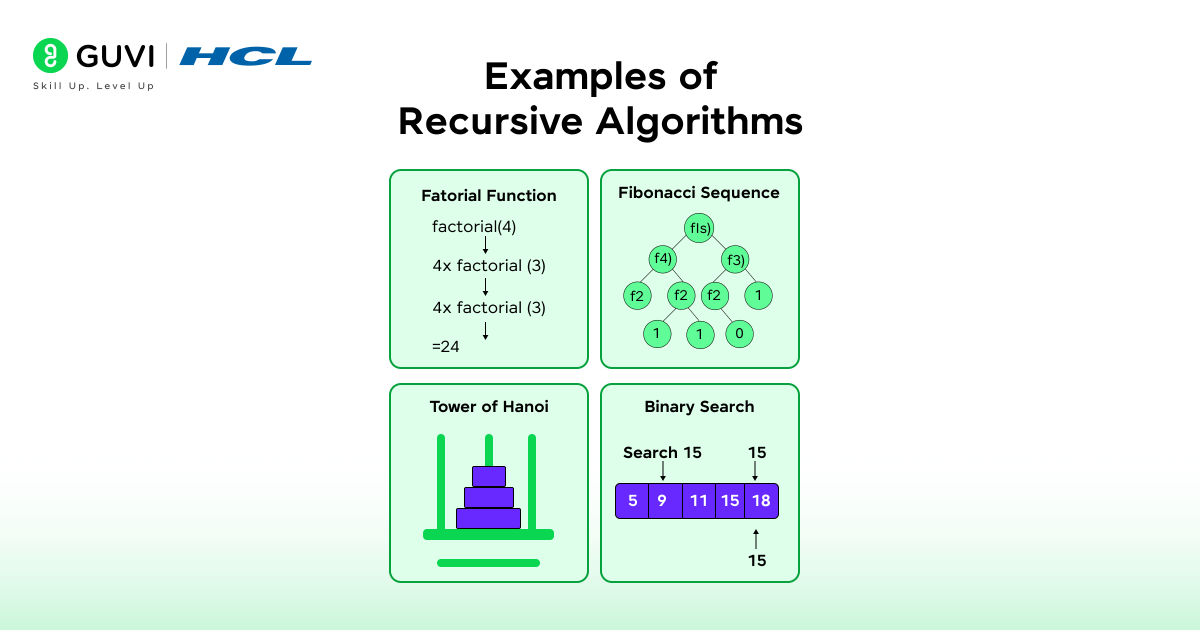
- Factorial Function
The factorial algorithm multiplies a number by the factorial of its preceding number until it reaches one. It demonstrates how recursion expresses mathematical repetition through direct function calls. The process starts with the given number and works backward until it arrives at the base value.
Example: To compute factorial(4), the program performs 4 × factorial(3), then 3 × factorial(2), then 2 × factorial(1). Once it reaches factorial(1)= 1, the recursion ends, and the results combine to produce 24.
- Fibonacci Sequence
The Fibonacci sequence builds each term as the sum of the previous two. The recursive approach expresses this naturally because each function call calculates two smaller values and adds them together. Although elegant, this algorithm grows exponentially unless optimized with memoization.
Example: To calculate fibonacci(5), the program calls fibonacci(4) and fibonacci(3). Each of these further expands until reaching the base values of Fibonacci (0) = 0 and Fibonacci (1) = 1. The final output combines these results to form the value 5.
- Tower of Hanoi
The Tower of Hanoi problem reflects recursion through physical movement logic. It involves transferring disks between rods under strict rules. The recursive design handles smaller sets of disks before addressing the main move, ensuring each step maintains proper order.
Example: With three disks, recursion moves the top two disks to an auxiliary rod. It shifts the largest disk to the target rod and then moves the two smaller disks onto it. Each recursive call focuses on one smaller movement pattern until all disks align correctly.
- Binary Search
Binary search applies recursion to locate an element in a sorted array. Each step compares the target value with the middle element and continues the search in the relevant half. This division continues until the element is found or the search range becomes empty.
Example: To find 15 in [5, 9, 11, 15, 18], the algorithm checks the middle element 11. Since 15 is greater, it searches the right half and finds 15 at the next recursive step. The process completes in logarithmic time due to consistent halving of the data range.
Bring your AI ideas to life: build powerful, production-ready software with our AI Software Development Course. Learn how to integrate models, design APIs, deploy scalable AI systems, and maintain code quality, all from industry experts. Get hands-on experience, build real projects, and transform your skills from theory to product-ready capabilities. Enroll today and start building the AI solutions of tomorrow!
lassic Recursion Problems in Python
Factorial, Fibonacci, and Tower of Hanoi are three popular problems used to understand recursive thinking.
1. Factorial Using Recursion
The factorial of a positive integer is the product of all integers from one to that number.
The recursive relation is:
factorial(n) = n × factorial(n - 1)The base case is factorial(0) = 1.
def factorial(n):
    if n < 0:
        raise ValueError("Factorial is not defined for negative numbers")

    if n == 0:
        return 1

    return n * factorial(n - 1)


print(factorial(5))
Output:
120The function continues calling itself with a smaller number until n becomes zero. The results then return in reverse order and produce the final value.
2. Fibonacci Sequence Using Recursion
The Fibonacci sequence begins with zero and one. Every following number is the sum of the previous two numbers.
def fibonacci(n):
    if n < 0:
        raise ValueError("Input must be a non-negative integer")

    if n <= 1:
        return n

    return fibonacci(n - 1) + fibonacci(n - 2)


for number in range(8):
    print(fibonacci(number), end=" ")
Output:
0 1 1 2 3 5 8 13This solution is easy to understand but inefficient for large inputs. It repeatedly calculates the same Fibonacci values and has approximately O(2ⁿ) time complexity.
Memoization can prevent repeated calculations:
from functools import lru_cache


@lru_cache(maxsize=None)
def fibonacci(n):
    if n < 0:
        raise ValueError("Input must be a non-negative integer")

    if n <= 1:
        return n

    return fibonacci(n - 1) + fibonacci(n - 2)


print(fibonacci(40))
Memoization reduces the time complexity to O(n) by storing previously calculated results.
3. Tower of Hanoi Using Recursion
Tower of Hanoi contains three rods and several disks of different sizes. The objective is to move all disks from the source rod to the destination rod.
The following rules apply:
- Only one disk can move at a time.
- A larger disk cannot be placed over a smaller disk.
- Only the top disk of a rod can be moved.
def tower_of_hanoi(disks, source, auxiliary, destination):
    if disks == 1:
        print(f"Move disk 1 from {source} to {destination}")
        return

    tower_of_hanoi(disks - 1, source, destination, auxiliary)

    print(f"Move disk {disks} from {source} to {destination}")

    tower_of_hanoi(disks - 1, auxiliary, source, destination)


tower_of_hanoi(3, "A", "B", "C")
Output:
Move disk 1 from A to C
Move disk 2 from A to B
Move disk 1 from C to B
Move disk 3 from A to C
Move disk 1 from B to A
Move disk 2 from B to C
Move disk 1 from A to C
Tower of Hanoi requires 2ⁿ - 1 moves for n disks. Therefore, its time complexity is O(2ⁿ).
Recursive Algorithms: Time and Space Complexity
| Recursive Algorithm | Time Complexity | Space Complexity | Iterative Alternative |
|---|---|---|---|
| Factorial | O(n) | O(n) | Multiplication using a loop |
| Fibonacci without memoization | O(2ⁿ) | O(n) | Two-variable loop |
| Fibonacci with memoization | O(n) | O(n) | Dynamic programming loop |
| Tower of Hanoi | O(2ⁿ) | O(n) | Explicit stack simulation |
| Recursive binary search | O(log n) | O(log n) | Binary search using a while loop |
| Tree traversal | O(n) | O(h) | Traversal using an explicit stack or queue |
| Recursive linked-list reversal | O(n) | O(n) | Pointer updates using a loop |
| Merge sort | O(n log n) | O(n) | Bottom-up merge sort |
Here, h represents the height of the tree. A balanced tree has approximately O(log n) height, while a skewed tree may have O(n) height.

Step-by-Step Execution Flow of a Recursive Algorithm
- Initialization of the Function Call: The process begins with the initial input passed to the recursive function. This input sets the context for the first evaluation and establishes the range of recursion that will follow.
- Base Case Evaluation: The algorithm checks whether the input satisfies the base condition. If it does, recursion halts immediately and returns a result that forms the foundation for all previous calls to resolve.
- Recursive Case Execution: If the base condition is not met, the function proceeds to call itself with modified inputs. Each recursive call simplifies the problem and moves it one step closer to the base case.
- Stack Frame Expansion: Every recursive call creates a new stack frame in memory. These frames hold intermediate data and return points. The stack grows downward with each call until the base case is reached.
- Unwinding and Result Composition: After reaching the base case, the recursive calls begin to resolve in reverse order. Each function retrieves the result from its deeper call, performs its operation, and returns it upward. This reversal completes the computation chain that connects all recursive levels.
Applications of the Recursion Algorithm
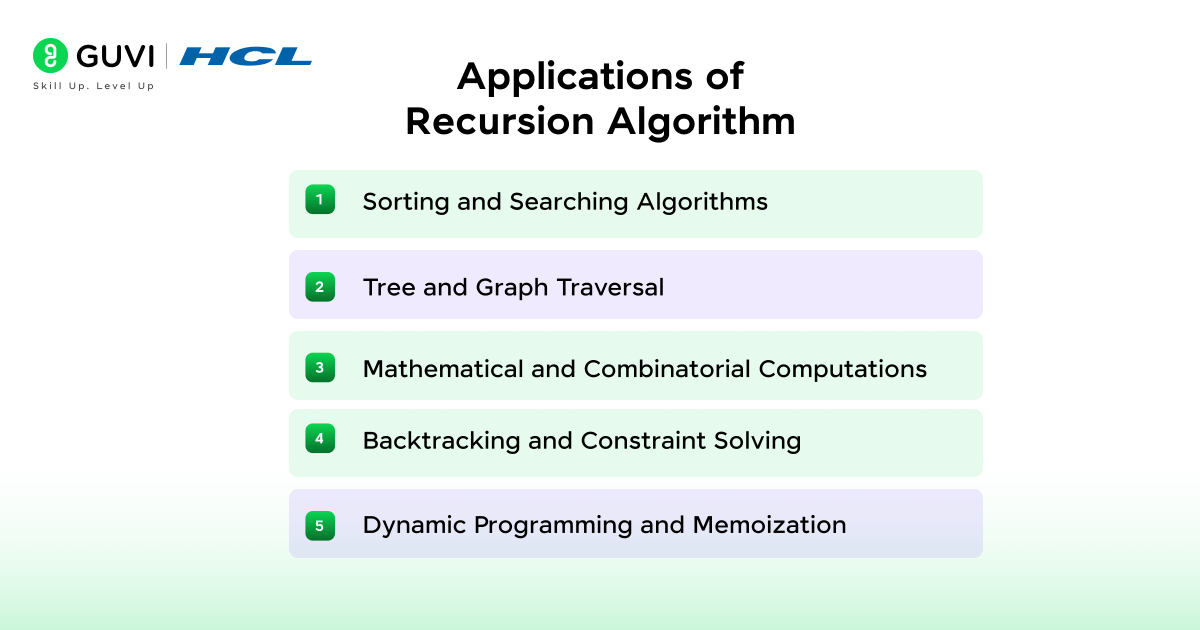
1. Sorting and Searching Algorithms
Recursive techniques form the base of quicksort, merge sort, and binary search. These algorithms repeatedly divide data until reaching atomic units, ensuring efficient processing in O(log n) or O(n log n) time.
2. Tree and Graph Traversal
Depth-first traversals in trees and graphs rely on recursion to visit nodes in sequence without explicit stack usage. This simplifies exploration and maintains order naturally.
3. Mathematical and Combinatorial Computations
Recursion simplifies computing factorials, Fibonacci numbers, GCD, and combinations. It breaks mathematical definitions into actionable steps aligned with their recursive expressions.
4. Backtracking and Constraint Solving
Used in complex problems like the N-Queens puzzle, Sudoku solver, and maze navigation. Recursion facilitates exploring all possibilities and reverting (backtracking) when a constraint fails.
5. Dynamic Programming and Memoization
Recursive approaches combined with memoization help solve overlapping subproblems efficiently (e.g., computing Fibonacci numbers, shortest paths, or knapsack optimization).
Recursion vs Iteration
| Factor | Recursion | Iteration |
| Definition | A method where a function calls itself to solve smaller subproblems. | A method that repeatedly executes a set of instructions using loops until a condition is met. |
| Termination | Stops when it reaches the base case. | Stops when the loop condition becomes false. |
| Memory Usage | Consumes more memory due to multiple call stack frames. | Uses less memory since variables are updated in place. |
| Speed | May be slower due to function call overhead. | Usually faster because it avoids repeated function calls. |
| Code Structure | Compact and closer to mathematical definitions. | Requires explicit control structures such as for or while loops. |
| Debugging | More difficult because of multiple recursive calls. | Easier to trace since the flow is linear. |
| Best Suited For | Problems with hierarchical or self-referential structures like trees and graphs. | Problems that involve simple repetitions or fixed number of iterations. |
| Example | Computing factorial using factorial(n) = n * factorial(n – 1). | Computing factorial using a loop that multiplies numbers from 1 to n. |
Recursion vs Iteration- When to Use Which?
Recursion and iteration can often solve the same problem. The better option depends on the problem structure, input size, memory limits, and readability requirements.
Use Recursion When
- The problem naturally contains smaller versions of itself.
- The data follows a hierarchical structure.
- The solution requires backtracking.
- Divide-and-conquer logic improves readability.
- The expected recursion depth remains manageable.
Tree traversal, merge sort, quicksort, directory traversal, N-Queens, and maze solving are common recursive applications.
Use Iteration When
- The problem involves straightforward repetition.
- The input may produce thousands of nested calls.
- Memory efficiency is important.
- Performance matters more than compact code.
- A loop expresses the logic clearly.
Factorial calculation, array traversal, Fibonacci generation, and linear searching are generally more efficient with iteration.
Consider an iterative factorial:
def factorial_iterative(n):
    if n < 0:
        raise ValueError("Factorial is not defined for negative numbers")

    result = 1

    for number in range(2, n + 1):
        result *= number

    return result


print(factorial_iterative(5))
This version runs in O(n) time but uses only O(1) additional space.
How to Convert a Recursive Algorithm Into an Iterative Algorithm
- Identify What Each Recursive Call Stores: Determine which parameters, local variables, return positions, and intermediate values must survive while deeper calls execute. These values represent the state that must be preserved in the iterative solution.
- Replace the Call Stack With an Explicit Stack: Many recursive algorithms can be rewritten using a stack data structure. Instead of allowing the runtime to create function frames automatically, the program pushes unfinished work onto an explicit stack and processes it manually.
- Convert the Base Case Into a Loop Condition: The recursive stopping condition usually becomes part of a
whileorforloop. The loop continues while unresolved states remain and terminates when the stack becomes empty or the required result is found. - Push New Subproblems Instead of Calling the Function: When the recursive version would call itself, the iterative version places the next subproblem on the stack. This preserves the order of pending work without creating another function frame.
- Preserve the Correct Processing Order: Stack order matters when converting recursion to iteration. Depth-first search, for example, uses a LIFO stack because the most recently discovered node should generally be processed first. Children may need to be pushed in reverse order when traversal order must match the recursive version.
- Handle the Unwinding Phase Explicitly: Some recursive algorithms perform calculations after a deeper call returns. These algorithms may require additional stack information to remember whether a subproblem has already been visited or which operation should happen after its child completes.
- Use the Technique for Deep Recursive Problems: Converting recursion to an explicit stack is useful for deep tree traversal, graph DFS, directory processing, expression evaluation, and other problems where nested function calls could exceed the language’s recursion depth.
- Do Not Assume Iterative Conversion Improves Time Complexity: Replacing recursive calls with an explicit stack primarily changes how execution state is stored. A recursive DFS and an iterative DFS, for example, can have the same time complexity even though their stack-management mechanisms are different.
Common Recursion Mistakes and How to Avoid Stack Overflow
Recursive code may appear simple, but small logical mistakes can create incorrect results or unlimited function calls.
1. Missing the Base Case
A recursive function without a base case continues calling itself until the program reaches its recursion limit.
def countdown(n):
    print(n)
    countdown(n - 1)
Add a stopping condition:
def countdown(n):
    if n <= 0:
        return

    print(n)
    countdown(n - 1)
2. Writing an Unreachable Base Case
The function may contain a base case but move in the wrong direction.
def countdown(n):
    if n == 0:
        return

    countdown(n + 1)
The value increases and never reaches zero. The recursive input must always move toward the base case.
3. Failing to Reduce the Problem
Passing the same input creates infinite recursion.
def factorial(n):
    if n == 0:
        return 1

    return n * factorial(n)
The corrected recursive call is:
return n * factorial(n - 1)4. Repeating the Same Calculations
Basic recursive Fibonacci recalculates the same values numerous times. Memoization stores completed results and avoids unnecessary calls.
5. Ignoring Large Input Sizes
Every recursive call creates a stack frame. Large inputs may exceed Python’s recursion limit and raise a RecursionError.
The current limit can be checked using:
import sys

print(sys.getrecursionlimit())
Python also allows the limit to be changed:
import sys

sys.setrecursionlimit(2000)
Increasing the limit should be done carefully. A very high value may consume excessive memory or crash the program.
How to Avoid Stack Overflow
- Confirm that every path reaches a base case.
- Reduce the input during every recursive call.
- Use iteration for deeply nested problems.
- Replace recursion with an explicit stack where possible.
- Apply memoization to repeated subproblems.
- Validate the input before starting recursion.
- Test the function with boundary and large input values.
- Avoid increasing the recursion limit without understanding memory usage.
Tail Recursion Optimization Explained With Code
Tail recursion occurs when the recursive call is the final operation performed by a function. No additional calculation remains after the recursive call returns.
Consider a tail-recursive factorial:
def tail_factorial(n, accumulator=1):
    if n < 0:
        raise ValueError("Factorial is not defined for negative numbers")

    if n == 0:
        return accumulator

    return tail_factorial(n - 1, accumulator * n)


print(tail_factorial(5))
The accumulator stores the intermediate result. The recursive call is the final action performed by the function.
Some programming languages perform tail call optimization. This optimization reuses the current stack frame instead of creating a new one for every call.
Does Python Optimize Tail Recursion?
Python does not perform tail call optimization. Therefore, the previous tail-recursive function still creates a new stack frame for every call and may raise a RecursionError for large values.
An iterative version is safer in Python:
def optimized_factorial(n):
    if n < 0:
        raise ValueError("Factorial is not defined for negative numbers")

    accumulator = 1

    while n > 0:
        accumulator *= n
        n -= 1

    return accumulator


print(optimized_factorial(5))
The iterative version provides the same result using O(1) additional space. Tail recursion may improve code structure, but it does not provide stack-memory optimization in Python.
LeetCode Recursion Problems With Difficulty Ratings
The following LeetCode problems can help learners practise recursion, backtracking, trees, and divide-and-conquer techniques.
| Problem | Number | Difficulty | Main Concept |
| Fibonacci Number | 509 | Easy | Basic recursion |
| Maximum Depth of Binary Tree | 104 | Easy | Tree recursion |
| Reverse Linked List | 206 | Easy | Recursive pointer handling |
| Merge Two Binary Trees | 617 | Easy | Parallel tree traversal |
| Symmetric Tree | 101 | Easy | Recursive tree comparison |
| Pow(x, n) | 50 | Medium | Divide and conquer |
| Generate Parentheses | 22 | Medium | Backtracking |
| Subsets | 78 | Medium | Decision-tree recursion |
| Permutations | 46 | Medium | Backtracking |
| Combination Sum | 39 | Medium | Recursive search |
| Word Search | 79 | Medium | Grid backtracking |
| Different Ways to Add Parentheses | 241 | Medium | Divide and conquer |
| N-Queens | 51 | Hard | Constraint-based backtracking |
| Sudoku Solver | 37 | Hard | Recursive constraint solving |
| Regular Expression Matching | 10 | Hard | Recursion with dynamic programming |
Beginners can start with Fibonacci Number and Maximum Depth of Binary Tree. Intermediate learners can then solve Subsets, Permutations, and Generate Parentheses. N-Queens and Sudoku Solver provide advanced practice in recursive backtracking.
Limitations of the Recursion Algorithm
- High Memory Usage: Recursive algorithms require additional memory because each call adds a new frame to the call stack. Large input sizes or deep recursion can exhaust available memory and cause stack overflow errors. This becomes more critical in problems that lack clear base conditions or require extensive branching.
- Slower Execution in Some Cases: Recursion can increase execution time because of repeated function calls and stack operations. Each call involves overhead related to parameter passing and return handling. Problems that can be solved with direct iteration may perform faster without recursion.
- Difficulty in Debugging and Tracing: Tracing the flow of recursive calls is often complex. Errors in base or recursive conditions may cause infinite loops or incorrect outputs. Understanding how data passes through multiple recursive layers requires careful step-by-step analysis.
- Limited Suitability for Simple Problems: Recursion may overcomplicate problems that can be solved with straightforward iteration. The added cost of function calls and stack maintenance may not justify the benefits of recursion for smaller tasks. Choosing the correct approach requires balancing readability and performance.
- Risk of Stack Overflow: Each recursive function call consumes space on the call stack. Deep or infinite recursion can fill the stack, which leads to runtime failure. This limitation makes recursion less practical for tasks that involve unpredictable or extremely large inputs.
Want to master how recursion powers algorithms from factorials to tree traversals? Learn to design, trace, and optimize recursive logic step by step with our Data Structures & Algorithms using Java Course. Gain hands-on experience with recursion, dynamic programming, and divide-and-conquer strategies used in top coding interviews and real-world applications. Strengthen your DSA foundation and elevate your problem-solving confidence today!
Conclusion
Recursion stands as one of the most essential concepts in DSA because it connects mathematical reasoning with algorithmic execution. It reflects how large problems can be expressed through smaller and similar subproblems. Each recursive call contributes to solving one layer of the problem until the complete result emerges. This structure promotes logical flow and precision in problem-solving. A clear grasp of recursion prepares programmers to tackle complex data problems efficiently and with precision.
FAQs
What is recursion in data structures and algorithms?
Recursion is a programming technique where a function calls itself to solve smaller versions of the same problem until it reaches a defined base case.
What are the main components of a recursion algorithm?
A recursion algorithm mainly includes a base case, which stops further calls, and a recursive case, which reduces the problem and calls the function again.
What are common examples of recursion algorithms?
Common recursion examples include factorial calculation, Fibonacci sequence, binary search, Tower of Hanoi, tree traversal, graph traversal, merge sort, and backtracking problems.
What is the difference between recursion and iteration?
Recursion solves problems through repeated function calls, while iteration uses loops. Recursion can make hierarchical problems easier to express, but iteration usually uses less memory.
What is the time and space complexity of recursion?
The complexity depends on the algorithm. For example, recursive factorial takes O(n) time and O(n) space, while recursive Fibonacci without memoization takes approximately O(2ⁿ) time and O(n) stack space.
How can stack overflow be avoided in recursion?
Stack overflow can be reduced by defining a reachable base case, decreasing the input on every call, avoiding excessive recursion depth, using memoization, or converting deep recursive logic into iteration or an explicit stack.
Success Stories

About the Author
Vaishali
I'm a seasoned writer with four years of experience across technical, non-technical, and just about every genre or niche you can imagine. Adaptable and curious, I enjoy exploring new topics and making information engaging and easy to understand. Fueled by a steady stream of tea, I approach each project with creativity, reliability, and genuine enthusiasm for storytelling.
View all posts by Vaishali
Connect with me @









Did you enjoy this article?