


Data Structure Articles
Sliding Window Technique: Explained with Examples
Two Pointer Technique: Problems and Applications


Get In Touch For Details! Request More Information

Why do Companies ask DSA for SDE roles? An In-Depth Guide
Jun 02, 2026 6 Min Read 4217 Views
(Last Updated)
Ever wondered why every software engineering interview seems obsessed with Data Structures and Algorithms (DSA)? You spend months practicing arrays, trees, and dynamic programming, only to wonder, how much of this will I actually use on the job?
The truth is, companies aren’t testing your ability to memorize syntax. They’re testing how you think. The concept of DSA for SDE roles is used to evaluate how well you can analyze problems, design efficient solutions, and reason about complexity—the exact skills top tech teams rely on every day.
So, to make it easier for you to understand, we’ve put together this blog that connects real interview expectations with DSA for SDE roles, along with simple explanations and examples to show why DSA for SDE roles matters in real problem-solving. Without further ado, let’s get started!
Table of contents
- TL;DR Summary
- What Are Data Structures and Algorithms?
- How Data Structures and Algorithms Impact Performance
- Why Do Interviews Focus on DSA?
- How DSA Skills Benefit You as a Developer
- Real-World Examples: DSA in Action
- Preparing for DSA in SDE Interviews
- Conclusion
- FAQs
- Why do companies ask DSA questions during SDE interviews?
- Do you really use data structures and algorithms every day as an SDE?
- Is DSA more important for big tech companies (like Google, Amazon) than smaller ones?
- If I have 10+ years of experience, do I still need to prepare DSA for interviews?
- How should I start preparing for DSA if I’m going for an SDE role?
TL;DR Summary
- This blog helps you clearly understand what Data Structures and Algorithms are and how they form the basic foundation of problem-solving in programming.
- It explains how Data Structures and Algorithms impact performance, helping you see why efficient code matters in real applications.
- It breaks down why interviews focus on DSA, giving you a better idea of how companies evaluate thinking and problem-solving skills.
- It shows how DSA skills benefit you as a developer, helping you understand their role in writing better and more structured code.
- It guides you through preparing for DSA in SDE interviews, helping you establish a clear direction for DSA practice and improvement in SDE roles.
What Are Data Structures and Algorithms?
A data structure is a way of organizing and storing data so that it can be accessed and modified efficiently. For example, arrays, linked lists, trees, graphs, stacks, and queues are common data structures.
An algorithm is a step-by-step procedure or set of rules for solving a problem. Algorithms include sorting a list of numbers, searching for an item, finding the shortest path in a graph, and so on.
Together, Data Structures and Algorithms are about choosing the right data structure and algorithm to solve a problem quickly and efficiently (minimizing time and memory use).
Why does this matter? In real-world software, you often deal with large amounts of data (think millions of users, search results, database records, etc.). The way you store and manipulate that data dramatically affects your program’s performance.
Even a computer that’s 100 times slower can outperform a faster one by using a better algorithm. In one example, a slower server running an efficient sort finished sorting 1,000,000 items in 1 second, while a much faster server using a naive sort took 100 seconds! The only difference was the algorithm. This illustrates why companies care deeply about how you solve a problem, not just whether you solve it.
If you want a platform that actually teaches DSA in a structured, beginner-friendly way while also giving you practical coding experience, consider enrolling in HCL GUVI’s DSA for Programmers Course that is designed specifically for learners who want clarity instead of confusion. It explains concepts in simple terms and guides you from the basics to advanced topics step by step.
How Data Structures and Algorithms Impact Performance
When building real-world applications, performance depends on how efficiently your solution handles increasing data. This is measured by time and space complexity, which indicate how an algorithm behaves at scale.
| Concept | What It Means | Common Big-O Examples | Real Impact |
|---|---|---|---|
| Time Complexity | How fast an algorithm runs | O(1), O(log n), O(n), O(n log n), O(n²), O(2ⁿ) | Affects execution speed and response time |
| Space Complexity | How much memory is used | O(1), O(n), O(n²) | Affects memory usage and system stability |
Now let’s understand it in simple engineering terms:
Time complexity describes how execution time increases as input grows. For example, O(1) is constant and extremely fast, while O(n²) becomes very slow when data size increases. Efficient systems usually aim for O(1), O(log n), or O(n log n) depending on the problem.
Space complexity explains how memory usage grows. A solution with O(1) space uses constant memory, while O(n) or higher means memory increases with input size, which can impact performance in large-scale systems.
In real engineering systems, the goal is always balance. A good system is not just fast, but also memory-efficient, ensuring it can handle growth from thousands to millions of users smoothly.
Also Read: Importance of DSA

Why Do Interviews Focus on DSA?
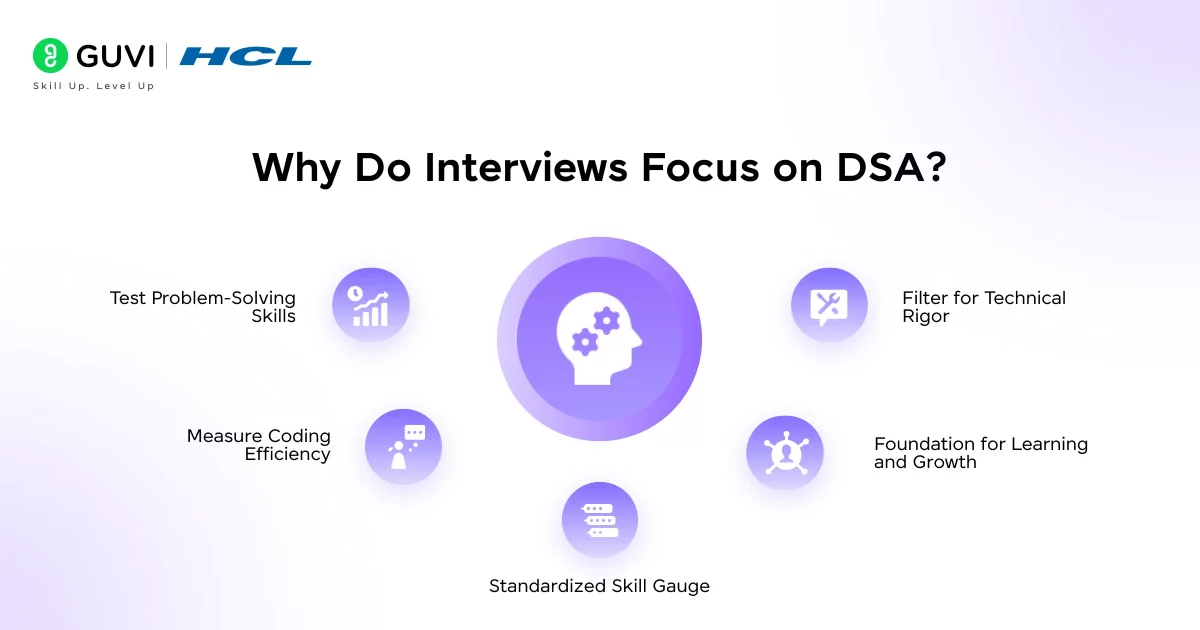
When you interview for an SDE role (especially at tech giants like Google, Amazon, Facebook/Meta, Apple, Microsoft, etc.), you’ll almost certainly face DSA questions. But why? Here are the main reasons:
- Test Problem-Solving Skills: Algorithm questions force you to think logically and break down problems. Interviewers watch how you approach a problem step by step.
- Measure Coding Efficiency: Companies care about code that runs fast and uses resources wisely. Interviewers expect you to choose efficient algorithms (for example, using binary search instead of linear search when appropriate). The ability to optimize code means your programs will use less memory and CPU in production.
- Standardized Skill Gauge: DSA questions provide a common yardstick. Every candidate can be given a similar algorithmic problem, making it easier for interviewers to compare how well different people solve it. This is more objective than asking each candidate about their past projects (which vary widely). As a result, companies often treat DSA proficiency as a fundamental skill.
- Foundation for Learning and Growth: DSA is the groundwork for more advanced computer science concepts. If you master DSA, you’ll be better equipped to learn things like system design, machine learning, big data, and more complex algorithms.
- Filter for Technical Rigor: High-profile tech roles require sharp technical minds. DSA problems are challenging, so by asking candidates to solve them, companies can filter out candidates who are not serious about engineering.
Key Takeaway:
“Good code is its own best documentation. As you’re about to add a comment, ask yourself, ‘How can I improve the code so that this comment isn’t needed?’”
— Steve McConnell, Author of Code Complete
Companies don’t ask DSA just because it’s tradition. They want to make sure you (the candidate) can handle complex scenarios, optimize solutions, and think like a computer scientist. In interviews, DSA problems are a reliable way to test these skills.
If you are a student and if you are curious about how DSA helps in getting you successfully placed, read the article – Is DSA Important for Placement?
How DSA Skills Benefit You as a Developer
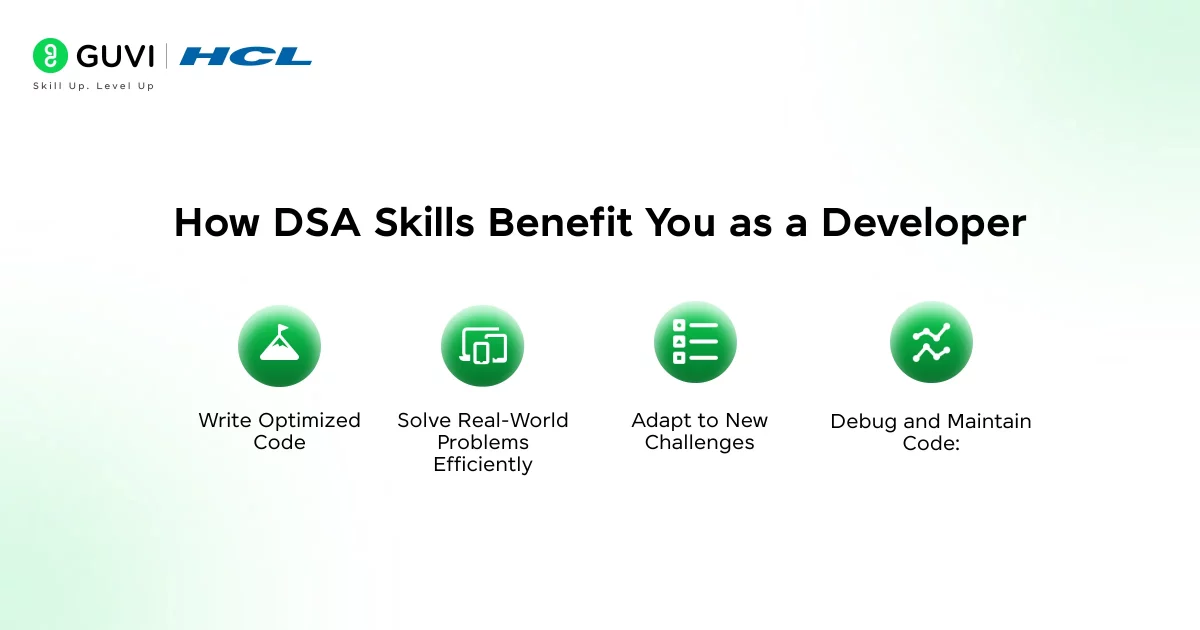
Understanding DSA isn’t just about getting through an interview – it makes you a better SDE on the job. Here’s how:
- Write Optimized Code: Knowing the right data structure and the best algorithm means your programs will run faster and scale better. This improves user experience and reduces infrastructure costs.
- Solve Real-World Problems Efficiently: Many everyday tasks are actually algorithmic puzzles. For example, finding a user in a large sorted database is a search problem (e.g., binary search), and recommending products can involve graph algorithms (e.g., collaborative filtering). Strong DSA knowledge lets you translate these tasks into code effectively.
- Adapt to New Challenges: Technologies change (new languages, frameworks, tools), but DSA concepts stay the same. Once you understand the logic of algorithms and how data is structured, you can apply that knowledge anywhere.
- Debug and Maintain Code: Engineers with a strong DSA background often write cleaner, modular code. They understand edge cases and can anticipate performance issues before they happen. This makes debugging easier.
In short, if you’re comfortable with DSA, you’ll write better code day-to-day, handle larger projects, and fit in well with engineering teams. Companies know this, so they test for it early.
Key Points to Remember:
- DSA = Problem Solving Power: Strong DSA skills mean better solutions.
- Efficiency is Crucial: Fast algorithms save time and resources.
- Practice Makes Perfect: Regular coding practice prepares you for interviews and real jobs.
Companies know that the best engineers have these skills, which is why DSA remains a staple of the SDE interview process. Focus on understanding the why behind each algorithm and data structure – this will help you not just in interviews, but every step of your software career.
If you want to read more about how DSA paves the way for effective coding and its use cases, consider reading HCL GUVI’s Free Ebook: The Complete Data Structures and Algorithms Handbook, which covers the key concepts of Data Structures and Algorithms, including essential concepts, problem-solving techniques, and real MNC questions.
Real-World Examples: DSA in Action
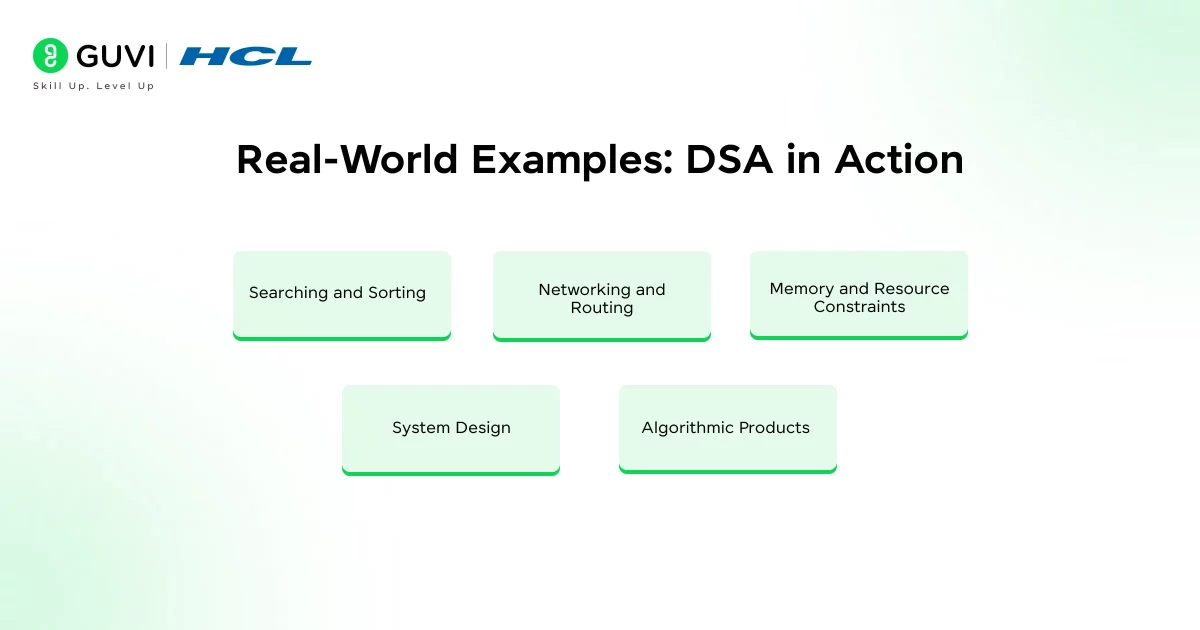
To make this concrete, consider some real scenarios where DSA knowledge is crucial:
- Searching and Sorting: Imagine a music streaming app with millions of songs. When you search for a song, the app might use a balanced binary search tree or a hash-based index to quickly find your query. If the programmers only knew naive search methods, it would be much slower. In interviews, solving a search or sort problem (such as finding duplicates, sorting numbers, or searching in a rotated array) mirrors real-world tasks.
- Networking and Routing: Behind the scenes, internet data packets find the best path using graph algorithms (like Dijkstra’s or A*). If you’re working on any distributed system or backend, you’ll indirectly rely on these algorithms. A solid grasp of graph DSA helps you understand and optimize such systems.
- Memory and Resource Constraints: Mobile and embedded devices have limited memory. Choosing the right data structure (for example, using a linked list vs. an array when memory is tight) can make or break an application. Companies building software for devices (like IoT or smartphones) value engineers who can manage these constraints with proper DSA.
- System Design: While system design interviews are separate, DSA knowledge underpins them. When explaining your design, you’ll naturally fall back on DSA terms. Companies ask DSA to ensure you can handle this thinking.
- Algorithmic Products: Some companies literally build products around algorithms. For example, Google’s search engine uses extremely complex algorithms (like PageRank), and Facebook’s newsfeed uses graph and sorting algorithms.
These examples show that DSA isn’t just academic: it powers most of the tech we use. By solving DSA questions in an interview, you’re simulating the kinds of challenges you’ll face on the job.
Preparing for DSA in SDE Interviews
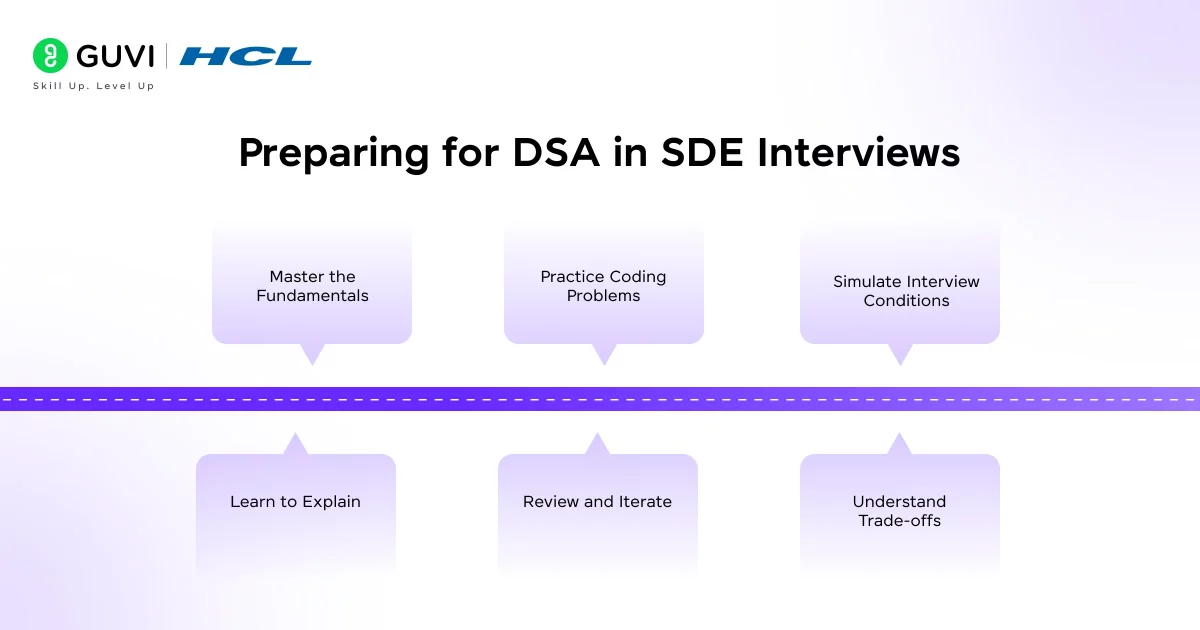
Knowing that companies value DSA, how should you prepare? Here are some practical tips:
- Master the Fundamentals: Make sure you understand basic data structures (arrays, stacks, queues, linked lists, trees, graphs, heaps, hash tables) and algorithms (sorting, searching, recursion, dynamic programming, etc.).
- Practice Coding Problems: Regularly solve algorithm problems on platforms like LeetCode, GeeksforGeeks, or HackerRank. Start with easy problems to build confidence, then gradually tackle harder ones. Practicing teaches you patterns: for example, once you’ve solved a few tree traversal problems, similar ones will feel easier.
- Simulate Interview Conditions: Time yourself, use a whiteboard or paper, and explain your solution out loud, as if the interviewer were watching. This helps you prepare for the pressure and communication aspect. Remember, interviewers care about how you think as much as what you do.
- Learn to Explain: Interviewers appreciate it when you can clearly explain your approach. As you practice, narrate your thought process. For example, when using a certain data structure, say why it’s a good fit. This shows depth of understanding.
- Review and Iterate: After solving problems, review the official or optimal solutions. There might be a faster algorithm you missed or a cleaner implementation. Learning multiple ways to solve similar problems builds flexibility.
- Understand Trade-offs: Sometimes, two algorithms solve the same problem differently (e.g., recursive vs. iterative, or using extra memory vs. saving memory). Be ready to discuss the trade-offs. This is a common interview follow-up (“What if I give you more memory? Less time?” etc.).
By following these steps, you’ll not only improve your DSA skills but also gain confidence. Many candidates find that consistent practice is the key – companies want to see that you’re dedicated and up to the challenge.
If you’re serious about mastering DSA in software development and want to apply it in real-world scenarios, don’t miss the chance to enroll in HCL GUVI’s IITM Pravartak and MongoDB Certified Online AI Software Development Course. Endorsed with NSDC certification, this course adds a globally recognized credential to your resume, a powerful edge that sets you apart in the competitive job market.
Conclusion
In conclusion, companies ask DSA for SDE roles because they want engineers who can think clearly, solve problems efficiently, and build optimized solutions. Data structures and algorithms form the core of writing scalable and high-performance software.
By mastering it, you show that you can break down complex problems, write efficient code, and grow as a strong developer. It not only helps you clear interviews but also prepares you for real-world engineering challenges. Mastering DSA for SDE roles means you’re not just interview-ready—you’re ready to build real systems that scale.
FAQs
1. Why do companies ask DSA questions during SDE interviews?
DSA questions help assess your problem-solving ability, coding efficiency, and foundational understanding of computer science.
2. Do you really use data structures and algorithms every day as an SDE?
Not necessarily exactly as in a LeetCode problem, but the concepts, choosing the right data structure, optimizing memory and time, underlie real-world engineering decisions.
3. Is DSA more important for big tech companies (like Google, Amazon) than smaller ones?
Yes, large tech firms often use DSA rounds as a standardized filter, so if you’re targeting major companies, strong DSA preparation is crucial.
4. If I have 10+ years of experience, do I still need to prepare DSA for interviews?
Yes, many companies still include DSA topics even for senior roles because they reflect your ability to learn, adapt, and solve unfamiliar problems.
5. How should I start preparing for DSA if I’m going for an SDE role?
Start with fundamentals (arrays, lists, trees, graphs, time/space complexity), practice coding problems consistently, simulate interview conditions, and review your solutions.
Success Stories












Did you enjoy this article?