


Artificial Intelligence and Machine Learning Articles
Finance Manager to Data Analytics: Career Growth, Salary and Seniority
How to Evaluate LLM Outputs in Production Deployments
AI/ML Skills Gap 2026: Why Companies Can't Find Job-Ready Talent
20 AI/ML Interview Questions Recruiters Can Use Without a Tech Background - Best Guide
Get In Touch For Details! Request More Information
How Google is Using Artificial Intelligence?
Nov 26, 2025 6 Min Read 3283 Views
(Last Updated)
What if the technology shaping your search results, powering your photos, and finishing your emails is quietly redefining the future? Artificial Intelligence isn’t just an add-on for Google; in fact, it’s the engine driving its transformation.
Right from understanding human language to predicting traffic patterns and advancing healthcare research, Google’s AI is weaving intelligence into everyday life at a scale once thought impossible.
Read the full blog to discover how Google is using AI to innovate and transform the world.
Table of contents
- Google: A Brief Outlook on Its Past and Present
- How Google Actually Uses Artificial Intelligence?
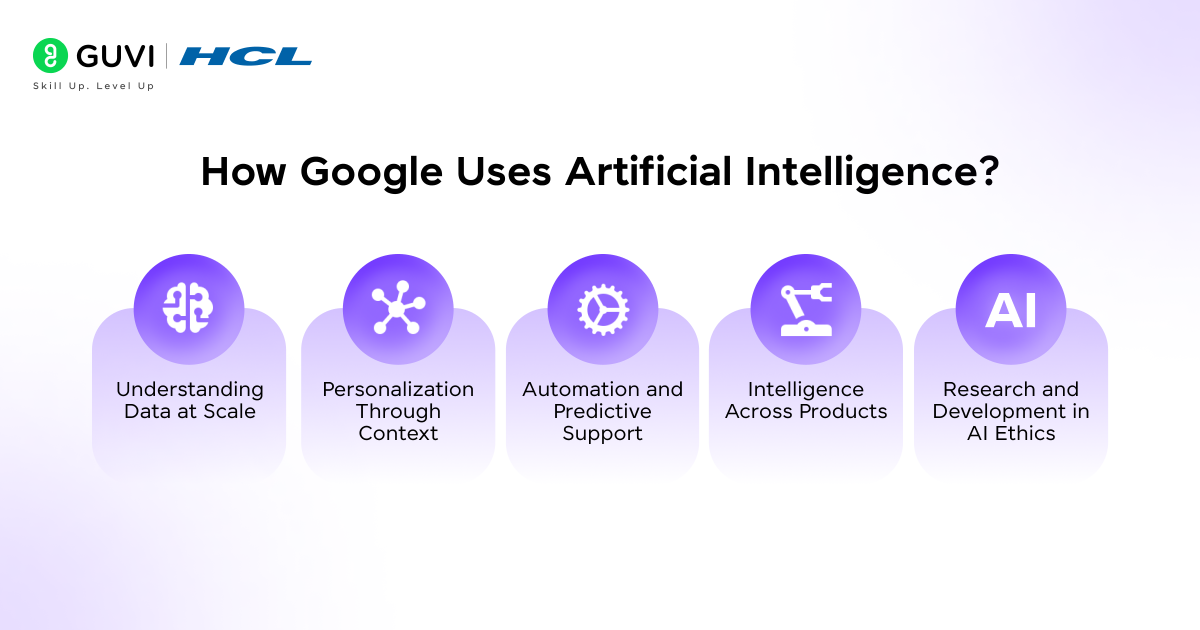
- Understanding Data at Scale
- Personalization Through Context
- Automation and Predictive Support
- Intelligence Across Products
- Research and Development in AI Ethics
- Top 5 Google Apps Powered by Artificial Intelligence
- Google Search
- Google Maps
- Google Photos
- Google Assistant
- Google Cloud AI
- Is Google Losing Space to AI Models in Search?
- The Shift Toward Direct Answers
- Google’s Answer: Gemini
- Google Nano Banana Retro Trends: A Creative Twist in AI Culture
- The Ethics Behind Google’s Artificial Intelligence
- Major Companies Challenging Google’s Dominance in Artificial Intelligence
- Future Outlook for Google and Artificial Intelligence
- Conclusion
- FAQs
- Will AI replace Google Search in the future?
- Does Google use AI for cybersecurity?
- What is Google Gemini and how is it different from ChatGPT?
Google: A Brief Outlook on Its Past and Present
Google began in 1998 as a search engine built on the belief that information should be structured and accessible. Over time, it evolved from a simple tool for finding websites into a global platform shaping how people connect, learn, and work. The company expanded its vision through products such as Gmail, YouTube, Chrome, and Android, turning digital interaction into an essential part of everyday life.
Today, Google operates at a scale that influences nearly every area of technology, from cloud computing to education and digital communication. The company’s next chapter rests on Artificial Intelligence, which now guides its progress across products and innovation, shaping how knowledge will move in the years ahead.
How Google Actually Uses Artificial Intelligence?
1. Understanding Data at Scale
Artificial Intelligence helps Google interpret massive streams of information that flow across search queries, maps, videos, and digital content. Through natural language processing, the system does more than categorize data; it evaluates relevance and context to understand meaning beyond surface patterns. It reads the tone of a question and the relationship between words. AI also analyzes the behavioral clues behind user actions. This awareness gives Google the ability to deliver information that feels intuitive rather than mechanical. The depth of this understanding is what allows its algorithms to adapt to language and shifting intent.
2. Personalization Through Context
Google uses AI to understand each user as an individual. It studies behavior patterns such as frequent searches, preferred locations, and content engagement to tailor results that feel personal. The objective is not to predict a single choice but to create relevance that evolves with the user’s rhythm. Personalization at this level builds a sense of continuity, where the system learns quietly and responds with subtle accuracy.
3. Automation and Predictive Support
AI automates repetitive processes that once required human attention. In Gmail, it predicts message intent and drafts smart replies that match tone and urgency. In Maps, it anticipates travel routes and suggests adjustments before conditions worsen. These forms of automation work to conserve mental effort, giving users a smoother and more responsive digital experience. The goal remains consistent: reduce the delay between intent and outcome so that technology feels responsive rather than reactive.
4. Intelligence Across Products
AI acts as the common language across Google’s platforms. Search uses it to refine meaning. Photos uses it to identify emotion and subject. YouTube uses it to recommend what fits the user’s state of mind at a given moment. Each product contributes to the same objective: to make interaction with information feel immediate and natural. The design behind this approach is simple yet deliberate: understand human behavior with precision and respond with clarity.
5. Research and Development in AI Ethics
Google continues to explore how Artificial Intelligence can advance without compromising human judgment or fairness. Its teams study bias, transparency, and model safety as part of ongoing research. The intention is to create systems that respect responsibility as much as accuracy. This focus marks a maturing stage in AI development, where intelligence becomes a tool of understanding rather than control.
Top 5 Google Apps Powered by Artificial Intelligence
1. Google Search
AI helps Google Search read intent rather than just words. It observes how people phrase questions, the order of terms, and the context built around them. This process allows the system to draw meaning that goes beyond literal keywords. Search results become tailored to intent, which helps users find accurate and meaningful information even when their queries are unclear.
2. Google Maps
Google Maps relies on AI to understand real-world movement. It studies traffic flow, weather impact, and historical driving data to suggest practical routes. The system constantly adjusts predictions as conditions change. This intelligence reduces uncertainty during travel and gives users more confidence in timing and direction.
3. Google Photos
AI in Google Photos identifies faces, objects, and places with a level of precision that mirrors human recall. It arranges albums automatically and highlights images that match emotional or thematic patterns. The system learns what matters most to each user and surfaces those memories with ease. This quiet intelligence turns a simple photo library into a visual diary that feels personal and orderly.
4. Google Assistant
Google Assistant utilizes AI to interpret natural speech and understand everyday language. It learns tone, phrasing, and preference through repeated interaction. This allows it to offer responses that feel more relevant and timely. Over time, the assistant becomes an active part of daily routine, managing reminders, directions, and quick answers with minimal effort from the user.
5. Google Cloud AI
Google Cloud applies AI to business operations where scale and accuracy matter. It supports industries in analyzing structured and unstructured data and predicting outcomes. It also helps in automating decisions that would otherwise require large teams. This approach allows organizations to save time and direct human attention toward creative and strategic work rather than repetitive analysis.
Is Google Losing Space to AI Models in Search?
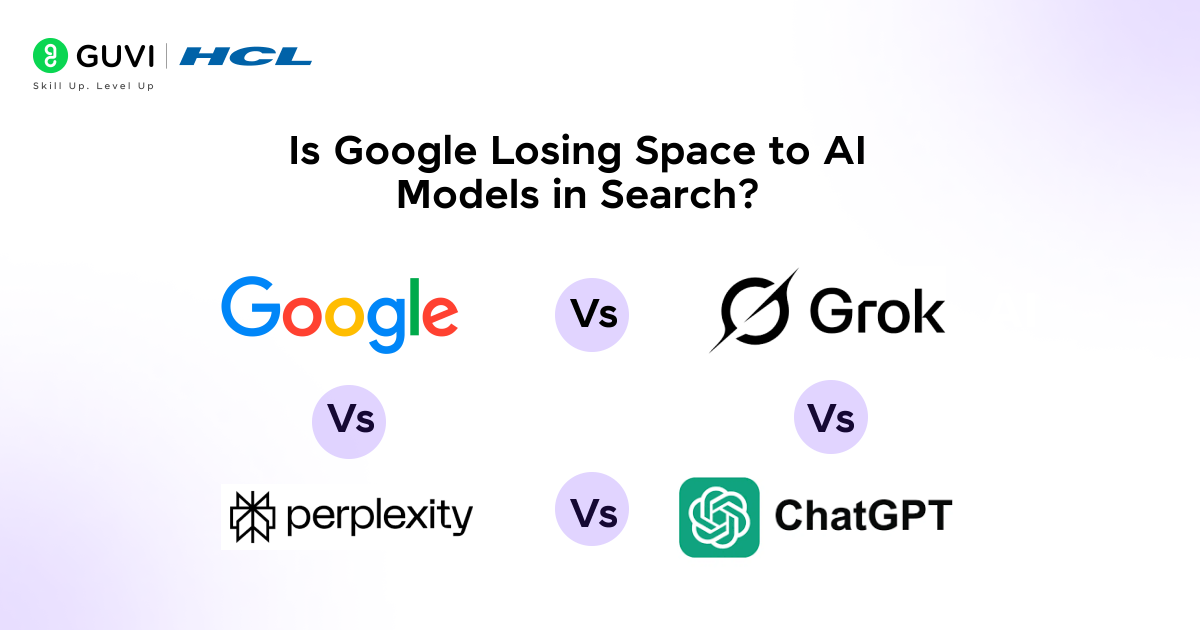
The entry of advanced conversational models has unsettled a space that Google shaped for decades. Artificial Intelligence has begun to reshape the landscape that Google once defined. The idea of browsing through countless links is giving way to direct, conversational answers. This shift challenges the very foundation of traditional search engines and places Google at a critical point of reinvention.
The Shift Toward Direct Answers
ChatGPT started this change by offering responses that feel complete and contextual. It was developed by OpenAI to provide direct and conversational answers that shorten the gap between a question and its meaning. Grok, created under Elon Musk’s X, adds an informal and adaptive tone that reflects how people communicate across social platforms. DeepSeek, built by a Chinese research collective, focuses on structured reasoning and draws connections between ideas to reach clear, logical outcomes.
Perplexity AI, developed by a team of former Google and OpenAI engineers, combines factual precision with concise explanation, creating an experience that feels both credible and immediate. These emerging systems are redefining how people access information and interpret knowledge. Together, they are replacing the habit of browsing with the habit of asking.
Google’s Answer: Gemini
Google’s response comes through Gemini, its advanced AI model designed to bring intelligence into the core of Search. Gemini merges Google’s vast informational network with language understanding that recognizes context and intent. It studies how people form questions and what patterns lie behind their searches. The goal is to offer depth and relevance without losing the reliability that defines Google’s name. Gemini aims to turn search into a space where conversation replaces complexity and precision meets intuition.
Google Nano Banana Retro Trends: A Creative Twist in AI Culture
Recently, Google’s Nano Banana feature inside Gemini has turned into a cultural statement rather than just another AI experiment. Powered by generative AI, the tool allows users to turn regular photos into stylized portraits that resemble classic eras, figurine art, and cinematic frames. In India, the “AI saree” trend spread rapidly as people used it to recreate nostalgic looks with striking accuracy. However, some generated images drew debate for adding details absent in the originals, which led to discussions about consent and creative boundaries. Google addressed these issues through SynthID watermarking and stronger content checks to preserve trust. The Nano Banana Retro Trends have given a tough call to ChatGPT and other conversational AI platforms by proving that creativity, emotion, and culture can define technological success as much as dialogue and reasoning.

The Ethics Behind Google’s Artificial Intelligence
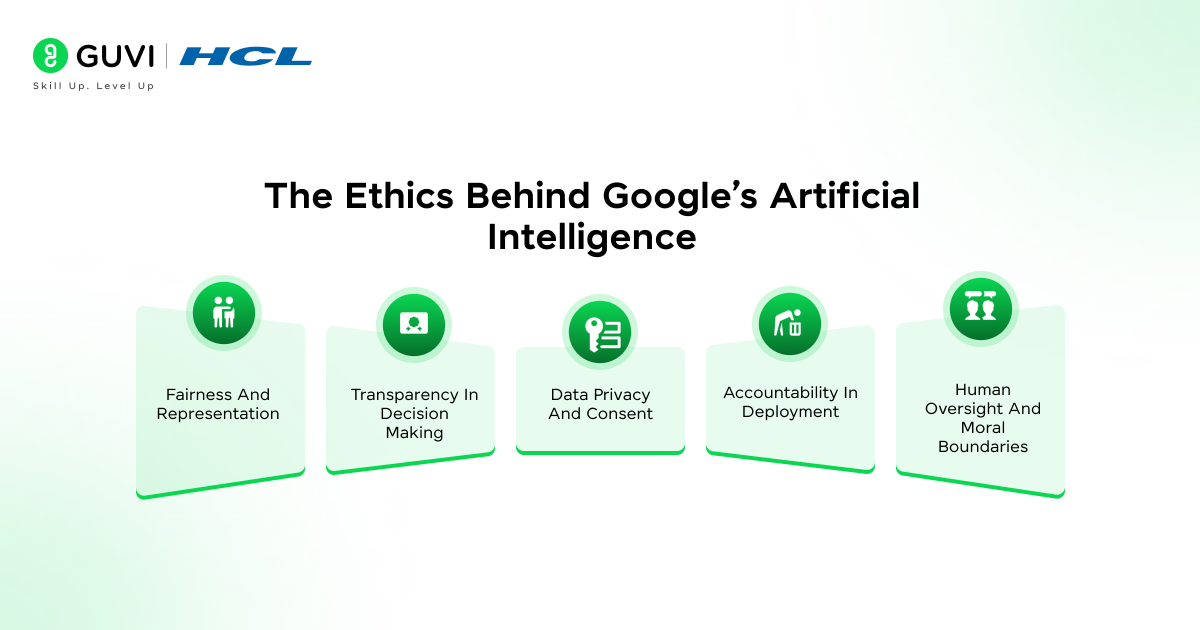
Google’s relationship with Artificial Intelligence carries both potential and responsibility. The search engine giant treats ethics not as a department but as a framework for every decision built into its technology:
- Fairness and Representation: Google designs its AI systems to reduce bias that could misrepresent people or ideas. Teams study how datasets form, who they include, and where imbalance occurs. The goal is to make results reflect human diversity rather than amplify selective perspectives.
- Transparency in Decision Making: Every AI system at Google undergoes review for explainability. Engineers work to make the logic behind each decision visible and understandable. This clarity helps users and researchers trace how conclusions form.
- Data Privacy and Consent: Privacy remains central to Google’s ethical model. AI systems are trained under strict frameworks that limit the exposure of personal information. The company applies differential privacy and anonymization methods to separate identity from data.
- Accountability in Deployment: Google views accountability as a shared duty between creators and operators of AI. Each release is evaluated for long-term impact, including social and environmental effects. Internal review boards test for safety and unintended consequences before tools reach public use.
- Human Oversight and Moral Boundaries: AI development at Google keeps human judgment at its core. The company reinforces the idea that intelligence should serve human reasoning and not replace it. Ethical training programs and cross-functional evaluations help maintain this boundary.
Fascinated by how Google uses AI to shape the future? Learn to build intelligent systems yourself with Our AI & ML Course with Intel Certification. Gain hands-on experience in Python, TensorFlow, and deep learning while mastering the same concepts powering innovations like Gemini, Google Photos, and Assistant. Earn your Intel-backed certification and step confidently into the world of Artificial Intelligence that’s transforming industries every day.
Major Companies Challenging Google’s Dominance in Artificial Intelligence
- Microsoft: Microsoft has positioned itself as one of Google’s strongest competitors through its partnership with OpenAI. This collaboration powers Bing’s conversational search and strengthens the intelligence behind Office and Azure. The company’s strategy links research, infrastructure, and real-world use, giving it both scientific and commercial influence.
- Amazon: Amazon’s strength lies in scale and integration. AI operates across its logistics networks, retail recommendations, and Alexa voice ecosystem. AWS gives Amazon another advantage, as it supplies machine learning infrastructure to startups and enterprises alike. This dual reach positions Amazon as both a user and a provider of AI power.
- NVIDIA: NVIDIA stands as the backbone of global AI infrastructure. Its chips power the training of nearly every modern AI model, including those from Google itself. Through its CUDA architecture and AI-focused GPUs, NVIDIA does not compete in search but in capacity.
- IBM: IBM continues to lead in fields where trust and precision outweigh speed. Its Watson platform applies AI to healthcare, finance, and science with a focus on verifiable outcomes. The company builds systems that prioritize accuracy and explainability. IBM focuses on decision intelligence that strengthens human expertise rather than mass adoption.
- Apple: Apple integrates AI within a closed ecosystem focused on privacy and device performance. Siri, Face ID, and predictive typing reflect visible results, yet its deeper AI efforts remain tied to personalization and user security. This privacy-first stance gives Apple moral and market strength as users grow cautious about surveillance and data misuse.
- Meta (Facebook): Meta’s investment in AI research has expanded rapidly through projects like LLaMA and its open-source vision models. AI supports content moderation, ad delivery, and digital experiences across Facebook, Instagram, and WhatsApp. Meta’s open research model invites global developers to test and refine its technology, allowing faster innovation.
- OpenAI: OpenAI changed the direction of public interaction with technology through ChatGPT and its advanced models. Its approach centers on human dialogue, contextual reasoning, and multi-modal learning that blends text, image, and code. The partnership with Microsoft strengthens its access to cloud infrastructure, allowing its systems to scale quickly.
Future Outlook for Google and Artificial Intelligence
Google stands at a turning point where its future depends on how well it can unify intelligence across every layer of human interaction. The company’s research now centers on large language models that connect understanding and creativity. Gemini represents the first phase of this shift, linking context and creativity under one framework.
The next stage will extend beyond search or conversation. Google plans to merge real-time learning into its cloud, workspace, and developer tools, making intelligence part of how systems think rather than a separate feature. The company is also preparing for an environment where personalization is no longer limited to device history but shaped by emotional tone and situational awareness.
Future research points toward deeper cognitive modeling and responsible automation. Google is investing in quantum computing to accelerate AI training and improve decision-making precision across large datasets.
Conclusion
Google’s path in Artificial Intelligence shows purpose and restraint. The company focuses on building systems that think with people, not ahead of them. Its progress depends on trust, context, and awareness. The coming years will decide whether Google’s intelligence becomes a quiet guide or another voice competing to be heard.
FAQs
1. Will AI replace Google Search in the future?
AI will not replace Google Search completely but will change how people use it. Conversational tools such as Gemini aim to give direct, reliable answers instead of only showing lists of websites.
2. Does Google use AI for cybersecurity?
Yes, Google applies AI to detect threats, block phishing attempts, and identify unusual activity across its platforms. These systems analyze behavior patterns to prevent breaches before they occur.
3. What is Google Gemini and how is it different from ChatGPT?
Gemini is Google’s advanced AI model that understands text, images, and voice together. It focuses on accuracy, context, and integration with Google’s ecosystem, while ChatGPT operates as a general conversational model built around open-ended dialogue.
Success Stories

About the Author
Vaishali
I'm a seasoned writer with four years of experience across technical, non-technical, and just about every genre or niche you can imagine. Adaptable and curious, I enjoy exploring new topics and making information engaging and easy to understand. Fueled by a steady stream of tea, I approach each project with creativity, reliability, and genuine enthusiasm for storytelling.
View all posts by Vaishali
Connect with me @









Did you enjoy this article?