


Artificial Intelligence and Machine Learning Articles
Finance Manager to Data Analytics: Career Growth, Salary and Seniority
How to Evaluate LLM Outputs in Production Deployments
AI/ML Skills Gap 2026: Why Companies Can't Find Job-Ready Talent
20 AI/ML Interview Questions Recruiters Can Use Without a Tech Background - Best Guide


Get In Touch For Details! Request More Information

Top 6 Machine Learning Classification Algorithms You Must Know
Aug 04, 2026 5 Min Read 4096 Views
(Last Updated)
Overview
- Logistic Regression: A simple, interpretable model best for binary problems like spam or not spam.
- K-Nearest Neighbors (KNN): Classifies a point based on the labels of its closest neighbors.
- Support Vector Machine (SVM): Finds the widest possible boundary between classes, strong on high-dimensional data.
- Decision Tree: A flowchart-style model that splits data on feature questions until it reaches a decision.
- Random Forest: Combines many decision trees and lets them vote, usually more accurate than any single tree.
Every time the AI system removes hate speech, ranks up resumes, or anticipates a medical condition it is exercising something that feels very similar to instincts. This instinct stems from Machine Learning Classification Algorithms, the invisible engines that enable machines to distinguish, decide, and adapt.
Table of contents
- TL;DR Summary
- What is Classification in Machine Learning?
- Why Classification Algorithms Matter
- Top 6 Machine Learning Classification Algorithms
- Logistic Regression
- k-Nearest Neighbors (KNN)
- Support Vector Machines (SVM)
- Naive Bayes
- Decision Trees
- Random Forest
- Comparison Table
- Sklearn Code: Top 5 Classifiers on One Dataset
- Which Classification Algorithm Should You Choose?
- Classification Algorithm Performance on Benchmark Datasets
- Classification Algorithms Interview Questions for ML Roles
- Wrapping It Up…
- FAQs
- What is the best classification algorithm for beginners?
- Is Random Forest always better than a single Decision Tree?
- Which algorithm works best for text classification?
- Do I need to scale my data before using these algorithms?
- Can I combine multiple classification algorithms?
- Which Python library should I use for classification?
- How much data do I need before training a classification model?
TL;DR Summary
- Classification is a supervised learning task where a model assigns data into fixed categories, such as spam or not spam.
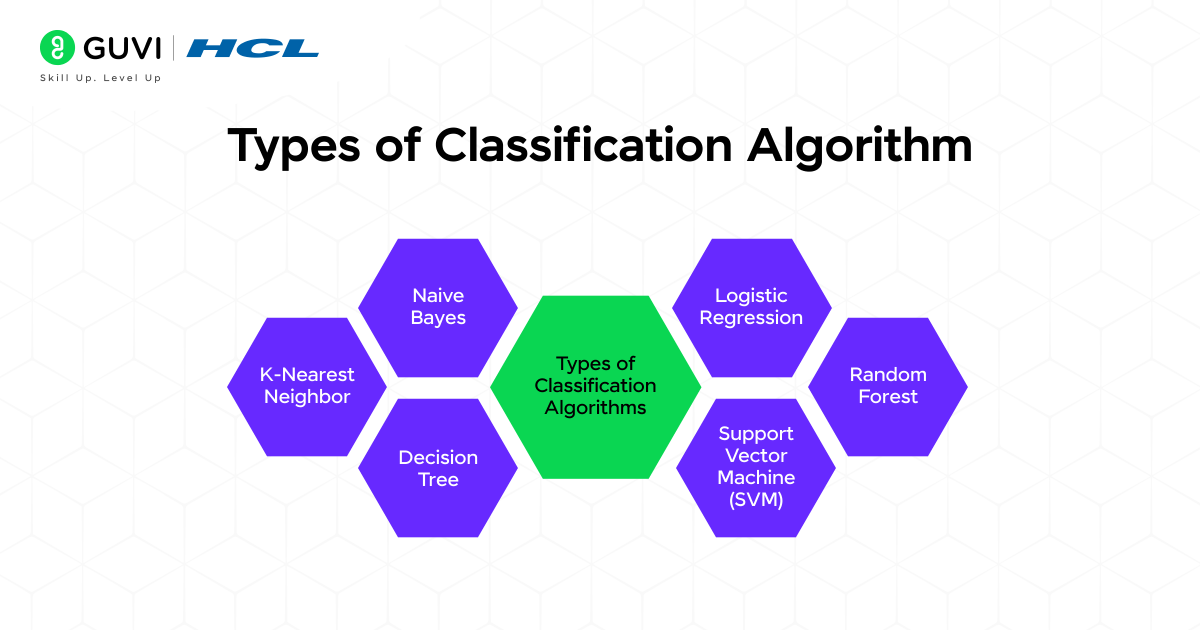
- The most widely used classification algorithms are Logistic Regression, KNN, SVM, Naive Bayes, Decision Tree, and Random Forest.
- Logistic Regression and Decision Trees are the easiest to interpret, while Random Forest and SVM usually deliver higher accuracy.
- Your choice depends on dataset size, whether the data is linearly separable, and how much interpretability you need.
- All six algorithms are available in scikit-learn and can be trained in just a few lines of code.
What is Classification in Machine Learning?
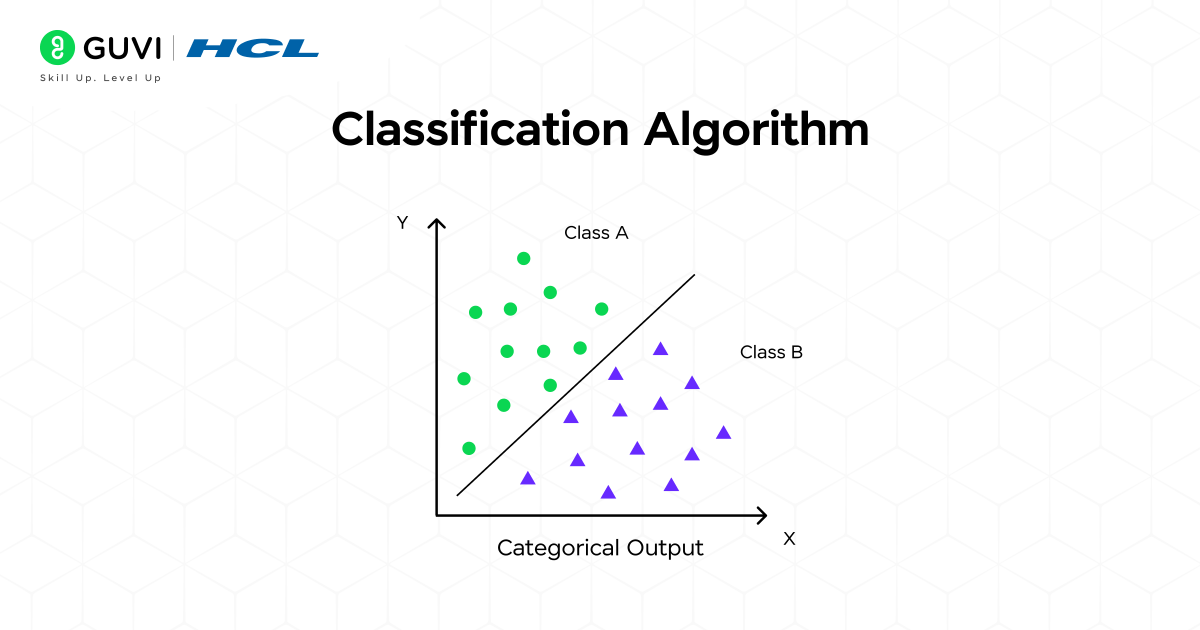
Classification is a type of supervised learning. You give the model labeled examples, and it learns to predict a category for new, unseen data.
You will see this pattern everywhere. A model deciding if an email is spam. A hospital system flagging a scan as normal or abnormal. A bank checking if a transaction looks fraudulent.
Under the hood, most of these systems rely on one of a handful of well-tested algorithms. Once you understand how these work, you can reason about almost any classification problem you come across.
Why Classification Algorithms Matter
Understanding Machine Learning Classification Algorithms helps data scientists and engineers automate predictions, improve accuracy, and make smarter business decisions. Classification algorithms form the foundation of intelligent systems. They:
- Simplify decision-making in complex systems
- Help automate tasks like email filtering or fraud detection
- Enhance personalization (e.g., recommendations, ads)
- Enable predictive analytics in finance, healthcare, and marketing
As data volumes explode, understanding how these algorithms work is crucial for anyone pursuing a career in AI or Data Science.
Top 6 Machine Learning Classification Algorithms
1. Logistic Regression
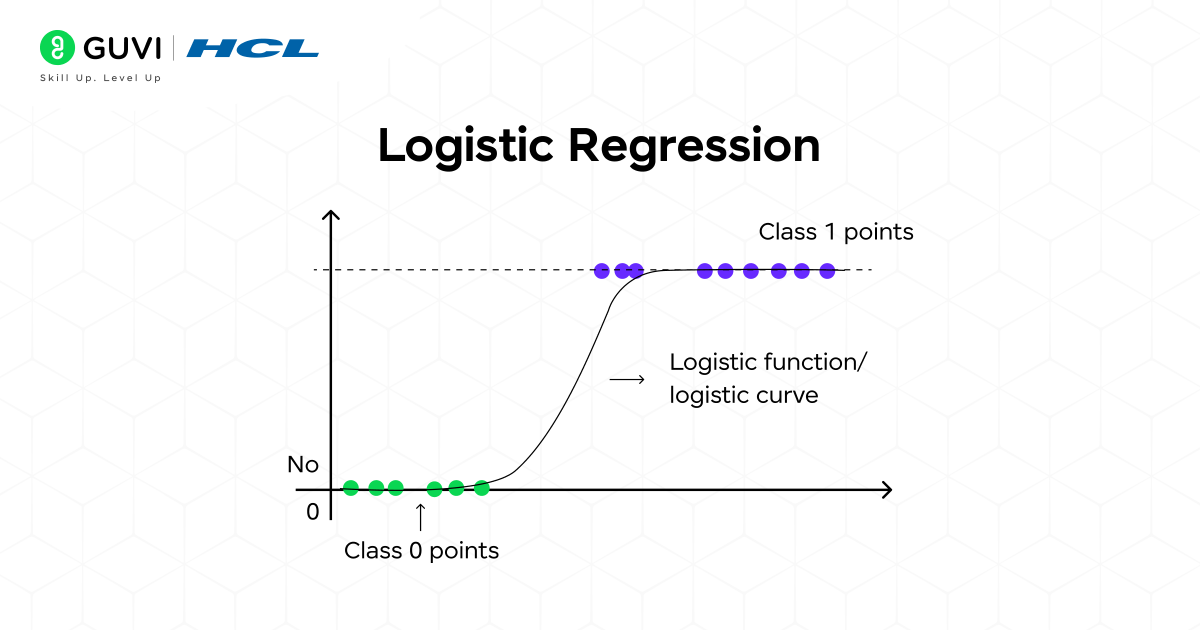
Don’t let the name confuse you; Logistic Regression is a classification algorithm, not a regression one. It’s one of the simplest, most interpretable, and widely-used algorithms for binary classification problems (e.g., Yes/No, Spam/Not Spam, 1/0).
2. k-Nearest Neighbors (KNN)
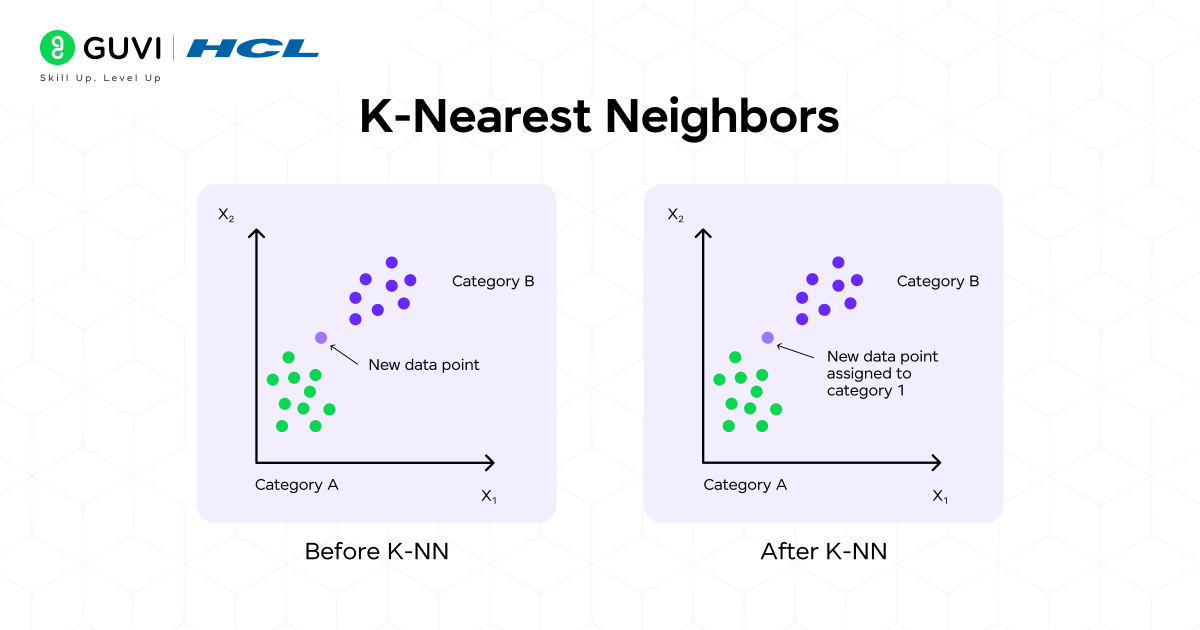
k-Nearest Neighbors is an uncomplicated, intuitive, and non-parametric algorithm. k-Nearest Neighbors is often referred to as a “lazy learner,” which implies that the training algorithm does not generate a general internal model. k-Nearest Neighbors will store the entire training dataset.
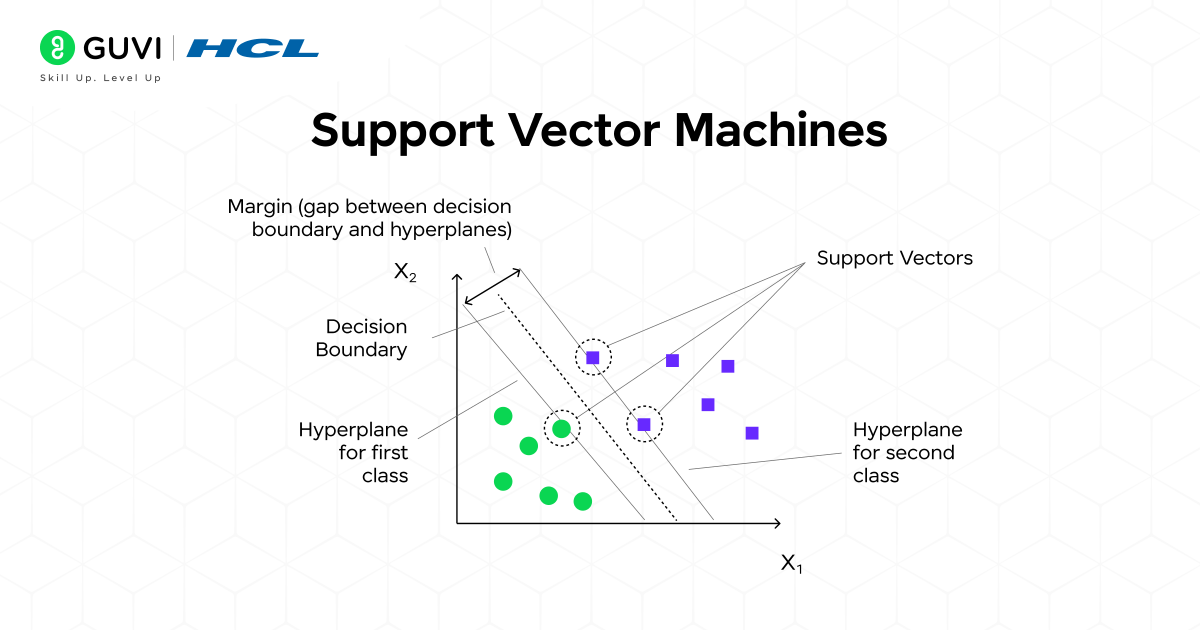
3. Support Vector Machines (SVM)
Support Vector Machines are powerful and versatile algorithms known for their robustness, especially in high-dimensional spaces. Their primary goal is to find the optimal “decision boundary” that separates classes.
4. Naive Bayes
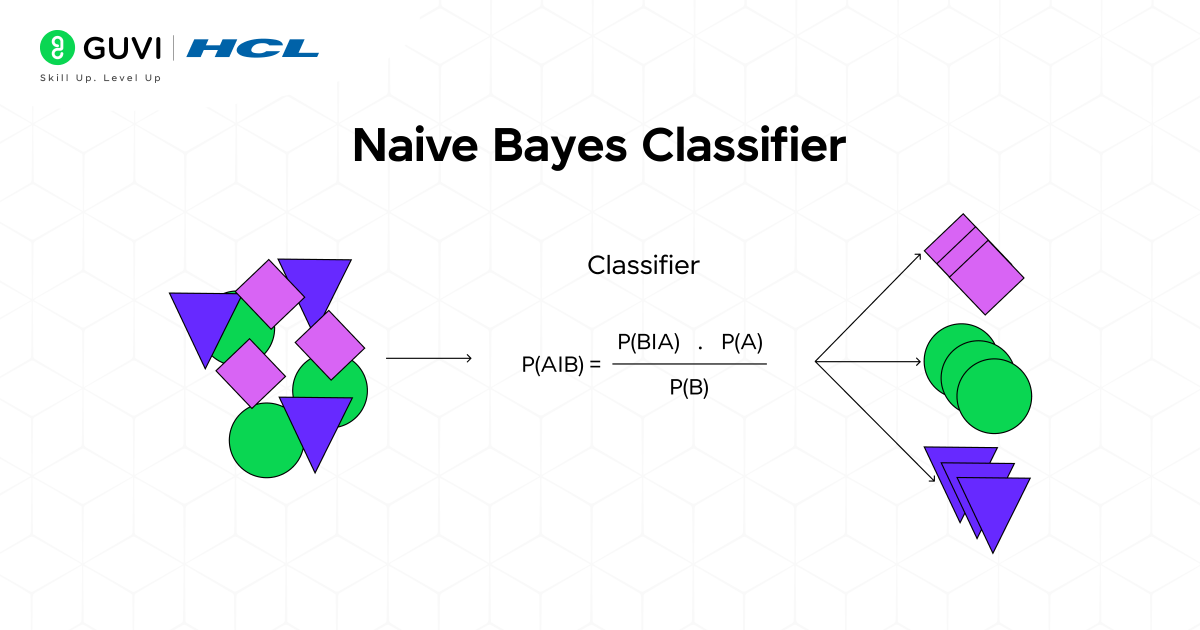
Naive Bayes is a group of algorithms that apply Bayes’ Theorem with a strong (and “naive”) assumption: that all features are independent of one another given the class label. For many situations, this assumption is a simplification, and in fact, it is very rarely true in real life; however, it works surprisingly well.
5. Decision Trees
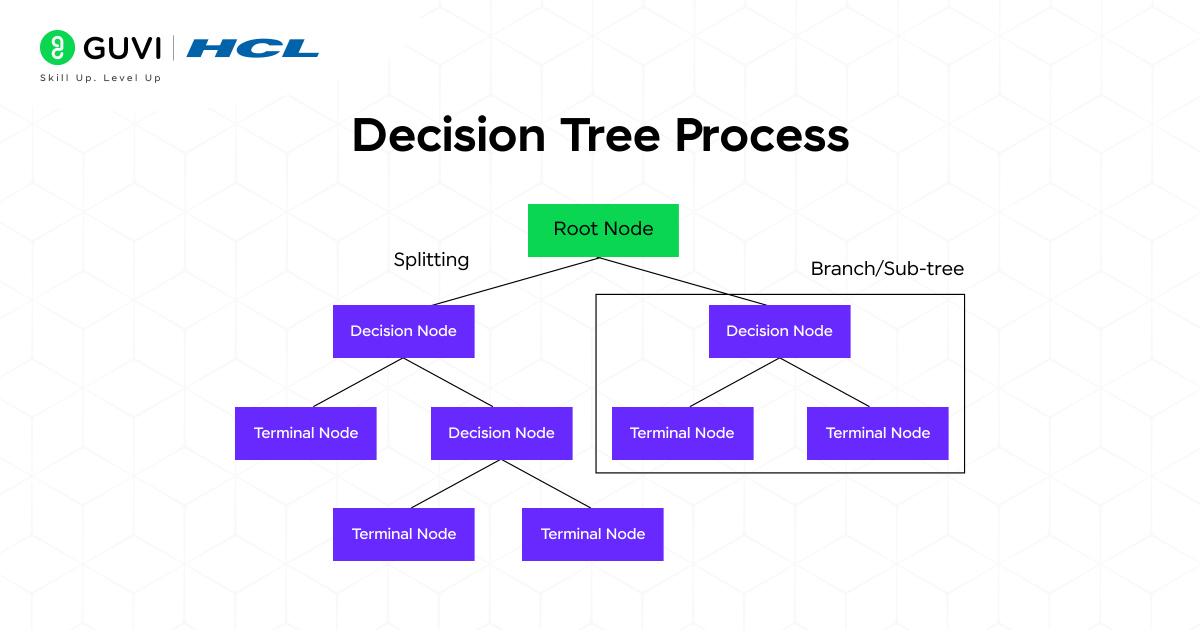
A Decision Tree is a flowchart-like model that mimics human decision-making. It asks a series of questions about the features of the data to arrive at a final classification. Its structure is white-box and highly intuitive.
6. Random Forest
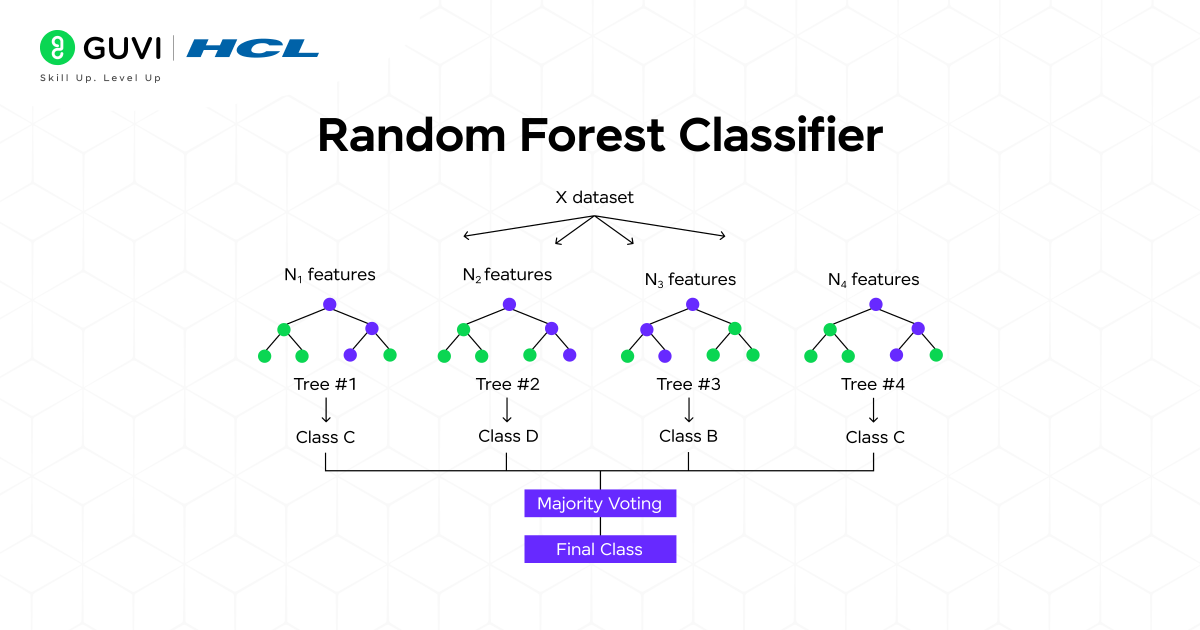
Random Forest is an ensemble method that builds upon the simplicity of Decision Trees to create a vastly superior model. The core idea is “the wisdom of the crowd.” Instead of relying on a single, fragile Decision Tree, it builds a “forest” of them and combines their predictions.
- The term “Machine Learning” was coined way back in 1959 by Arthur Samuel — decades before modern AI took off!
- The Naïve Bayes classifier is one of the oldest algorithms (from the 1700s!) yet it still powers spam filters and sentiment analysis today.
- Support Vector Machines once powered the top handwriting recognition systems, including early postal automation!
- Random Forest got its name because it’s literally a “forest” of decision trees — each one trained on random subsets of data.
- Classification models aren’t just for AI — they’re used in finance, medicine, marketing, cybersecurity, and even astronomy to detect galaxies!
Comparison Table
| Algorithm | Type | When to Use | Interpretable? | Python Class |
|---|---|---|---|---|
| Logistic Regression | Linear | Binary classification, linearly separable data | Yes | LogisticRegression |
| KNN | Instance based | Small datasets, non linear boundaries | Somewhat | KNeighborsClassifier |
| SVM | Margin based | High dimensional data, text or image classification | No | SVC |
| Naive Bayes | Probabilistic | Text classification, spam filtering | Yes | GaussianNB / MultinomialNB |
| Decision Tree | Tree based | When you need a clear, explainable model | Yes | DecisionTreeClassifier |
| Random Forest | Ensemble | Large datasets, complex patterns, higher accuracy | No | RandomForestClassifier |
Sklearn Code: Top 5 Classifiers on One Dataset
Here is how the five most commonly used classifiers look on the same dataset, so you can compare their syntax directly.
from sklearn.datasets import load_breast_cancer
from sklearn.model_selection import train_test_split
from sklearn.linear_model import LogisticRegression
from sklearn.neighbors import KNeighborsClassifier
from sklearn.svm import SVC
from sklearn.tree import DecisionTreeClassifier
from sklearn.ensemble import RandomForestClassifier

data = load_breast_cancer()
X_train, X_test, y_train, y_test = train_test_split(
    data.data, data.target, test_size=0.2, random_state=42
)

models = {
    "Logistic Regression": LogisticRegression(max_iter=5000),
    "KNN": KNeighborsClassifier(n_neighbors=5),
    "SVM": SVC(kernel="rbf"),
    "Decision Tree": DecisionTreeClassifier(max_depth=5),
    "Random Forest": RandomForestClassifier(n_estimators=100)
}

for name, model in models.items():
    model.fit(X_train, y_train)
    print(name, "accuracy:", model.score(X_test, y_test))
Running this on the breast cancer dataset usually shows Random Forest and SVM edging out Logistic Regression and KNN by a small margin, with the Decision Tree landing somewhere in between.
Which Classification Algorithm Should You Choose?
Use this quick decision path when you’re stuck.
- Is interpretability critical, such as for a regulated industry like lending? Start with Logistic Regression or a Decision Tree.
- Is your dataset text heavy, like reviews or emails? Try Naive Bayes first.
- Is your dataset small with a non linear pattern? KNN is worth testing.
- Is your dataset high dimensional, such as image or genomic data? SVM tends to handle this well.
- Do you have a large dataset and mainly care about accuracy over interpretability? Random Forest is usually the strongest default.
If none of these feels clearly right, train two or three candidates on your data and compare their accuracy and F1 score directly. There is no substitute for testing on your actual problem.

Classification Algorithm Performance on Benchmark Datasets
On standard benchmark datasets like UCI’s Breast Cancer, Adult Income, and MNIST digits, a consistent pattern shows up across research and practitioner comparisons.
- Ensemble methods like Random Forest generally outperform single models on datasets with complex, non-linear relationships.
- Logistic Regression stays competitive on smaller, linearly separable datasets and trains far faster.
- SVM performs strongly on high-dimensional data such as image pixels or text vectors, but training time grows quickly as data size increases.
- KNN accuracy tends to drop as dataset size grows, since prediction time scales with the number of stored points.
These are general tendencies, not guarantees. Your own dataset’s size, noise level, and feature relationships will decide what actually wins for your use case.
Classification Algorithms Interview Questions for ML Roles
If you’re prepping for a data science or ML interview, these are the questions that come up most often around classification. Knowing the “why” behind each algorithm matters more than memorizing definitions.
1. What is the difference between classification and regression?
Classification predicts a discrete category, such as spam or not spam. Regression predicts a continuous numeric value, such as house price.
2. Why is Logistic Regression called “regression” if it’s used for classification?
It’s named after the underlying linear regression math it builds on, but the sigmoid function converts that output into a class probability, making it a classification tool.
3. What is the bias-variance tradeoff in the context of Decision Trees?
A shallow tree has high bias and underfits. A deep, unpruned tree has high variance and overfits. Random Forest reduces variance by averaging many trees.
4. Why does KNN require feature scaling?
KNN relies on distance calculations between points. If one feature has a much larger scale than others, it will dominate the distance and skew predictions.
5. What does the “kernel trick” do in SVM?
It maps data into a higher-dimensional space where a linear boundary can separate classes that weren’t linearly separable in the original space, without explicitly computing that transformation.
6. Why is Naive Bayes called “naive”?
Because it assumes all features are independent of each other given the class label, an assumption that’s rarely true in real data but still performs well in practice.
7. How does Random Forest reduce overfitting compared to a single Decision Tree?
It trains each tree on a random subset of data and features, then averages predictions across trees. This reduces the variance that causes a single tree to overfit.
8. What metric would you use instead of accuracy for an imbalanced dataset?
Precision, recall, F1 score, or the area under the ROC curve, since accuracy alone can be misleading when one class dominates the dataset.
If this topic sparked your curiosity, it’s time to go beyond theory and build real-world ML projects. Join HCL GUVI’s IITM Pravartak Certified Artificial Intelligence & Machine Learning Course, designed by industry experts and backed by NSDC. Learn hands-on with expert mentorship, live projects, and job-ready skills.
Wrapping It Up…
Classification algorithms are the backbone of most real-world machine learning systems, from spam filters to fraud detection. Each algorithm on this list, Logistic Regression, KNN, SVM, Naive Bayes, Decision Tree, and Random Forest, solves the same core problem in a different way, with its own tradeoffs between speed, accuracy, and interpretability.
Once you understand these tradeoffs, picking the right one for your dataset becomes far less guesswork and far more informed decision making. Start by testing two or three candidates on your own data rather than picking one on reputation alone.
FAQs
What is the best classification algorithm for beginners?
Logistic Regression is the easiest starting point. It’s simple to implement and easy to explain, and it introduces the core ideas you’ll reuse in more advanced models.
Is Random Forest always better than a single Decision Tree?
Usually, yes, in terms of accuracy and resistance to overfitting. But you lose interpretability, since you’re now working with hundreds of trees instead of one.
Which algorithm works best for text classification?
Naive Bayes is a strong default for spam detection and sentiment analysis, and SVM is also a solid choice for larger text datasets.
Do I need to scale my data before using these algorithms?
Yes, for KNN and SVM specifically. Logistic Regression, Decision Trees, and Random Forest are less sensitive to feature scale.
Can I combine multiple classification algorithms?
Yes. Techniques like bagging, boosting, and stacking combine multiple models to improve accuracy, and Random Forest itself is one example of this approach.
Which Python library should I use for classification?
Scikit-learn covers all six algorithms in this article and is the standard starting point. For deep learning based classification, TensorFlow or PyTorch is a better fit.
How much data do I need before training a classification model?
There’s no fixed number, but a few hundred labeled examples per class is a reasonable starting point for simpler algorithms like Logistic Regression or Naive Bayes.
Success Stories

About the Author
Vishalini Devarajan
An Aerospace Engineer turned content writer, I focus on making complex concepts easy to understand through well-structured, reader-friendly blogs. Whether it’s a technical topic or a non-technical one, I love creating content that is clear, engaging, and impactful.
View all posts by Vishalini Devarajan
Connect with me @


















Did you enjoy this article?