


Artificial Intelligence and Machine Learning Articles
AI/ML Skills Gap 2026: Why Companies Can't Find Job-Ready Talent
20 AI/ML Interview Questions Recruiters Can Use Without a Tech Background - Best Guide
How Industry-Backed AI/ML Bootcamps Are Changing the AI/ML Hiring Pipeline - Best Guide 2026
From IT Support to AI Engineer: A Realistic Career Switch Guide 2026


Get In Touch For Details! Request More Information
How to Become a Machine Learning Architect in 2026?
Feb 20, 2026 5 Min Read 2430 Views
(Last Updated)
The intelligent systems are reshaping the world. From the hyper-personalized experiences on your streaming services, to predictions that save lives in medical diagnostics and the complex orchestration of global supply chains, a new class of professional leaders is emerging: the Machine Learning Architect.
Often referred to as the “unicorn” of the tech industry, the Machine Learning Architect is the chief designer who builds the bridge from abstract data science to tangible, scalable, and ethically sound production systems. No, a Machine Learning Architect does not just create models, it designs the entire system for which models will thrive, generate value and evolve.
If you are excited by the opportunity to design the intelligent infrastructure of the future and want to place yourself at the front-end of this high-value career opportunity, then this is your field manual. We will break down the role, sequence the foundational skill stack for 2026 and create a framework to become a credible Machine Learning Architect.
Table of contents
- Understanding the Role: What Does a Machine Learning Architect Do?
- Core Foundation: Skills & Knowledge You Must Master
- 1 Mathematics & Statistics Fundamentals
- 2 Machine Learning & Deep Learning Expertise
- 3 Software Engineering & Systems Design
- 4 Data Engineering & Infrastructure
- 5 MLOps & DevOps
- 6 Governance, Ethics, Security & Compliance
- 7 Soft Skills & Leadership
- Educational & Experiential Path
- 1 Start with a solid education
- 2 Acquire hands-on project experience
- 3 Acquire leadership and architectural responsibilities
- 4 Consider specialization tracks
- Key Steps & Milestones Toward Becoming a Machine Learning Architect in 2026
- Machine Learning Architect Salary in India (2026)
- Recommended Learning Resources & Tools
- 1 Online Courses & Specializations
- 2 Books & References
- 3 Open Source Tools & Platforms to Practice
- Building Your Portfolio & Personal Brand
- A Sample Career Timeline & Role Transition
- Roadmap Summary for Aspiring Architects
- Common Mistakes to Avoid
- Wrapping it up…
- What does a Machine Learning Architect do?
- How long does it take to become a Machine Learning Architect?
- Do I need a degree to be a Machine Learning Architect?
- What are the essential skills required for a Machine Learning Architect?
1. Understanding the Role: What Does a Machine Learning Architect Do?
Before we dive into the “how” part, it is important to understand the “what.” The Machine Learning Architect role is also sometimes misconceived. It is a strategic, cross-functional role sitting right in-between data science, software engineering, and business strategy
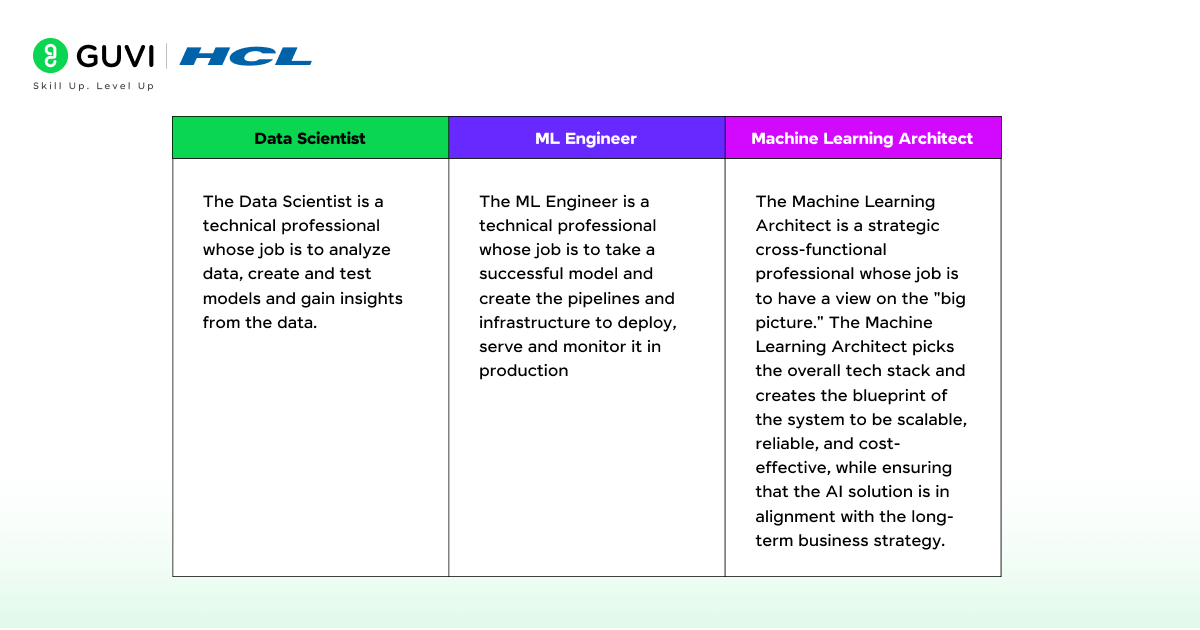
Key Differences:
- Data Scientist: The Data Scientist is a technical professional whose job is to analyze data, create and test models and gain insights from the data.
- ML Engineer: The ML Engineer is a technical professional whose job is to take a successful model and create the pipelines and infrastructure to deploy, serve and monitor it in production.
- Machine Learning Architect: The Machine Learning Architect is a strategic cross-functional professional whose job is to have a view on the “big picture.” The Machine Learning Architect picks the overall tech stack and creates the blueprint of the system to be scalable, reliable, and cost-effective, while ensuring that the AI solution is in alignment with the long-term business strategy.
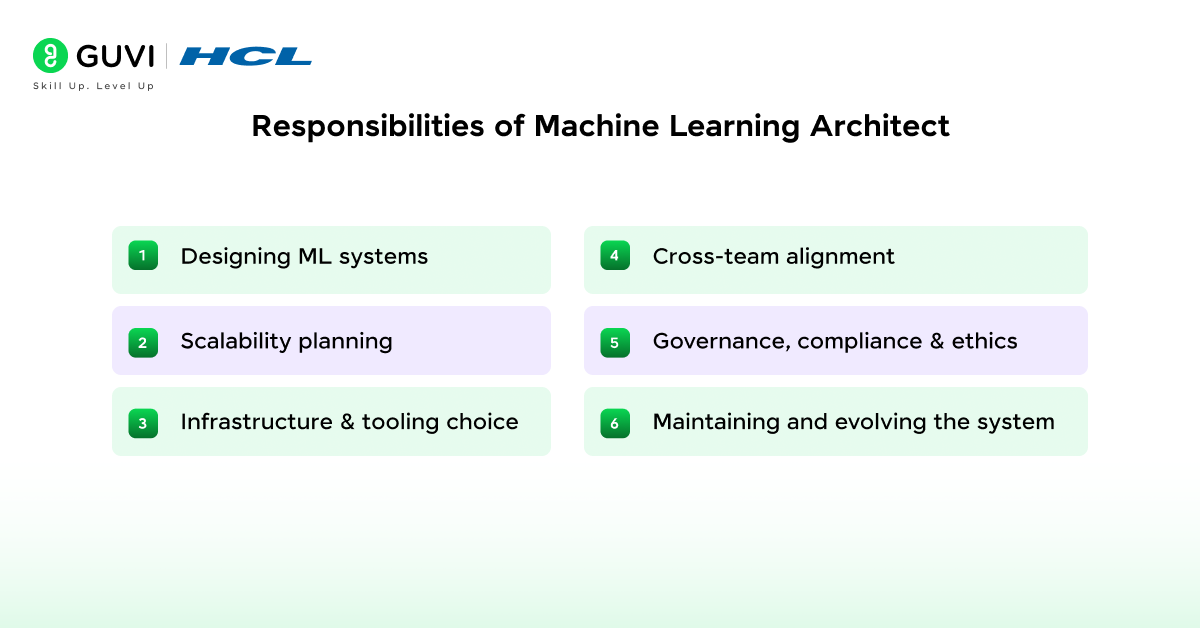
Their responsibilities typically include:
- Designing ML systems: choosing architectures, selecting algorithms, defining data flows, and integration with existing systems.
- Scalability planning: ensuring the systems can handle large volumes, high throughput, real-time data, and evolving model versions.
- Infrastructure & tooling choice: selecting frameworks, cloud or on-prem infrastructure, CI/CD, MLOps platforms.
- Cross-team alignment: interfacing with data engineers, DevOps, software engineers, and product stakeholders to integrate ML into products.
- Governance, compliance & ethics: ensuring data privacy, explainability, audit trails, model monitoring, bias detection.
- Maintaining and evolving the system: model retraining pipelines, monitoring, versioning, rollback, and drift detection.
2. Core Foundation: Skills & Knowledge You Must Master
2.1 Mathematics & Statistics Fundamentals
- Linear algebra: vector spaces, matrices, eigen decomposition, singular value decomposition.
- Probability & statistics: distributions, expectation, variance, Bayesian thinking, hypothesis testing.
- Optimization & convex analysis: gradient methods, constrained optimization, regularization.
- Mathematical foundations of models: how regression, SVM, neural networks, kernels, etc., work underneath.
These are non-negotiable. As an architect, you must understand the “why” behind choices, not just use libraries
2.2 Machine Learning & Deep Learning Expertise
You should already be comfortable with:
- Supervised, unsupervised, reinforcement learning methods.
- Neural networks, CNNs, RNNs, transformers, attention, generative models.
- Modern architectures (e.g., Graph Neural Networks, diffusion models) from 2026 will see more adoption.
- Transfer learning, fine-tuning, meta-learning, and few-shot learning.
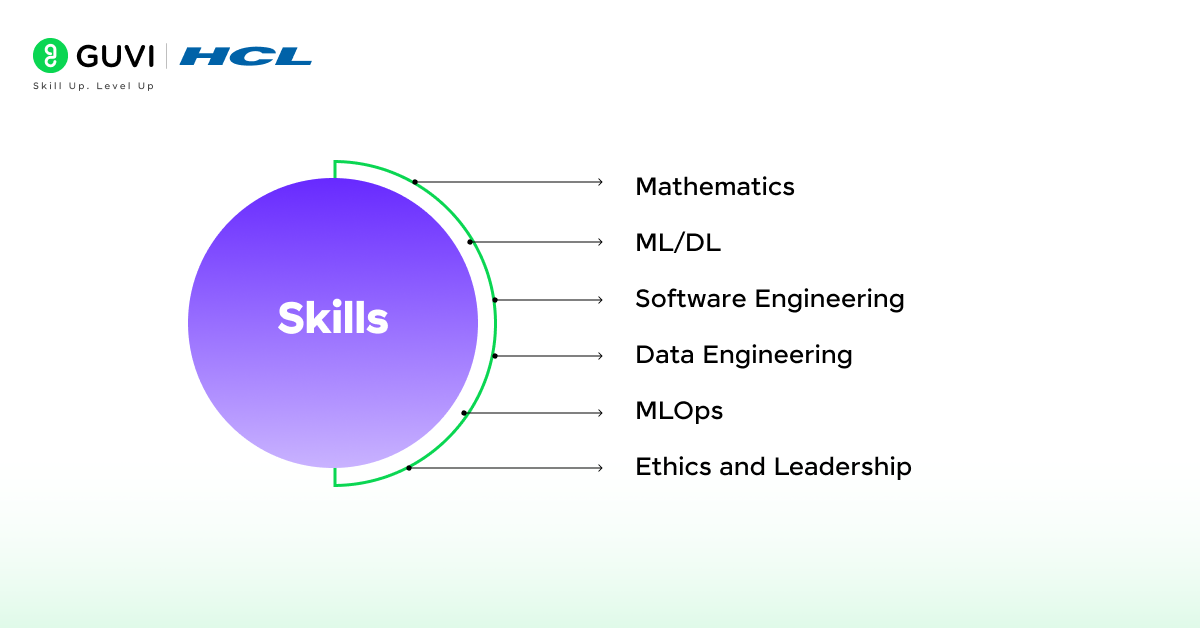
2.3 Software Engineering & Systems Design
Because you are designing full ML systems, not just prototypes:
- Master a programming language (Python is standard; others like Java, C++, or Go may help).
- Know software engineering best practices: modularity, interfaces, testing, and version control.
- Systems design principles: distributed systems, microservices, messaging queues, event-driven architecture.
- API design, data pipelines, schema design.
- Performance engineering, caching, and latency tuning.
2.4 Data Engineering & Infrastructure
An ML architect often works closely with data engineering:
- ETL/ELT pipelines, streaming vs batch.
- Data warehousing, data lakes.
- Big data tools: Spark, Flink, Kafka, Presto, etc.
- Databases (SQL, NoSQL, graph DBs).
- Cloud infrastructure (AWS, GCP, Azure) or hybrid/on-prem setups.
2.5 MLOps & DevOps
- Continuous Integration / Continuous Deployment (CI/CD) for ML.
- Model versioning (e.g. MLflow, DVC), model registry.
- Model serving (e.g. TensorFlow Serving, TorchServe, BentoML, KFServing).
- Monitoring & observability: drift detection, logs, metrics.
- Automated retraining pipelines, rollback, A/B testing, and shadow deployments.
- Containerization (Docker, Kubernetes).
2.6 Governance, Ethics, Security & Compliance
- Model interpretability/explainability (SHAP, LIME, counterfactual methods).
- Fairness, bias mitigation.
- Privacy (differential privacy, federated learning).
- Auditability, logging, traceability.
- Attack vectors (adversarial attacks, data poisoning) and security.
2.7 Soft Skills & Leadership
- Communication and stakeholder management.
- Translating business requirements to technical design.
- Mentoring, guiding, documenting.
- Tradeoff decision-making and risk assessment.
New to Machine Learning? Start with HCL GUVI’s Free 5-Day AI & ML Email Course get daily lessons, real-world use cases, and project ideas straight to your inbox.
3. Educational & Experiential Path
3.1 Start with a solid education
While not mandatory, a degree in CS, EE, mathematics, or related fields helps. Many ML professionals also pursue:
- Master’s in AI, ML, data science, or related fields.
- Specialized online courses: many from top universities or platforms (Coursera, edX, etc.).
Focus on courses that combine theory and implementation.
3.2 Acquire hands-on project experience
This is critical. Commit to building real systems (not just academic toy problems):
- End-to-end ML projects: from data ingestion to deployment and monitoring.
- Participate in open source or contribute to ML frameworks.
- Kaggle or similar competitions (with focus on productionizing your pipeline, not just winning).
- Internships, job roles as Data Engineer / ML Engineer / Backend Engineer roles that let you touch multiple layers.
3.3 Acquire leadership and architectural responsibilities
- Proposing architecture designs for new ML systems.
- Leading small teams or pairing with engineers on system design.
- Documenting design decisions, tradeoffs, and driving consensus.
- Owning larger, cross-cutting ML infrastructure.
3.4 Consider specialization tracks
- Industry-specific ML (finance, healthcare, autonomous vehicles, telecom, robotics, NLP).
- Edge ML / federated learning.
- Large language model platforms.
- Reinforcement learning systems.
- Graph and knowledge systems.
4. Key Steps & Milestones Toward Becoming a Machine Learning Architect in 2026
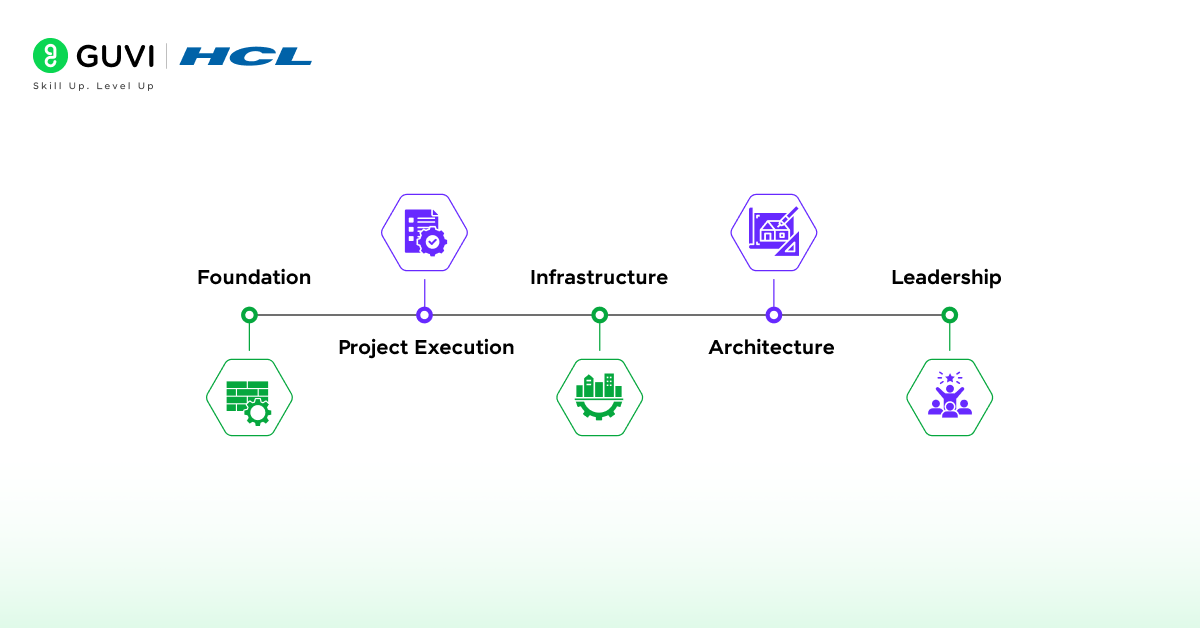
| Phase | Duration | Focus | Milestones |
| Phase 0 | 6–12 months | Foundation | Deep understanding of ML, math, programming, and software engineering |
| Phase 1 | 6–12 months | Project execution | Build pipelines, serve models, monitor, and handle scaling |
| Phase 2 | 6 months | Infrastructure & MLOps | Lead design, domain specialization, and evangelism |
| Phase 3 | 6–12 months | System architecture | Design multi-component ML systems, define interfaces |
| Phase 4 | Ongoing | Leadership & specialization | Deep understanding of ML, math, programming, and software engineering |
In 2026, in particular, there are/will be existing and upcoming trends that will shape your journey:
- Utilization of large foundation models (LLM) and customizing them.
- Complexity of edge ML and on-device inference.
- Federated Learning and privacy-preserving ML.
- Responsible AI, regulation and transparency obligations.
- Heavy emphasis on automation, AIOps, and self-optimizing pipelines.
Therefore, make sure your educational approach includes incorporating these emerging trends at the beginning.

5. Machine Learning Architect Salary in India (2026)
In 2026, Machine Learning Architects in India are among the top-paid AI professionals. With companies rapidly adopting automation and AI-driven systems, the demand for skilled architects has skyrocketed.
Here’s a quick breakdown of the average annual salaries based on experience level:
| Experience Level | Average Salary (INR per annum) |
| Entry-Level (0–2 years) | ₹10 – ₹18 LPA |
| Mid-Level (3–6 years) | ₹20 – ₹35 LPA |
| Senior-Level (7+ years) | ₹40 – ₹60 LPA |
| Top MNC / Specialized Roles | ₹70 LPA and above |
You can refer to Ambitionbox or Glassdoor for the updated salary of Machine Learning Architects
6. Recommended Learning Resources & Tools
6.1 Online Courses & Specializations
- HCL GUVI’s IITM Pravartak Certified AI & Machine Learning Course
- Machine Learning and Deep Learning specializations (Coursera, edX, Fast.ai)
- Courses on systems design and distributed systems
- MLOps specialization courses (CI/CD, model serving, monitoring)
- Research papers and tutorials on large models, federated learning, and explainability
6.2 Books & References
- “Deep Learning” by Goodfellow, Bengio, Courville
- “Hands-On Machine Learning with Scikit-Learn, Keras, and TensorFlow” by Aurélien Géron
- “Designing Data-Intensive Applications” by Martin Kleppmann
- “Building Machine Learning Powered Applications” by Emmanuel Ameisen
- “Machine Learning Engineering” by Andriy Burkov
- Research papers in top conferences (NeurIPS, ICML, ACL, CVPR, etc.)
6.3 Open Source Tools & Platforms to Practice
- TensorFlow, PyTorch (modeling)
- MLflow, DVC, Weights & Biases (experiment tracking, versioning)
- Kubeflow, Seldon, TensorRT, KFServing (serving & orchestration)
- Apache Airflow, Prefect, Dagster (pipeline orchestration)
- Apache Kafka, Spark, Flink (data streaming)
- Docker, Kubernetes, Helm, Istio (infrastructure & deployment)
- Prometheus, Grafana, OpenTelemetry (monitoring)
- Explainability tools: SHAP, LIME, Captum
7. Building Your Portfolio & Personal Brand
Being a recognized Machine Learning Architect is about your portfolio and brand:
- Write blog posts, create case studies, and share your decisions on architecture.
- Publish open source projects (infrastructure code, tools, libraries).
- Publish your projects on GitHub and document them well.
- Give talks or tutorials in your local technology community.
- Be active on technical forums, answer other people’s questions, and write articles.
This helps any recruiter or stakeholder see not only the models you’ve created but also your systems thinking and architecture ability.
8. A Sample Career Timeline & Role Transition
Here’s a hypothetical timeline for someone starting with ML/engineering experience to become a Machine Learning Architect over ~4 years:
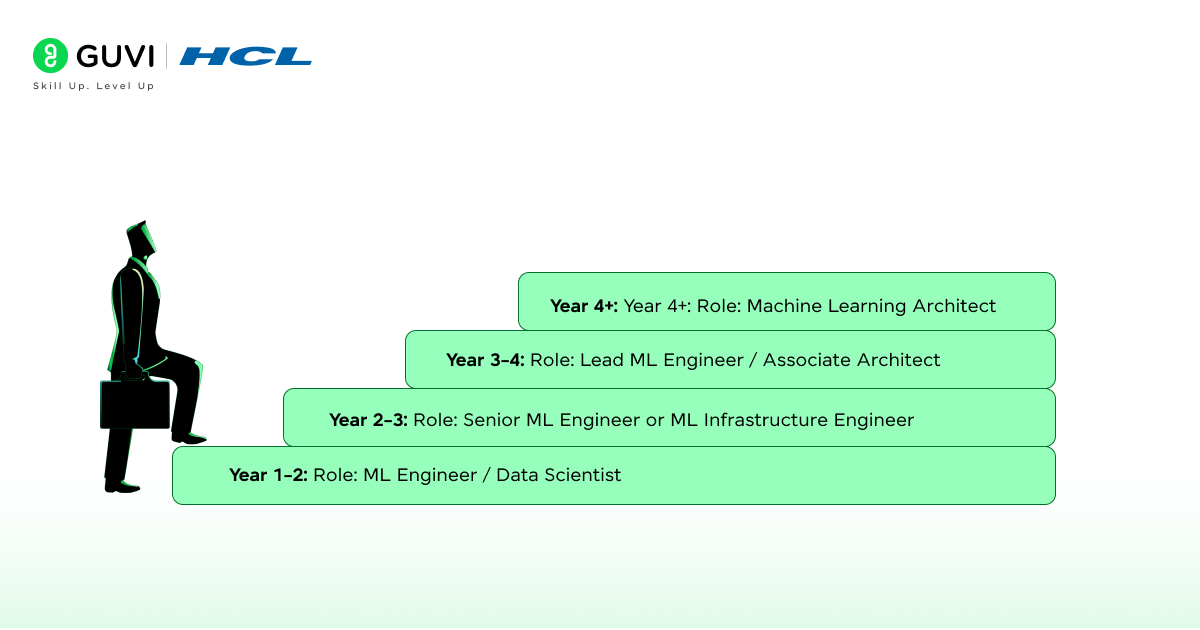
- Year 1–2: Role: ML Engineer / Data Scientist
Work on building models, understanding data systems, and deploying prototypes. - Year 2–3: Role: Senior ML Engineer or ML Infrastructure Engineer
Start focusing on pipelines, model serving, reliability, and collaborating with infra and backend teams. - Year 3–4: Role: Lead ML Engineer / Associate Architect
You propose architecture designs for new ML features, lead small teams, select frameworks, and manage cross-team alignment. - Year 4+: Role: Machine Learning Architect
Full ownership of ML system design, governance, scaling strategy, and leading multiple teams.
This timeline can vary depending on your prior experience, opportunities, and the complexity of the domain you work in.
9. Roadmap Summary for Aspiring Architects
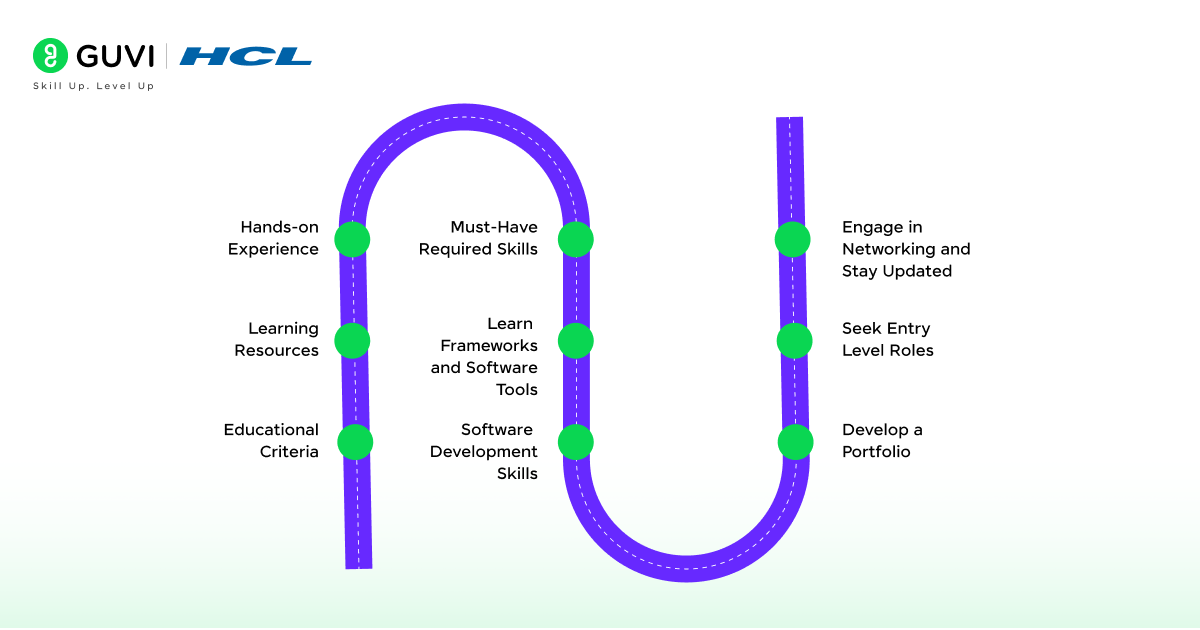
- Build strong foundations: Math, ML, software engineering.
- Implement full-stack ML projects: from data ingestion to deployment and monitoring.
- Gain experience in infrastructure & MLOps: pipelines, serving, versioning.
- Start designing system-level architectures: cross-module ML systems.
- Lead small teams/design efforts: take on ownership, propose designs.
- Develop domain specializations to add value.
- Stay current: research, tools, trends (LLMs, federated learning, compliance).
- Document and share: public portfolio, blogs, open source.
- Iterate and learn: assess tradeoffs, learn from failures, refine.
10. Common Mistakes to Avoid
- Focusing only on accuracy: neglecting latency, scalability, and reliability.
- Skipping monitoring & governance: neglecting drift, biases, and auditability.
- Over-engineering too early: designing a complex system before proving value.
- Ignoring edge cases: fallback strategies, missing data, failures.
- Not coordinating with other teams: building ML in isolation leads to integration issues.
- Neglecting cost considerations: cloud compute, storage, inference cost.
If you’re serious about building a career in this domain, start strong with a solid foundation. Enroll in programs like HCL GUVI’s IITM Pravartak Certified Artificial Intelligence & Machine Learning Course, where you’ll gain hands-on experience, personalized mentorship, and real-world projects designed to turn you into a job-ready professional.
Wrapping it up…
The path to becoming a Machine Learning Architect is demanding. It requires a relentless curiosity, a passion for both theory and practice, and a commitment to lifelong learning. It’s a role that carries significant responsibility, as the systems you design will have a tangible impact on businesses and society.
But the rewards are immense. You will be at the cutting edge of technology, solving the most complex problems, and your work will be the engine of innovation. Use this blueprint as your guide. Start building your foundation today, deepen your engineering expertise tomorrow, and cultivate the strategic mindset that will allow you to design the intelligent future.
The title of Machine Learning Architect isn’t just given; it’s earned through deliberate practice, strategic career moves, and an unwavering vision. The blueprint is in your hands. The future is yours to architect.
1. What does a Machine Learning Architect do?
A Machine Learning Architect plans the entire ML ecosystem from data pipelines to model operationalization ensuring scalability, reliability, and alignment with business needs.
2. How long does it take to become a Machine Learning Architect?
A usual road to becoming a Machine Learning Architect is between 3–5 years depending on your foundation. You’ll move from foundational ML concepts to system design, MLOps, and leadership opportunities.
3. Do I need a degree to be a Machine Learning Architect?
Not necessarily. You would be well served to have one. In general, it is often more about experience and a track record of demonstrating knowledge through applied projects, relevant online certification, and continued education in programs.
4. What are the essential skills required for a Machine Learning Architect?
Expertise in ML algorithms, software engineering, cloud infrastructure, MLOps practices, data governance, and a commitment to close communication and leadership.
Success Stories

About the Author
Vishalini Devarajan
An Aerospace Engineer turned content writer, I focus on making complex concepts easy to understand through well-structured, reader-friendly blogs. Whether it’s a technical topic or a non-technical one, I love creating content that is clear, engaging, and impactful.
View all posts by Vishalini Devarajan
Connect with me @











Did you enjoy this article?