


Software Development Articles
How to Read and Understand System Design Diagrams?
System Engineer Roles and Responsibilities: 12 Proven Duties for Growth
SAP Consultant Roles and Responsibilities: 12 Proven Duties for Growth and Success
Network Engineer Roles and Responsibilities: 12 Essential Duties for Success


Get In Touch For Details! Request More Information

Software Development Best Practices in 2026
Feb 06, 2026 5 Min Read 8012 Views
(Last Updated)
The difference between good software and great software is not just what the software can do, but how it was built. Anyone can write code, but when it comes to writing clean, secure, efficient, maintainable code long-term, it requires diligence and proven approaches. This is where software development best practices become important. These practices provide standards and references that help on the path to developing applications that are reliable, scalable, and future-proof.
Organizations that follow these best practices are able to ensure quality from planning, architecture, coding, testing, and continuing through deployment and maintenance. This means better management of resources, errors, collaboration, security, and ultimately code that meets user needs.
In this article, we will look at the most recommended software engineering best practices, including development, agile, DevOps, testing, documentation, and workflow management, to produce good ideas for great software.
Table of contents
- Software Development Best Practices
- Part 1: Writing Clean and Maintainable Code
- Clean Code Practices:
- Code Review Practices:
- Part 2: The Processes - Building, Testing, and Releasing Responsibly
- Agile Development Best Practices:
- DevOps Best Practices:
- Software Testing Best Practices:
- Part 3: Security, Documentation, and Management
- Secure Coding Practices:
- Documentation Best Practices:
- Software Project Management Practices:
- Part 4: Software Development Workflow Optimization
- Final thoughts…
- FAQs
- What are software development best practices?
- Why are best practices important in software engineering?
- Are best practices only for large organizations?
- What can beginners start to do to use software engineering best practices?
Software Development Best Practices
Part 1: Writing Clean and Maintainable Code
Behind every great application is great code. This is where you start your journey of learning best coding practices.
1. Clean Code Practices:
“Clean code” means code that it is readable, understandable, and maintainable by humans (as well as computers). It is based on the idea that reading code will take up a lot more time than writing it. Here are ways to achieve that:
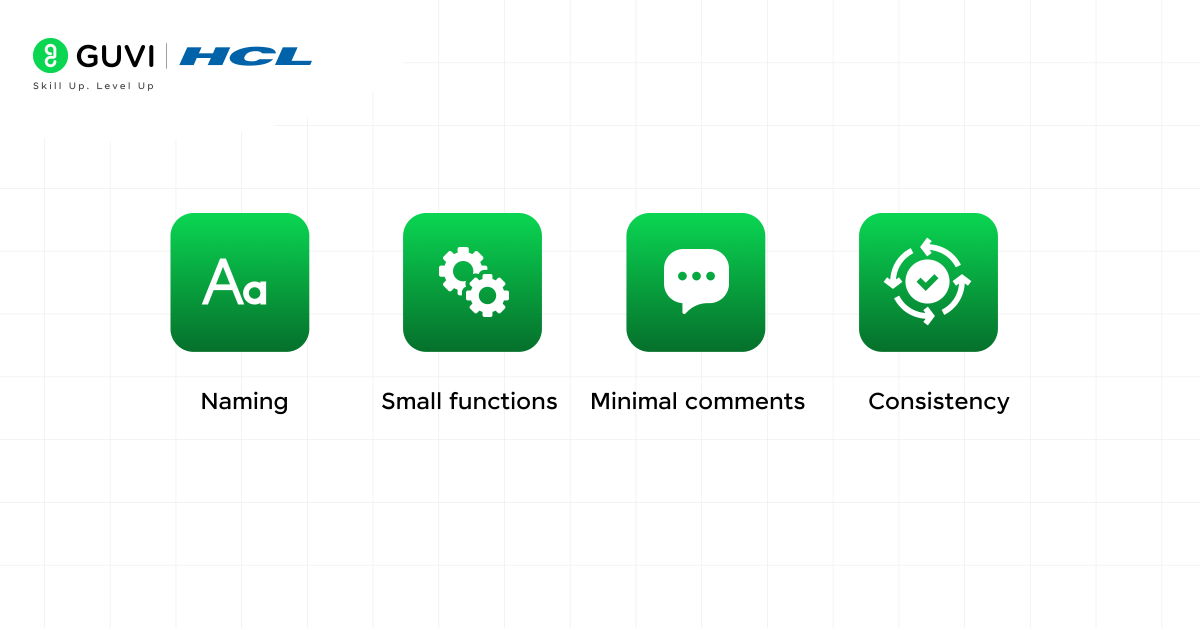
- Meaningful Names: Variables, functions, and classes should have names that convey their intent. “d” is an awful name; “elapsedTimeInDays” is fantastic. It is self-documenting.
- Small Functions: Functions should do one thing and do it correctly. They should be small, typically no more than around 20 lines. This makes them easier to test, debug, and reuse.
- Minimal Comments: Good code is mostly self-documenting with good name choices and structure. Comments should provide a rationale on “why” something is done, not what is being done (the code should tell you that). We should also avoid comments that are redundant or inaccurate/outdated.
- Consistent Format: Consistency in indentation, brace style, and spacing is essential. Fortunately, there are tools called “linters” (such as ESLint for JavaScript or Prettier) that will help automate that on a team-wide basis to enforce software development standards.
2. Code Review Practices:
A code review is when other developers evaluate your code before it becomes a part of the main project. This is not meant to harm you, but rather it is a joint process meant to help the project quality.
- What is the goal? To find bugs, improve design, promote consistency, and share knowledge across the team.
- How to review? You should be constructive and respectful. Look at the code, not the person. Ask questions (“What was your rationale for this?”) instead of absolute commands.
- How to be reviewed? You should accept comments gracefully and not defend your code. Consider the reviewer’s perspective. A review is an opportunity to learn.
Part 2: The Processes – Building, Testing, and Releasing Responsibly
Writing code is just the start. How we build, test, and release defines how efficient we are as a team and the stability of the product.
3. Agile Development Best Practices:
Agile is focused on iterative progress, collaborative teams, and responsiveness to change. It is best described as moving small and continuously improving rather than making one big-bang piece of software at the end of the development process.
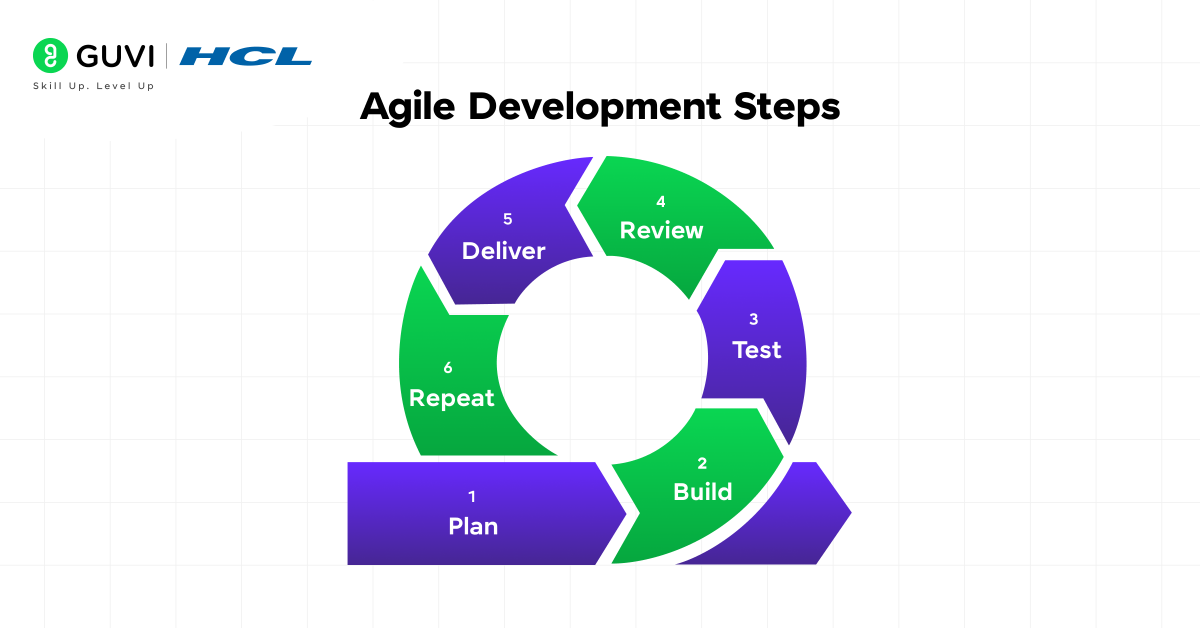
- Do Sprints: Short, time-boxed development cycles (typically 2-4 weeks) where a team plans, builds, tests, and reviews a set of features.
- Perform Daily Stand-ups: Brief, 15-minute meetings where every team member answers: What did I do yesterday? What will I do today? What is blocking me?
- Prioritize the Backlog: Keep a prioritized list of everything the product needs (the product backlog). Refine the top priority items and move them into the next sprint!
4. DevOps Best Practices:
DevOps is both a cultural and technical practice that integrates Development (Dev) with Operations (Ops). The goal is to provide the fastest cycle time for the software development life cycles and to also provide continuous delivery with a high level of quality.
- Continuous Integration (CI): Developers continually merge their code changes into a shared repository, where automated builds and tests run. This allows for early catching of integration bugs.
- Continuous Delivery/Continuous Deployment (CD): An extension of CI where, in Continuous Delivery, any change that passes all tests is released into a staging or production environment. This allows releases to be low-risk and routine events.
- Infrastructure as Code (IaC): Infrastructure (servers, networks) is managed and provisioned using machine-readable definition files, rather than using the command line or other manual processes. Tools like Terraform and Ansible make IaC accessible and usable, but also to ensure consistency and replicability of environments.
5. Software Testing Best Practices:
You can’t simply rely on clicking around your application to find bugs. Automated testing must be used to provide quality and speed.
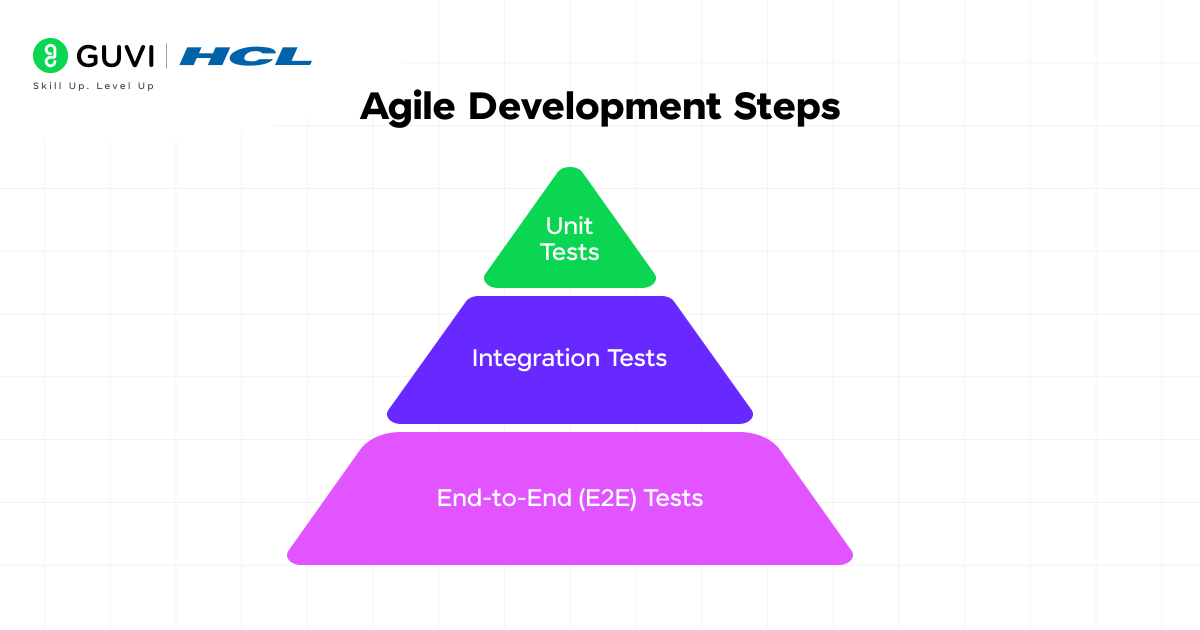
- The Test Pyramid: The test pyramid shows us how to create our testing strategy:
- Unit Tests (Foundation of the Pyramid): Unit tests test individual functions or components in isolation; they are fast, cheap, and numerous.
- Integration Tests (Middle): Integration tests test how well different modules or services work together.
- End-to-End (E2E) Tests (Top): E2E tests test the entire application flow from start to finish, taking on the perspective of a user. These tests are slow and expensive.
- Write Tests First (TDD): Test Driven Development is a practice where you write a test, which is failing, before you write any code to make it pass. This guarantees that your code will be testable and that you have defined what done looks like upfront.
Part 3: Security, Documentation, and Management
The technical aspects are crucial, but they rely on broader disciplines to make the project secure, understandable, and well-managed.
6. Secure Coding Practices:
You cannot think about security at the end of a development process. Security needs to be integrated into your development process from the start (“Shift Left Security”).
- Input Validation: Never trust user input: Always validate, clean, and escape anything from any user input to help reduce attacks like SQL Injection and Cross-Site Scripting (XSS).
- Principle of Least Privilege: Users and systems should only be given the minimum levels of access that is required to perform their function: Don’t run a web app as an administrator!
- Keep Dependencies Up-To-Date: Third-party libraries are a common way to have vulnerabilities. Use tools to scan regularly and, if necessary, update your dependencies.
- Use Proven Security Frameworks: Whenever possible, rely on established and trusted frameworks and libraries for authentication and authorization instead of rolling your own.

7. Documentation Best Practices:
Having good documentation is a present to your future self and your team members. It answers questions without needing anyone to interpret the code.
- Readme File: Every project should have a README.md file at the root of the project. It should describe what the project does, how to set the project up, and how to run it.
- API Documentation: If you build an API, you should document the endpoints, parameters, and responses. Tools like Swagger/OpenAPI can automatically create interactive documentation based on your code.
- Architectural Decision Records (ADRs): Research and write short documents that explain a significant architectural decision, some background/context for the decision, and ultimately what the consequences were. These are extremely helpful when trying to understand “why” the system is built this way, months or years later.
8. Software Project Management Practices:
The best code in the world can still be pointless if a project is mismanaged. Effective software management helps put the team in a position to build the right thing and to do it most effectively.
- Clear Requirements: User stories and tasks should be clear and concise, and each should have well-defined “acceptance criteria” indicating what “done” means.
- Visible Communication: Use tools (like Jira, Trello, or Azure Boards) where everyone can see the progress, priorities, and blockers — developers, managers, and stakeholders alike.
- Effort Estimation: Estimates are estimates, not guarantees. Use things like planning poker to establish team-wide consensus on how much effort a task may involve. Always plan a buffer for any unexpected items.
- Regular Retrospective: At the conclusion of each sprint, hold a meeting to discuss what went well, what didn’t, and what could be improved. Regularly improve your processes.
Part 4: Software Development Workflow Optimization
The ultimate goal is to weave all these individual practices into a seamless, efficient, and high-quality workflow. Software development workflow optimization is the continuous effort to streamline this process from idea to delivery.
A typical optimized workflow looks like this:
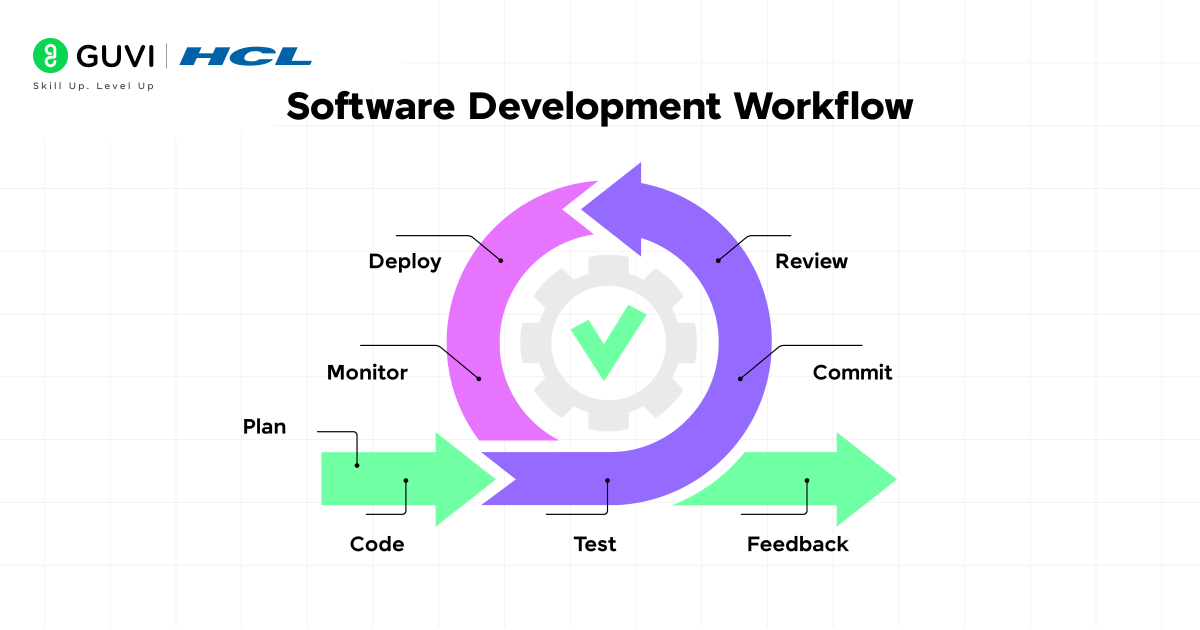
- Plan & Design: A feature is defined in the backlog. The team discusses the approach and creates a simple design.
- Code: A developer creates a new branch and starts coding, following clean code practices.
- Test: They write unit tests to define the desired behavior.
- Commit: They make small, frequent commits with clear messages to their branch (version control best practices).
- Integrate & Review: They push their branch and open a Pull Request. Automated CI pipelines run the test suite. Teammates perform a code review.
- Merge & Deploy: Once approved, the code is merged into the main branch. The CD pipeline automatically deploys the change to a staging environment.
- Release: After final checks, the change is deployed to production (manually or automatically).
- Monitor & Learn: The team monitors the application for performance issues or bugs and gathers feedback for the next cycle.
This workflow, powered by DevOps and Agile principles, creates a virtuous cycle of continuous improvement and delivery.
If you are curious about software development and want to become a software developer, then grab the opportunity to learn with HCL GUVI’s IITM Pravartak and MongoDB Certified Online AI Software Development Course. The NSDC-endorsed course gives you a globally recognized certificate to add to your résumé, which is a significant advantage that will help you stand out in the competitive employment market.
Final thoughts…
Adopting these software development best practices is not about strictly following a set of rules. Rather, it is about recognizing the underlying principles of quality, collaboration, speed, and security – and applying them in your own context.
You don’t have to take on all of these practices at once. Start with one. Maybe clean code and learning Git. Then, gradually include code reviews. Later, take on improving your test coverage or, maybe, automate your deployment pipeline.
The overall benefit of adopting these practices is significant. Less technical debt. Fewer bugs in production. Satisfied developers. More predictable releases. An ultimately better and more valuable software product. By adopting these practices, you are not just writing code; you are building a sustainable future for the project and the team.
FAQs
1. What are software development best practices?
Software development best practices are a collection of proven approaches, standards, and guidelines. Software development best practices help developers produce clean, secure, and maintainable code while maintaining quality, scalability, and efficiency in the software.
2. Why are best practices important in software engineering?
Best practices aid in consistency, error reduction, better teamwork across teams, testing, security, and maintainability.
3. Are best practices only for large organizations?
No. Small teams or individual developers can also use best practices, like version control, clean code, and documentation. In the long run, best practices save developers time and problems.
4. What can beginners start to do to use software engineering best practices?
Beginner software engineers can start with the basics, like using version control (like Git), writing clean and readable code, writing meaningful comments, and testing their code regularly.
Success Stories

About the Author
Vishalini Devarajan
An Aerospace Engineer turned content writer, I focus on making complex concepts easy to understand through well-structured, reader-friendly blogs. Whether it’s a technical topic or a non-technical one, I love creating content that is clear, engaging, and impactful.
View all posts by Vishalini Devarajan
Connect with me @















Did you enjoy this article?