


Artificial Intelligence and Machine Learning Articles
Finance Manager to Data Analytics: Career Growth, Salary and Seniority
How to Evaluate LLM Outputs in Production Deployments
AI/ML Skills Gap 2026: Why Companies Can't Find Job-Ready Talent
20 AI/ML Interview Questions Recruiters Can Use Without a Tech Background - Best Guide


Get In Touch For Details! Request More Information
Math for AI: Essential Linear Algebra, Calculus, and Optimization Techniques for Artificial Intelligence
Jun 05, 2026 7 Min Read 6710 Views
(Last Updated)
Over 90% of today’s most powerful artificial intelligence models rely on advanced mathematics to function effectively. Math for AI is not just about theory; it powers everything from recommendation engines to image recognition systems.
Whether you are learning linear algebra, exploring optimization for AI, or understanding probability and calculus, building strong mathematical foundations can give you a better understanding of machine learning and deep learning. In this blog, we will break down the mathematical concepts behind modern AI and connect them with real-world AI applications.
Table of contents
- TL;DR Summary
- Linear Algebra for Artificial Intelligence
- 1 What is Linear Algebra?
- 2. Why Linear Algebra Matters in AI
- 3 Core Concepts in Linear Algebra for AI
- 4 Real-World AI Applications of Linear Algebra
- Calculus in Machine Learning
- 1 Calculus Basics for AI
- 2 Role of Derivatives and Gradients
- 3 How Does Calculus Power Learning?
- 4 Practical Applications of Calculus in AI
- Probability and Statistics for AI
- 1 Introduction to Probability in Artificial Intelligence
- 2 Key Probability Concepts Used in AI
- 3 Bayesian Methods in AI
- 4 Statistics for Model Evaluation and Inference
- 5 Real-World Applications in AI
- Optimization Techniques for Artificial Intelligence
- 1 The Role of Optimization in AI
- 2 Objective Functions and Loss Functions
- 3 Gradient-Based Optimization Methods
- 4 Convex Optimization in AI
- 5 Non-Convex Optimization in Deep Learning
- 6 Regularization and Constraints
- 7 Real-World AI Applications of Optimization
- Matrix Algebra in Machine Learning
- 1 Matrices and Data Representation
- 2 Matrix Operations in Machine Learning
- 3 Applications of Matrix Algebra in AI
- 4 Role of Matrix Decompositions
- Derivatives and Gradients: Core Concepts for Deep Learning
- 1 The Role of Derivatives in Neural Networks
- 2 Gradients in High-Dimensional Spaces
- 3 Backpropagation: Efficient Gradient Computation
- 4 Vanishing and Exploding Gradients
- 5 Practical Implementation
- 6 Impact on Optimization
- Statistical Inference in Artificial Intelligence
- 1 Point Estimation: Maximum Likelihood and Bayesian Approaches
- 2 Confidence Intervals and Credible Intervals
- 3 Hypothesis Testing and Model Comparison
- 4 Cross-Validation and Generalization
- 5 Statistical Inference for Uncertainty Quantification
- Probability Distributions in Machine Learning
- 1 Types of Probability Distributions in Machine Learning
- 2 Application in Generative Models
- 3 Importance of Probability Distributions in Bayesian Inference
- Conclusion
- FAQs
- Do I need to learn all Math for AI topics before starting AI projects?
- Why do some AI models perform well even when I don’t fully understand the math behind them?
- How much math is needed for beginners who want to work in AI?
- Why do AI models sometimes stop improving even after more training?
- Which Math for AI topic should I focus on first if I find everything overwhelming?
- How can I practice Math for AI without only studying theory?
TL;DR Summary
• This blog helps you understand how Math for AI supports machine learning and deep learning through concepts like linear algebra, calculus, probability, and optimisation.
• Explore how mathematical concepts are applied in real AI applications such as neural networks, recommendation systems, image recognition, and generative models.
• Build an understanding of derivatives, gradients, and matrix operations used in AI models.
• Discover how mathematical foundations help AI models learn, improve predictions, and reduce errors.
Gradient descent, one of the most important optimization methods in Math for AI, was first introduced by mathematicians as early as 1847.
1. Linear Algebra for Artificial Intelligence
1.1 What is Linear Algebra?
Linear algebra is a branch of mathematics for data science focused on vectors and their transformations. In math for AI, it provides the fundamental language for representing and manipulating data.
1.2. Why Linear Algebra Matters in AI
Linear algebra powers nearly every aspect of artificial intelligence and machine learning:
- Data Representation: Images and sensor data are converted into vectors and matrices for processing.
- Neural Networks: Each layer in a neural network is essentially a matrix transformation.
- Efficient Computation: Hardware (like GPUs) is optimized for matrix operations. It further enables large-scale AI models.
1.3 Core Concepts in Linear Algebra for AI
Vectors and Matrices
- Vectors: Ordered lists of numbers representing data points or features.
- Matrices: Two-dimensional arrays of numbers. It is used to represent datasets or weight parameters in models.
Matrix Multiplication
- Combines input data with model weights in neural networks.
- Facilitates operations like transforming images and rotating points in space. Matrix multiplication further supports combining features.
Eigenvalues and Eigenvectors
- Eigenvalues: Indicate the magnitude of transformation in a particular direction.
- Eigenvectors: Define directions along which transformations (like PCA) act.
- Use Case: Principal Component Analysis (PCA) uses eigenvectors to reduce data dimensionality for better model performance.
1.4 Real-World AI Applications of Linear Algebra
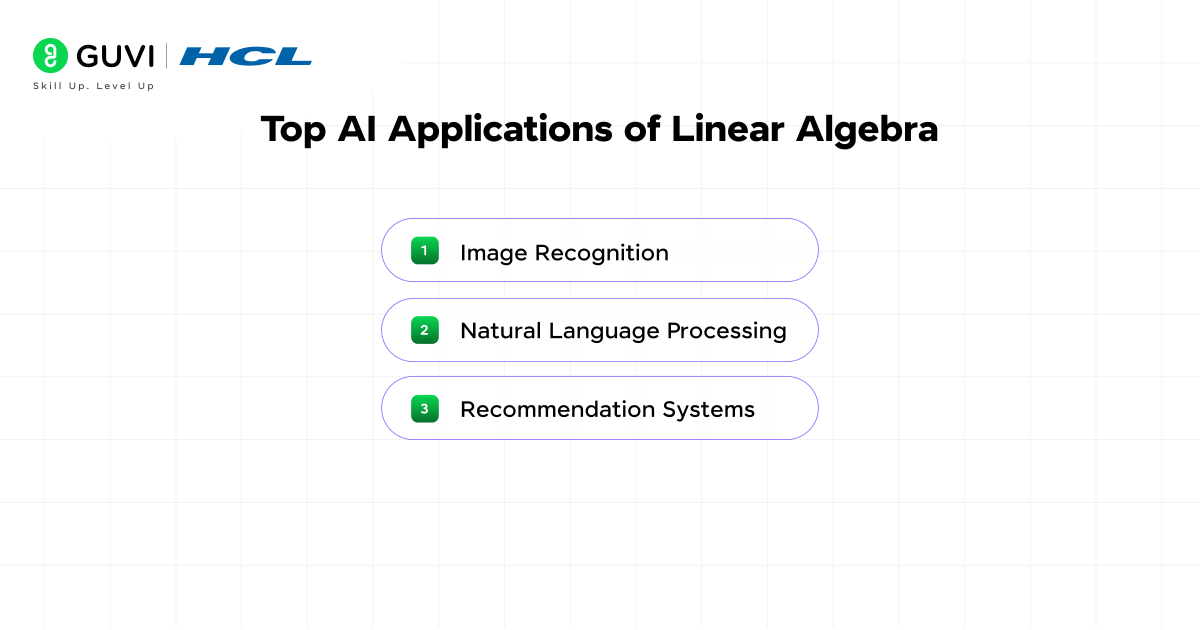
- Image Recognition: Convolutions in neural networks are matrix multiplications over pixel data.
- Natural Language Processing: Word embeddings are vectors that capture the meaning of words.
- Recommendation Systems: Matrix factorization is used for predicting user preferences in platforms like Netflix and Spotify.
Get started with HCL GUVI’s free AI & ML resources and build future-ready skills today: AI/ML eBook
2. Calculus in Machine Learning
2.1 Calculus Basics for AI
Calculus studies change and motion, and this module of mathematics provides the tools to analyze how functions behave. It helps us understand and control how models improve over time in machine learning.
2.2 Role of Derivatives and Gradients
- Derivatives: Calculate the rate of change of a function concerning its input. This is crucial for understanding how changing a model parameter affects the output or loss in machine learning.
- Gradients: The gradient generalizes the derivative for functions with many variables (like neural networks). It points in the direction of the steepest ascent or descent, further guiding optimization.
2.3 How Does Calculus Power Learning?
Backpropagation and the Chain Rule
- Backpropagation: The primary algorithm for training neural networks. It relies on the chain rule from calculus to efficiently compute gradients for all weights in the network.
- Chain Rule: Helps us compute the derivative of composite functions. It is pretty crucial since neural networks are made up of layers of functions.
Minimizing Loss Functions
- Machine learning models learn by minimizing a loss function or a measure of prediction error.
- Calculus helps calculate how each parameter should change to reduce the loss.
- Optimization algorithms (like gradient descent) utilize these gradients to update model parameters.
2.4 Practical Applications of Calculus in AI
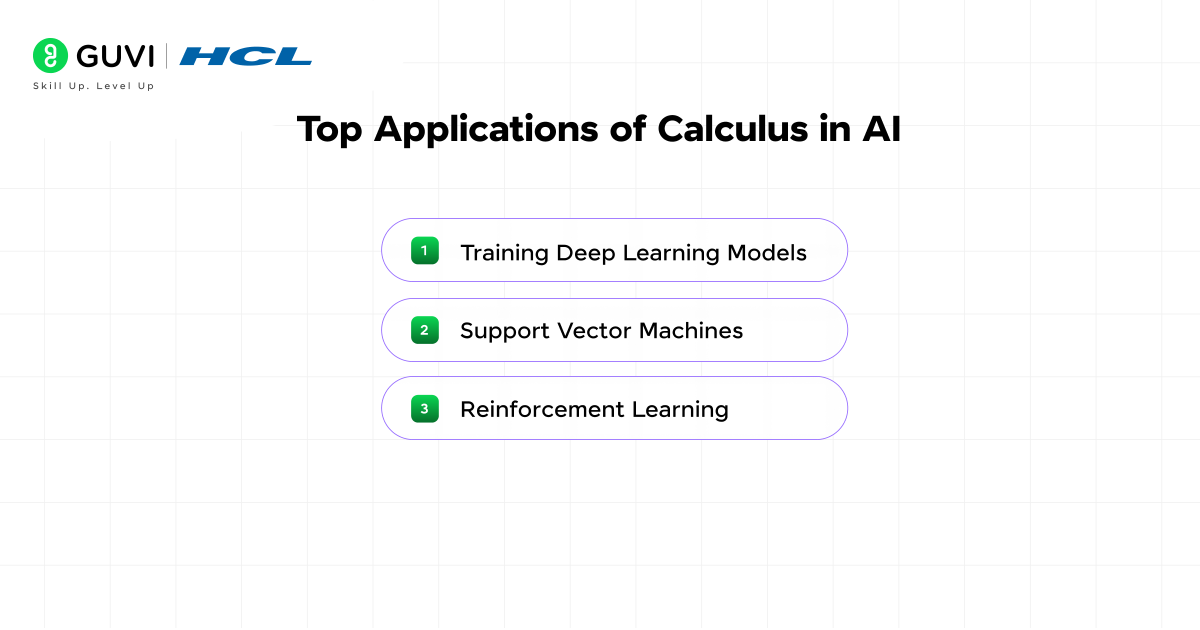
- Training Deep Learning Models: Models couldn’t learn from data or improve over time without calculus.
- Support Vector Machines: Find optimal boundaries using derivatives.
- Reinforcement Learning: Policy gradients help agents learn better strategies.
3. Probability and Statistics for AI
3.1 Introduction to Probability in Artificial Intelligence
Probability theory is pretty vital in artificial intelligence for modeling uncertainty and making predictions based on incomplete or noisy data. Probabilistic thinking authorizes AI systems to quantify the likelihood of outcomes and make data-driven decisions.
3.2 Key Probability Concepts Used in AI
- Random Variables: Variables whose values are determined by the outcome of a random event. Used extensively in modeling stochastic processes in machine learning.
- Probability Distributions: Mathematical functions that describe the probability of different outcomes. Common examples in AI include:
- Normal (Gaussian) Distribution: Widely used in regression and generative AI models.
- Bernoulli/Binomial Distributions: Utilize for binary events such as spam detection or image classification. For example, cat vs. non-cat.
- Poisson Distribution: Useful in event count modeling, such as click prediction.
3.3 Bayesian Methods in AI
Bayesian inference enables AI systems to update their beliefs as new data arrives. It further levels up model predictions over time.
- Bayes’ Theorem: Constructs the foundation for probabilistic programming and generative modeling.
- Applications: The Main ones are:
1. Naive Bayes classifiers
2. Bayesian neural networks
3. Probabilistic graphical models.
3.4 Statistics for Model Evaluation and Inference
- Statistical Inference: Concluding populations or processes based on data samples. Core techniques include:
- Point Estimation: Estimating unknown parameters (such as mean or variance) from data.
- Confidence Intervals: Quantifying the uncertainty around an estimated parameter.
- Hypothesis Testing: Employed to validate if AI model improvements are statistically significant.
- P-Values and Significance Levels: Help determine if observed effects are likely due to chance.
3.5 Real-World Applications in AI
- Spam Detection: Probability models estimate the probability of an email being spam.
- Speech Recognition: Statistical models handle variations and uncertainties in spoken language.
- Anomaly Detection: Statistical techniques identify data points that enormously deviate from expected patterns.
4. Optimization Techniques for Artificial Intelligence
4.1 The Role of Optimization in AI
Optimization is central to artificial intelligence. It enables algorithms to learn by minimizing error and maximizing performance. Optimization for AI means finding the best set of parameters. It includes examining parameters such as weights and biases. They make a model perform optimally on a given task.
4.2 Objective Functions and Loss Functions
- Objective Function: The function that an AI algorithm seeks to optimize (maximize or minimize).
- Loss Function: A specific type of objective function measuring the difference between predicted and actual values; e.g., mean squared error for regression, cross-entropy for classification.
4.3 Gradient-Based Optimization Methods
- Gradient Descent: The most common optimization algorithm in machine learning. It updates model parameters in the direction of the steepest decrease of the loss function.
- Variants:
- Batch Gradient Descent: Uses the entire dataset for each update. It is pretty rare for large datasets.
- Stochastic Gradient Descent (SGD): Updates parameters using one data point at a time. This occurs faster and more scalably.
- Mini-Batch Gradient Descent: Compromise between batch and SGD for efficient computation.
- Adaptive Methods:
- Adam: Combines momentum and adaptive learning rates. It is widely used for deep neural networks.
- RMSProp: Adjusts learning rates based on recent gradient magnitudes.
- Variants:
4.4 Convex Optimization in AI
- Convex Optimization: Deals with problems where the objective function is convex. Also, any local minimum is a global minimum. This assures the solution found is the best possible.
- Examples:
- Support Vector Machines (SVMs): Find the optimal separating hyperplane.
- LASSO Regression: Performs variable selection and regularization in linear models.
- Logistic Regression: Used for binary classification tasks.
- Examples:
4.5 Non-Convex Optimization in Deep Learning
- Deep neural networks involve non-convex loss surfaces. It leads to multiple local minima and saddle points.
- Stochastic optimization techniques and good initialization result in highly effective models. It takes place despite the lack of guarantees for global minima.
4.6 Regularization and Constraints
- Regularization: Penalizes model complexity to prevent overfitting (e.g., L1 and L2 regularization).
- Constraints: Incorporate problem-specific requirements into the optimization process.
4.7 Real-World AI Applications of Optimization
- Training Deep Learning Models: Optimization algorithms are employed to update millions of parameters.
- Hyperparameter Tuning: Optimization helps select the best model configurations.
- Resource Allocation in Robotics and Scheduling: Optimization promises efficient operation under constraints.
5. Matrix Algebra in Machine Learning
Matrix algebra forms the backbone of data representation and computation in machine learning. It provides a structure for organizing data and model parameters. Most operations in neural networks depend on efficient matrix algebra
5.1 Matrices and Data Representation
Data in machine learning is often stored as matrices. Each row can represent a data sample. Each column generally represents a feature or variable. Weights in neural networks are also organized as matrices.
5.2 Matrix Operations in Machine Learning
Matrix multiplication combines data with model weights. This operation helps compute the outputs of each layer in a neural network. Transposing a matrix flips its rows and columns. It is often needed during calculations. The inverse of a matrix, when it exists, helps solve systems of linear equations.
Matrix algebra supports efficient computation on modern hardware. GPUs are designed to deal with large matrix multiplications quickly. Sparse matrices support storage and computation savings when most entries are zero.
5.3 Applications of Matrix Algebra in AI
Principal Component Analysis or PCA employs matrix operations to reduce data dimensionality. Recommendation engines employ matrix factorization to uncover patterns in user-item data. Computer vision models process images as large matrices of pixel values.
5.4 Role of Matrix Decompositions
Matrix decomposition techniques break down complex matrices into simpler parts. Singular value decomposition (SVD) helps with noise reduction and feature extraction. Eigenvalue decomposition assists in analyzing stability and extracting important directions in data.

6. Derivatives and Gradients: Core Concepts for Deep Learning
The concepts of derivatives and gradients are the mathematical backbone of learning in neural networks. Modern deep learning would not be possible without these.
6.1 The Role of Derivatives in Neural Networks
A derivative measures how much a function’s output changes in response to a small change in its input. The function is usually the loss function, and the input is a model parameter, such as a weight in the context of deep learning. A neural network determines whether increasing or decreasing a parameter will reduce error by calculating the derivative.
6.2 Gradients in High-Dimensional Spaces
A deep neural network can have millions of parameters. The gradient is not a single number, but a vector that contains a partial derivative for each parameter. This vector points in the direction of the greatest rate of decrease for the loss function in the high-dimensional parameter space. Moving along the negative gradient permits the model to descend toward lower error values.
6.3 Backpropagation: Efficient Gradient Computation
Backpropagation is the nucleus algorithm for computing gradients in neural networks.
- The procedure begins by performing a forward pass to compute the loss.
- Then, the algorithm works backward, layer by layer, using the chain rule to compute gradients efficiently.
- Each layer calculates the gradient of its output concerning its input. Also, these gradients are multiplied as they are propagated backward.
6.4 Vanishing and Exploding Gradients
Training deep networks can introduce gradient issues. If the gradients become very small, they vanish, making it hard for the network to learn in earlier layers. If gradients become very large, they explode and destabilize training. Solutions include using activation functions like ReLU and initializing weights with care.
6.5 Practical Implementation
Modern frameworks like TensorFlow and PyTorch provide automatic differentiation. This means the framework keeps track of computations and automatically computes gradients for all parameters. Researchers and practitioners can build very deep networks without manually deriving and coding gradients.
6.6 Impact on Optimization
Correct and stable gradients are critical for optimization algorithms like stochastic gradient descent and Adam. The optimization algorithm cannot find a minimum for the loss function if gradient information is lost or corrupted. It further results in poor or failed training.
7. Statistical Inference in Artificial Intelligence
Statistical inference provides the formal basis for learning from data in AI. It allows for decision making and model selection under uncertainty.
7.1 Point Estimation: Maximum Likelihood and Bayesian Approaches
Point estimation is the technique of using data to calculate the single best guess for an unknown model parameter. Maximum likelihood estimation (MLE) is a frequentist approach that chooses parameters that maximize the probability of the observed data. Parameters are treated as random variables and the focus is on the posterior distribution given the data in Bayesian inference.
7.2 Confidence Intervals and Credible Intervals
Confidence intervals give a range where the true parameter value is likely to lie with a specified probability. For example, a 95% confidence interval suggests the true value is within the range for 95% of repeated samples. Bayesian methods use credible intervals. It directly represents the probability that a parameter is within a certain range given the observed data.
7.3 Hypothesis Testing and Model Comparison
Hypothesis testing is used to assess the validity of assumptions about data or models. The null hypothesis usually states that there is no effect or difference. AI researchers can decide whether to reject the null hypothesis by computing a test statistic and its p-value. Hypothesis tests compare different models or algorithms to ensure performance gains are real in machine learning
7.4 Cross-Validation and Generalization
AI models must generalize to new data. Cross-validation splits the dataset into training and validation sets multiple times to evaluate how well the model performs outside its training data. This procedure helps detect overfitting, where a model learns patterns specific to the training set but fails on new examples.
7.5 Statistical Inference for Uncertainty Quantification
Statistical inference also quantifies the uncertainty in model predictions. Probabilistic models return distributions rather than point estimates. It can be critical in applications like medical diagnosis or risk assessment. Techniques such as bootstrapping and Bayesian posterior sampling provide uncertainty intervals for predictions.
8. Probability Distributions in Machine Learning
Probability distributions are the foundation for modeling randomness and uncertainty in machine learning algorithms. The choice of distribution affects the behavior and performance of many AI models.
8.1 Types of Probability Distributions in Machine Learning
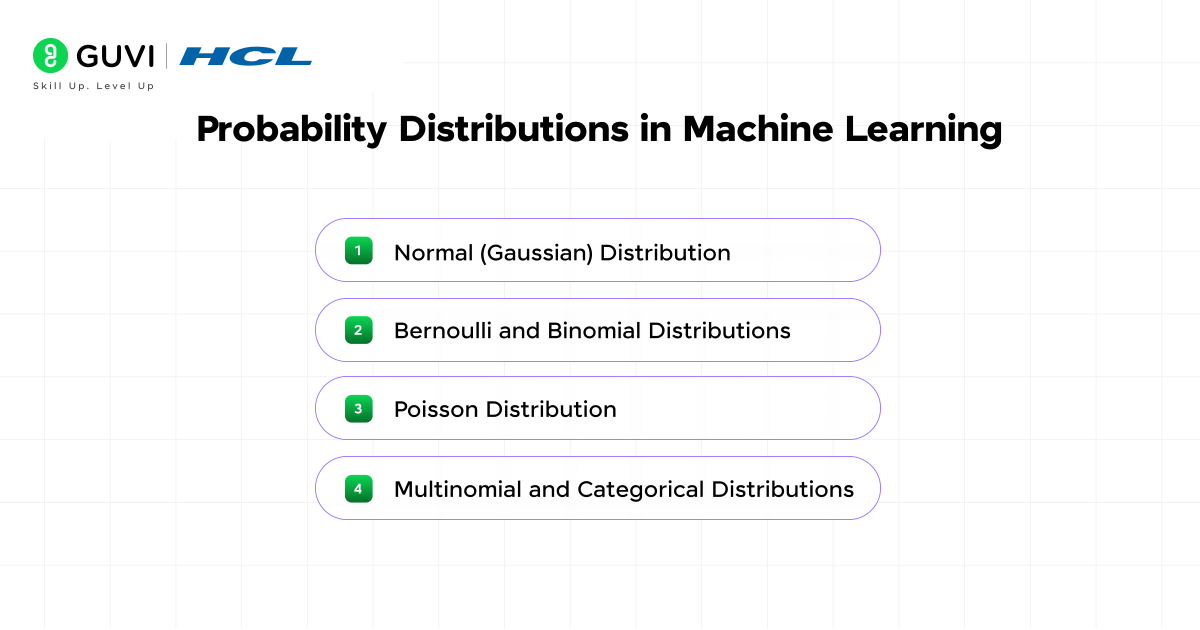
- Normal (Gaussian) Distribution and Its Importance
The normal distribution is symmetric and bell-shaped. Many real-world processes are well-approximated by the normal distribution due to the central limit theorem. Noise is often assumed to be Gaussian in machine learning. Linear regression assumes that the residuals follow a normal distribution. This assumption further simplifies analysis and inference.
- Bernoulli and Binomial Distributions in Classification
The Bernoulli distribution models events with two possible outcomes. Logistic regression models the probability of an outcome using a Bernoulli distribution for binary classification. The binomial distribution models the number of successes in a fixed number of independent Bernoulli trials. It is important in situations where multiple binary predictions are made, such as in ensemble methods.
- Poisson Distribution for Rare Events
The Poisson distribution models the probability of a given number of rare events occurring in a fixed interval of time or space. This is valuable for event prediction tasks, such as forecasting equipment failures or counting the number of requests to a web server.
- Multinomial and Categorical Distributions for Multi-Class Problems
Multi-class classification tasks repeatedly use the categorical distribution. It models the probability of each class. The multinomial distribution extends this to count occurrences for multiple classes in a series of trials. Softmax activation functions in neural networks produce outputs that match the categorical distribution.
8.2 Application in Generative Models
Generative models like Gaussian Mixture Models assume data comes from a mixture of several normal distributions. Variational autoencoders use the normal distribution in their latent spaces. Generative adversarial networks usually depend on sampling from standard distributions to create new and realistic data.
8.3 Importance of Probability Distributions in Bayesian Inference
Probability distributions are central to Bayesian inference. The prior distribution represents beliefs before data. The probability describes the probability of the observed data given the parameters. The posterior combines both, which summarizes what is known after observing data.
A deep understanding of derivatives and gradients, and probability distributions gives practitioners the proficiency to design and evaluate sophisticated machine learning models. These mathematical principles are at the core of every AI breakthrough.
Master the core mathematics behind AI with the HCL GUVI AI/ML course, certified by Intel®. Join 80,000+ learners who’ve upskilled with real-world projects, an industry-aligned curriculum, and hands-on training in linear algebra, calculus, optimization, and more. With Intel certification, native language support, and career-ready skills, this is the most practical path to becoming an AI professional in 2026 and beyond.
Conclusion
Mathematics is not just a supporting tool for artificial intelligence; it is the foundation behind many modern AI systems. From recommendation engines and speech recognition to deep learning models, strong mathematical concepts play a major role in how AI works.
Building knowledge in areas like linear algebra, calculus, probability, and optimization does more than help you understand models—it helps you better understand how real-world AI systems learn, improve, and make decisions.
FAQs
Do I need to learn all Math for AI topics before starting AI projects?
Start with basics and learn deeper concepts alongside projects to understand where each topic is used.
Why do some AI models perform well even when I don’t fully understand the math behind them?
Libraries handle many calculations automatically, but Math for AI helps understand model behavior and improve results.
How much math is needed for beginners who want to work in AI?
Strong basics in algebra, calculus, probability, and optimization are usually enough to begin.
Why do AI models sometimes stop improving even after more training?
Problems like poor optimization, bad data quality, or model limitations can affect learning.
Which Math for AI topic should I focus on first if I find everything overwhelming?
Linear algebra and basic calculus create a strong foundation before moving to advanced topics.
How can I practice Math for AI without only studying theory?
Use small datasets, build simple models, and connect mathematical concepts with practical experiments.
Success Stories

















Did you enjoy this article?