


Artificial Intelligence and Machine Learning Articles
Finance Manager to Data Analytics: Career Growth, Salary and Seniority
How to Evaluate LLM Outputs in Production Deployments
AI/ML Skills Gap 2026: Why Companies Can't Find Job-Ready Talent
20 AI/ML Interview Questions Recruiters Can Use Without a Tech Background - Best Guide


Get In Touch For Details! Request More Information
What is Clustering in Machine Learning? A Beginner’s Guide [2025]
Sep 04, 2025 5 Min Read 3351 Views
(Last Updated)
Clustering in machine learning helps you make sense of enormous datasets by organizing similar data points into manageable groups. When you’re facing thousands or millions of data points, clustering algorithms can reveal hidden patterns that might otherwise remain undiscovered.
Fundamentally, clustering is a statistical technique that classifies different objects or observations based on their similarities or patterns. Unlike supervised learning, clustering doesn’t require labeled data, making it particularly valuable when you’re exploring new datasets.
As you begin your journey with machine learning, understanding clustering algorithms will equip you with essential tools for market segmentation, social network analysis, medical imaging, and even anomaly detection. In this beginner-friendly guide, we’ll explore what clustering in machine learning is, examine different clustering methods, and show you how these powerful algorithms can transform your approach to data analysis.
Table of contents
- What is Clustering in Machine Learning?
- Why clustering is important in ML
- Types of Clustering Algorithms in Machine Learning
- 1) K-Means Clustering
- 2) Hierarchical Clustering
- 3) Density-Based Clustering (DBSCAN)
- 4) Distribution-Based Clustering
- 5) Fuzzy Clustering
- How K-Means Clustering Works
- Step-by-step process
- Choosing the value of K
- Example with 2D data points
- Real-World Applications of Clustering in Machine Learning
- Concluding Thoughts…
- FAQs
- Q1. What is clustering in machine learning and why is it important?
- Q2. How does clustering differ from classification in machine learning?
- Q3. What are the main types of clustering algorithms?
- Q4. How does K-means clustering work?
What is Clustering in Machine Learning?
Clustering is an unsupervised machine learning technique designed to group unlabeled examples based on their similarity to each other. The main objective is to organize data points so that items within the same cluster share more similarities compared to those in different clusters. After the clustering process completes, each group receives a unique label called a cluster ID.
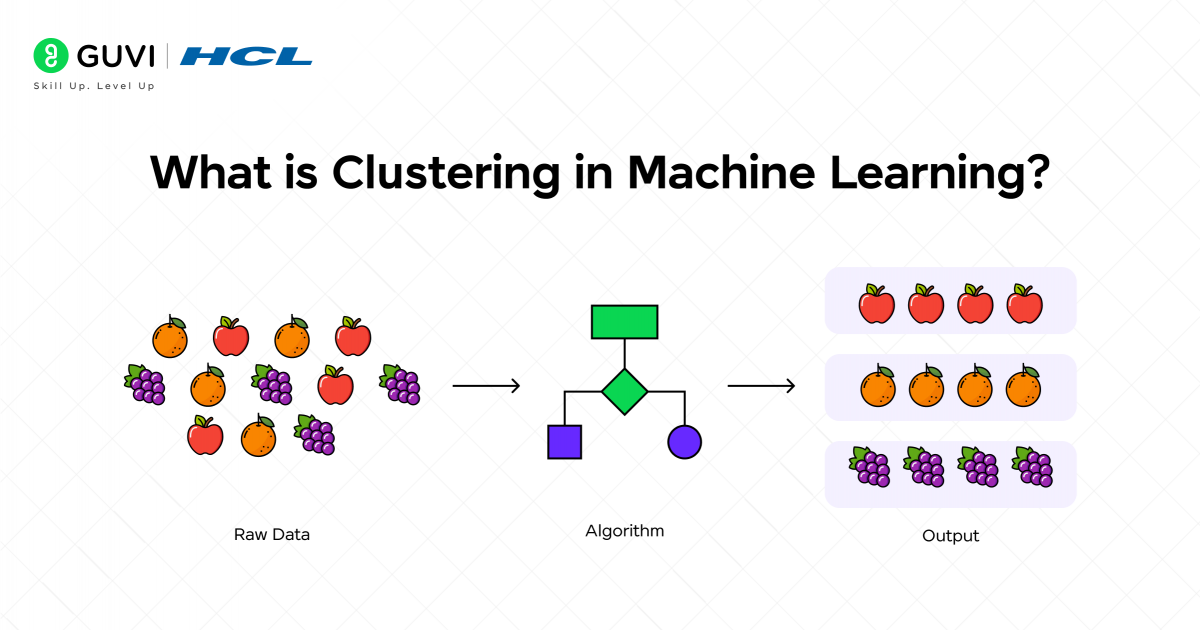
Consider this practical example: in a patient study evaluating a new treatment protocol, researchers might use clustering analysis to group patients with similar treatment responses together.
Essentially, clustering in machine learning helps simplify large, complex datasets with numerous features by reducing them to a single cluster ID, making the data more manageable for analysis.
Why clustering is important in ML
- Clustering in machine learning holds significant importance in machine learning for several reasons. First, it enables exploratory data analysis with new datasets, helping you understand underlying trends, patterns, and outliers. This makes it particularly valuable when you’re unfamiliar with a dataset’s structure or potential insights.
- Moreover, clustering facilitates data compression by replacing numerous features with a single cluster ID, thereby reducing storage and processing requirements. It also supports data imputation by inferring missing feature values from other examples within the same cluster.
- Furthermore, clustering helps reduce data complexity so you can focus on group behavior rather than becoming overwhelmed by individual data points. This simplification proves extremely useful when working with high-dimensional data or large datasets.
Types of Clustering Algorithms in Machine Learning
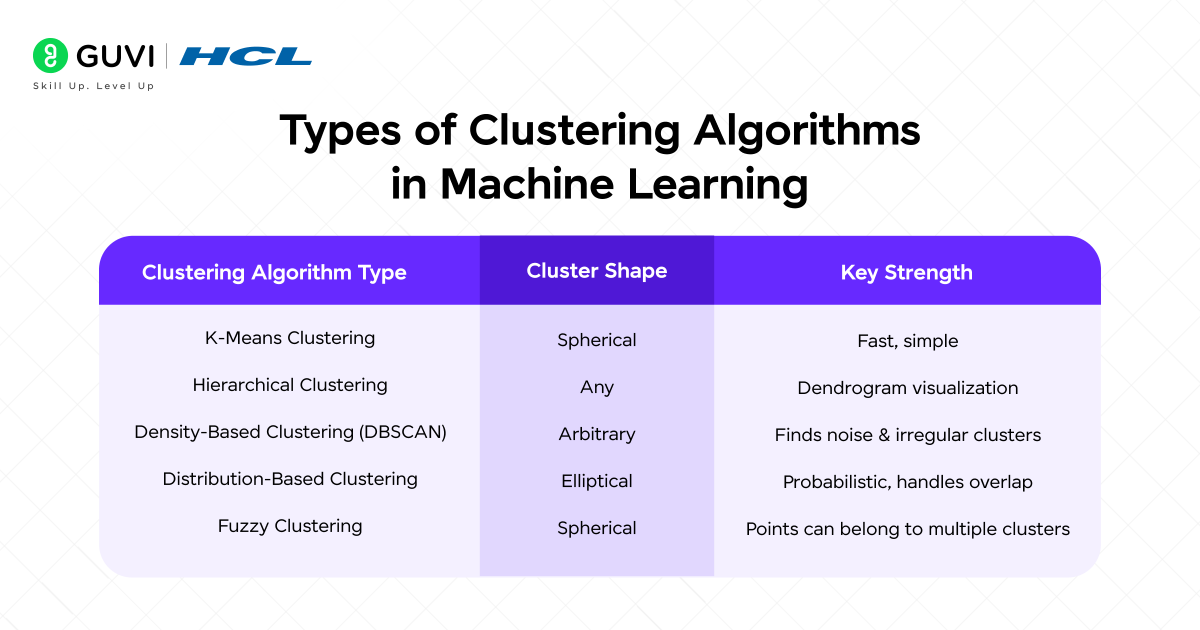
Machine learning offers a variety of clustering techniques, each with distinct approaches to grouping data. Understanding these different algorithms helps you select the most appropriate method for your specific data analysis needs.
1) K-Means Clustering
K-Means stands as one of the most widely used clustering algorithms due to its simplicity and efficiency. This centroid-based technique organizes data points around central vectors that represent clusters. The algorithm works through a straightforward process:
- Randomly initialize K centroids (cluster centers)
- Assign each data point to its nearest centroid
- Recalculate the centroids based on the assigned points
- Repeat until convergence or maximum iterations reached
K-Means excels with spherical clusters of similar size but requires specifying the number of clusters (K) beforehand. This makes it ideal for customer segmentation, image compression, and document clustering applications.
2) Hierarchical Clustering
Hierarchical clustering in machine learning builds a tree-like structure of clusters that shows relationships at multiple levels. This method comes in two main varieties:
- Agglomerative clustering: A “bottom-up” approach where each data point starts as its cluster, and similar clusters merge iteratively until all points form a single cluster
- Divisive clustering: A “top-down” approach that begins with all data in one cluster and recursively splits into smaller groups
The results appear in a dendrogram—a tree diagram visualizing the arrangement of clusters. Hierarchical clustering works well with any valid distance measure and excels with hierarchical data like taxonomies.
3) Density-Based Clustering (DBSCAN)
Density-Based Spatial Clustering of Applications with Noise (DBSCAN) identifies clusters as dense regions separated by areas of lower density. Unlike K-Means, this approach:
- Finds arbitrarily shaped clusters
- Automatically determines the number of clusters
- Effectively handles noise and outliers
DBSCAN requires two key parameters: epsilon (ε), which defines the radius of the neighborhood around points, and minPts, the minimum number of points needed within that radius to form a dense region. This algorithm proves particularly effective for datasets with irregular cluster shapes and varying densities.
4) Distribution-Based Clustering
Distribution-based clustering assumes data points originate from a mixture of probability distributions. These algorithms identify the underlying distributions generating the data and use this information to form clusters.
The Gaussian Mixture Model (GMM) represents the most common approach in this category, assuming data comes from a mixture of Gaussian distributions. GMM offers several advantages:
- Handles overlapping clusters effectively
- Models the covariance structure of data
- Provides probabilistic cluster assignments
This makes distribution-based clustering valuable for image segmentation, pattern recognition, and anomaly detection.
5) Fuzzy Clustering
Unlike traditional “hard” clustering, where each data point belongs to exactly one cluster, fuzzy clustering allows data points to belong to multiple clusters with varying degrees of membership. Fuzzy C-Means (FCM) is the most prominent algorithm in this category, assigning membership grades that indicate how strongly each point belongs to different clusters.
The FCM algorithm works by:
- Initializing cluster centers
- Assigning membership values to data points
- Iteratively updating centers and memberships until convergence
Fuzzy clustering proves especially useful when dealing with overlapping data where boundaries between clusters aren’t well-defined.
First, understanding these fundamental clustering approaches allows you to select the most appropriate technique based on your data characteristics and analysis goals.
How K-Means Clustering Works
K-means stands out as one of the most accessible clustering algorithms for beginners to understand. And as this is a beginner’s guide, we’ll learn about k-means so that you can completely grasp what clustering in machine learning is.
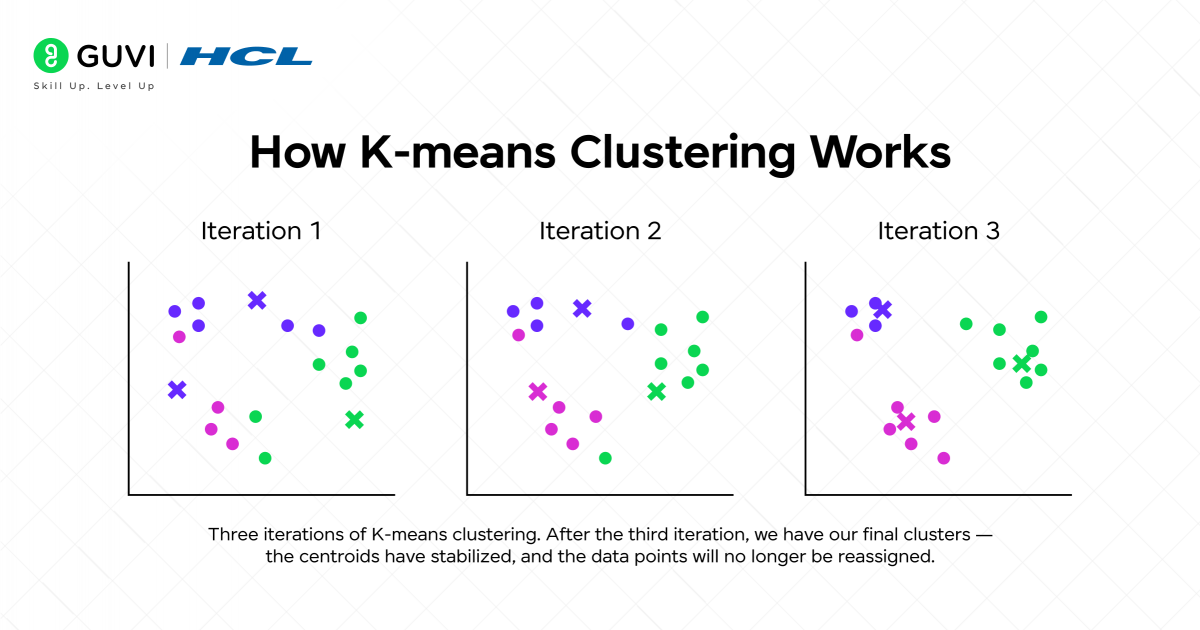
The fundamental idea behind K-means is finding commonalities by measuring distances between data points—the closer two points are, the more similar they are considered.
Step-by-step process
K-means follows a straightforward iterative approach:
- Initialization: Begin by randomly selecting K points as initial cluster centroids
- Assignment: Calculate the distance between each data point and all centroids, then assign each point to its closest centroid
- Update: Recalculate the centroids by taking the mean of all points assigned to each cluster
- Repeat: Continue steps 2-3 until the centroids no longer change significantly or you reach a maximum number of iterations
During this process, K-means attempts to minimize the total intra-cluster variation (the sum of squared distances from each point to its assigned centroid). This measurement, often called “inertia” or “within-cluster sum of squares,” decreases with each iteration as the algorithm refines the clusters.

Choosing the value of K
Selecting the appropriate number of clusters represents a critical decision in K-means clustering. Several methods can help determine the optimal value:
- The Elbow Method plots the sum of squared distances (inertia) against different values of K. As you increase K, the inertia naturally decreases. However, at some point—resembling an “elbow” in the graph—this decrease slows dramatically. This inflection point generally indicates a good value for K.
- Silhouette Analysis measures how similar each point is to its cluster compared to other clusters. The silhouette score ranges from -1 to +1, with higher scores indicating better-defined clusters. The K value with the highest average silhouette score often represents an optimal choice.
- Gap Statistic compares your clustering results with a randomly distributed reference dataset. The optimal K maximizes the gap between these measurements, indicating that your clustering structure significantly outperforms random grouping.
Example with 2D data points
Consider a simple dataset with four points and two variables:
| Item | X1 | X2 |
| A | 7 | 9 |
| B | 3 | 3 |
| C | 4 | 1 |
| D | 3 | 8 |
If we initially partition these into two clusters—(A, B) and (C, D)—the algorithm proceeds as follows:
First, calculate the centroids for each cluster:
- Cluster (A,B) centroid: (5,6)
- Cluster (C,D) centroid: (3.5,4.5)
Next, measure each point’s distance to both centroids. For instance, point B is closer to the (C, D) centroid with a distance of √2.5, compared to √13 for the (A, B) centroid. Consequently, B gets reassigned to the second cluster.
This creates new clusters: (A) and (B, C, D). After recalculating centroids and checking distances again, if no points change clusters, the algorithm has converged. The final result would be two distinct clusters grouping similar data points.
This iterative refinement makes K-means both intuitive and powerful for identifying natural groupings in your data.
K-Means is Older Than You Think: The K-Means algorithm was first introduced in 1957, long before modern machine learning took off.
Clustering Shapes Search Engines: Google and other search engines use clustering to group similar web pages and deliver more relevant results.
Real-World Applications of Clustering in Machine Learning
Beyond theoretical understanding, clustering in machine learning delivers practical solutions and applications across diverse industries. Let’s explore how these algorithms tackle real-world challenges.
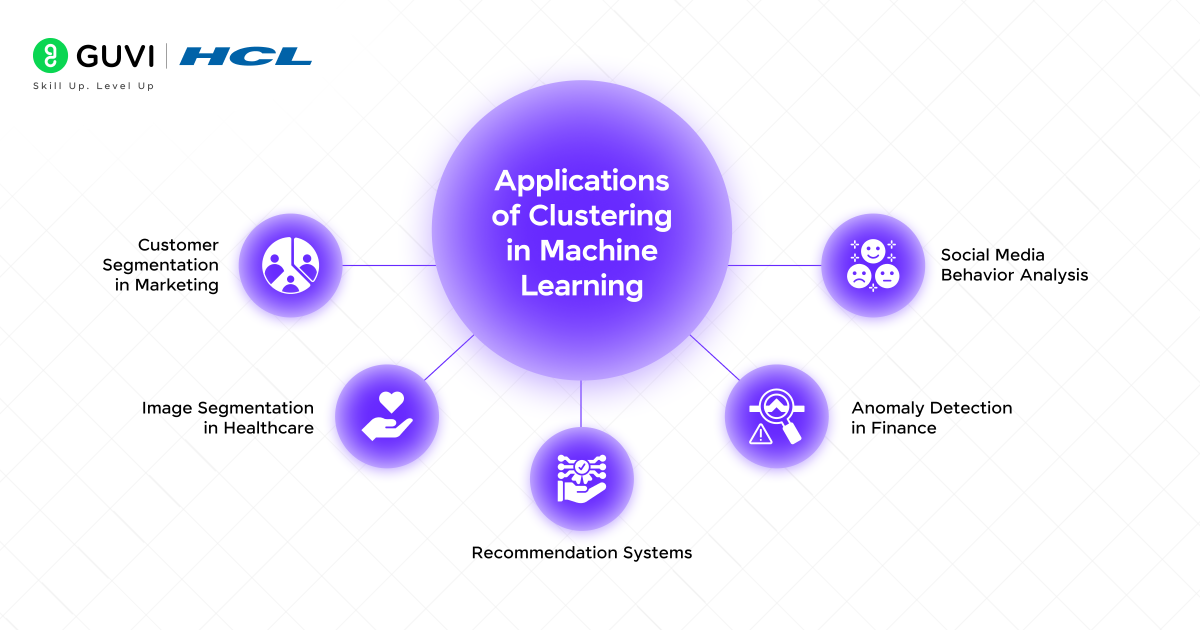
- Customer Segmentation in Marketing: Clustering helps businesses group customers by behavior, demographics, or engagement. Streaming platforms target high-usage viewers, and email marketers personalize content based on interaction patterns, enabling tailored strategies for each segment.
- Image Segmentation in Healthcare: Clustering, especially K-means with CNN (96.45% accuracy), supports analysis of medical images like MRIs, dermoscopy, and CT scans. Hierarchical clustering improves brain tumor detection in MRI scans.
- Recommendation Systems: Clustering enhances recommendations by grouping similar users or items. It addresses cold-start issues and improves accuracy through user-based and item-based filtering.
- Anomaly Detection in Finance: Clustering detects fraud by grouping typical transaction patterns and flagging outliers. It’s used in anti-money laundering systems and trader behavior analysis with methods like isolation forests.
- Social Media Behavior Analysis: Social platforms use clustering to analyze user behavior, detect trends, and personalize content. It also identifies similar accounts for better marketing and engagement.
Want to turn your interest in clustering into a career in AI and ML? Check out GUVI’s Artificial Intelligence and Machine Learning Course, certified by Intel and IIT-M Pravartak, designed by industry experts to help you build real-world skills and land top tech roles—no prior experience needed.
Concluding Thoughts…
Clustering in machine learning stands as a powerful tool in your machine learning toolkit, especially when dealing with unlabeled data that needs organization and pattern discovery. Throughout this guide, you’ve learned how clustering algorithms group similar data points together, thus revealing hidden structures within complex datasets.
As you continue your machine learning journey, remember that clustering in machine learning represents just one facet of unsupervised learning. This fundamental technique allows you to make sense of data without labeled examples, therefore opening doors to discovering patterns that might otherwise remain hidden. Good Luck!
FAQs
Q1. What is clustering in machine learning and why is it important?
Clustering in machine learning is an unsupervised machine learning technique that organizes data into groups based on similarities. It’s important because it helps discover hidden patterns in large datasets, simplifies complex data, and supports tasks like customer segmentation, anomaly detection, and exploratory data analysis.
Q2. How does clustering differ from classification in machine learning?
Clustering in machine learning is an unsupervised learning method that groups similar data points without predefined labels. Classification, on the other hand, is a supervised learning technique that assigns data to predefined categories based on labeled training data. Clustering discovers patterns, while classification predicts categories.
Q3. What are the main types of clustering algorithms?
The main types of clustering algorithms include centroid-based (like K-means), hierarchical, density-based (such as DBSCAN), distribution-based, and fuzzy clustering. Each type has its own approach to grouping data and is suitable for different kinds of datasets and analysis goals.
Q4. How does K-means clustering work?
K-means clustering works by iteratively assigning data points to K clusters based on their similarity to cluster centroids. It starts with random centroids, assigns points to the nearest centroid, recalculates centroids based on assigned points, and repeats until convergence. The algorithm aims to minimize the total distance between points and their cluster centroids.
Success Stories

About the Author
Jaishree Tomar
A recent CS Graduate with a quirk for writing and coding, a Data Science and Machine Learning enthusiast trying to pave my own way with tech. I have worked as a freelancer with a UK-based Digital Marketing firm writing various tech blogs, articles, and code snippets. Now, working as a Technical Writer at GUVI writing to my heart’s content!
View all posts by Jaishree Tomar
Connect with me @


















Did you enjoy this article?