


Project Articles
Business Analysis in Digital Transformation Projects - Best Guide
Build No-Code AI Agents with Flowise AI: Step-by-Step Beginner Guide


Get In Touch For Details! Request More Information
12 Best C Project Ideas [With Source Code]
Jul 22, 2026 8 Min Read 58021 Views
(Last Updated)
When you start your journey in software development, the first and foremost language that you come across is C. One of the best ways to enhance your learning is by working on real projects. But, where do you start?
Well, you’ve come to the right place! If you’re a beginner or someone looking to sharpen your C programming, finding the right C project ideas can be a game-changer.
In this article, we’ll walk through the top 10 C project ideas that are not only exciting but also practical. These projects will help you apply your coding knowledge in the real world and give you a strong portfolio to showcase. So, without further ado, let us get started!
Quick TL;DR Summary
- This blog covers 12 C project ideas across beginner to advanced levels, helping you apply coding knowledge in real-world scenarios.
- Explains each project with features, duration, technology stack, and learning outcomes to guide structured learning.
- Highlights benefits like improved structured thinking, memory management awareness, debugging skills, and stronger portfolio building.
- Shares common mistakes and practical tips to help you write better, safer, and more organized C programs.
C was created in 1972 and still powers over 90% of systems today.
Table of contents
- What is C Programming?
- Top 12 C Project Ideas
- Student Management System
- Library Management System
- Banking Management System
- Hospital Management System
- Online Quiz System
- Tic-Tac-Toe Game
- Mini Calculator
- Simple ATM Interface
- Snake Game
- Basic Chat Application
- File Encryption and Decryption System
- Compiler Design
- Benefits of Building C Projects
- Improved Structured Thinking
- Stronger Memory Management Awareness
- Better Data Handling Skills
- Increased Debugging Confidence
- Stronger Portfolio and Interview Advantage
- Common Mistakes to Avoid While Building C Projects
- Tips to Make Your C Projects More Impressive
- Conclusion
- FAQs
- What are the easy C Program project ideas for beginners?
- Why are C Program projects important for beginners?
- What skills can beginners learn from C Program projects?
- Which C Program project is recommended for someone with no prior programming experience?
- How long does it typically take to complete a beginner-level C Program project?
What is C Programming?
C programming is a foundational language that provides direct control over how data is stored, accessed, and processed inside a computer. It allows the developer to write instructions that interact closely with system memory and processor operations, which reveals how software functions at its core.
The language follows a structured approach through functions and clear control flow, which supports organized reasoning in problem-solving. C is used in areas such as operating systems and performance-focused applications because it offers reliability and clarity at a low level.
Discover our free beginner’s course on C programming to write strong and efficient code: C Programming Beginners Course
C is the language that builds everything from operating systems to embedded firmware. Before diving into projects, make sure your fundamentals are solid — HCL GUVI has both a free handbook and a beginner course: C Programming Tutorial
Top 12 C Project Ideas
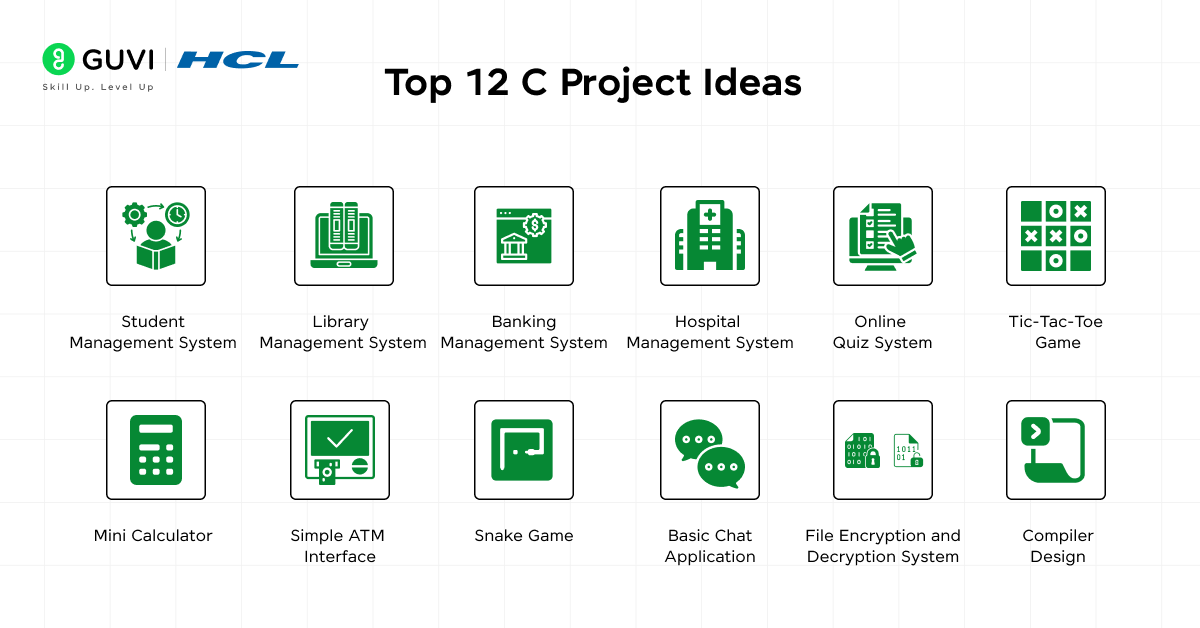
These C project ideas are designed to give you a comprehensive understanding of how the C program works, the technology stack required, and the learning outcomes of each project. Here’s a comprehensive list of the top 10 C project ideas.
1. Student Management System
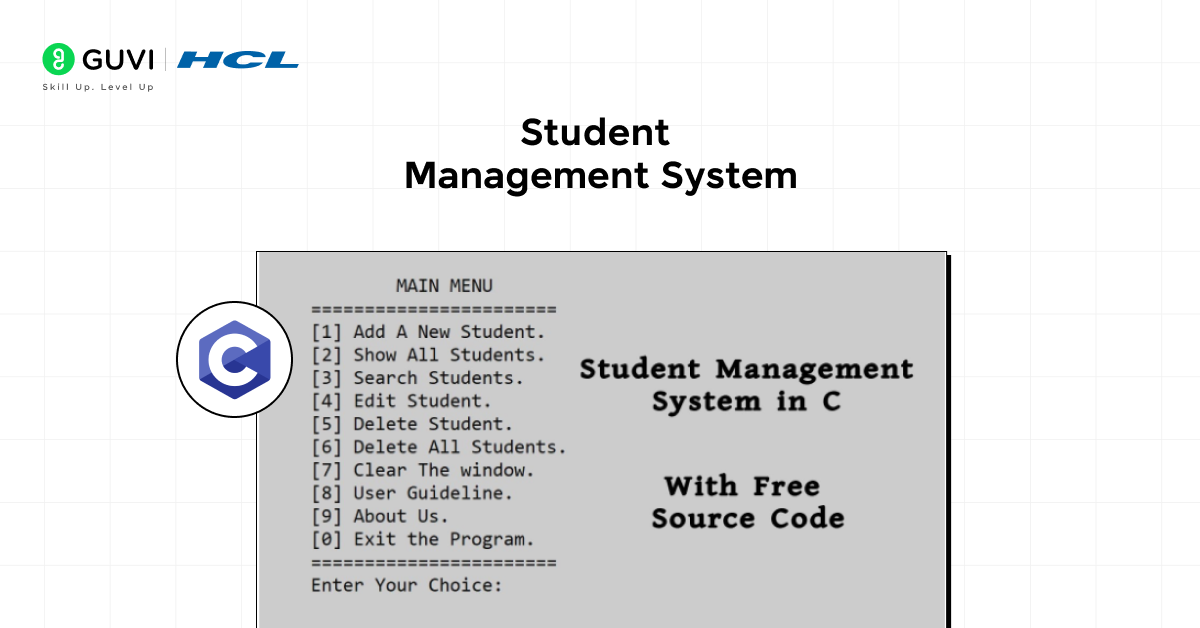
A Student Management System is an ideal beginner project that allows you to build a simple console-based application where you can manage students’ personal and academic records. This system enables you to add, delete, and update student records, as well as display a list of all registered students.
Duration: 7-10 days
Project Complexity: Beginner
Technology Stack: C programming, File Handling
Features:
- Add and remove students
- Update student details
- View all student records
Security Requirements: Implement input validation to prevent invalid data entries, and ensure secure file handling to avoid data corruption.
Learning Outcome: You will gain hands-on experience with file handling, learn to work with structures, and understand how to organize and manipulate data in a program.
Input/Output Requirements: The system accepts student data (e.g., name, roll number, grades) as input and stores it in a file. It outputs the stored data when requested.
Source Code: Student Management System

2. Library Management System
A Library Management System helps in automating the management of library activities. Users can add books, borrow or return them, and check the availability of books. This project uses linked lists for data management, making it an intermediate-level project.
Duration: 10-12 days
Project Complexity: Intermediate
Technology Stack: C, Data Structures (Linked Lists), File Handling
Features:
- Add and remove books
- Issue books to users
- Track borrowed and returned books
Security Requirements: Input validation and secure file handling are essential to prevent data corruption or invalid entries.
Learning Outcome: This project enhances your understanding of data structures, especially linked lists, and improves your memory management skills in C.
Input/Output Requirements: Users input book details or requests for borrowing/returning. The system provides availability status or details on book issues.
Source Code: Library Management System
3. Banking Management System
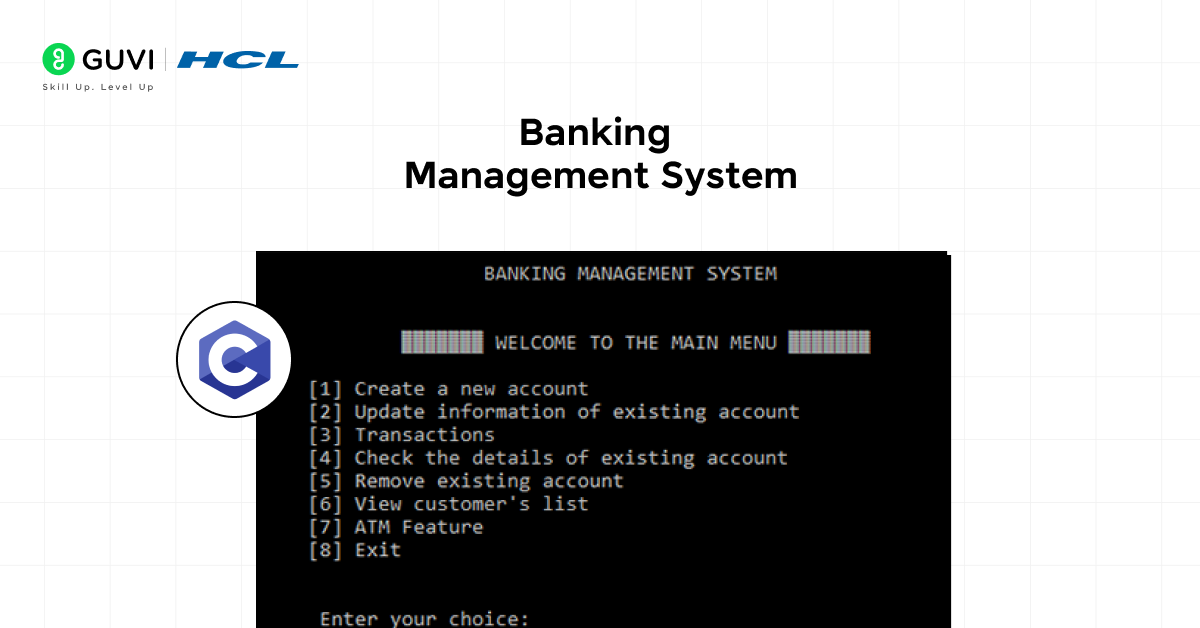
The Banking Management System allows users to create bank accounts, deposit and withdraw money, and check account balances. This project focuses on handling user data through file management.
Duration: 5-7 days
Project Complexity: Beginner
Technology Stack: C, File Handling
Features:
- Create new accounts
- Deposit/Withdraw money
- Check account balances
Security Requirements: Implement input validation, especially for numerical data like account balance, and use proper memory handling to avoid data leaks.
Learning Outcome: You’ll get a solid understanding of file operations and data organization in C programming, enhancing your ability to build simple user-interactive systems.
Input/Output Requirements: Users input account details and request deposit/withdrawal operations. The system outputs updated balances and transaction summaries.
Source Code: Banking Management System
Banking systems use file I/O, structs, and numerical data validation — core C concepts covered in HCL GUVI’s free C handbook: C Programming Tutorial
4. Hospital Management System
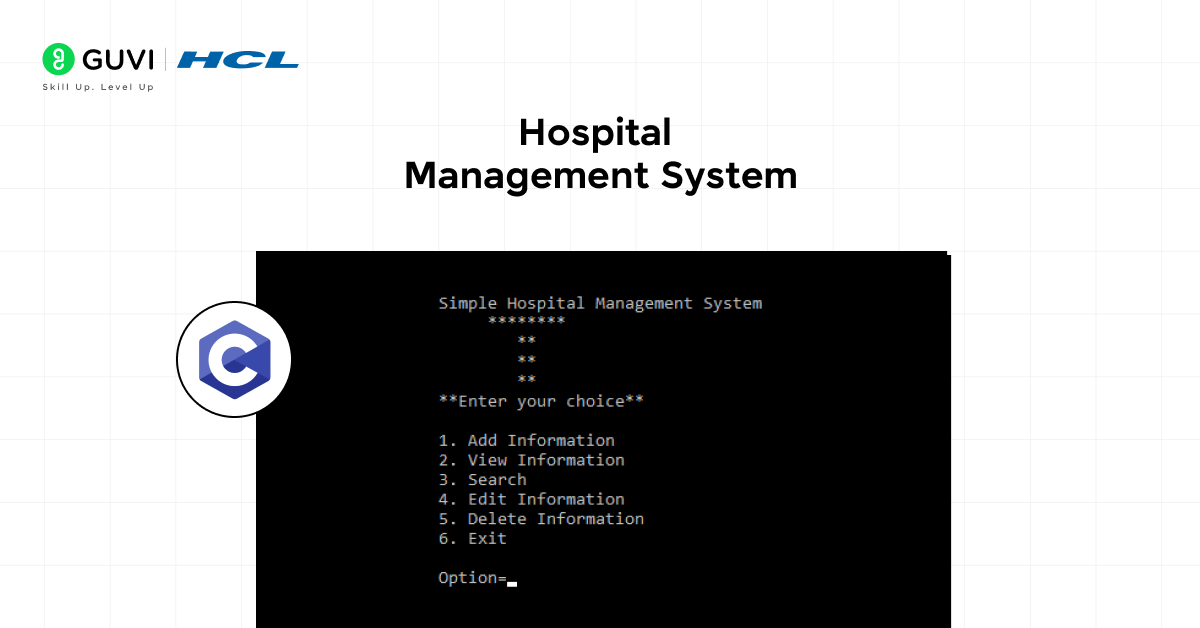
A Hospital Management System allows you to manage patient details, doctor appointments, and medical records. This is an intermediate project that introduces you to managing more complex data, such as patient history and doctor schedules.
Duration: 8-10 days
Project Complexity: Intermediate
Technology Stack: C, Structs, File Handling
Features:
- Add and update patient records
- Schedule appointments
- Maintain doctor and patient histories
Security Requirements: Ensure input validation for patient details and implement error handling to avoid application crashes.
Learning Outcome: You will learn how to manage multiple datasets in C and understand how to design a system with interdependent modules (patients, doctors, schedules).
Input/Output Requirements: Inputs include patient details, appointment scheduling requests, and doctor information. The system outputs patient records and appointment schedules.
Source Code: Hospital Management System
Built your first C project? Now sharpen your coding skills with real programming challenges. Practice C concepts, improve your problem-solving ability, and prepare for coding interviews with HCL GUVI CodeKata—featuring hundreds of coding questions ranging from beginner to advanced. Start solving today and code with confidence!
5. Online Quiz System
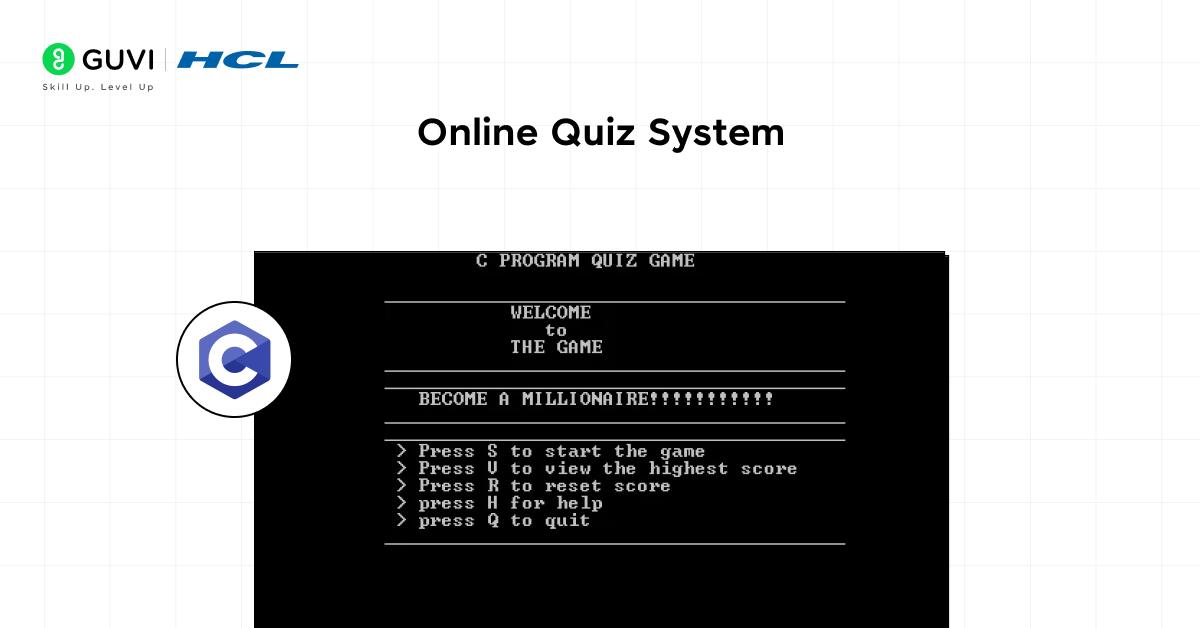
An Online Quiz System is an engaging project that allows users to take a quiz from a pre-defined set of questions. The system tracks user answers and scores at the end of the quiz.
Duration: 6-8 days
Project Complexity: Beginner
Technology Stack: C, File Handling
Features:
- Multiple-choice quiz functionality
- Score calculation at the end of the quiz
- Display correct answers
Security Requirements: Ensure input validation to handle invalid answers and protect quiz data with proper file handling.
Learning Outcome: This project will help you understand user input handling, develop a scoring mechanism, and manage quiz data through files.
Input/Output Requirements: User inputs answers to questions, and the system outputs scores and the correct answers at the end of the quiz.
Source Code: Online Quiz System
6. Tic-Tac-Toe Game
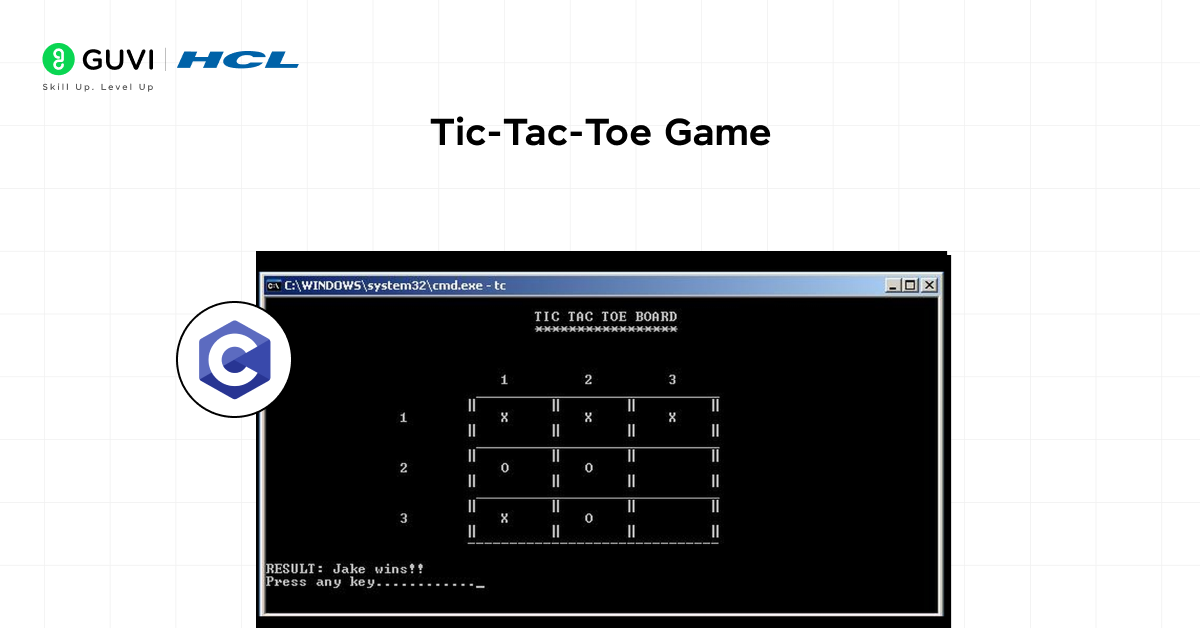
The Tic-Tac-Toe Game is a classic two-player game where players take turns marking a 3×3 grid. The first player to align three of their marks (either X or O) vertically, horizontally, or diagonally wins the game.
Duration: 2-3 days
Project Complexity: Beginner
Technology Stack: C, Arrays, Loops, Conditional Statements
Features:
- Two-player mode
- Real-time board updates
- Win/draw detection
Security Requirements: Validate user inputs to prevent invalid moves and ensure that grid cells are not overwritten.
Learning Outcome: You’ll learn how to use loops, conditionals, and arrays, while also improving your problem-solving skills by implementing game logic.
Input/Output Requirements: Users input their move (grid position), and the game outputs the updated grid and the game’s status (win/draw).
Source Code: Tic-Tac-Toe Game
7. Mini Calculator
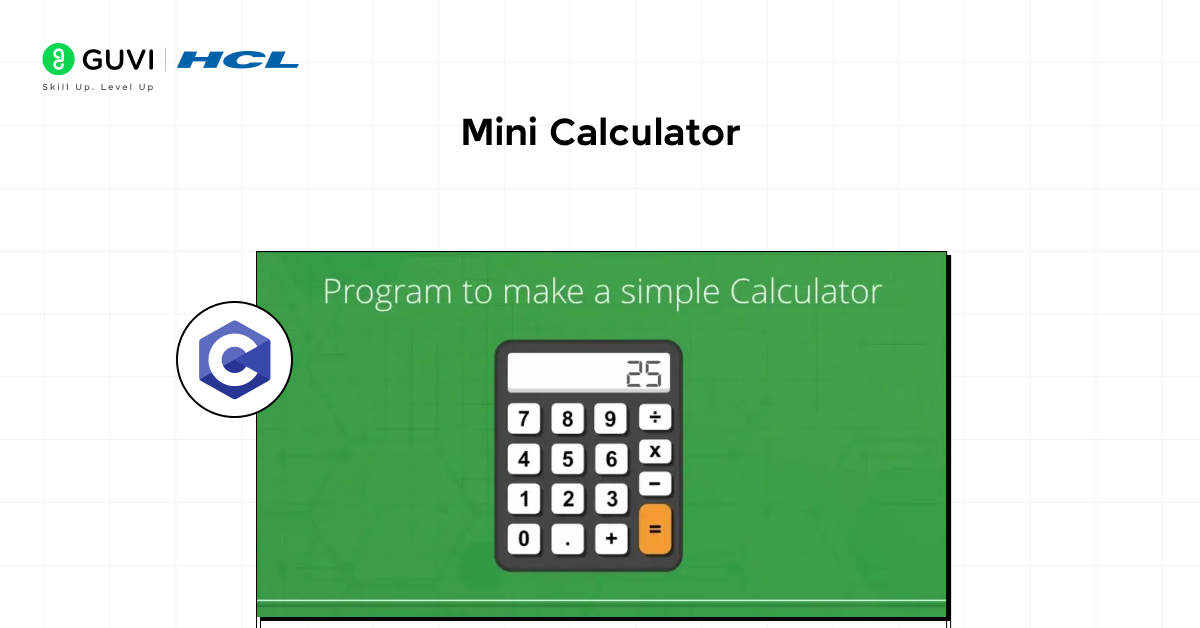
The Mini Calculator project is a simple calculator program that performs basic arithmetic operations like addition, subtraction, multiplication, and division.
Duration: 1-2 days
Project Complexity: Beginner
Technology Stack: C, Arithmetic Operations, Conditional Statements
Features:
- Supports addition, subtraction, multiplication, and division
- User-friendly input and output
- Error handling for division by zero
Security Requirements: Validate input to handle division by zero errors and non-numeric entries.
Learning Outcome: This project will strengthen your understanding of basic C programming concepts like conditional statements and arithmetic operations.
Input/Output Requirements: Users input two numbers and the type of operation, and the system outputs the result.
Source Code: Mini Calculator
The Mini Calculator covers arithmetic operators, switch-case, and user input — the building blocks of every C program. Revise all of these in HCL GUVI’s free handbook: C Programming Tutorial
8. Simple ATM Interface
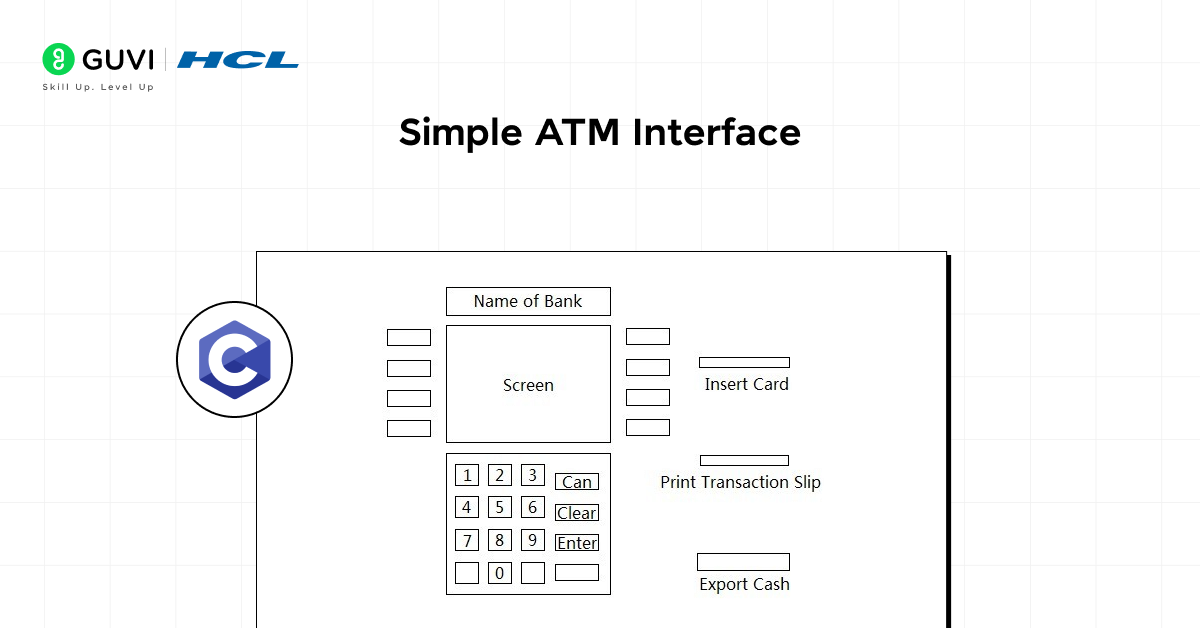
The Simple ATM Interface allows users to perform basic banking operations like checking balances, depositing, and withdrawing money.
Duration: 3-5 days
Project Complexity: Beginner
Technology Stack: C, File Handling
Features:
- Balance inquiry
- Deposit and withdraw money
- PIN authentication
Security Requirements: Use proper error handling and input validation to prevent invalid data entries and ensure secure PIN handling.
Learning Outcome: You’ll gain experience with user interaction and file handling in C programming.
Input/Output Requirements: The user inputs their account details and selects a transaction type, and the system provides a balance or transaction confirmation.
Source Code: Simple ATM Interface
9. Snake Game
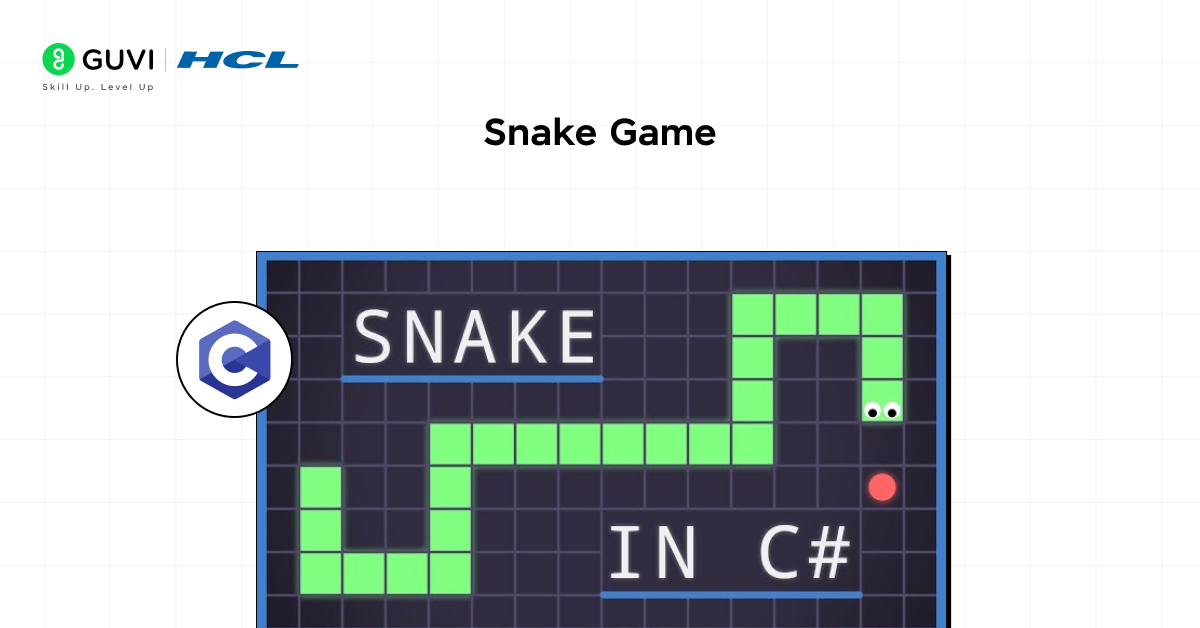
The Snake Game is a popular project where the player controls a growing snake that moves around the screen to collect food. Each time the snake eats, it grows longer, and the game continues until the snake collides with itself or the game boundary.
Duration: 4-6 days
Project Complexity: Intermediate
Technology Stack: C, Graphics Libraries (optional)
Features:
- User controls the snake’s movement with keyboard input
- Snake grows with each food collected
- Game over condition when the snake collides with itself or the boundary
Security Requirements: Validate input to ensure smooth gameplay and handle boundary collisions to prevent game crashes.
Learning Outcome: You’ll learn game logic development, real-time user input handling, and simple graphics in C.
Input/Output Requirements: User inputs keyboard controls for movement, and the system outputs the updated position of the snake and game status.
Source Code: Snake Game
The Snake Game uses real-time input, graphics, and game loop logic in C — one of the most impressive beginner projects to show in interviews. HCL GUVI’s C handbook covers the low-level concepts that power every game loop: C Programming Tutorial
10. Basic Chat Application
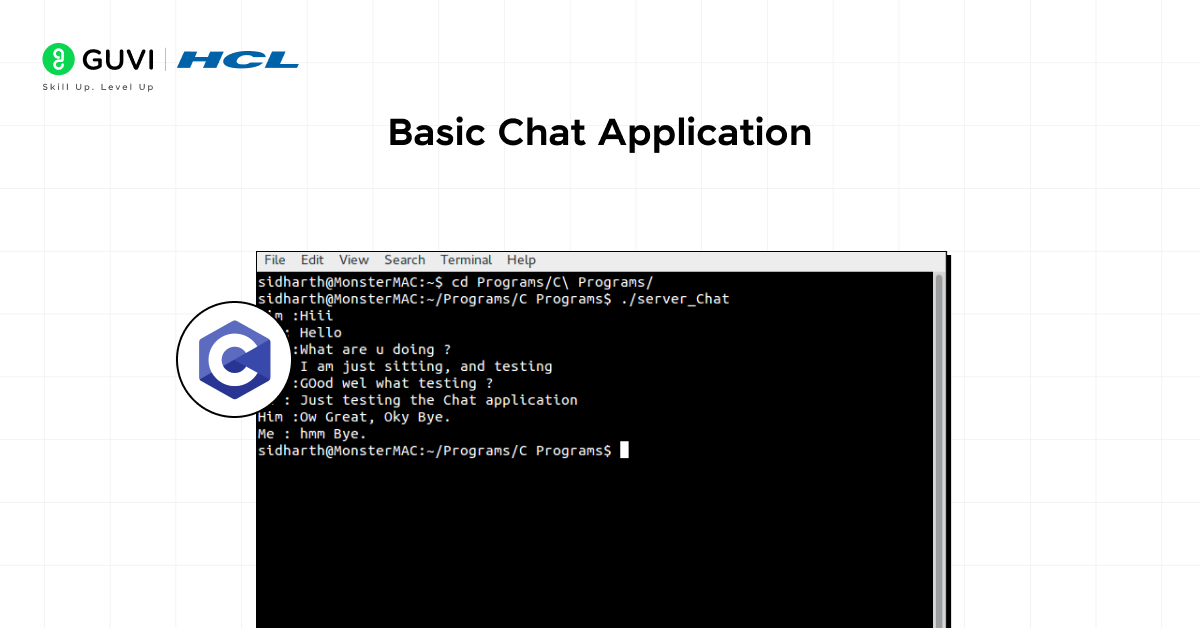
A Basic Chat Application allows two users to communicate through text-based messages. This is an advanced project that involves socket programming and enables real-time communication between two systems.
Duration: 10-12 days
Project Complexity: Advanced
Technology Stack: C, Socket Programming
Features:
- Real-time messaging between two users
- Simple client-server architecture
- Basic authentication (optional)
Security Requirements: Ensure secure socket communication and handle input to prevent buffer overflow and unauthorized access.
Learning Outcome: You’ll gain hands-on experience with socket programming, network communication, and real-time data transfer.
Input/Output Requirements: Users input messages, and the system sends and receives messages in real time.
Source Code: Basic Chat Application
11. File Encryption and Decryption System
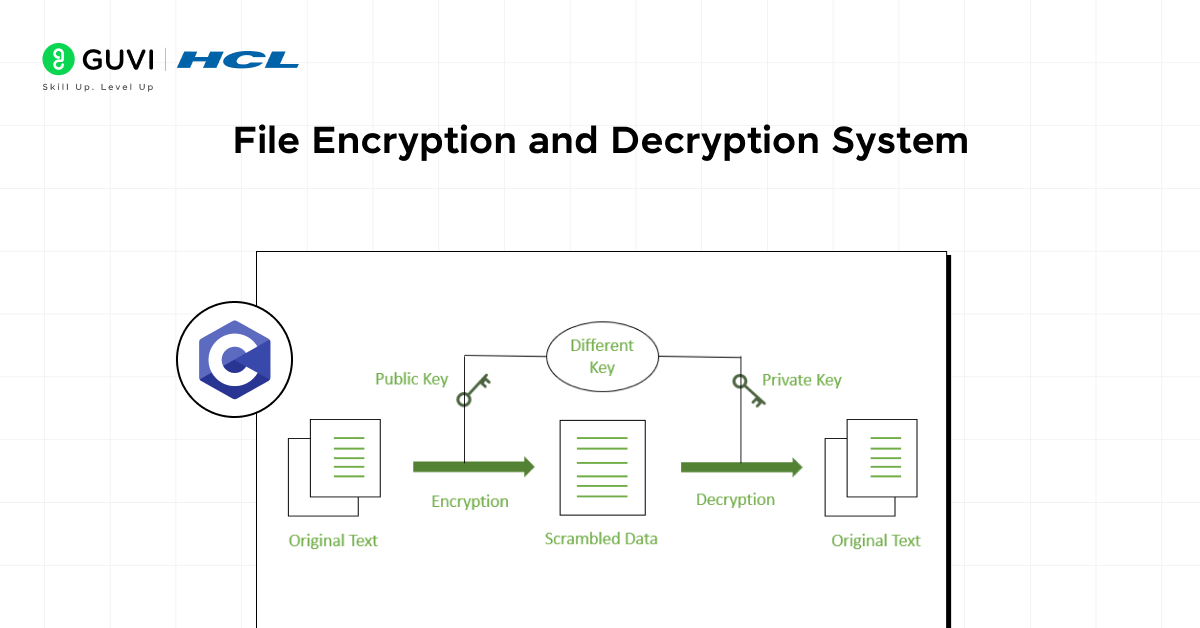
The File Encryption and Decryption System allows users to securely encrypt and decrypt files using a basic encryption algorithm. This project introduces you to the world of cryptography and teaches how to implement security protocols in C.
Duration: 10-15 days
Project Complexity: Advanced
Technology Stack: C, File Handling, Cryptography Libraries
Features:
- Encrypt files using a chosen encryption algorithm
- Decrypt files to their original form
- Key-based encryption and decryption
Security Requirements: Ensure secure key management and implement secure memory handling to avoid data leaks.
Learning Outcome: You will learn about basic cryptography concepts, secure file handling, and how to work with encryption and decryption algorithms in C.
Input/Output Requirements: Users input the file they want to encrypt or decrypt, and the system outputs the processed file (encrypted or decrypted).
Source Code: File Encryption and Decryption System
12. Compiler Design
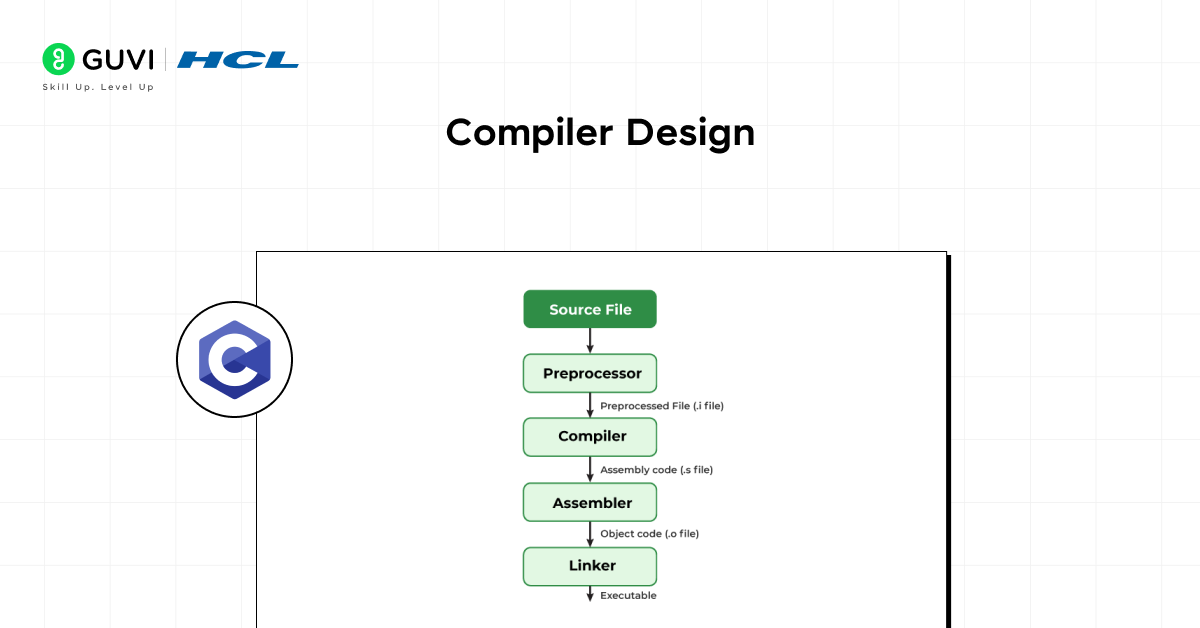
The Compiler Design project involves building a simple compiler that takes in source code written in a subset of a programming language and generates output in machine code or another language. This is a highly advanced project that introduces you to compiler theory and parser design.
Duration: 20-30 days
Project Complexity: Advanced
Technology Stack: C, Lex, Yacc (Lexical Analyzer & Parser Generator)
Features:
- Lexical analysis of the source code
- Syntax analysis and parsing
- Code generation for basic operations
Security Requirements: Ensure secure parsing and error handling to prevent injection attacks or compiler crashes.
Learning Outcome: You’ll gain a deep understanding of how compilers work, including lexical analysis, parsing, and code generation. It will also enhance your skills in working with data structures and algorithm design.
Input/Output Requirements: The compiler takes source code as input and outputs an intermediate or machine code representation of the program.
Source Code: Compiler Design
These C project ideas offer a broad range of experiences, from simple games to advanced real-time applications, all helping you enhance your C programming skills.
Benefits of Building C Projects
1. Improved Structured Thinking
Programming tasks require step-by-step planning. C projects guide you to break logic into smaller functional parts. This develops a habit of arranging conditions, loops, and operations into well-organized sequences. It becomes easier to manage larger tasks because each part follows a predictable pattern.
2. Stronger Memory Management Awareness
C gives direct memory access. Projects help you understand how memory is allocated, used, and released. You learn the difference between automatic and manually allocated memory. This teaches discipline because memory handled incorrectly leads to program instability. Consistent practice brings clarity on safe and reliable memory usage.
3. Better Data Handling Skills
Projects often involve storing data, processing it, and presenting results. Through these tasks, you understand how structures, arrays, and files work together. Real projects show how data moves across program components. This strengthens your ability to design programs that manage user information in a structured and consistent manner.
4. Increased Debugging Confidence
Debugging teaches you to verify logic through observation and analysis. Working on C projects helps you learn how errors occur and how to trace them back to their cause. You begin to analyze output, check variable states, and adjust logic in a controlled way. This builds patience and problem-solving clarity.
5. Stronger Portfolio and Interview Advantage
Completed C projects represent your practical capability. They provide direct evidence of your understanding of program logic, file systems, and structured code organization. During interviews, you can clearly explain how your project works. This allows you to communicate your skill with confidence and clarity.
Common Mistakes to Avoid While Building C Projects
- Mismanagement of Heap and Stack Memory: Confusion between stack-allocated and heap-allocated memory leads to crashes. Stack memory is automatically cleared upon scope exit. Heap memory must be freed manually. Track which variables exist in which region.
- Ignoring Return Values of Standard Library Functions: Functions such as fopen, malloc, and scanf may fail. Failing to check return values can lead to null pointer dereferencing. Always verify before using returned data.
- Using Uninitialized Variables: Variables declared without initialization may hold unpredictable values. Assign initial states explicitly. This reduces inconsistent behavior during program execution.
- Inconsistent Function Interfaces: Passing too many unrelated arguments into functions creates confusion. Group related values into struct types. This supports clarity and reduces unnecessary parameter passing.
- Incorrect Buffer Size Management: Arrays and character buffers require clear size limits. Overflows corrupt memory beyond the intended region. Always compute lengths before copy operations.
- Overreliance on printf Debugging: Printing values may hide deeper issues. Use debugging tools that allow inspection of the execution state directly. This builds disciplined reasoning about program flow.
- No Separation Between Logic and Output Formatting: Place core logic in pure computation functions. Handle display formatting in separate parts. This structure supports reuse, testing, and algorithm clarity.
- Weak Error Messaging: Error messages should indicate what failed and why. For example, “file not found” has more meaning than “error occurred.” Clear messages reduce troubleshooting time.
The fastest way to write better C code is to understand the language deeply — not just copy syntax. HCL GUVI’s free C handbook explains every concept with clear examples: C Programming Tutorial
Tips to Make Your C Projects More Impressive
- Structure Code Into Distinct Modules: Split your program into .c and .h files. Create headers to declare function prototypes and data structures. Source files should implement logic. This approach reveals a professional workflow style and prepares you for larger projects.
- Use Pointers With Clear Ownership Rules: Decide which function allocates memory and which function frees it. Clear ownership prevents memory leaks and accidental double frees. Write comments to note responsibility when memory allocation is involved.
- Select Appropriate Data Structures: Linked lists help with variable-sized collections. Arrays support predictable indexing. Stacks and queues help with ordered access patterns. Choosing a structure based on an access pattern improves code clarity and performance.
- Apply Defensive Input Validation: Validate each input at the boundary. For example, check that array indices stay within permitted ranges. This avoids undefined behavior, which is one of the most common causes of crashes in C programs.
- Use Meaningful Constants Through #define or const: Avoid hard-coded numeric values inside logic. Named constants communicate purpose. It becomes easier to adjust behavior and maintain consistency across the codebase.
- Compile With Warnings Activated: Use gcc -Wall -Wextra during compilation. Compiler warnings highlight potential logic errors and unsafe operations. Address warnings early before they lead to runtime issues.
- Test Logic Using Incremental Builds: Write and verify functions one part at a time. Compile, test, then proceed. This approach reduces debugging complexity as the program grows.
- Use Tools such as GDB and Valgrind: GDB helps inspect variables during execution. Valgrind identifies memory leaks and invalid accesses. Tool-assisted debugging produces a more stable program and builds deeper comprehension.
Accelerate your career with HCL GUVI’s Embedded C Programming Course and master the skills needed to design efficient, real-time embedded systems. Learn microcontrollers, memory management, and build reliable, resource-optimised applications while gaining practical, industry-ready knowledge to stand out in job interviews.
Conclusion
In conclusion, exploring C program project ideas is a fantastic way to hone your programming skills. These projects will guide you through different levels of difficulty and provide real-world applications of C programming.
Whether you’re a beginner or advancing your knowledge, working on these projects will significantly boost your problem-solving and coding abilities.
FAQs
1. What are the easy C Program project ideas for beginners?
Some easy C program projects for beginners include a mini calculator, student management system, and ATM interface.
2. Why are C Program projects important for beginners?
They help you apply theoretical knowledge in real-world scenarios, enhancing your problem-solving and debugging skills.
3. What skills can beginners learn from C Program projects?
You’ll learn file handling, data structures, memory management, and algorithmic thinking.
4. Which C Program project is recommended for someone with no prior programming experience?
The Mini Calculator is a great starting project for those with no prior experience due to its simplicity and focus on basic arithmetic.
5. How long does it typically take to complete a beginner-level C Program project?
On average, a beginner project takes 3-7 days, depending on complexity and time spent.
Success Stories

Did you enjoy this article?
Comments










Dear Sir, GM, very good effort. I am interested in learning deep in C, for creating projects, as specified in your Profile. I am also interested in learning concept, how to work from home and earn money, by making projects in C, SQL and Python. Please help, if possible.