


Career Articles
Treasury Manager to Data Analytics: Skills and Career Growth
Tax Professional to Data Analyst: Is Tax Analytics a Good Niche?
From Investment Research to Data Analytics: How to Bridge the Technical Skills Gap
How Banking and Financial Services Professionals Can Move into Data Analytics


Get In Touch For Details! Request More Information
AI and ML Job Opportunities: Top Trends to Consider in India
Sep 08, 2026 7 Min Read 33115 Views
(Last Updated)
Two engineering graduates apply for the same round of AI and ML job opportunities the same month. One only lists “Python” on their resume. The other lists a GenAI project, a certification, and a portfolio link. Only one of them gets called back, and it’s not close.
AI and ML job opportunities in India span roles like ML Engineer, AI Researcher, NLP Engineer, and Data Scientist, with India’s AI-related roles projected to cross 1 million by the end of 2026. This guide covers where the jobs actually are, what they pay by experience level, and a step-by-step roadmap to land your first role.
Table of contents
- TL;DR Summary
- AI and ML Job Opportunities Across India's Tech Ecosystem
- AI and ML Salary in India by Experience Level
- Emerging Sectors and Trends Creating New AI and ML Job Opportunities
- What is RAG and Why Does it Matter for Your Career?
- Skills and Certifications You Need for AI and ML Jobs in India
- How to Land Your First AI and ML Job Opportunities: A Step-by-Step Roadmap
- Where AI and ML Job Opportunities Actually Are: GCCs, Remote Work, and Tier 2 Cities
- Understanding the AI Talent Gap: How You Can Stand Out
- Common Mistakes to Avoid When Chasing AI and ML Job Opportunities
- Ethical AI and Governance: A Rising Concern Across AI and ML Job Opportunities
- Conclusion
- Frequently Asked Questions
- What’s the difference between AI and ML, and why should I focus on both?
- What is the future of AI in creative industries?
- How can I showcase AI and ML skills without prior work experience?
- How do AI and ML influence cybersecurity roles?
- What role does AI play in sustainability efforts?
- What is the difference between an AI course and an AI & ML course?
- How do I choose the best AI course for my career goals?
- What should I look for before enrolling in an AI & ML course?
- How should I evaluate AI & ML certifications before enrolling?
TL;DR Summary
AI and ML job opportunities in India are growing at an unprecedented pace in 2026, with demand across healthcare, finance, e-commerce, and manufacturing.
Key highlights:
- Top roles include ML Engineer, AI Researcher, NLP Engineer, and Data Scientist
- Salaries range from roughly ₹6L for freshers to ₹80L+ for senior specialists, varying widely by company tier and specialization
- Python, TensorFlow, Deep Learning, and NLP are the most in-demand technical skills
- India faces a significant AI talent gap, making skilled professionals highly valuable
- GCCs are hiring aggressively, with 64% of new roles in 2026 requiring AI or data skills
- Ethical AI and Generative AI roles are rapidly emerging as new career paths
AI and ML Job Opportunities Across India’s Tech Ecosystem
India is at the centre of the AI revolution. Companies across healthcare, finance, retail, and manufacturing are actively hiring, and demand is far outpacing supply, which means skilled candidates have more leverage than ever. Here’s a look at the roles, salary ranges, and companies actively hiring right now.
| Industry | Key Roles | Average Salary (INR) | Top Companies Hiring |
|---|---|---|---|
| Healthcare | AI Engineer, Data Scientist | ₹15 to 20 LPA | Practo, Apollo |
| Finance | ML Engineer, AI Consultant | ₹18 to 25 LPA | Paytm, ICICI Bank |
| Manufacturing | AI Specialist, Robotics Engineer | ₹12 to 18 LPA | Tata, Mahindra |
| E-Commerce | Data Scientist, AI Engineer | ₹14 to 22 LPA | Amazon, Flipkart |
| Retail | AI Consultant, ML Engineer | ₹15 to 23 LPA | Reliance Retail, BigBasket |
| Telecommunications | AI Specialist, Data Analyst | ₹16 to 24 LPA | Airtel, Reliance Jio |
| Automotive | Robotics Engineer, AI Developer | ₹13 to 20 LPA | Maruti Suzuki, Bosch |
The variety here is worth noting: whichever of these AI and ML job opportunities fits your background, there’s a realistic path into it.
According to LinkedIn’s 2024 Emerging Jobs Report, AI and ML Specialist is one of the fastest-growing job titles globally, with a growth rate of over 74% in the past four years. India ranks among the top five countries generating the most AI talent worldwide.
AI and ML Salary in India by Experience Level
Pay is often the deciding factor when weighing different AI and ML job opportunities.
A single “average salary” figure hides more than it reveals, since pay varies enormously by company type, specialization, and city. Here’s a more useful breakdown.
| Experience Level | Typical Salary Range | What Drives the Range |
|---|---|---|
| Fresher (0-2 years) | ₹6L to ₹15L | IT services firms (TCS, Infosys, Wipro) pay ₹6-10L; product companies and AI startups pay up to ₹15L for strong portfolios |
| Mid-level (3-6 years) | ₹18L to ₹40L | Specialization matters a lot: GenAI, LLM, and MLOps skills push pay toward the higher end |
| Senior (7+ years) | ₹35L to ₹80L+ | FAANG India, GCCs, and funded AI startups pay well above traditional IT services |
GenAI and LLM engineers typically earn 20 to 40% more than generalist ML engineers at the same experience level. These figures vary significantly by source and company, so treat them as directional ranges, not fixed numbers.
If you’re serious about building this skill set properly, HCL GUVI’s Data Science Course covers Python, ML fundamentals, and real projects with placement assistance.
Emerging Sectors and Trends Creating New AI and ML Job Opportunities
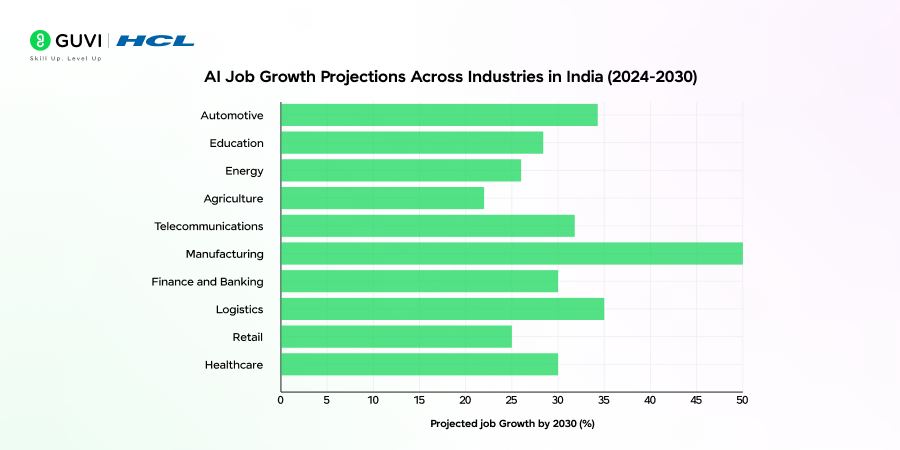
The AI landscape isn’t static. A few shifts are creating entirely new categories of AI and ML job opportunities that didn’t exist two or three years ago.
- Retail’s smarter systems. Companies are building predictive analytics engines and personalised recommendation tools, driving demand for AI consultants and ML engineers who understand both the tech and the business.
- Education’s AI push. AI researchers and chatbot developers are being hired to build personalised learning platforms and adaptive assessment tools.
- Domain-specific models over generic ones. A healthcare company doesn’t want a one-size-fits-all model; it wants one trained on medical data, compliant with regulations, and accurate enough to assist clinicians. This rewards professionals who pair AI skills with real industry knowledge.
- AI entering non-technical roles. Customer service, supply chain, and marketing are all absorbing AI tools, opening doors for professionals from non-IT backgrounds willing to upskill.
If you have domain expertise in any of these areas, pairing it with AI skills puts you in a genuinely strong position for the AI and ML job opportunities opening up right now. And if you’re weighing whether an advanced degree helps, Career in AI/ML: Do You Need a Master’s or PhD? is worth reading before you decide.
What is RAG and Why Does it Matter for Your Career?
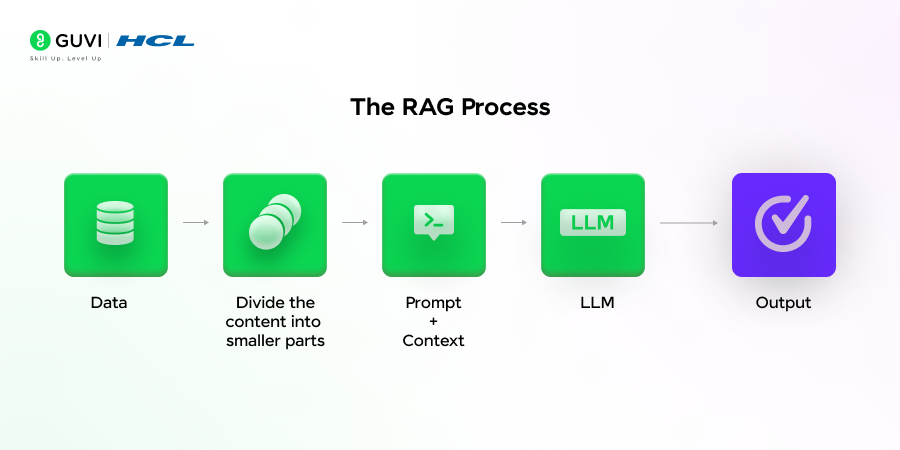
Retrieval-Augmented Generation, or RAG, combines Generative AI with real-time data retrieval, keeping AI outputs both accurate and relevant.
- Where it’s used: legal, healthcare, and finance, industries where accuracy is non-negotiable, are adopting RAG rapidly.
- New roles it created: RAG Engineer and AI Content Accuracy Specialist are both roles that barely existed a few years ago.
- Why it’s worth learning: if you want a high-value niche rather than a generic “AI” skillset, RAG is one of the sharpest ones available right now.
A 2023 Deloitte report found that 41% of organisations feel only slightly or not at all prepared to address talent concerns related to AI adoption. This talent gap is your opportunity.
Skills and Certifications You Need for AI and ML Jobs in India
Employers are looking for professionals who can work with real tools on real problems, not just theoretical knowledge. Here’s a breakdown of the skills behind most AI and ML job opportunities and where they take you.
| Skill | Role | Practical Application | Certification Options |
|---|---|---|---|
| Python | Data Scientist, ML Engineer | Data modelling, automation | HCL GUVI Python Tutorials |
| TensorFlow | ML Developer | Neural network training | DeepLearning.AI TensorFlow Developer Professional Certificate |
| Cloud-based AI (AWS) | AI Architect, Cloud Engineer | Deploying AI models, cloud infrastructure | AWS Certified Machine Learning Engineer – Associate |
| Natural Language Processing | NLP Engineer, AI Researcher | Text analysis, chatbots, sentiment analysis | HCL GUVI NLP with Python Certification |
| Deep Learning | ML Engineer, Data Scientist | Neural networks, autonomous systems | DeepLearning.AI Deep Learning Specialization |
Python is the single most versatile skill here and appears in virtually every role listed above. Build that foundation first, then specialise in the area that aligns with your goals.
Python appears in over 80% of AI and ML job postings on Naukri.com, making it the most critical foundational skill for anyone entering this field.
How to Land Your First AI and ML Job Opportunities: A Step-by-Step Roadmap
Landing the right AI and ML job opportunities starts with sequencing your prep correctly.
- Build your Python and math foundation first. Statistics, linear algebra, and solid Python fundamentals underpin everything else.
- Pick one specialization before spreading yourself thin. NLP, computer vision, MLOps, and GenAI lead to different job families; going deep on one beats going shallow on all of them.
- Build 2-3 real projects, not tutorials you followed along with. Your own decisions, your own dataset, your own debugging, that’s what shows up in an interview.
- Get a recognised certification to pass resume screens. Many companies filter resumes before a human reads them; a certification from an IIT-affiliated programme or a provider like Google or AWS clears that first filter.
- Apply broadly across company types. IT services firms, product companies, GCCs, and AI startups all hire and pay differently, so don’t limit yourself to only the most competitive product companies.
- Prepare for practical, not just theoretical, interviews. Expect to explain project decisions and debug code live, not just recite definitions.
How long landing real AI and ML job opportunities actually takes depends heavily on where you’re starting from, not just how hard you work.
| Starting Point | Realistic Time to Job-Ready |
|---|---|
| Complete beginner, no coding background | 10 to 18 months of structured, part-time learning |
| Working developer switching into AI/ML | 6 to 9 months, since Python and engineering fundamentals already exist |
| Data scientist transitioning to GenAI/LLMs | 3 to 6 months, mostly learning new tools on top of existing skills |
Only ~16% of India’s IT professionals are currently considered AI-skilled, even as AI-related job demand heads toward 1 million roles in 2026. That gap is exactly why realistic, honest timelines matter more than “learn AI in 30 days” claims.
Where AI and ML Job Opportunities Actually Are: GCCs, Remote Work, and Tier 2 Cities
Bengaluru gets most of the attention, but it’s far from the only place AI and ML job opportunities are opening up.
Global Capability Centres (GCCs) are one of the biggest, and most underrated, sources of AI and ML job opportunities right now:
- GCC hiring is projected to cross 510,000 jobs in 2026
- Nearly 2 in 3 new GCC roles require AI, data science, or intelligent automation skills
- Around 80% of GCCs launched in 2026 are AI-first by mandate, not AI as a side project
- GCCs pay roughly 12 to 20% more than comparable roles at traditional IT services firms
Remote and freelance work is a genuine, viable path to AI and ML job opportunities, not just a side hustle:

- Platforms like Upwork, Toptal, and Turing connect Indian AI/ML talent with global clients, often at rates above domestic full-time salaries
- Remote-first AI startups, many funded internationally, hire India-based engineers as core team members, not contractors
- This path suits people with some project experience already; it’s a harder entry point for absolute beginners, since clients expect minimal hand-holding
Tier 2 cities are catching up fast on AI and ML job opportunities:
- Bengaluru still holds roughly 30% of GCC hiring and about half of India’s AI/ML talent pool
- Tier 2 hiring is growing at roughly 23% year-on-year, nearly twice the metro pace
- Pune, Coimbatore, Kochi, Ahmedabad, Jaipur, Indore, and Chandigarh are the most-cited 2026 expansion targets
- The trade-off: fewer total roles than Bengaluru or Hyderabad, but lower living costs and less competition per opening
Alongside GCCs, IT services giants (TCS, Infosys, Wipro), product companies (Amazon, Flipkart, Paytm), and a fast-growing AI startup ecosystem all compete for the same talent pool chasing these AI and ML job opportunities, which works in your favour as a candidate.
Understanding the AI Talent Gap: How You Can Stand Out
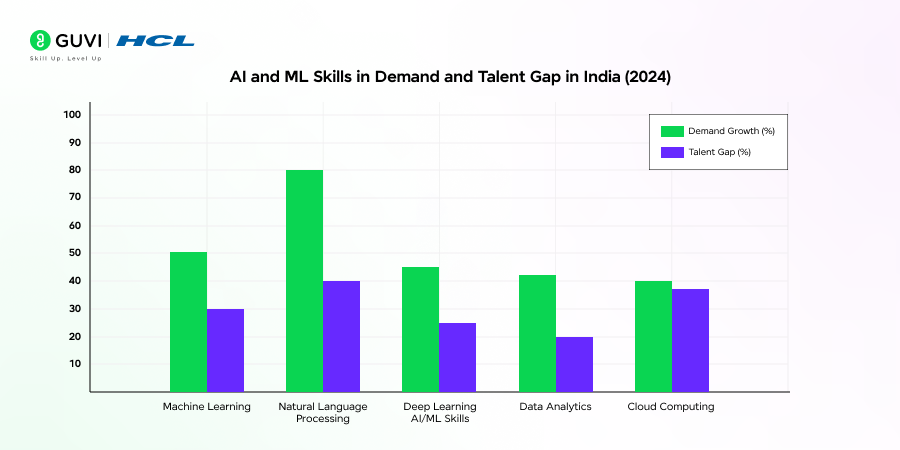
India’s AI talent gap is real, and it’s exactly why AI and ML job opportunities are growing faster than universities and training programmes can fill them. That’s good news if you’re actively building your skills.
- Build specialised, not just broad skills. Employers increasingly want depth in specific areas like NLP, computer vision, or MLOps, not generalists who “know AI.”
- Get hands-on experience. Internships, freelance projects, and personal AI projects matter more than ever; recruiters at companies like Flipkart and Infosys have said they prioritise practical work over credentials alone.
- Earn relevant certifications. A recognised certification from an IIT-affiliated programme or a global provider like Google or AWS signals credibility and commitment.
- Build a visible portfolio. A strong GitHub profile with documented AI projects can be more persuasive than your resume alone.
- Stay current on emerging trends. Professionals who actively follow Generative AI, LLMs, and agentic systems consistently land the best AI and ML job opportunities. Who is an Agentic AI Developer? Role, Skills and Salary in 2026 covers one of the newest AI-adjacent career paths worth watching.
Common Mistakes to Avoid When Chasing AI and ML Job Opportunities
Knowing what to do isn’t the same as knowing what not to do when chasing real AI and ML job opportunities. These are the mistakes that quietly slow people down.
- Targeting only FAANG or MAANG companies. Indian product startups and GCCs pay well too, and they’re a genuinely easier entry point for a first role.
- Chasing PhD-level math before writing any code. Most applied AI/ML roles don’t need it; start applied, and go deeper into theory only when a real project demands it.
- Building models only in a notebook, never deploying them. A model that only runs in Jupyter isn’t production experience, and interviewers can tell the difference immediately.
- Skipping communication and soft skills. Explaining trade-offs clearly matters as much as technical depth once you’re past entry level, especially for senior and lead roles.
- Avoiding LinkedIn and networking entirely. A large share of AI hiring in India still happens through referrals and direct outreach, not job boards alone.
- Picking tools before picking problems. “I want to learn TensorFlow” is a weaker starting point than “I want to solve X,” since the tools follow naturally once the problem is clear.
Ethical AI and Governance: A Rising Concern Across AI and ML Job Opportunities
As AI advances alongside the surge in AI and ML job opportunities, ethical concerns have become central for businesses and regulators alike. Professionals who understand these concerns are increasingly in demand, and the issues are also shaping how AI itself evolves, presenting both challenges and possibilities.
- Bias in AI algorithms: AI systems can inherit biases from their training data, leading to unfair outcomes.
- Data privacy and security: AI often processes sensitive user data, making compliance with laws like GDPR essential.
- Transparency and explainability: Deep learning systems are often “black boxes”; being able to explain AI decisions matters for accountability.
- Automation and job displacement: As AI automates tasks, responsible deployment matters more for the long-term health of AI and ML job opportunities, given real concerns about job loss.
- Ethical use in sensitive sectors: Healthcare and law enforcement, in particular, must ensure AI protects individuals’ rights and well-being.
Programs like HCL GUVI’s Artificial Intelligence & Machine Learning Course provide hands-on experience with AI tools, mentorship, and career guidance, alongside a credential that adds real weight to your resume as AI and ML job opportunities keep expanding.
Conclusion
AI and ML job opportunities in India in 2026 are among the most diverse and well-compensated in the entire tech sector. From ML Engineering to Ethical AI, the career paths available to you today are far broader than they were even two years ago.
The talent gap works in your favour, but only if you act. Build your technical foundation with Python and core ML concepts. Specialise in a domain you care about. Get your hands on real projects. The professionals who combine technical skills with industry knowledge and practical experience are the ones who are landing roles at top companies with competitive salaries. Your next move starts with learning the right skills.
Frequently Asked Questions
What’s the difference between AI and ML, and why should I focus on both?
AI is the broader concept of machines performing tasks that usually require human intelligence, while ML is a subset of AI that focuses on machines learning from data.
What is the future of AI in creative industries?
AI is already making waves in creative industries, helping with content creation, design, music production, and more.
How can I showcase AI and ML skills without prior work experience?
Building a strong portfolio with personal projects, contributions to open-source initiatives, and participating in hackathons or competitions can demonstrate your skills.
How do AI and ML influence cybersecurity roles?
AI and ML are transforming cybersecurity by enabling faster detection of threats and automating responses to incidents. Careers in AI-driven cybersecurity are on the rise, focusing on AI systems that predict and prevent cyberattacks more effectively than traditional methods.
What role does AI play in sustainability efforts?
AI is contributing significantly to sustainability efforts, such as optimizing energy use and improving agricultural practices. This growing field offers exciting AI and ML job opportunities as companies focus on green technology, making it one of the top AI and ML trends to consider in India.
What is the difference between an AI course and an AI & ML course?
An AI course focuses on artificial intelligence concepts, while an AI & ML course includes machine learning, deep learning, NLP, computer vision, and practical model-building skills. If you’re looking for hands-on AI and ML training, explore the HCL GUVI AI & ML Programme.
How do I choose the best AI course for my career goals?
Choose an AI course based on your career goals, curriculum, hands-on projects, mentor support, industry tools, and placement assistance. A structured AI & ML Programme can help you build practical skills and a strong portfolio.
What should I look for before enrolling in an AI & ML course?
Look for a structured curriculum, practical projects, experienced mentors, updated AI tools, certification value, and career support. Compare programmes carefully before enrolling in an AI & ML Programme.
How should I evaluate AI & ML certifications before enrolling?
Evaluate AI & ML certifications based on industry recognition, curriculum relevance, hands-on learning, project experience, and career outcomes. You can also compare what’s included in the HCL GUVI AI & ML Programme before making a decision.
Success Stories

About the Author
Jebasta
I translate the language of data into stories that anyone can understand. As a writer with a data science background, I simplify analytics, AI, and decision-making so beginners and enthusiasts can confidently explore the world of data.
View all posts by Jebasta
Connect with me @














Did you enjoy this article?