


Cyber Security Articles
How to Perform a Basic Penetration Test on Your Web App
Falco Runtime Security Tutorial: Catch Attacks as They Happen

Get In Touch For Details! Request More Information
Non-Coding Jobs in Cybersecurity: A Comprehensive Guide
Oct 01, 2026 7 Min Read 28651 Views
(Last Updated)
Cybersecurity is often associated with programming, malware analysis, and penetration testing, but coding is only one part of the field. Organizations also need professionals who can investigate threats, assess risk, monitor security events, manage compliance, audit controls, coordinate incidents, and translate technical risks into business decisions.
That creates several non-coding jobs in cybersecurity for candidates whose strengths lie in analysis, investigation, governance, communication, or security operations. These careers still require strong cybersecurity fundamentals, but advanced programming is not always a daily requirement. This guide covers 11 non-coding cybersecurity roles, their responsibilities, required skills, and salary potential to help you identify the right career path.
Table of contents
- Quick Answer
- The Importance of Non-Coding Jobs in Cybersecurity
- Top 11 Non-Coding Jobs in Cybersecurity
- Information Security Analyst
- Cyber Threat Intelligence Analyst
- Security Operations Center (SOC) Analyst
- Incident Response Analyst
- Compliance Officer
- Security Auditor
- Project Manager
- Security Risk Assessor
- Cybersecurity Sales Engineer
- Cybersecurity Consultant
- Cybersecurity Trainer or Educator
- Can You Get a Cybersecurity Job Without Coding?
- What Skills Matter Most for Non-Coding Cybersecurity Jobs?
- How Can Beginners Gain Cybersecurity Experience Without Programming?
- Which Certifications Help With Non-Coding Cybersecurity Careers?
- How Do You Choose the Right Non-Coding Cybersecurity Career?
- Do Non-Coding Cybersecurity Professionals Need to Learn Programming Later?
- Conclusion
- FAQs
- What is the easiest job in cybersecurity?
- Can a non-technical person get into cybersecurity?
- Which is easy AI or cybersecurity?
- Is cybersecurity a tough job?
Quick Answer
Non-coding cybersecurity careers focus on threat analysis, risk, compliance, incident response, auditing, and security operations rather than software development.
- SOC Analyst: Monitors alerts, logs, and suspicious activity.
- Threat Intelligence Analyst: Tracks attackers, campaigns, and indicators of compromise.
- Incident Response Analyst: Investigates breaches and coordinates containment and recovery.
- Compliance & Audit: Reviews controls against security standards and regulations.
- Security Risk Assessor: Evaluates vulnerabilities, impact, and residual risk.
- Cybersecurity Consultant: Assesses security posture and recommends controls.
- Sales & Training Roles: Translate cybersecurity products and concepts for clients or learners.
The Importance of Non-Coding Jobs in Cybersecurity
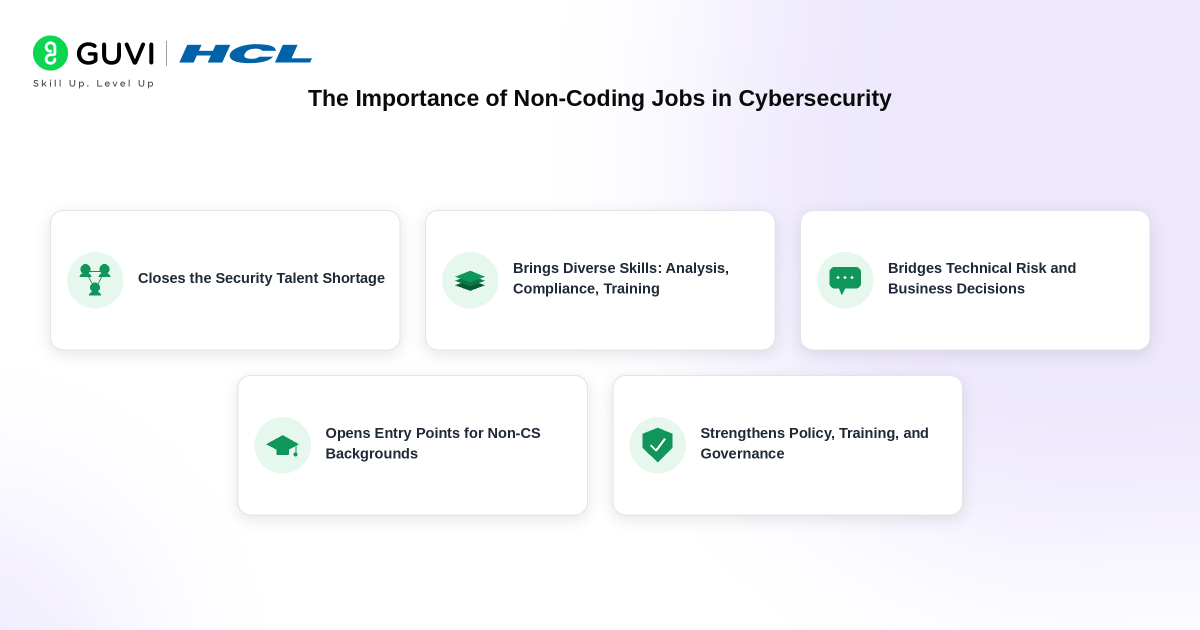
Cybersecurity is not limited to penetration testing or secure coding. It also depends on professionals who monitor threats, assess risk, investigate incidents, audit controls, manage compliance, and strengthen an organization’s overall security posture.
Non-coding cybersecurity roles are especially important because many security failures result from weak processes, poor access controls, delayed threat detection, or compliance gaps rather than software flaws alone. These roles require strong knowledge of security principles, risk frameworks, networks, incident response, and threat analysis, along with the ability to interpret evidence and make sound security.
Top 11 Non-Coding Jobs in Cybersecurity
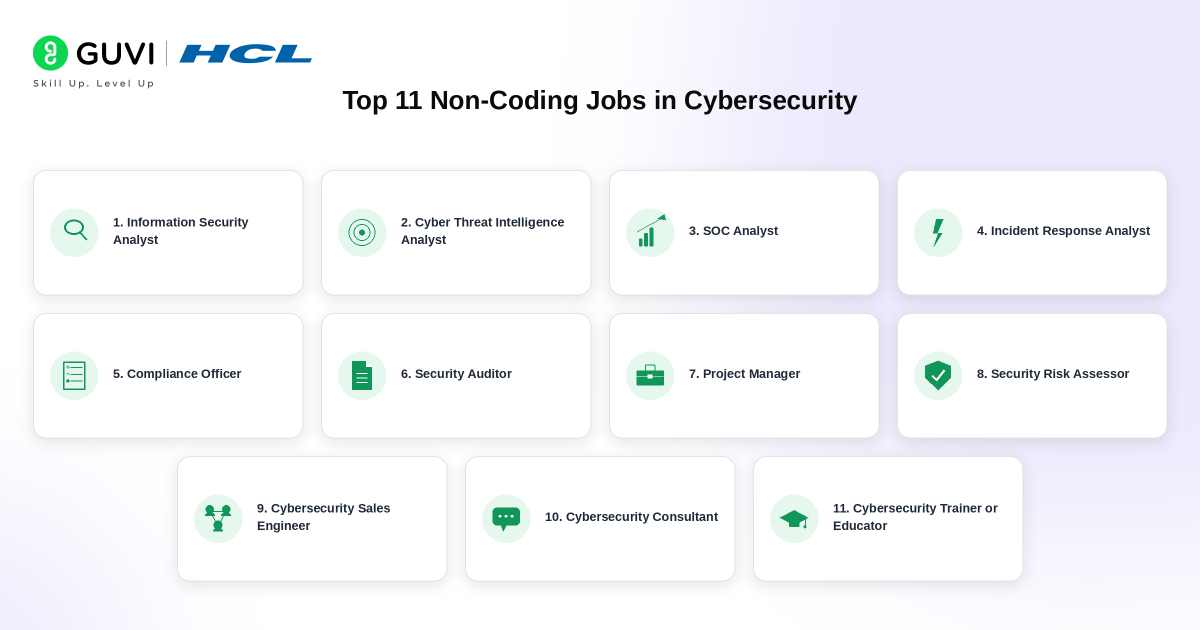
Non-coding cybersecurity roles still require strong technical understanding. Professionals may work with SIEM platforms, threat intelligence feeds, vulnerability scanners, IAM systems, incident logs, security frameworks, cloud controls, and compliance standards without writing production code. The roles below show where those skills are applied.
1. Information Security Analyst
An Information Security Analyst protects systems, networks, and sensitive data by continuously assessing an organization’s security posture. The role commonly involves reviewing security alerts, vulnerability findings, access controls, configuration weaknesses, and security policies.
Analysts may work with SIEM platforms, endpoint detection tools, vulnerability scanners, IAM systems, and frameworks such as NIST CSF or ISO 27001. They also help prioritize remediation based on asset criticality, exploitability, business impact, and existing controls.
Typical responsibilities include:
- Monitoring security events and suspicious activity
- Reviewing vulnerability scan results
- Assessing access permissions and security controls
- Supporting incident investigation
- Tracking remediation and security risks
- Preparing security reports and metrics
Coding is usually not the core requirement, but knowledge of networking, operating systems, authentication, vulnerability management, and risk assessment is essential.
Salary: ₹5LPA to ₹11LPA
2. Cyber Threat Intelligence Analyst
As the cyber threat landscape evolves, Cyber Threat Intelligence Analysts study attackers, campaigns, malware families, infrastructure, and indicators of compromise to help organizations anticipate threats.
Their work typically combines open-source intelligence, threat feeds, security reports, domain and IP analysis, malware intelligence, and frameworks such as MITRE ATT&CK. The goal is to convert raw threat data into actionable intelligence for SOC teams, incident responders, and security leaders.
Typical responsibilities include:
- Tracking threat actors and attack campaigns
- Enriching IPs, domains, hashes, and other indicators
- Mapping attacker behavior to MITRE ATT&CK techniques
- Monitoring dark web or open-source intelligence
- Producing tactical and strategic threat reports
- Supporting detection and incident-response teams
The role relies heavily on research, analytical reasoning, and understanding attacker behavior rather than software development.
Salary: ₹13LPA to ₹28LPA
3. Security Operations Center (SOC) Analyst
A SOC Analyst monitors an organization’s security environment for suspicious activity and investigates alerts generated by security tools. The role sits at the operational center of threat detection and incident escalation.
SOC Analysts frequently work with SIEM systems, EDR platforms, firewalls, IDS/IPS tools, email-security systems, and threat intelligence feeds. They correlate logs from endpoints, servers, applications, cloud platforms, and network devices to determine whether an alert represents a genuine threat.
Typical responsibilities include:
- Monitoring SIEM alerts and dashboards
- Triaging security incidents
- Investigating suspicious logins, malware, and network activity
- Correlating endpoint, network, and authentication logs
- Escalating confirmed incidents
- Documenting investigation timelines and findings
Basic scripting can help automate repetitive work, but strong log analysis, networking, Windows/Linux, incident triage, and threat-detection skills matter more for many entry-level SOC roles.
Salary: ₹4.5LPA to ₹15LPA
4. Incident Response Analyst
Incident Response Analysts investigate confirmed or suspected security breaches and coordinate containment, eradication, recovery, and post-incident analysis.
Their work may involve endpoint evidence, authentication logs, network traffic, email artifacts, malware indicators, compromised accounts, and cloud audit logs. They often follow structured incident-response procedures such as preparation, detection, containment, eradication, recovery, and lessons learned.
Typical responsibilities include:
- Determining the scope and impact of an incident
- Identifying compromised accounts, hosts, or systems
- Preserving and analyzing forensic evidence
- Coordinating containment actions
- Tracking attacker persistence and lateral movement
- Developing incident timelines
- Recommending controls to prevent recurrence
The role requires knowledge of incident-response methodology, digital forensics, log analysis, threat behavior, and security controls. Coding is useful but not mandatory for many positions.
Salary: ₹5.7LPA to ₹30.8LPA
5. Compliance Officer
A cybersecurity Compliance Officer ensures that security policies, processes, and technical controls align with applicable regulatory, contractual, and industry requirements.
Rather than directly configuring every security system, these professionals evaluate whether controls around access management, encryption, logging, data retention, incident response, third-party risk, and business continuity meet required standards.
Typical responsibilities include:
- Mapping controls to compliance requirements
- Reviewing security policies and procedures
- Collecting audit evidence
- Tracking compliance gaps and remediation
- Supporting internal and external audits
- Coordinating with legal, risk, security, and IT teams
Knowledge of frameworks and regulations such as ISO 27001, SOC 2, PCI DSS, NIST, or privacy requirements can be important depending on the organization.
Salary: ₹15.5LPA to ₹40LPA
Build strong cybersecurity foundations for both technical and non-coding career paths with HCL GUVI’s Cyber Security and Ethical Hacking Course. Learn cybersecurity fundamentals, network security, threat analysis, ethical hacking, and security practices through structured, practical training.
6. Security Auditor
Security Auditors independently evaluate whether an organization’s security controls are designed correctly and operating effectively.
They may review IAM configurations, user-access reviews, password policies, logging controls, backup processes, vulnerability-management records, incident-response procedures, network controls, and change-management evidence. Their work commonly involves control testing, evidence sampling, interviews, and documentation rather than coding.
Typical responsibilities include:
- Testing security controls against defined criteria
- Reviewing configurations and audit evidence
- Identifying control deficiencies
- Evaluating compliance with security standards
- Assessing remediation plans
- Producing formal audit findings and recommendations
Strong knowledge of governance, risk, controls, audit methodology, and cybersecurity frameworks is essential.
Salary: ₹5.2LPA to ₹31.8LPA
7. Project Manager
In cybersecurity projects, a Project Manager coordinates people, timelines, budgets, dependencies, and delivery across security initiatives.
Typical projects can include SIEM deployment, identity migration, security-tool rollout, cloud-security implementation, compliance programs, vulnerability-remediation campaigns, or incident-response improvements.
A cybersecurity Project Manager may need to coordinate security analysts, engineers, developers, cloud teams, vendors, compliance specialists, and business stakeholders.
Typical responsibilities include:
- Defining scope, milestones, and deliverables
- Tracking security dependencies and risks
- Coordinating cross-functional teams
- Managing vendors and implementation timelines
- Reporting project status to stakeholders
- Ensuring security requirements remain part of delivery
Deep coding knowledge is not required, but enough technical understanding is needed to interpret security requirements, risks, architecture dependencies, and implementation blockers.
Salary: ₹28LPA to ₹37LPA
8. Security Risk Assessor
Security Risk Assessors evaluate how vulnerabilities, threats, and control weaknesses could affect business systems, applications, data, or infrastructure.
The role goes beyond identifying a vulnerability. Assessors determine its likelihood, potential impact, existing controls, residual risk, and remediation priority. They may use qualitative or quantitative risk-scoring methods and frameworks such as NIST or ISO-based risk models.
Typical responsibilities include:
- Identifying assets, threats, and vulnerabilities
- Assessing likelihood and business impact
- Reviewing existing security controls
- Calculating inherent and residual risk
- Maintaining risk registers
- Recommending mitigation or risk-treatment options
Strong knowledge of risk methodology, security architecture, cloud and application controls, and business impact analysis is more important than coding.
Salary: ₹6PA to ₹10LPA
9. Cybersecurity Sales Engineer
Cybersecurity Sales Engineers translate complex security products into technical solutions that address customer requirements.
They may demonstrate technologies such as SIEM, EDR, IAM, SASE, firewalls, cloud-security platforms, vulnerability-management tools, or data-protection products. Their work often includes product demonstrations, architecture discussions, proof-of-concept support, technical discovery, and responding to security questionnaires.

Typical responsibilities include:
- Understanding customer security architecture
- Mapping product capabilities to security requirements
- Conducting technical demonstrations
- Supporting proof-of-concept deployments
- Answering technical and compliance questions
- Working with sales, product, engineering, and customer-security teams
The role requires strong networking, security architecture, product knowledge, and communication skills rather than extensive coding.
Salary: ₹12LPA to ₹24LPA
10. Cybersecurity Consultant
Cybersecurity Consultants help organizations identify security gaps, design controls, assess risks, improve governance, and strengthen their overall security architecture.
Depending on the engagement, consultants may conduct maturity assessments, security reviews, compliance gap analyses, cloud-risk assessments, third-party risk reviews, incident-response planning, or security-program design.
Typical responsibilities include:
- Assessing the current security posture
- Performing risk and control-gap assessments
- Designing security roadmaps
- Recommending policies and technical controls
- Supporting regulatory or framework alignment
- Presenting findings to technical and executive stakeholders
Consultants need broad cybersecurity knowledge because they may work across IAM, network security, cloud security, governance, incident response, compliance, and risk within different client environments.
Salary: ₹11.2LPA to ₹25LPA
11. Cybersecurity Trainer or Educator
Cybersecurity Trainers turn complex technical topics into structured learning experiences for students, employees, security teams, or certification candidates.
A trainer may teach networking security, SOC operations, ethical hacking concepts, incident response, IAM, cloud security, risk management, or security frameworks. Practical training can involve labs, packet captures, simulated phishing attacks, log-analysis exercises, incident scenarios, and security-tool demonstrations.
Typical responsibilities include:
- Developing cybersecurity curricula and labs
- Teaching tools, frameworks, and security concepts
- Creating practical attack and defense exercises
- Assessing learner performance
- Updating material as threats and technologies evolve
- Explaining complex security concepts in accessible language
Coding is not always necessary, but trainers need enough technical depth to explain how attacks, defenses, protocols, operating systems, and security tools behave in real environments.
Salary: ₹2.8LPA to ₹9.2LPA
Also Read: The Ultimate Cybersecurity Roadmap for Beginners
Can You Get a Cybersecurity Job Without Coding?
Yes. Several cybersecurity careers focus more heavily on risk, monitoring, investigation, governance, compliance, auditing, and communication than software development.
However, “non-coding” does not mean “non-technical.” Candidates should still understand concepts such as:
- Networking: TCP/IP, DNS, ports, firewalls, and network traffic.
- Operating Systems: Windows, Linux, permissions, processes, and logs.
- Security Fundamentals: Threats, vulnerabilities, controls, and attack vectors.
- Identity and Access Management: Authentication, authorization, and least privilege.
- Security Tools: SIEM platforms, vulnerability scanners, ticketing systems, and dashboards.
- Cloud Security Basics: IAM, shared responsibility, misconfigurations, and cloud logging.
The goal is to understand how systems are protected and compromised even when writing software is not the primary responsibility.
What Skills Matter Most for Non-Coding Cybersecurity Jobs?
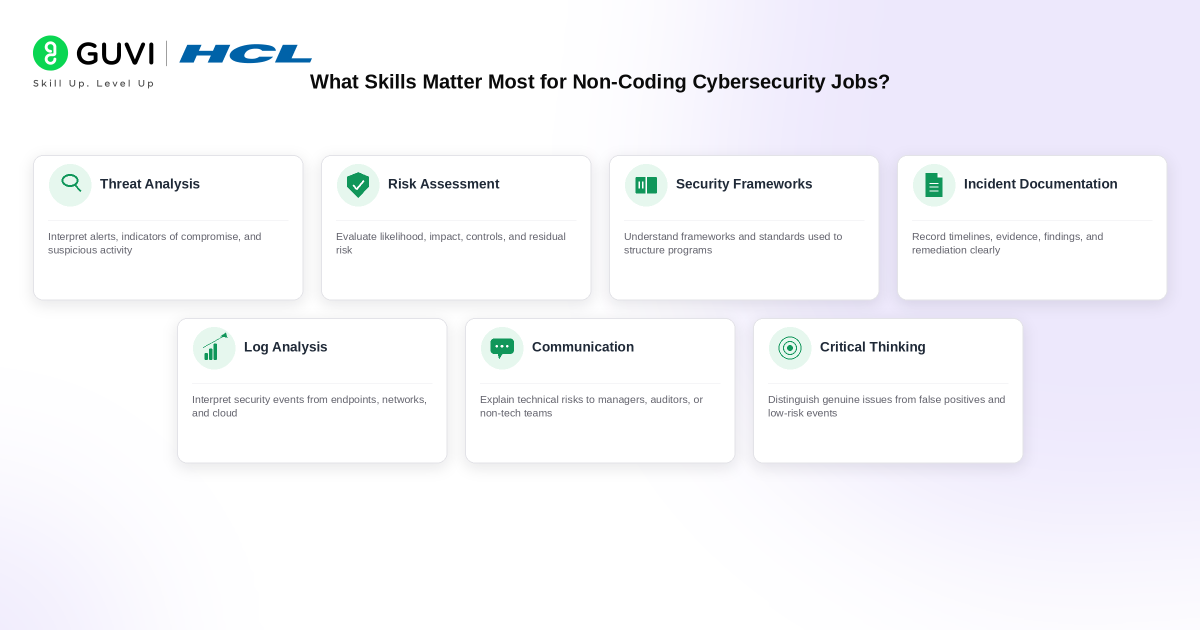
Non-coding cybersecurity professionals combine technical understanding with analytical and business skills.
The most useful capabilities include:
- Threat Analysis: Interpret alerts, indicators of compromise, and suspicious activity.
- Risk Assessment: Evaluate likelihood, impact, controls, and residual risk.
- Security Frameworks: Understand frameworks and standards used to structure security programs.
- Incident Documentation: Record timelines, evidence, findings, and remediation actions clearly.
- Log Analysis: Interpret security events generated by endpoints, networks, applications, and cloud platforms.
- Communication: Explain technical risks to managers, customers, auditors, or non-technical teams.
- Critical Thinking: Distinguish genuine security issues from false positives and low-risk events.
NIST’s NICE Framework also describes cybersecurity work through specific tasks, knowledge, and skills rather than treating cybersecurity as one uniform technical role.
How Can Beginners Gain Cybersecurity Experience Without Programming?
Candidates do not need to build complex security software to demonstrate practical cybersecurity ability. A portfolio can instead show how well they investigate, document, assess, and respond to security problems.
Useful beginner projects include:
- Analyze sample phishing emails and document indicators of compromise.
- Review Wireshark captures and explain suspicious network behavior.
- Create an incident-response playbook for ransomware or credential theft.
- Perform a basic security risk assessment for a hypothetical business.
- Build a compliance checklist around common security controls.
- Review authentication or firewall logs and document unusual events.
- Create a vulnerability-assessment report with risk ratings and remediation priorities.
These projects demonstrate practical reasoning and security awareness without requiring a programming-heavy portfolio.
Which Certifications Help With Non-Coding Cybersecurity Careers?
The right certification depends on the career path rather than whether the role involves coding.
- ISC2 Certified in Cybersecurity (CC): Suitable for beginners building foundational knowledge across security principles, access controls, network security, operations, and incident response. ISC2 states that prior work experience is not required.
- Security-Focused Foundation Certifications: Useful for candidates targeting SOC, analyst, or general security roles.
- Audit and Governance Credentials: Better aligned with compliance, governance, risk, and security-audit careers.
- CISA: Relevant to information systems auditing, control, governance, and security, although full CISA certification requires professional experience.
- Vendor Certifications: Microsoft, AWS, Google Cloud, and security-tool certifications can strengthen candidates targeting cloud or platform-specific security roles.
Certifications work best when combined with practical labs, security reports, case studies, or hands-on tool experience.
How Do You Choose the Right Non-Coding Cybersecurity Career?
Start with the type of security problem you enjoy solving rather than selecting a role only by salary or job title.
| If You Enjoy | Roles to Explore |
|---|---|
| Investigating suspicious activity | SOC Analyst, Incident Response Analyst |
| Researching attackers and campaigns | Cyber Threat Intelligence Analyst |
| Policies, controls, and regulations | Compliance Officer |
| Reviewing security effectiveness | Security Auditor |
| Assessing business and technical risk | Security Risk Assessor |
| Advising different organizations | Cybersecurity Consultant |
| Explaining technical solutions to clients | Cybersecurity Sales Engineer |
| Coordinating people and security projects | Project Manager |
| Teaching and simplifying concepts | Cybersecurity Trainer |
A candidate interested in investigation may prefer security operations, while someone who enjoys policies and structured controls may fit governance, risk, compliance, or auditing better.
Do Non-Coding Cybersecurity Professionals Need to Learn Programming Later?
Not necessarily, but basic scripting can become useful as responsibilities grow. Security professionals may eventually use simple Python, PowerShell, Bash, or SQL to automate repetitive tasks, analyze logs, query data, or process security information.
The important distinction is between coding as the core job and coding as a supporting skill. An auditor, risk analyst, SOC analyst, or compliance professional may build a successful cybersecurity career without becoming a software developer, while still learning enough scripting to work more efficiently.
Conclusion
A cybersecurity career does not have to begin with advanced programming. Roles across security operations, threat intelligence, incident response, risk, compliance, auditing, consulting, project management, and training rely heavily on analytical thinking, security knowledge, communication, and decision-making.
The strongest starting point is to choose a role that matches your strengths, build solid networking and security fundamentals, gain hands-on experience with relevant tools, and develop role-specific credentials over time.
FAQs
What is the easiest job in cybersecurity?
Well, it usually depends on your personal skills and interests, but entry-level positions such as cybersecurity analyst or IT support can be good starting points.
Can a non-technical person get into cybersecurity?
Yes, non-technical individuals can enter cybersecurity through roles such as policy analysts, risk assessors, or compliance specialists. Developing a foundational understanding of cybersecurity concepts is crucial though.
Which is easy AI or cybersecurity?
Both AI and cybersecurity have unique challenges. AI involves complex algorithms and programming, while cybersecurity demands a deep understanding of evolving threats and defensive strategies. So whilst we can’t really pick the easier one, we can help you master both!
Is cybersecurity a tough job?
Cybersecurity can be challenging due to the constantly evolving nature of cyber threats. It requires continuous learning and adaptation. However, with dedication and ongoing education, and experts like ours you can build a successful career in cybersecurity.
Success Stories

About the Author
Vaishali
I'm a seasoned writer with four years of experience across technical, non-technical, and just about every genre or niche you can imagine. Adaptable and curious, I enjoy exploring new topics and making information engaging and easy to understand. Fueled by a steady stream of tea, I approach each project with creativity, reliability, and genuine enthusiasm for storytelling.
View all posts by Vaishali
Connect with me @

Did you enjoy this article?
Comments









Very easy to understand and tells us everything we need to know.