


Full Stack Development Articles
Full Stack Development for Career Changers: A Practical 6-Month Learning Plan
Full Stack Development Course Fees in India: What Does the Cost Include?
How to Move from Backend Development to Full Stack Development
How to Become a Full Stack Developer After 5 Years in a Non-Development IT Role

Get In Touch For Details! Request More Information
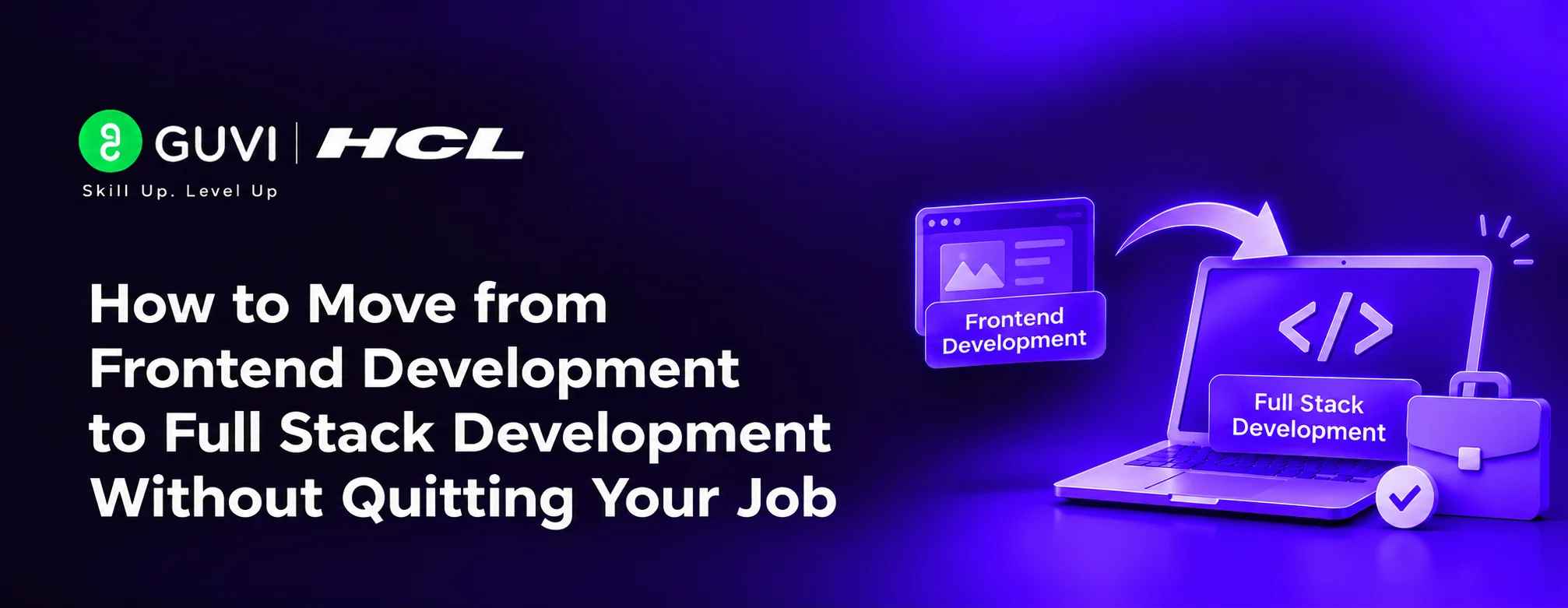
How to Move from Frontend Development to Full Stack Development Without Quitting Your Job
Nov 11, 2026 4 Min Read 43 Views
(Last Updated)
Your button is pixel perfect, your loading spinner is smooth, and then the data never shows up. A teammate says, “the API is returning a 500,” and you can only stare at the network tab, because what happens behind that request is a mystery.
Can a frontend developer to full stack developer switch happen while you keep your job? Yes. You already build what users see, and the missing half is the server and the database. You can learn full stack while working, and about five to six months at ten hours a week is a fair plan.
In this guide, you will find what your frontend skills already give you, the backend skills for frontend developers to learn first, a 24 week plan split into work and study tracks, ways to learn on the job, and what the pay data says.
Table of contents
- TL;DR Summary
- What is Frontend Developer to Full Stack Developer?
- What You Already Know That Servers Also Need
- Backend Skills for Frontend Developers
- Node.js and Express
- Databases and CRUD
- Authentication and Authorization
- API Security Basics
- Error Handling and Logging
- Deployment
- Learn Full Stack While Working: A 24 Week Plan
- 💡 Did You Know?
- Ways to Learn on the Job
- Build the Backend for a UI You Already Made
- What the Pay Data Says
- How to Position Yourself in Interviews
- What HCL GUVI's Full Stack Development Course Offers a Working Frontend Developer
- Common Mistakes in Frontend Developer to Full Stack Developer Moves
- Conclusion
- FAQs
- How long does frontend developer to full stack developer take?
- Which backend skills for frontend developers should I learn first?
- Can I learn full stack while working full time?
- Should a frontend developer to full stack developer pick Node.js?
- Do I need to leave my job to switch from frontend developer to full stack developer?
TL;DR Summary
- What it is: Frontend developer to full stack developer means adding the server, database, and security side to the screens you already build.
- Your edge: A frontend developer to full stack developer knows users, state, and APIs from the receiving end.
- Learn first: For frontend developer to full stack developer moves, Node.js, a database, authentication, and basic API security.
- Plan: A frontend developer to full stack developer plan takes 24 weeks, using work tasks and after hours study together.
- Proof: Frontend developer to full stack developer hiring rewards one app with your own screens, API, and database.
- Next step: Start frontend to full stack development by tracing one feature from the button to the database.
What is Frontend Developer to Full Stack Developer?
Frontend developer to full stack developer is the shift from owning only the screens to also owning the server logic and data behind them. A full stack developer owns a feature from the click to the database.
You already call APIs every day, so you know what a good response looks like. For the wider picture, read what a back end architecture is made of.
With sprints to deliver, extra study must be efficient. HCL GUVI’s Full Stack Development course has live weekday and weekend batches, so you can study the server side after office hours, with mentors to ask when an error makes no sense.
What You Already Know That Servers Also Need
A frontend developer to full stack developer carries over more than expected, since many frontend habits have a server side twin.
| Your Frontend Habit | Its Backend Twin |
|---|---|
| Splitting UI into components | Splitting a server into modules and services |
| Managing state | Designing data models |
| Form validation | Server side validation, since the browser can be bypassed |
| Calling fetch | Writing the routes that answer it |
| Client side routing | API routes and middleware |
| Performance tuning | Caching and faster queries |
| Environment settings | Environment variables and secrets |
Backend Skills for Frontend Developers
A frontend developer to full stack developer should learn these in order and use JavaScript where possible, since it is already a strength.
1. Node.js and Express
Run JavaScript on the server and build your first routes. This guide to the best Node.js frameworks helps you choose one.
2. Databases and CRUD
Learn to create, read, update, and delete data in one SQL and one NoSQL database. This explainer on what CRUD means covers the basics.
3. Authentication and Authorization
Login is where a frontend developer to full stack developer sees both sides meet. Follow this walkthrough on setting up JWT in a Node.js app, and read why JSON web tokens matter for modern logins.
4. API Security Basics
Hiding a button does not stop a request, so the server must check who may do what. These best practices for securing MERN applications cover validation, sessions, and more.
5. Error Handling and Logging
Send clear error codes and log what went wrong. You will finally see both sides of that 500 error.
6. Deployment
Put your server online and connect it to your frontend. This tutorial on Railway deployment shows one way.
Learn Full Stack While Working: A 24 Week Plan
To learn full stack while working, a frontend developer to full stack developer can use two tracks at once: tasks at your job and study after hours. The plan suits about ten hours a week in total.
| Weeks | At Work | After Hours |
|---|---|---|
| 1 to 4 | Trace one feature from the UI to the database | Node.js and Express basics |
| 5 to 10 | Read API code with a backend teammate | Databases, CRUD, and your first REST API |
| 11 to 16 | Ask for one small backend ticket | Authentication and API security |
| 17 to 20 | Review API contracts before building screens | Connect your own frontend to your own backend |
| 21 to 24 | Offer to own a small feature on both sides | Deploy, add tests, and do mock interviews |
💡 Did You Know?
- Node.js, created by Ryan Dahl, was first released in May 2009, which let JavaScript developers write server code in the language they already knew.
Ways to Learn on the Job
Your day job can teach a frontend developer to full stack developer more than a course, if you ask the right questions.
- Trace a feature: Follow one request from click to database and back.
- Sit with a backend teammate: Ask them to explain one pull request each week.
- Take a small backend ticket: A bug fix or a new field is enough.
- Read your API docs: Note how routes, errors, and auth are designed.
- Check your company rules: Ask before using work code in personal projects.

Build the Backend for a UI You Already Made
The quickest proof for frontend developer to full stack developer is to take a frontend you built and write the missing server.
- Pick a UI: A dashboard, a store, or a booking page works.
- Design the data: List the tables or collections it needs.
- Write the API: Add routes, validation, and login.
- Connect and deploy: Replace mock data with real calls.
Need ideas? Browse these Node.js project ideas and these backend development project ideas.
What the Pay Data Says
Reported ranges for full stack developers sit above those for frontend developers at the same experience.
| Experience | Frontend Developer | Full Stack Developer |
|---|---|---|
| 1 to 3 years | about ₹4.2 to ₹4.7 lakh a year | about ₹5.3 to ₹5.9 lakh a year |
| 3 to 6 years | about ₹6.9 to ₹7.6 lakh a year | about ₹9.3 to ₹10.3 lakh a year |
Note: Salary figures may change over time as users update their reported data. Please refer to the linked source for the latest salary ranges.
Read these as averages, not offers. City, company, and skills move the number, and no course can promise a raise. If a frontend developer to full stack developer move happens without backend experience, an employer may start you nearer your current level, so build proof before you negotiate.
How to Position Yourself in Interviews
Frontend developer to full stack developer interviews check the new half closely.
- Lead with a two sided app: Show the screens, the API, and the database together.
- Know the basics: Be ready to explain REST, authentication, and database design.
- Say what you chose: Explain why you picked a database or a login method.
- Keep your frontend edge: Your UI sense is a strength, so show it.
What HCL GUVI’s Full Stack Development Course Offers a Working Frontend Developer
- Learn after work: 130+ hours of live online classes, in weekday or weekend batches, with recordings.
- Backend focus: Node.js, Express.js, MongoDB, Mongoose, and REST APIs, tested with Postman.
- Quick frontend revision: HTML, CSS, JavaScript, React, and Tailwind CSS.
- Beyond code: DSA, system design, DevOps, and GenAI.
- Projects: An e-commerce web application, an order management system, a cloud deployment pipeline, and an AI chatbot that answers questions from documents.
- Support: Live mentors, one to one doubt solving, and help with mock interviews, your resume, portfolio, and GitHub.
- Credentials: An IITM Pravartak certification and a complimentary MongoDB certification.
Classes are taught in English, Tamil, Hindi, and Telugu, which suits a frontend developer to full stack developer who wants the backend covered quickly. See the syllabus and choose a batch on the Full Stack Development course page.
Common Mistakes in Frontend Developer to Full Stack Developer Moves
- Trusting the client: In frontend developer to full stack developer work, always validate on the server.
- Skipping the database: Learn data modelling before frameworks.
- Learning every backend language: In frontend developer to full stack developer plans, start with Node.js and finish a project.
- Studying without shipping: Deploy what you build.
- Quitting too early: Learn full stack while working, and move once you have proof.
Conclusion
Frontend developer to full stack developer works because you already own the screen users touch. Add Node.js, a database, authentication, and security, and you can build a feature from end to end.
Follow the 24 weeks, use your job as a classroom, and ship one complete app. Frontend to full stack development does not need a career break.
HCL GUVI’s Full Stack Development course puts live mentors beside you while you build and deploy projects, then adds interview practice and two certifications. Pick a batch and start your frontend developer to full stack developer plan this week.
FAQs
1. How long does frontend developer to full stack developer take?
About five to six months at ten hours a week. A busy release cycle can stretch it.
2. Which backend skills for frontend developers should I learn first?
Start with Node.js, Express, a database, and authentication. Add API security and deployment next.
3. Can I learn full stack while working full time?
Yes. A frontend developer to full stack developer can split effort between tasks at work and fixed study slots after hours, as in the 24 week plan.
4. Should a frontend developer to full stack developer pick Node.js?
It is a practical start because you already write JavaScript. You can add another backend language later.
5. Do I need to leave my job to switch from frontend developer to full stack developer?
No. Keep your job, build a two sided project, and move when you have proof.
Success Stories

About the Author
Jebasta
I translate the language of data into stories that anyone can understand. As a writer with a data science background, I simplify analytics, AI, and decision-making so beginners and enthusiasts can confidently explore the world of data.
View all posts by Jebasta
Connect with me @























Did you enjoy this article?