


Mechanical CAD Articles
Types of Mechanical Stress with Examples
LinkedIn Profile Tips for Mechanical Engineers: How to Build a Recruiter-Friendly Profile
Stress and Strain in Mechanical Engineering: Types, Formulas and Applications


Get In Touch For Details! Request More Information
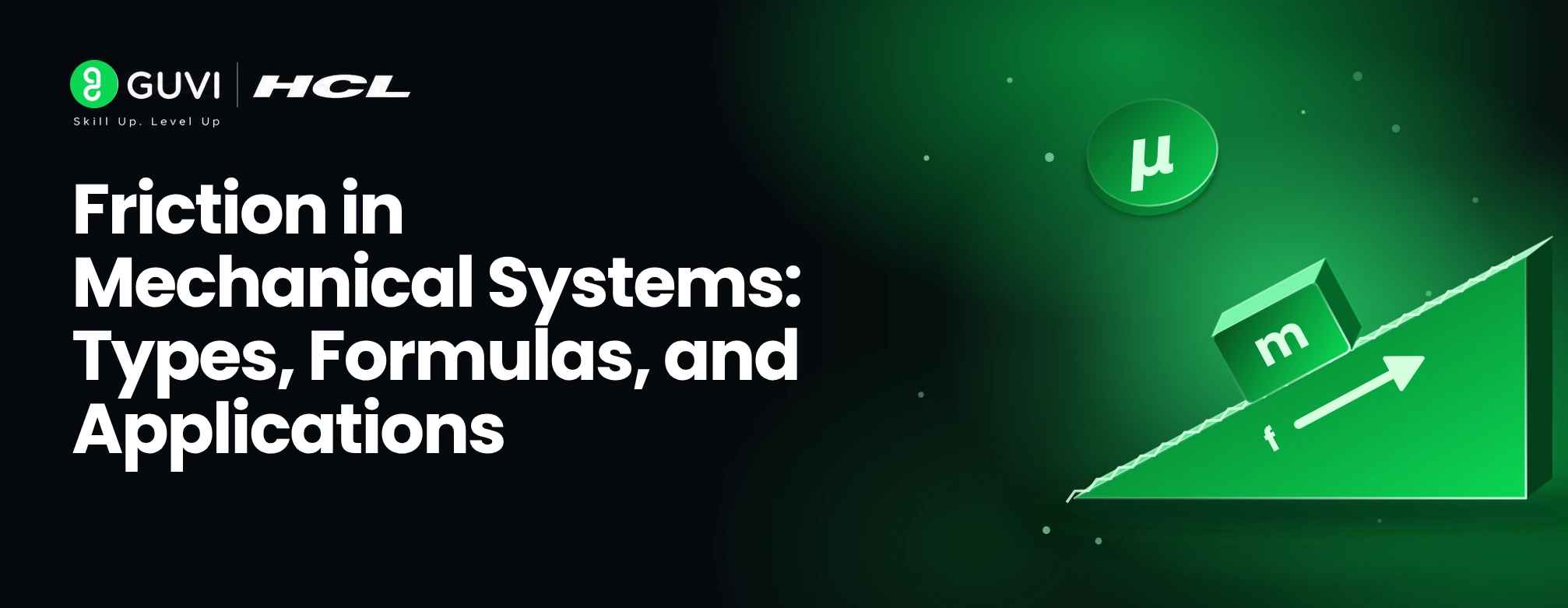
Friction in Mechanical Systems: Types, Formulas, and Applications
Nov 04, 2026 5 Min Read 58 Views
(Last Updated)
Every machine you have ever used depends on friction, and also fights it. Friction in mechanical systems holds a bolt tight, lets a car’s tyres grip the road and stops a vehicle when you press the brake. It also wears out bearings, wastes energy as heat and makes motors work harder than they should. Understanding how friction behaves is a basic skill for anyone designing, operating or maintaining machines.
This guide covers what friction is, its types, the formulas behind it, the factors that influence it and how engineers control it.
Table of contents
- TL;DR
- What Is Friction in Mechanical Systems?
- Types of Friction in Mechanical Engineering
- Static Friction
- Limiting Friction
- Kinetic (Sliding) Friction
- Rolling Friction
- Fluid Friction
- Understanding the Formulas
- Factors Affecting Friction in Mechanical Systems
- Difference Between Static, Kinetic, Rolling, and Fluid Friction
- Applications of Friction in Mechanical Systems
- How to Reduce or Control Friction in Mechanical Systems
- Why Understanding Friction Is Important in Mechanical Engineering
- Conclusion
- Frequently Asked Questions (FAQs)
- What is friction in mechanical systems?
- What are the main types of friction in mechanical engineering?
- What factors affect friction between two surfaces?
- How can friction be reduced in mechanical systems?
- Why is friction important in machine design?
TL;DR
- Friction is a force that resists relative motion, or the tendency to move, between two surfaces in contact.
- The main types are static, limiting, kinetic (sliding), rolling and fluid friction.
- Friction depends on the surface materials, roughness, normal force, lubrication, temperature, speed, wear and contamination.
- In machines, friction is sometimes essential (brakes, clutches, belts) and sometimes harmful (bearings, gears, sliding guides).
- Engineers control friction through lubrication, material selection, coatings, rolling-element bearings, alignment and maintenance.
What Is Friction in Mechanical Systems?
Friction in mechanical systems is the resistive force that acts along the contact surface between two components when one slides, rolls or tries to move relative to the other. It always acts opposite to the direction of motion, or opposite to the direction the motion would take.
Even a polished steel surface looks rough under a microscope. When two surfaces touch, only the tiny high points, called asperities, make real contact. These points interlock, deform and sometimes weld together at a microscopic level. Pulling the surfaces apart sideways means breaking or deforming these junctions, and that is the resistance we call friction.
Three things shape its size:
- Surface contact: how rough or smooth the surfaces are.
- Normal force: how hard the surfaces are pressed together.
- Material properties: how the two materials interact, such as steel on steel versus rubber on concrete.
A simple example: Try pushing a heavy machine tool across a workshop floor. At first it does not budge, even though you are pushing. Friction is matching your push exactly. Push harder and it suddenly starts moving, and then it needs a bit less force to keep going. That change in behaviour leads us to the different types of friction.
Understanding friction is essential for designing reliable and efficient mechanical systems. Take your mechanical engineering knowledge further with HCL GUVI’s Mechanical CAD course. Develop hands-on CAD skills, learn industry-relevant design tools, and gain practical experience in creating mechanical components and assemblies.
Start your journey towards a career in mechanical design with HCL GUVI!
Types of Friction in Mechanical Engineering
Static Friction
Static friction is the resistance that stops two surfaces from starting to move relative to each other. It adjusts itself to match the applied force, up to a limit. If you push a crate with a small force, static friction equals that force and the crate stays still.
Example: The friction between a bolt’s threads and a nut keeps a joint from loosening on its own.
Limiting Friction
Limiting friction is the maximum value of static friction, reached just before motion begins. Once the applied force exceeds this value, the surfaces start to slide.
Formula: F_max = μs × N
Kinetic (Sliding) Friction
Kinetic friction acts when two surfaces slide against each other. For most material pairs, it is slightly lower than limiting friction, which is why it takes a bigger push to start something moving than to keep it moving.
Formula: Fk = μk × N
Example: A brake pad pressing against a spinning disc produces kinetic friction that slows the wheel.
Rolling Friction
Rolling friction is the resistance an object meets while rolling over a surface. It arises mainly because the wheel and the surface deform slightly at the contact area. It is generally much smaller than sliding friction, which is why wheels and ball bearings are so useful.
Example: The resistance a ball in a ball bearing experiences as it rolls between the inner and outer races.
Fluid Friction
Fluid friction is the resistance experienced by an object moving through a fluid, or between layers of a fluid moving at different speeds. It depends on the fluid’s viscosity and the relative speed, not on a dry coefficient of friction.
Example: In a journal bearing, a thin oil film separates the shaft from the bearing. The shaft’s motion shears the oil layers, and that internal resistance is fluid friction.
Also checkout: Best Way to Learn Mechanical Engineering in 2026: Complete Roadmap
Understanding the Formulas
- F = frictional force
- μs = coefficient of static friction
- μk = coefficient of kinetic friction
- N = normal force, the force pressing the surfaces together, acting perpendicular to the contact surface
On a horizontal surface, N equals the weight of the object. On an inclined surface, it is only the component of weight perpendicular to the incline.
These equations are simplified models. They work well for introductory calculations and many design estimates, but real friction can vary with operating conditions such as speed, temperature, surface finish, contamination and lubrication. The coefficient of friction is not a fixed constant of a material. It depends on the pair of surfaces and the conditions they operate in.
Also checkout: What is Mechanical Engineering 101
Factors Affecting Friction in Mechanical Systems
Nature and material of surfaces. Different material pairs have different coefficients of friction. Rubber on dry concrete grips strongly, while hardened steel on polished steel slides much more easily. Designers choose pairs to match the job, such as high-friction linings for brakes and low-friction bronze for bushings.
Surface roughness and finish. Rougher surfaces generally have more asperity interlocking, so friction is higher. But very smooth, clean surfaces can also show high friction because more of the surface makes true contact. That is why finish is specified carefully on sliding parts.
Normal force. In the basic model, friction rises in direct proportion to the normal force. Tightening a clamp or increasing brake pressure increases the frictional force available.
Lubrication and operating conditions. A lubricant film separates surfaces and replaces dry friction with much lower fluid friction. Without it, friction and wear rise sharply.
Temperature and speed. Heat can thin the lubricant, change material properties and alter the coefficient of friction. In brakes, extreme heat can reduce friction, a problem known as brake fade. Speed affects how a lubricant film forms and how much heat is generated.
Wear and contamination. Dust, metal particles and moisture can act as abrasives or change the contact conditions. Over time, wear changes surface geometry and roughness, which in turn changes how a component behaves.

Also checkout: Mechanical Engineering Resume: 9 Important Things To Look Out For
Difference Between Static, Kinetic, Rolling, and Fluid Friction
| Type of Friction | When It Occurs | How It Affects Motion | Mechanical Example |
| Static | Surfaces are at rest relative to each other | Prevents motion from starting, up to a limit | A bolted joint resisting loosening |
| Kinetic (Sliding) | Surfaces slide over each other | Opposes ongoing sliding and generates heat | Brake pad on a rotating disc |
| Rolling | An object rolls over a surface | Small resistance to rolling, mostly from deformation | Ball bearing or wheel on a rail |
| Fluid | A body moves through, or between layers of, a fluid | Resistance depends on viscosity and speed | Oil film in a journal bearing |
Applications of Friction in Mechanical Systems
Braking systems. Brakes depend on friction between pads and a disc or shoe and a drum to convert kinetic energy into heat. The friction material must keep a stable coefficient of friction across a wide temperature range.
Clutches and power transmission. A clutch transmits torque through friction between engaged plates. Enough friction means no slip under load, while controlled slip lets the drive engage smoothly.
Bearings and rotating shafts. Here, the goal is low friction. Rolling-element bearings and lubricated journal bearings reduce power loss and heat, helping shafts spin efficiently.
Gears and mechanical drives. Gear teeth experience a mix of rolling and sliding contact. Friction at the tooth surfaces causes power loss and wear, so lubrication and tooth surface finish matter.
Belt and pulley systems. Flat and V-belt drives transmit power through friction between the belt and pulley. If friction is too low, the belt slips and the drive loses efficiency. Proper tension keeps enough grip.
Screws, nuts and bolted joints. Thread friction is what keeps a fastener from backing off. Some screws are even designed to be self-locking because friction in the threads prevents them from turning under load. The same friction also means part of the tightening torque is lost, which is why torque specifications matter.
Industrial machinery. In machine tools, conveyors, presses and pumps, friction influences energy consumption, positioning accuracy, wear rates and maintenance intervals. Slideways and guides, for instance, need controlled friction for smooth, precise movement.
Also checkout: Promising Scope of Mechanical Engineering in India in 2026
How to Reduce or Control Friction in Mechanical Systems
Lubrication with oils and greases. Oils suit high speeds and are good at carrying heat away, while greases stay in place and suit slow or sealed components. Both reduce metal-to-metal contact.
Selecting suitable materials. Pairing materials with compatible, low-friction behaviour, such as bronze bushings with steel shafts, reduces friction and wear.
Surface finishing and coatings. Grinding, polishing and honing improve surface quality, and coatings can lower friction or increase hardness and wear resistance.
Using rolling-element bearings. Replacing sliding contact with rolling contact is one of the most effective ways to cut friction in rotating machinery.
Proper alignment. Misaligned shafts and bearings create uneven loading, extra friction, heat and early failure.
Regular maintenance and inspection. Replacing worn lubricant, cleaning contaminants and checking for wear keep friction at design levels.
Reducing friction is not always the goal. Brakes, clutches, belt drives and threaded fasteners all need enough friction to work. The engineering task is controlling friction: low where it wastes energy, reliably high where function depends on grip.
Why Understanding Friction Is Important in Mechanical Engineering
- Efficiency and energy use: Friction losses consume power. Lower friction in transmissions and bearings means less energy for the same output.
- Heat generation: Friction turns mechanical energy into heat, which can affect lubricants, tolerances and material strength.
- Wear and service life: Persistent friction removes material from surfaces, shortening component life.
- Mechanical performance: Grip, positioning accuracy and smoothness all depend on frictional behaviour.
- Maintenance: Lubrication schedules and inspection routines exist largely to manage friction and its effects.
- Safety and reliability: Reliable braking, secure fasteners and non-slipping drives all rely on friction behaving as designed.
For designers, this shapes everyday decisions: which materials to pair, what finish to specify, which bearing type to use, how to size a brake or clutch, and how much extra capacity to allow for changing conditions.
Conclusion
Friction in mechanical systems is neither good nor bad on its own. It is useful when it provides grip, holds joints together and transmits power, and unwanted when it wastes energy, produces heat and wears parts out. Knowing the types of friction, the basic formulas and the factors that change them helps engineers decide when to increase friction and when to minimise it. That understanding is a core part of designing machines that are efficient, durable and safe.
Frequently Asked Questions (FAQs)
1. What is friction in mechanical systems?
Friction in mechanical systems is the force that resists relative motion, or the tendency of motion, between two contacting surfaces. It acts along the contact surface, opposite to the direction of motion.
2. What are the main types of friction in mechanical engineering?
The main types are static friction, limiting friction, kinetic (sliding) friction, rolling friction and fluid friction. Each applies to a different contact condition, from stationary surfaces to rolling parts and lubricated bearings.
3. What factors affect friction between two surfaces?
Friction is affected by the materials in contact, surface roughness, the normal force, lubrication, temperature, speed, wear and contamination.
4. How can friction be reduced in mechanical systems?
Common methods include lubrication, choosing suitable materials, surface finishing and coatings, using rolling-element bearings, keeping components aligned and carrying out regular maintenance.
5. Why is friction important in machine design?
Friction affects efficiency, heat, wear, safety and reliability. Designers must provide enough friction for brakes, clutches and belts, and minimise it in bearings, gears and sliding parts.
Success Stories

About the Author
Vishalini Devarajan
An Aerospace Engineer turned content writer, I focus on making complex concepts easy to understand through well-structured, reader-friendly blogs. Whether it’s a technical topic or a non-technical one, I love creating content that is clear, engaging, and impactful.
View all posts by Vishalini Devarajan
Connect with me @









Did you enjoy this article?