


Mechanical CAD Articles
Types of Mechanical Stress with Examples
LinkedIn Profile Tips for Mechanical Engineers: How to Build a Recruiter-Friendly Profile
Stress and Strain in Mechanical Engineering: Types, Formulas and Applications


Get In Touch For Details! Request More Information
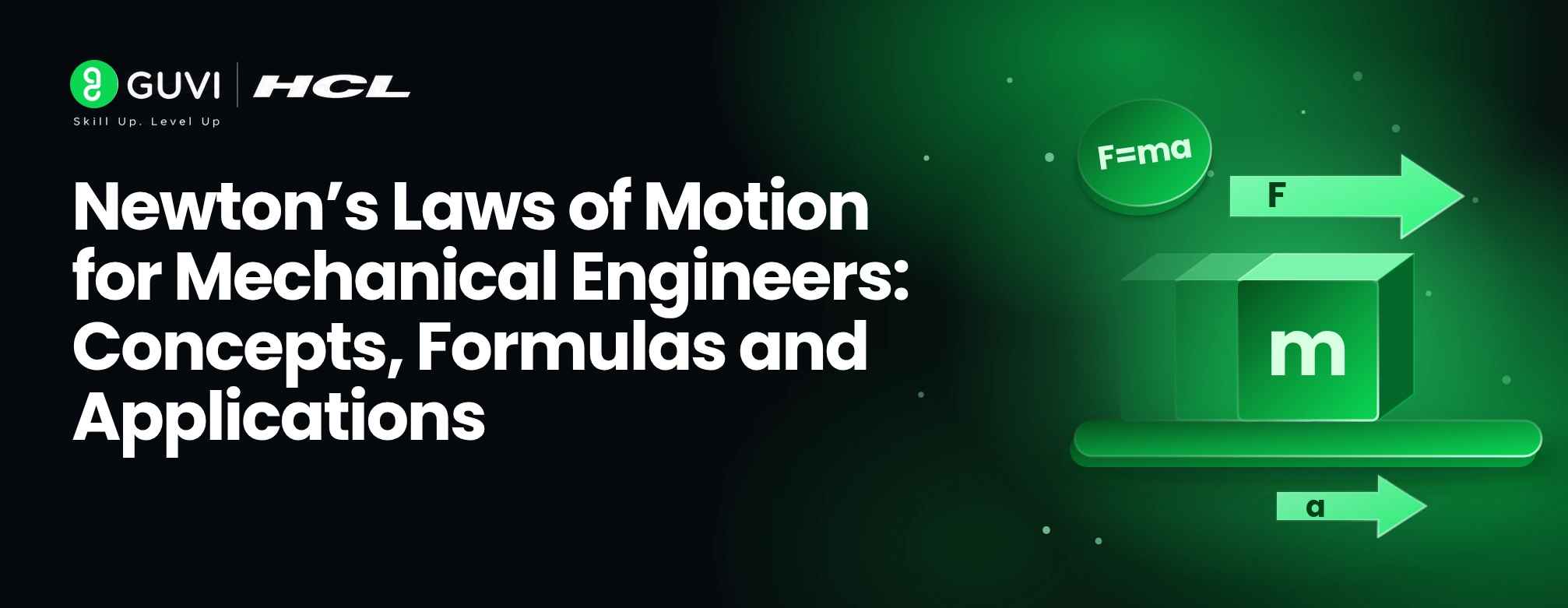
Newton’s Laws of Motion for Mechanical Engineers: Concepts, Formulas and Applications
Nov 02, 2026 4 Min Read 96 Views
(Last Updated)
Every machine you study in mechanical engineering, from a bicycle to a gas turbine, moves because forces act on it. Newton’s laws of motion for mechanical engineers are the rules that link those forces to the motion they produce.
Statics, dynamics, machine design and vehicle engineering all build on them. This blog explains the three laws in plain language, with formulas, a worked example and real engineering applications.
Table of contents
- TL;DR
- What Are Newton’s Laws of Motion?
- Newton’s First Law of Motion: Law of Inertia
- Newton’s Second Law of Motion: Law of Acceleration
- Newton’s Third Law of Motion: Law of Action and Reaction
- Applications of Newton’s Laws of Motion in Mechanical Engineering
- Difference Between Newton’s Three Laws of Motion
- Why Are Newton’s Laws of Motion Important for Mechanical Engineers?
- Conclusion
- Frequently Asked Questions (FAQs)
- What are Newton’s three laws of motion?
- Why are Newton’s laws important in mechanical engineering?
- What is the formula for Newton’s Second Law?
- How is Newton’s First Law used in mechanical engineering?
- What are some real-world applications of Newton’s Third Law?
TL;DR
- Newton’s three laws of motion describe how force, mass and motion are related.
- First law: a body stays at rest or in uniform motion unless an unbalanced external force acts on it.
- Second law: net force equals mass times acceleration (F = ma).
- Third law: forces always come in pairs, equal in size and opposite in direction, acting on two different bodies.
- Engineers use these laws to design vehicles, machines, robots and engines.
What Are Newton’s Laws of Motion?
Newton’s laws of motion are three fundamental principles that describe how a body responds to forces. They explain when an object stays at rest, how it accelerates, and how two interacting bodies push on each other.
c published them in 1687. They hold in an inertial reference frame, which is simply a frame that is not accelerating itself. For most machine and vehicle problems, the ground is a good enough inertial frame.
For engineers, the value is predictive. If you know the forces on a component, you can work out how it will move before anything is built.
Want to apply Newton’s Laws of Motion to real-world mechanical systems? Explore HCL GUVI’s Mechanical CAD Design Course and develop practical skills in 2D drafting, 3D modelling, and mechanical design using industry-relevant CAD tools. Build your engineering skills and take the next step towards a career in mechanical design.
Newton’s First Law of Motion: Law of Inertia
Statement: A body remains at rest, or keeps moving in a straight line at constant speed, unless an unbalanced external force acts on it.
This tendency to resist a change in motion is called inertia. Mass is its measure: the more mass a body has, the harder it is to start, stop or turn. Inertia is often described in three forms:
- Inertia of rest: a stationary object stays put until pushed.
- Inertia of motion: a moving object keeps moving until something slows it.
- Inertia of direction: a moving object keeps its direction until a force turns it.
The key idea is the difference between balanced and unbalanced forces. When the forces on a body add up to zero, they are balanced and its motion does not change. Only a non-zero net force changes the state of motion.
Where you see it: when a stationary car pulls away, passengers lean back because their bodies want to stay at rest. When the car brakes hard, they lurch forward because their bodies want to keep moving. This is why seat belts exist, and why cargo in a truck must be strapped down.
Engineers also put inertia to work. The flywheel on an engine crankshaft stores rotational energy and smooths out the jerky power strokes of the pistons.
Also checkout: Promising Scope of Mechanical Engineering in India in 2026
Newton’s Second Law of Motion: Law of Acceleration
Statement: The acceleration of a body is directly proportional to the net force acting on it and inversely proportional to its mass. The acceleration is in the direction of that net force.
Formula: F = ma
| Symbol | Meaning | SI unit |
| F | Net force | newton (N) |
| m | Mass | kilogram (kg) |
| a | Acceleration | metre per second squared (m/s²) |
One newton is the force needed to give a 1 kg mass an acceleration of 1 m/s².
Worked example: A car of mass 1,000 kg has a net forward force of 2,500 N after engine thrust at the wheels is reduced by drag and rolling resistance. Its acceleration is:
a = F / m = 2,500 / 1,000 = 2.5 m/s²
If the same net force acts on a 2,000 kg loaded vehicle, acceleration drops to 1.25 m/s². Doubling the mass halves the acceleration, while doubling the net force doubles it.
Mass vs weight: Mass is the amount of matter in a body and stays constant everywhere. Weight is the gravitational force on that mass, W = mg, where g ≈ 9.81 m/s² on Earth. A 10 kg component weighs about 98.1 N on Earth but has the same 10 kg mass on the Moon.
This law sits behind almost every sizing decision: how much torque a motor needs to accelerate a conveyor, how much braking force stops a loaded truck, or how strong a lifting arm must be.
Also checkout: 6 Mechanical Engineering Webinars and Workshops That You Should Know
Newton’s Third Law of Motion: Law of Action and Reaction
Statement: When one body exerts a force on a second body, the second body exerts a force of equal magnitude and opposite direction on the first.
The important detail is that these two forces act on different bodies. Because they never act on the same object, they do not cancel each other out on any single body. Each body responds only to the force acting on it.

Some examples from mechanical systems:
- Vehicle tyres: The tyre pushes backward on the road, and the road pushes the tyre forward. That forward force on the car is what moves it.
- Rocket propulsion: The engine throws hot gas backward, and the gas pushes the rocket forward. This works even in vacuum, because the push is between the rocket and its exhaust.
- Rotating machinery: A pump impeller pushes fluid outward, and the fluid pushes back on the impeller. A shaft pressing on its bearings gets an equal reaction from the bearings, which designers must account for when sizing them.
Applications of Newton’s Laws of Motion in Mechanical Engineering
Engineers use these laws to draw free-body diagrams, calculate forces, predict motion and size components. Common areas include:
- Automobile engineering: The second law helps size engines and brakes, and the first law drives the design of seat belts, airbags and crumple zones.
- Machine design: Forces on gears, shafts, cams and linkages are worked out with F = ma and action-reaction pairs.
- Robotics and automation: Motor torque and arm acceleration are chosen so a robot can move payloads quickly without overshooting.
- Industrial machinery: Presses, conveyors, cranes and hoists are designed around the loads and accelerations they must handle.
- Engine and propulsion systems: Piston-crank dynamics, turbine blades and jet or rocket thrust all rely on the second and third laws.
- Mechanical system design: Vibration, balancing and structural loading studies begin with a force balance on each part.
Also checkout: 12 Best Books to Learn Mechanical Engineering
Difference Between Newton’s Three Laws of Motion
| Law | Main principle | Key concept | Formula | Practical example |
| First | A body resists changes in its motion | Inertia | ΣF = 0 means no change in motion | Passengers lurching forward when a car brakes |
| Second | Net force produces acceleration | Force, mass and acceleration | F = ma | Heavier vehicle accelerating more slowly with the same engine force |
| Third | Forces occur in equal and opposite pairs | Action and reaction on different bodies | F(A on B) = −F(B on A) | Tyre pushing the road backward, road pushing the car forward |
Why Are Newton’s Laws of Motion Important for Mechanical Engineers?
These laws are the starting point for almost every analysis you will do. They help you to:
- Understand how moving objects behave under different loads.
- Calculate forces and accelerations in a machine or vehicle.
- Analyse a mechanical system by isolating each part and studying the forces on it.
- Design machines that are safe and efficient, with parts sized for the loads they will actually see.
- Understand vehicle dynamics, including acceleration, braking and cornering.
- Solve real engineering problems, from conveyor drives to robotic arms.
Later subjects such as dynamics, kinematics of machines, vibrations and fluid mechanics all rest on this foundation.
Conclusion
Newton’s laws of motion for mechanical engineers come down to three ideas: bodies resist changes in motion, net force causes acceleration, and forces always come in pairs. Once these feel natural, force diagrams, motion problems and machine design become much easier to approach. Practise with free-body diagrams and small numerical problems, and the rest of mechanics will follow.
Frequently Asked Questions (FAQs)
1. What are Newton’s three laws of motion?
The first law says a body keeps its state of rest or uniform motion unless a net external force acts. The second says F = ma. The third says every action force has an equal and opposite reaction force on another body.
2. Why are Newton’s laws important in mechanical engineering?
They let engineers calculate forces, predict motion and size components. Without them, designing vehicles, engines, robots or any moving machine would be guesswork.
3. What is the formula for Newton’s Second Law?
F = ma, where F is net force in newtons, m is mass in kilograms and a is acceleration in m/s².
4. How is Newton’s First Law used in mechanical engineering?
It guides the design of safety features like seat belts and cargo restraints, and explains devices like flywheels that use inertia to keep rotation steady. It is also the basis for static equilibrium, where the net force on a body is zero.
5. What are some real-world applications of Newton’s Third Law?
Rocket and jet propulsion, a car moving through tyre-road contact, a pump impeller moving fluid, and the reaction loads on bearings and supports are all direct uses of it.
Success Stories

About the Author
Vishalini Devarajan
An Aerospace Engineer turned content writer, I focus on making complex concepts easy to understand through well-structured, reader-friendly blogs. Whether it’s a technical topic or a non-technical one, I love creating content that is clear, engaging, and impactful.
View all posts by Vishalini Devarajan
Connect with me @





Did you enjoy this article?