


Data Analysis Articles
BPO Experience for Data Analyst Jobs Does It Count When Applying? - Best Guide
Can a BPO Team Leader Become a Data Analyst?
How to Switch From BPO to Data Analytics in 2026: Best Skills, Roadmap & Jobs
Will Moving From Team Lead to Data Analyst Reduce Salary or Seniority?


Get In Touch For Details! Request More Information
BPO vs Data Analyst Salary in India: What Changes After the Switch?
Oct 08, 2026 5 Min Read 48 Views
(Last Updated)
Switching from a BPO role to a Data Analyst position can be an attractive option for professionals who want to move toward a more analytical career. However, one of the biggest questions is what happens to your salary after the transition.
The BPO vs Data Analyst salary in India comparison is not simply about which job pays more. Your experience, current salary, analytical skills, industry knowledge, location, and the level of the new role can all affect your compensation. A professional with four or more years of BPO experience may approach the switch differently from someone with one or two years of experience.
For non-IT professionals, the transition can involve a short-term adjustment in job level or salary, but relevant business experience can also become an advantage. This guide explains what may change after the switch and how early-career and senior BPO professionals can approach the transition strategically.
Table of contents
- TL;DR
- Is Data Analyst Salary Higher Than BPO Salary in India?
- What Changes for Professionals With Less Than 4 Years of Experience?
- What Should You Learn?
- What Changes for Professionals With 4+ Years of Experience?
- Can BPO Experience Help You Become a Data Analyst?
- Will You Take a Salary Cut After Switching?
- How Can You Protect Your Salary?
- Don't Present Yourself as a Complete Fresher
- Build Relevant Projects
- Target the Right Roles
- Which Data Analyst Skills Matter Most?
- Excel
- SQL
- Power BI
- Statistics
- Should You Switch if Your BPO Salary Is Already Higher?
- How Should You Explain the Switch in an Interview?
- What Does the Long-Term Career Path Look Like?
- S3 vs S4: Which Transition Strategy Fits You?
- Start Your Learning Journey with HCL GUVI.
- Conclusion
- FAQs
- Is a Data Analyst salary higher than a BPO salary in India?
- Can I become a Data Analyst after working in BPO for four years?
- Will I have to take a salary cut when moving from BPO to Data Analytics?
- What skills should BPO professionals learn to become Data Analysts?
- Should a BPO Team Lead apply for fresher Data Analyst jobs?
- Is switching from BPO to Data Analytics worth it?
TL;DR
- BPO vs Data Analyst salary in India varies significantly based on experience, skills, location, company, and job level.
- BPO professionals with under four years of experience may find it easier to transition by building strong Excel, SQL, Power BI, and analytical skills.
- Professionals with four or more years of BPO experience should avoid positioning themselves as complete freshers and highlight transferable business and reporting experience.
- A switch to Data Analytics can sometimes involve a short-term salary adjustment if the new position is entry-level.
- BPO experience in operations, customer service, quality, workforce management, and reporting can be valuable for business-focused analyst roles.
Is Data Analyst Salary Higher Than BPO Salary in India?
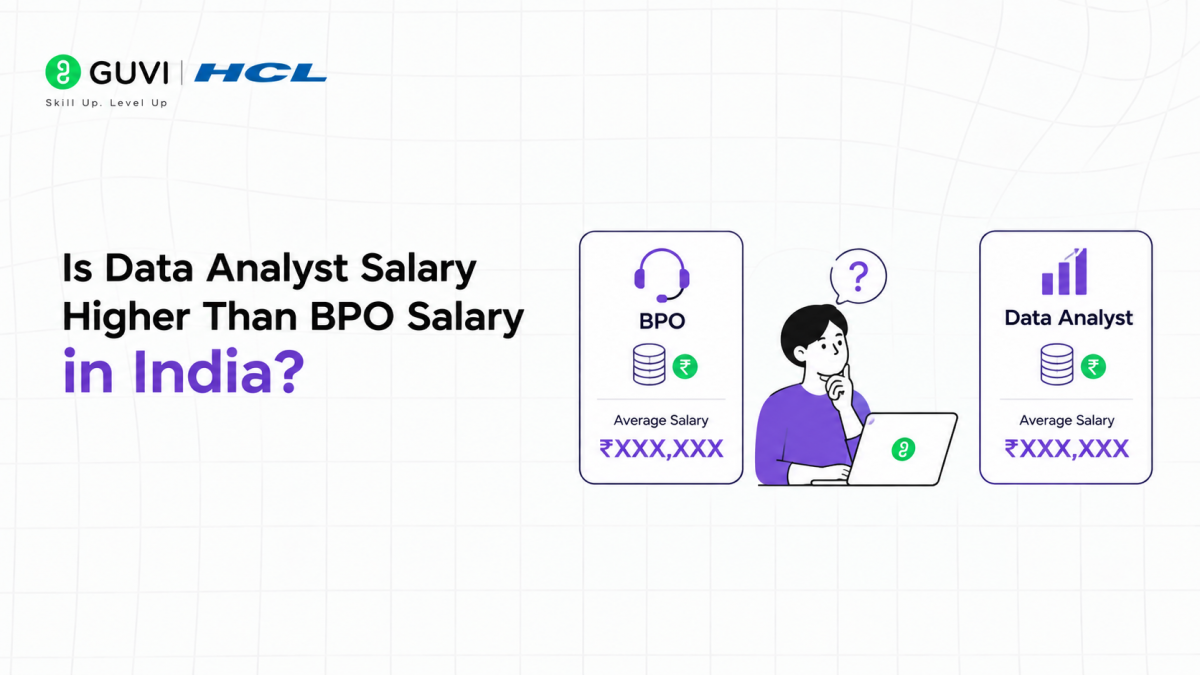
It can be, but there is no fixed answer.
BPO salaries vary according to the type of process, experience, company, shift, location, and whether the employee moves into quality, workforce management, or leadership.
Data Analyst salaries similarly vary according to technical skills, experience, industry, location, and company.
The important difference is career direction. BPO professionals often progress through operations and management, while Data Analysts can progress toward senior analytics, business intelligence, specialized analytics, and analytics leadership roles.
Therefore, switching to analytics should be evaluated as a long-term career decision rather than simply a way to get an immediate salary increase.
Thinking about switching to a data analytics career? HCL GUVI’s Data Science Course helps you build practical skills in Python, data analysis, statistics, and machine learning through hands-on projects and industry-focused learning.
What Changes for Professionals With Less Than 4 Years of Experience?
For professionals with under four years of experience, the transition can be relatively straightforward if they already work with reports, Excel, KPIs, or operational data.
You may already have experience with:
- Performance reports
- Customer metrics
- Quality scores
- Productivity measurements
- SLA tracking
- Excel reporting
- Process monitoring
These experiences can provide useful business context when applying for junior Data Analyst or reporting positions.
What Should You Learn?
Focus on practical skills rather than trying to learn every data-related technology.
You should also build two or three projects that demonstrate how you use these skills to solve business problems.
Pro Tip: Build a project around a problem you already understand, such as customer satisfaction, employee productivity, SLA performance, or workforce analysis. Your existing BPO knowledge can make the project more realistic.
What Changes for Professionals With 4+ Years of Experience?
The strategy is different for experienced BPO professionals.
If you have four or more years of experience, applying only for fresher Data Analyst positions could result in an unnecessary salary reduction and underuse your existing experience.
Instead, consider roles that combine your business background with analytics, such as:
- Data Analyst
- Operations Analyst
- Reporting Analyst
- Business Analyst
- Workforce Analyst
- MIS Analyst
- Business Intelligence Analyst
For example, a BPO Team Lead who regularly analyzed performance metrics, prepared reports, monitored KPIs, and identified process issues can present those responsibilities as relevant analytical experience.
You are not starting your professional career again. You are adding a technical capability to an existing career.
Can BPO Experience Help You Become a Data Analyst?
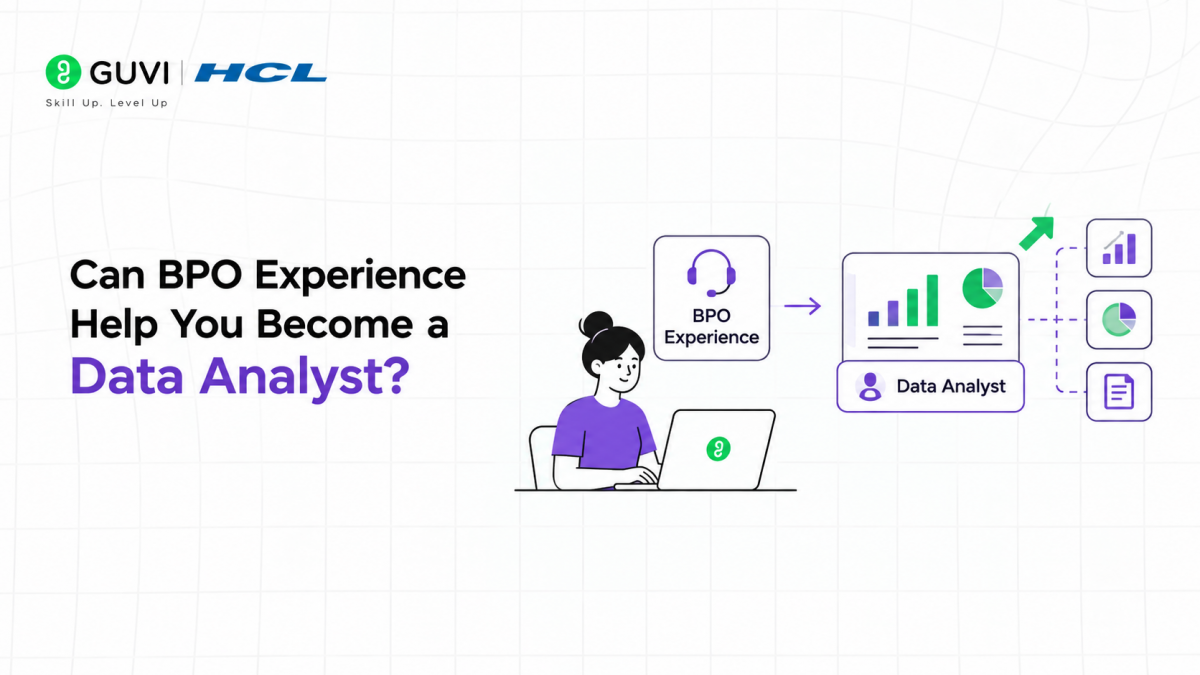
Yes, especially when your previous work involved measurable business processes.
Consider the difference between these descriptions:
Basic description:
Managed a customer support team and monitored daily performance.
Analytics-focused description:
Analyzed productivity, quality, and SLA metrics to identify performance trends and support process improvements.
The second version highlights analytical thinking while remaining grounded in actual responsibilities.
BPO professionals can also target analytics roles within industries they already understand. Someone with customer operations experience, for example, may be a strong candidate for customer analytics, workforce analytics, or operations analytics roles.
Previous industry experience can become an advantage in analytics because employers often need analysts who understand the business problem behind the data, not just the tools used to analyze it.
Will You Take a Salary Cut After Switching?
Possibly, but it is not guaranteed.
A salary reduction is more likely when:
- You have little practical analytics experience.
- You apply for an entry-level position.
- Your current BPO salary is significantly higher.
- The employer treats you as a fresher.
- Your previous responsibilities have little connection to analytics.
The difference may be smaller if you have strong reporting experience, relevant business knowledge, and practical analytics skills.
A temporary salary adjustment can sometimes make sense if the new role gives you genuine experience with SQL, dashboards, data analysis, and business intelligence.
However, don’t accept a lower salary simply because a company uses the “Data Analyst” title.
How Can You Protect Your Salary?
1. Don’t Present Yourself as a Complete Fresher
If you already have several years of professional experience, keep that experience visible on your resume.
Highlight:
- KPI ownership
- Reporting
- Process improvement
- Business metrics
- Stakeholder communication
- Team or project responsibilities
Then add your new analytics skills.
2. Build Relevant Projects
Your portfolio should demonstrate practical problem-solving.
Useful project ideas include:
Customer Support Dashboard: Analyze ticket volume, response time, satisfaction, and resolution rates.
Employee Performance Dashboard: Analyze productivity, attendance, quality scores, and monthly performance.
SLA Analysis: Identify trends in service-level performance and investigate reasons for missed targets.
These projects can connect your previous BPO experience with your new analytics capabilities.

3. Target the Right Roles
Do not search only for “Data Analyst.”
Also consider:
BPO → Operations Analyst → Data Analyst → Senior Data AnalystFor some professionals, this can be a more realistic transition than moving directly into a highly technical analytics position.
Which Data Analyst Skills Matter Most?
You do not need an enormous technical stack to start.
1. Excel
Learn pivot tables, XLOOKUP, conditional formulas, data cleaning, charts, and basic dashboards.
2. SQL
Focus on SELECT, WHERE, GROUP BY, JOIN, CASE, subqueries, CTEs, and window functions.
3. Power BI
Learn data import, cleaning, relationships, dashboards, filters, slicers, and calculated measures.
4. Statistics
Understand averages, percentages, distributions, correlation, and sampling.
The goal is to interpret data correctly and communicate useful business insights.
Should You Switch if Your BPO Salary Is Already Higher?
Not automatically.
Compare the complete opportunity rather than salary alone.
Consider:
- Current salary
- New salary
- Actual job responsibilities
- Technical exposure
- Career progression
- Learning opportunities
- Promotion opportunities
- Future job options
For example, accepting a modest reduction may be reasonable if the new position gives you genuine analytics experience and a clear path toward Senior Data Analyst roles.
But taking a large salary cut for a role that mainly involves manual reporting or data entry may not provide the career change you expected.
Warning: Always check the actual responsibilities of a Data Analyst position. Some jobs use the title while primarily involving spreadsheet maintenance, repetitive reporting, or data entry.
How Should You Explain the Switch in an Interview?
Connect your previous experience with your new career direction.
A simple structure is:
Previous experience → Interest in data → Skills developed → Projects → Career goalFor example:
“I have several years of experience in BPO operations, where I worked with performance metrics and reports. I became interested in understanding the trends behind those numbers, so I developed my skills in SQL, Excel, Power BI, and data analysis. I now want to combine my business experience and analytical skills in a dedicated data role.”
This is stronger than saying you simply want to leave BPO for a higher-paying IT career.
What Does the Long-Term Career Path Look Like?
Your first Data Analyst salary should not be the only consideration.
A possible progression is:
BPO Professional → Data Analyst → Senior Data Analyst → Analytics Lead → Analytics ManagerDepending on your interests, you can later move into:
- Business Intelligence
- Product Analytics
- Operations Analytics
- Analytics Engineering
- Data Science
- Analytics Management
For experienced BPO professionals, previous leadership and domain knowledge can become valuable again when moving into analytics leadership.
S3 vs S4: Which Transition Strategy Fits You?
| Experience | Recommended Approach |
|---|---|
| Under 4 years | Build Excel, SQL, Power BI, and statistics skills; target junior and mid-level analyst roles |
| 4+ years | Highlight business, reporting, KPI, and leadership experience; target experienced-hire analyst and operations analytics roles |
The goal is not to erase your BPO background. It is to make that experience part of your analytics story.
Start Your Learning Journey with HCL GUVI.
Thinking about switching to a data analytics career? HCL GUVI’s Data Science Course helps you build practical skills in Python, data analysis, statistics, and machine learning through hands-on projects and industry-focused learning.
Conclusion
The BPO vs Data Analyst salary in India comparison should be treated as a career transition decision, not simply a comparison between two salaries. Your first analytics salary may be lower, similar, or higher depending on your experience, skills, and the role you secure.
For professionals with less than four years of experience, building practical skills in Excel, SQL, Power BI, and data analysis can create a strong foundation. For those with four or more years of experience, the better approach is to combine existing business and leadership experience with analytics skills.
You do not have to start your professional career from zero. The strongest transition uses what you already know while building the skills needed for your next career stage.
FAQs
1. Is a Data Analyst salary higher than a BPO salary in India?
It can be, but there is no fixed comparison. Salary depends on experience, company, location, role level, technical skills, and industry.
2. Can I become a Data Analyst after working in BPO for four years?
Yes. Your BPO experience can be valuable, especially if you have worked with reports, KPIs, customer data, quality metrics, or process improvement. Build practical skills in SQL, Excel, Power BI, and statistics alongside your existing experience.
3. Will I have to take a salary cut when moving from BPO to Data Analytics?
Not necessarily. A salary cut is more likely if you are treated as a fresher, but relevant business experience and strong analytical skills can help you target experienced-hire positions.
4. What skills should BPO professionals learn to become Data Analysts?
Start with Excel, SQL, Power BI, data cleaning, basic statistics, and data visualization. Practical projects can help demonstrate that you can apply these skills to real business problems.
5. Should a BPO Team Lead apply for fresher Data Analyst jobs?
Not always. With four or more years of experience, consider Operations Analyst, Reporting Analyst, Business Analyst, Workforce Analyst, and experienced Data Analyst positions where your previous experience can add value.
6. Is switching from BPO to Data Analytics worth it?
It can be worthwhile if you genuinely want to work with data and are prepared to build the required skills. Evaluate the first role based on its analytical responsibilities, learning opportunities, salary, and long-term career growth rather than the title alone.
Success Stories

About the Author
HCL GUVI
This article was selected and published as part of the HCL GUVI AI Blogathon 2026, an initiative designed to encourage students, AI enthusiasts, and aspiring tech writers to simplify complex AI concepts through impactful technical content. The contest recognized high-quality, original, and insightful AI-focused blogs, with selected authors receiving publication opportunities on the HCL GUVI blog platform along with official author credits and recognition.
View all posts by HCL GUVI
Connect with me @










Did you enjoy this article?