


Forward Deployed Engineer Articles
Best Career Paths Into Forward Deployed Engineering
FDE Project Lifecycle: From Discovery to Deployment
Is Forward Deployed Engineering a Real Engineering Discipline?
Forward Deployed Engineering Explained for Non-Technical Founders


Get In Touch For Details! Request More Information
The Rise of the T-Shaped Engineer and Why FDEs Are the Model
Sep 08, 2026 3 Min Read 36 Views
(Last Updated)
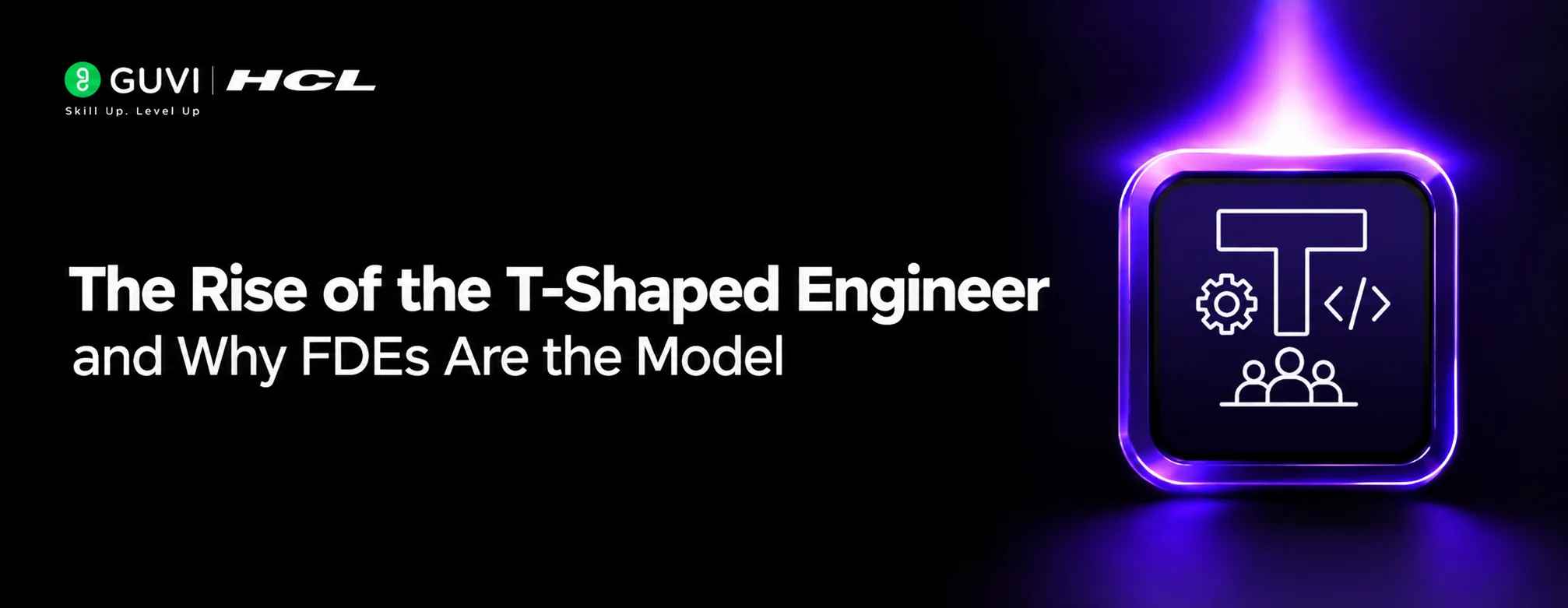
Modern engineering increasingly requires people who can connect different technical disciplines without losing specialist expertise. This is where the T-shaped engineer model becomes useful. It combines strong knowledge in one area with enough understanding of neighboring technologies to navigate complex projects, collaborate across teams, and approach problems from a broader systems perspective.
Table of contents
- TL;DR Summary
- What Is a T-Shaped Engineer?
- Why Are FDEs a Strong Example of T-Shaped Engineering?
- The Two Dimensions of T-Shaped Engineering
- What Does the Vertical Part of the T Represent?
- What Does the Horizontal Part of the T Represent?
- What Skills Does a T-Shaped Engineer Need?
- How Does an FDE Apply the T-Shaped Model?
- How Can You Become a T-Shaped Engineer?
- What Should You Learn for FDE-Style Engineering?
- Building the Technical Breadth FDEs Need
- Why Does This Model Matter for the Future of Engineering?
- Conclusion
- FAQs
- What is a T-shaped engineer?
- Why are FDEs considered T-shaped engineers?
- Do T-shaped engineers need to know everything?
- What should I specialize in?
- Are communication skills important for FDEs?
- How can I become a T-shaped engineer?
- Is the T-shaped model useful outside FDE roles?
TL;DR Summary
- T-shaped engineers develop deep expertise alongside broad technical awareness.
- FDEs apply this model by working across engineering, AI, infrastructure, and customer requirements.
- Technical depth enables reliable implementation, while breadth helps connect different systems.
- The model is increasingly useful as engineering becomes more cross-functional and AI-driven.
Quick Answer
| A T-shaped engineer has deep expertise in one technical discipline and practical knowledge across several related areas. The vertical part of the “T” represents specialization, while the horizontal part represents breadth, allowing engineers to understand connected technologies, collaborate with specialists, and solve problems that cross traditional technical boundaries. |
What Is a T-Shaped Engineer?
A T-shaped engineer develops genuine expertise in one technical discipline while maintaining working knowledge across several related fields. For example, a backend engineer could specialize in Python and distributed systems while understanding databases, cloud infrastructure, frontend fundamentals, and AI integrations.
The objective is not to become an expert in everything. Instead, engineers should understand enough about adjacent technologies to investigate problems, make informed decisions, and collaborate effectively.
Why Are FDEs a Strong Example of T-Shaped Engineering?
- FDEs naturally demonstrate T-shaped engineering because their work sits between technical implementation, product requirements, and customer problems. Their responsibilities can extend from discovery and technical scoping to system design, implementation, and production rollout.
- An FDE may therefore write production code, understand infrastructure, integrate systems, evaluate AI behavior, and communicate technical decisions. This combination requires both specialist knowledge and technical flexibility.
The Two Dimensions of T-Shaped Engineering
What Does the Vertical Part of the T Represent?
- The vertical part represents technical depth in a chosen specialization. This could be backend engineering, AI, data engineering, cloud, DevOps, frontend development, cybersecurity, or distributed systems.
- Deep knowledge allows engineers to solve difficult problems rather than simply connect existing tools. Strong fundamentals in areas such as architecture, testing, performance, APIs, databases, and debugging provide a foundation that remains useful as individual technologies change.
What Does the Horizontal Part of the T Represent?
- The horizontal part represents breadth across connected technical areas. FDEs may need working knowledge of APIs, SQL, databases, cloud platforms, authentication, frontend fundamentals, data pipelines, AI applications, deployment, monitoring, and security.
- This breadth helps engineers investigate problems across system boundaries. For example, poor AI application performance might originate in retrieval, APIs, databases, infrastructure, or architecture rather than the model itself.
Current FDE roles can span customer discovery, system architecture, full-stack development, AI deployment, productionization, evaluation, and adoption.
What Skills Does a T-Shaped Engineer Need?
- A T-shaped engineer should build capabilities progressively rather than attempting to learn every technology simultaneously. Programming, Git, testing, debugging, APIs, databases, and system design provide an essential engineering foundation.
- After establishing those fundamentals, choose one discipline for deeper specialization and gradually learn the technologies surrounding it.
- Communication and problem-solving should develop alongside technical ability because FDE-style work requires understanding requirements, explaining trade-offs, and working with different stakeholders.
The HCL GUVI Artificial Intelligence eBook can provide an additional beginner-friendly reference for strengthening AI fundamentals.
How Does an FDE Apply the T-Shaped Model?
- An FDE applies the model by combining different technical capabilities to solve one practical customer problem. Consider a retail company that wants an AI assistant to help customer-support agents find information in internal documents.
- The FDE could analyze the workflow, identify relevant data, build retrieval functionality, connect APIs, work with cloud infrastructure, evaluate responses, deploy the application, and improve it using customer feedback. The project combines software engineering, data, infrastructure, AI, product thinking, and communication.

How Can You Become a T-Shaped Engineer?
- Start with depth before expanding breadth. Choose a technical foundation such as backend development, AI, data, frontend, or cloud and develop meaningful expertise in it.
- Then move beyond isolated tutorials by building complete projects. Working with APIs, databases, authentication, deployment, testing, and monitoring naturally exposes you to adjacent areas and develops broader system understanding.
For additional architecture practice, explore the System Design Roadmap.
What Should You Learn for FDE-Style Engineering?
Engineers targeting FDE or modern AI engineering roles should strengthen their software foundation before adding practical AI capabilities. This approach builds depth in one area while gradually developing broader technical knowledge.
HCL GUVI’s Artificial Intelligence & Machine Learning Certification Bundle covers machine learning, deep learning, NLP, computer vision, reinforcement learning, generative AI, and related technologies.
Building the Technical Breadth FDEs Need
A T-shaped engineer combines deep expertise in one area with enough knowledge across adjacent technologies to solve broader problems. For FDEs, this can include understanding AI systems, retrieval-augmented generation (RAG), and deployment alongside their core engineering skills.
The “Generative AI Engineering: Foundations, RAG & Deployment – Workshop” from HCL GUVI provides exposure to these areas. It is particularly relevant for engineers looking to strengthen the AI engineering and deployment side of their technical breadth.
Why Does This Model Matter for the Future of Engineering?
- The T-shaped model provides a balance between specialization and adaptability. Engineers still need strong technical judgment even as AI tools automate parts of coding, testing, documentation, and debugging.
- FDEs demonstrate this particularly well because their responsibilities connect technical implementation with real-world requirements. Their work increasingly involves ambiguity, customer collaboration, end-to-end ownership, and production delivery.
Conclusion
The T-shaped engineer model combines meaningful technical specialization with broad knowledge of connected disciplines. This makes it particularly relevant to FDEs, whose responsibilities can span software, APIs, databases, cloud, AI, product requirements, and customer problems.
Becoming T-shaped does not require mastering every available technology. Instead, develop serious expertise in one area, understand the systems around it, and repeatedly apply that knowledge to complete real-world projects. This combination can help engineers become more adaptable as technical roles continue to become increasingly cross-functional.
FAQs
1. What is a T-shaped engineer?
A T-shaped engineer has deep expertise in one technical area and broad working knowledge across related disciplines.
2. Why are FDEs considered T-shaped engineers?
FDEs combine software development with APIs, databases, cloud, AI, integrations, product thinking, and customer communication.
3. Do T-shaped engineers need to know everything?
No. They need deep expertise in one area and sufficient breadth to understand and navigate adjacent technologies.
4. What should I specialize in?
Choose an area aligned with your career goals, such as backend engineering, AI, data engineering, cloud, frontend, or security.
5. Are communication skills important for FDEs?
Yes. FDEs frequently work with customers and cross-functional teams, making communication and requirement gathering important.
6. How can I become a T-shaped engineer?
Build strong fundamentals, specialize deeply in one area, learn adjacent technologies, and solve complete real-world projects.
7. Is the T-shaped model useful outside FDE roles?
Yes. Software engineers, AI engineers, product engineers, technical leads, and engineering managers can all benefit from this approach.
Success Stories

About the Author
HCL GUVI
This article was selected and published as part of the HCL GUVI AI Blogathon 2026, an initiative designed to encourage students, AI enthusiasts, and aspiring tech writers to simplify complex AI concepts through impactful technical content. The contest recognized high-quality, original, and insightful AI-focused blogs, with selected authors receiving publication opportunities on the HCL GUVI blog platform along with official author credits and recognition.
View all posts by HCL GUVI
Connect with me @












Did you enjoy this article?