


Artificial Intelligence and Machine Learning Articles
AI in Retail: Demand Forecasting and Personalization
The Cold Start Problem in Recommender Systems


Get In Touch For Details! Request More Information
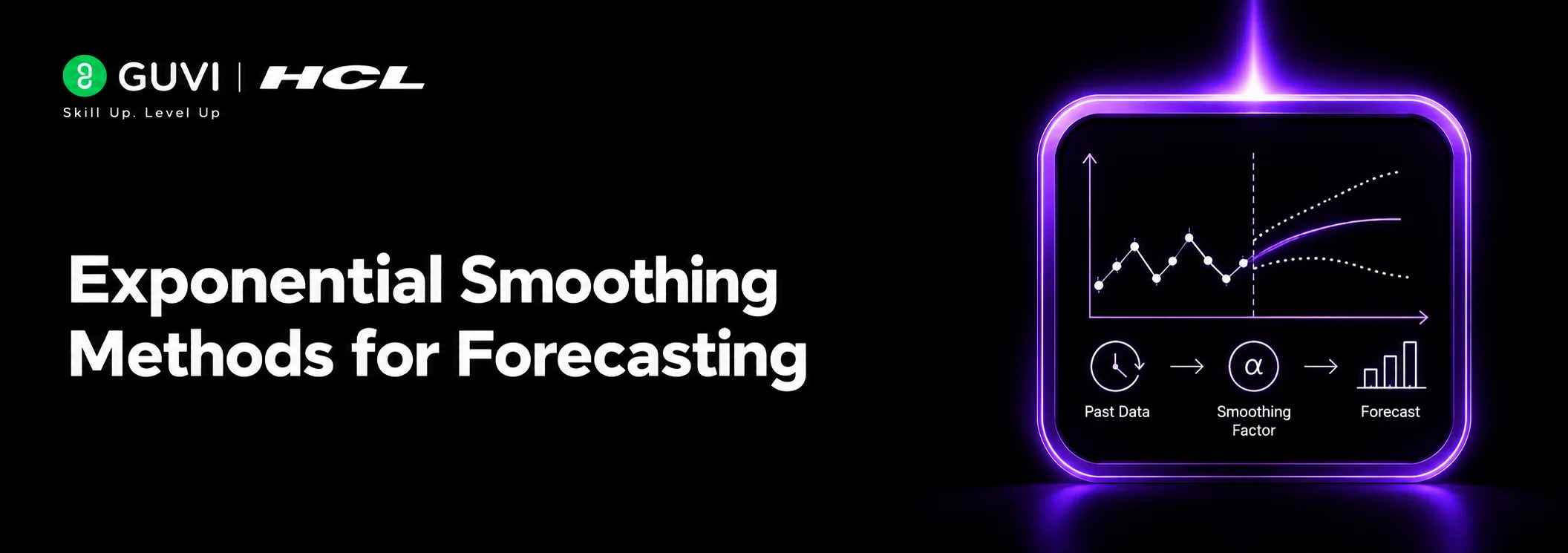
Exponential Smoothing Methods for Forecasting
Sep 04, 2026 3 Min Read 14 Views
(Last Updated)
Forecasting involves using historical data to estimate future values. Exponential Smoothing Methods are popular time series techniques that assign greater importance to recent observations while gradually reducing the influence of older data. They are useful for forecasting data with level, trend, and seasonal patterns.
Table of contents
- TL;DR Summary
- What Is Exponential Smoothing?
- Why Use Exponential Smoothing?
- Types of Exponential Smoothing
- Simple Exponential Smoothing
- Holt's Linear Trend Method
- Holt-Winters Method
- Additive vs Multiplicative Seasonality
- Additive Seasonality
- Multiplicative Seasonality
- How Exponential Smoothing Works
- Step 1: Prepare the Time Series
- Step 2: Examine the Pattern
- Step 3: Select the Method
- Step 4: Estimate Parameters
- Step 5: Generate Forecasts
- Step 6: Evaluate Performance
- Example
- Key Concepts to Remember
- A Practical Forecasting Workflow
- Collect Historical Data
- Clean the Dataset
- Visualize the Series
- Choose a Model
- Fit the Model
- Generate Forecasts
- Evaluate the Forecast
- Compare With Baselines
- Real-World Applications
- Retail
- Supply Chain
- Energy
- Finance
- Manufacturing
- Best Practices
- Conclusion
- FAQs
- What is Exponential Smoothing?
- What is Simple Exponential Smoothing used for?
- What is Holt's method?
- What is Holt-Winters forecasting?
- What does the smoothing parameter control?
- What is the difference between additive and multiplicative seasonality?
- How do you evaluate exponential smoothing forecasts?
TL;DR Summary
- Exponential smoothing gives more weight to recent observations.
- Simple Exponential Smoothing is useful for data without a clear trend or seasonality.
- Holt’s method handles trends.
- Holt-Winters methods handle trend and seasonality.
- These methods are relatively simple and computationally efficient.
Quick Answer
| Exponential Smoothing is a forecasting technique that calculates future values by assigning different weights to historical observations, with recent observations generally receiving greater weight. The main methods include Simple Exponential Smoothing, Holt’s method, and Holt-Winters’ method. The appropriate method depends on whether the time series contains level, trend, and seasonal patterns. |
What Is Exponential Smoothing?
Exponential smoothing forecasts future values by applying exponentially decreasing weights to older observations.
In simple terms:
Recent observations → Higher weight
Older observations → Lower weight
This makes exponential smoothing responsive to recent changes in the data.
Why Use Exponential Smoothing?
Exponential smoothing can be useful when:
- Recent observations are more relevant.
- The dataset contains temporal patterns.
- A simple forecasting method is preferred.
- Fast forecasting is required.
- Interpretability is important.
Types of Exponential Smoothing
1. Simple Exponential Smoothing
Simple Exponential Smoothing is designed for time series with a relatively stable level and no systematic trend or seasonality.
A basic form is:
Fₜ₊₁ = αYₜ + (1 − α)Fₜ
Where:
- Fₜ₊₁ = next forecast
- Yₜ = current observed value
- Fₜ = current forecast
- α = smoothing parameter between 0 and 1
A larger α gives greater weight to recent observations.
2. Holt’s Linear Trend Method
Holt’s method extends exponential smoothing to handle trend.
It separately estimates:
- Level
- Trend
This makes it more appropriate when the series consistently increases or decreases over time.
3. Holt-Winters Method
Holt-Winters extends the approach further by modeling:
- Level
- Trend
- Seasonality
It is useful for data with recurring seasonal patterns, such as monthly sales or daily demand.
Additive vs Multiplicative Seasonality
Holt-Winters methods can represent seasonality in different ways.
Additive Seasonality
Used when seasonal fluctuations remain approximately constant over time.
Multiplicative Seasonality
Used when seasonal fluctuations change proportionally with the level of the series.
For example, seasonal sales variations that become larger as overall sales increase may be better represented by multiplicative seasonality.
How Exponential Smoothing Works
A typical workflow is:
Historical Data → Identify Pattern → Select Method → Estimate Parameters → Forecast → Evaluate
Step 1: Prepare the Time Series
Ensure observations are correctly ordered by time.
Step 2: Examine the Pattern
Determine whether the data has:
- Level
- Trend
- Seasonality
Step 3: Select the Method
Choose Simple Exponential Smoothing, Holt’s method, or Holt-Winters based on the observed pattern.
Step 4: Estimate Parameters
Estimate smoothing parameters using the available historical data.
Step 5: Generate Forecasts
Use the fitted model to predict future observations.
Step 6: Evaluate Performance
Compare predictions against actual values using suitable forecasting metrics.
Example
Suppose a retailer records monthly sales.
If sales fluctuate around a relatively stable level without clear trend or seasonality, Simple Exponential Smoothing may be appropriate.
If sales steadily increase over time, Holt’s method may be more suitable.
If sales increase while also showing a repeating yearly pattern, Holt-Winters can model both the trend and seasonality.
The term “exponential” comes from the way the weights assigned to older observations decrease exponentially as observations become further removed from the present.
Key Concepts to Remember
- Simple Exponential Smoothing: Handles level without systematic trend or seasonality.
- Holt’s method: Handles level and trend.
- Holt-Winters: Handles level, trend, and seasonality.
- Smoothing parameter: Controls how strongly recent observations influence the forecast.
- Additive seasonality: Seasonal variation is roughly constant.
- Multiplicative seasonality: Seasonal variation changes with the series level.

A Practical Forecasting Workflow
1. Collect Historical Data
Gather regularly spaced observations for the variable being forecast.
2. Clean the Dataset
Address missing observations and inconsistencies that could affect forecasting.
3. Visualize the Series
Look for trends, recurring patterns, and changes in variability.
4. Choose a Model
Select the simplest exponential smoothing method that matches the characteristics of the series.
5. Fit the Model
Estimate the model parameters using historical observations.
6. Generate Forecasts
Produce predictions for the desired forecasting horizon.
7. Evaluate the Forecast
Use metrics such as MAE, RMSE, or MAPE when appropriate.
8. Compare With Baselines
Compare the exponential smoothing model with simple forecasting methods to determine whether it provides meaningful improvement.
The HCL GUVI’s Artificial Intelligence eBook introduces artificial intelligence, machine learning, generative AI, and intelligent automation concepts, helping learners build a broader understanding of modern AI technologies.
Real-World Applications
Retail
Forecast product sales and inventory requirements.
Supply Chain
Estimate future demand to support inventory and planning decisions.
Energy
Forecast electricity consumption and other time-dependent measurements.
Finance
Model certain time-dependent business and economic indicators.
Manufacturing
Forecast production requirements and operational demand.
Professionals interested in artificial intelligence, machine learning, and forecasting can strengthen their expertise through HCL GUVI’s Artificial Intelligence and Machine Learning Course.
Best Practices
- Examine the time series before selecting a method.
- Preserve chronological order when splitting data.
- Avoid using future observations during model training.
- Select additive or multiplicative seasonality based on the data pattern.
- Compare forecasts with appropriate baselines.
- Evaluate forecasts using more than one relevant metric when appropriate.
- Reassess the model when the underlying time series changes.
Conclusion
Exponential Smoothing Methods provide practical approaches for forecasting time-dependent data. Simple Exponential Smoothing works well for stable series, Holt’s method incorporates trends, and Holt-Winters methods can account for both trends and seasonality. Selecting the method based on the actual structure of the data and evaluating its forecasts against suitable baselines can lead to more reliable forecasting results.
FAQs
1. What is Exponential Smoothing?
Exponential Smoothing is a forecasting technique that gives greater weight to recent observations while gradually reducing the influence of older observations.
2. What is Simple Exponential Smoothing used for?
It is generally used for time series with a stable level and without a systematic trend or seasonal pattern.
3. What is Holt’s method?
Holt’s method extends exponential smoothing by modeling both the level and trend of a time series.
4. What is Holt-Winters forecasting?
Holt-Winters extends exponential smoothing to model level, trend, and seasonality.
5. What does the smoothing parameter control?
The smoothing parameter controls how strongly recent observations influence the updated estimate or forecast.
6. What is the difference between additive and multiplicative seasonality?
Additive seasonality assumes seasonal fluctuations are relatively constant, while multiplicative seasonality assumes seasonal fluctuations vary with the level of the series.
7. How do you evaluate exponential smoothing forecasts?
Forecasts can be evaluated using metrics such as MAE, RMSE, and MAPE, along with comparisons against suitable baseline forecasting methods.
Success Stories

About the Author
HCL GUVI
This article was selected and published as part of the HCL GUVI AI Blogathon 2026, an initiative designed to encourage students, AI enthusiasts, and aspiring tech writers to simplify complex AI concepts through impactful technical content. The contest recognized high-quality, original, and insightful AI-focused blogs, with selected authors receiving publication opportunities on the HCL GUVI blog platform along with official author credits and recognition.
View all posts by HCL GUVI
Connect with me @










Did you enjoy this article?