


Artificial Intelligence and Machine Learning Articles
AI in Retail: Demand Forecasting and Personalization
The Cold Start Problem in Recommender Systems


Get In Touch For Details! Request More Information
TinyML: Machine Learning on Microcontrollers
Sep 04, 2026 3 Min Read 12 Views
(Last Updated)
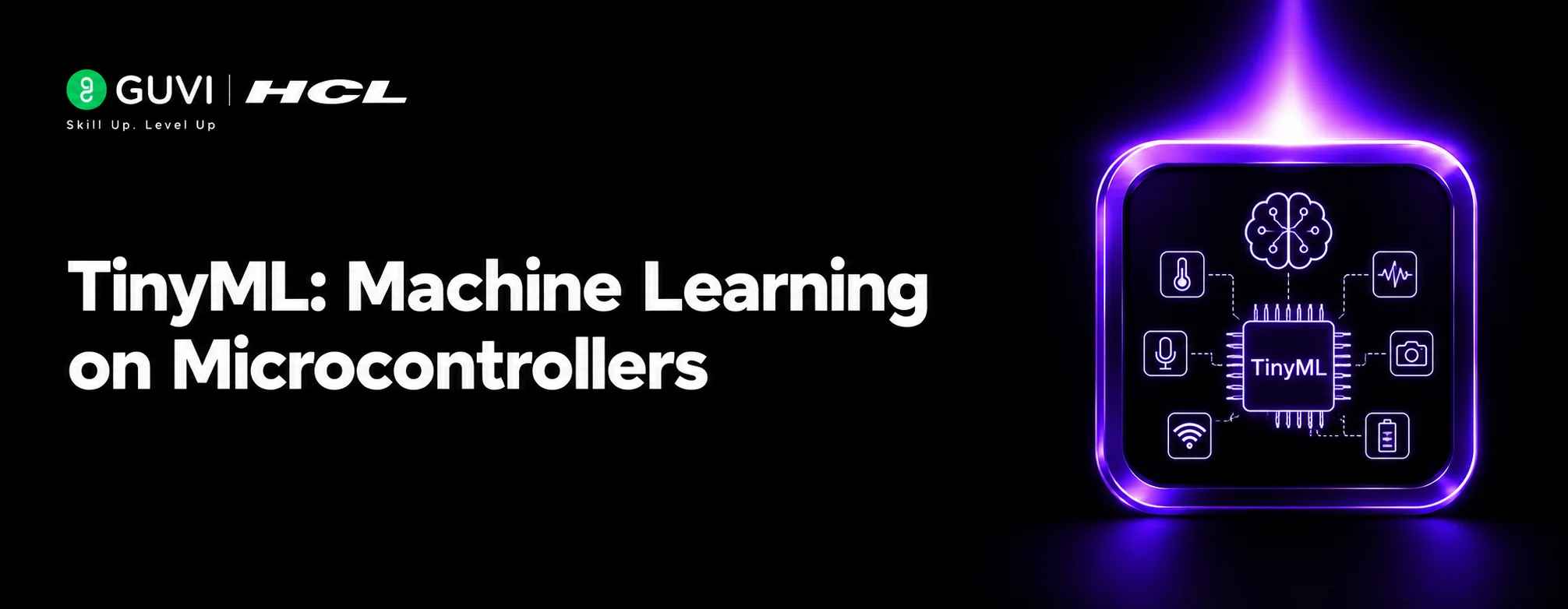
Machine learning does not always need powerful servers or cloud infrastructure. TinyML brings machine learning capabilities to small, low-power devices such as microcontrollers. These devices can process sensor data and make predictions locally, making TinyML useful for applications where low latency, low power consumption, privacy, or limited connectivity is important.
Table of contents
- TL;DR Summary
- What Is TinyML?
- Why TinyML Matters
- How TinyML Works
- Step 1: Collect Data
- Step 2: Prepare the Data
- Step 3: Train the Model
- Step 4: Optimize the Model
- Step 5: Deploy to the Microcontroller
- Step 6: Run Inference
- TinyML Hardware
- Model Optimization
- Quantization
- Pruning
- Smaller Architectures
- Common TinyML Applications
- Keyword Detection
- Predictive Maintenance
- Wearable Devices
- Environmental Monitoring
- Smart Agriculture
- TinyML vs Cloud AI
- Key Concepts to Remember
- A Practical TinyML Workflow
- Define the Task
- Collect Sensor Data
- Train the Model
- Optimize the Model
- Measure Resource Requirements
- Deploy the Model
- Test On Device
- Optimize Further
- Real-World Applications
- Industrial IoT
- Wearables
- Smart Homes
- Agriculture
- Best Practices
- Conclusion
- FAQs
- What is TinyML?
- Why is TinyML useful?
- What devices can run TinyML?
- Why do TinyML models need optimization?
- What is quantization?
- What is TinyML used for?
- How is TinyML different from cloud AI?
TL;DR Summary
- TinyML runs ML models on resource-constrained devices.
- Microcontrollers have limited memory, processing power, and energy.
- Models must be small and computationally efficient.
- TinyML enables local AI without constant cloud connectivity.
- Common applications include sensors, wearables, and smart devices.
Quick Answer
| TinyML is the practice of running machine learning models on small, low-power devices such as microcontrollers. Because these devices have limited memory, processing capacity, and battery power, TinyML models need to be highly optimized. It enables devices to process sensor data and perform tasks such as classification, anomaly detection, and keyword recognition directly on the device. |
What Is TinyML?
TinyML combines:
Machine Learning + Embedded Systems + Low-Power Computing
Instead of sending every sensor reading to a cloud server, a TinyML device can process information locally.
For example:
Microphone → TinyML Model → Recognize Keyword → Trigger Action
This can reduce the need for continuous internet connectivity.
Why TinyML Matters
Microcontrollers are designed to operate with very limited resources.
TinyML can provide:
- Low-power operation
- Local processing
- Reduced latency
- Lower bandwidth requirements
- Improved privacy for some applications
- Offline functionality
How TinyML Works
A typical TinyML workflow is:
Collect Data → Train Model → Optimize Model → Deploy → Run Inference
Step 1: Collect Data
Gather sensor data relevant to the task.
Step 2: Prepare the Data
Clean, label, and preprocess the collected data.
Step 3: Train the Model
Train a machine learning model using a more capable computer or development environment.
Step 4: Optimize the Model
Reduce the model’s memory and computational requirements.
Step 5: Deploy to the Microcontroller
Convert and load the optimized model onto the target device.
Step 6: Run Inference
The microcontroller processes incoming data and produces predictions locally.
TinyML Hardware
TinyML commonly targets microcontrollers with constrained resources.
Examples of hardware capabilities that matter include:
- RAM
- Flash storage
- Processor speed
- Power consumption
- Available sensor interfaces
The hardware must have enough resources to store and execute the selected model.
Model Optimization
Large machine learning models are usually unsuitable for tiny devices without optimization.
Quantization
Quantization reduces the numerical precision used by model parameters and computations.
For example, a model may use lower-precision integer representations instead of larger floating-point representations where appropriate.
Pruning
Pruning removes less-important model parameters to reduce model size and computation.
Smaller Architectures
Using compact neural network architectures can make deployment easier on constrained hardware.
Common TinyML Applications
Keyword Detection
A microcontroller can detect specific spoken keywords locally.
Predictive Maintenance
Sensor data can be analyzed to identify unusual machine behavior.
Wearable Devices
TinyML can process motion or other sensor data on wearable hardware.
Environmental Monitoring
Devices can classify or detect patterns in temperature, vibration, sound, or other sensor measurements.
Smart Agriculture
Sensors can use local ML models to identify patterns in agricultural environments.
TinyML vs Cloud AI
| Feature | TinyML | Cloud AI |
| Processing | On-device | Remote servers |
| Connectivity | Often optional | Usually required |
| Latency | Potentially very low | Network-dependent |
| Power | Designed for low power | Depends on device and connection |
| Model size | Usually highly constrained | Can be much larger |
| Privacy | Data can remain local | Data may be transmitted |
Professionals interested in artificial intelligence, machine learning, and embedded AI can strengthen their expertise through HCL GUVI’s Artificial Intelligence and Machine Learning Course.
Although newer architectures such as EfficientNet and Vision Transformers have emerged, the ResNet architecture remains widely used for its simplicity, reliability, and strong transfer learning performance. Many pretrained computer vision models continue to use ResNet as a backbone.

Key Concepts to Remember
- TinyML brings ML to resource-constrained devices.
- Microcontrollers have limited memory and computational resources.
- Models often require optimization before deployment.
- Quantization can reduce model size and computational requirements.
- Pruning can remove unnecessary model parameters.
- Local inference can reduce latency and bandwidth requirements.
- TinyML is particularly useful for sensor-driven applications.
A Practical TinyML Workflow
1. Define the Task
Determine exactly what the device needs to detect or predict.
2. Collect Sensor Data
Gather representative data from the sensors that will be used in deployment.
3. Train the Model
Train an appropriate model using a development computer.
4. Optimize the Model
Apply techniques such as quantization or pruning when appropriate.
5. Measure Resource Requirements
Check RAM, storage, inference time, and energy consumption.
6. Deploy the Model
Convert the model into a format suitable for the target microcontroller.
7. Test On Device
Evaluate the model using real sensor inputs rather than relying only on desktop testing.
8. Optimize Further
Balance model accuracy against memory, speed, and power requirements.
Real-World Applications
Industrial IoT
Microcontrollers can analyze vibration and other sensor signals to detect potential equipment problems.
Wearables
Local models can interpret motion and other sensor information.
Smart Homes
Devices can recognize sounds, gestures, or other signals without continuously sending raw data to the cloud.
Agriculture
Low-power devices can analyze environmental sensor readings in the field.
HCL GUVI’s Artificial Intelligence eBook introduces artificial intelligence, machine learning, generative AI, and intelligent automation concepts, helping learners build a broader understanding of modern AI technologies.
Best Practices
- Start with a small model appropriate for the device.
- Collect representative real-world sensor data.
- Measure memory and inference requirements early.
- Optimize models before deployment.
- Test performance directly on the target hardware.
- Consider energy consumption for battery-powered devices.
- Balance accuracy with computational constraints.
Conclusion
TinyML makes it possible to run machine learning directly on small, resource-constrained microcontrollers. By combining compact models with optimization techniques such as quantization and pruning, developers can build low-power AI systems capable of local inference. TinyML is particularly useful for sensor-based applications where low latency, offline operation, or reduced data transmission is important.
FAQs
1. What is TinyML?
TinyML is the deployment of machine learning models on small, resource-constrained devices such as microcontrollers.
2. Why is TinyML useful?
TinyML enables local AI processing with potentially low latency, low power consumption, reduced bandwidth requirements, and offline operation.
3. What devices can run TinyML?
TinyML commonly targets microcontrollers and other highly resource-constrained embedded devices.
4. Why do TinyML models need optimization?
Microcontrollers have limited RAM, storage, processing power, and energy, so models often need to be smaller and more computationally efficient.
5. What is quantization?
Quantization reduces the numerical precision used by model parameters and computations, potentially reducing memory and computational requirements.
6. What is TinyML used for?
Applications include keyword detection, predictive maintenance, wearables, environmental monitoring, and smart agriculture.
7. How is TinyML different from cloud AI?
TinyML performs inference directly on the device, while cloud AI generally sends data to remote computing infrastructure for processing.
Success Stories

About the Author
HCL GUVI
This article was selected and published as part of the HCL GUVI AI Blogathon 2026, an initiative designed to encourage students, AI enthusiasts, and aspiring tech writers to simplify complex AI concepts through impactful technical content. The contest recognized high-quality, original, and insightful AI-focused blogs, with selected authors receiving publication opportunities on the HCL GUVI blog platform along with official author credits and recognition.
View all posts by HCL GUVI
Connect with me @










Did you enjoy this article?