


Artificial Intelligence and Machine Learning Articles
AI in Retail: Demand Forecasting and Personalization
The Cold Start Problem in Recommender Systems


Get In Touch For Details! Request More Information
What is Neural Style Transfer Explained
Sep 04, 2026 4 Min Read 11 Views
(Last Updated)
Imagine taking the content of one image and recreating it using the artistic style of another. A photograph of a city, for example, could be transformed to resemble a painting by Van Gogh or a watercolor illustration. Neural Style Transfer makes this possible by using deep learning to separate an image’s content from its visual style and combine them into a new image.
The technique uses neural networks, particularly convolutional neural networks (CNNs), to understand visual patterns at different levels. It has become an important example of how deep learning can be used for creative image generation and transformation.
Table of contents
- TL;DR Summary
- What Is Neural Style Transfer?
- How Does Neural Style Transfer Work?
- Content Representation
- Style Representation
- Content Loss and Style Loss
- The Role of Convolutional Neural Networks
- The Image Optimization Process
- Traditional vs Fast Neural Style Transfer
- Neural Style Transfer With Python
- Key Takeaways
- Conclusion
- FAQs
- What is Neural Style Transfer?
- Which neural network is commonly used for Neural Style Transfer?
- What is content loss?
- What is style loss?
- How can I control the strength of the artistic style?
TL;DR Summary
- Neural Style Transfer combines the content of one image with the style of another.
- CNNs extract visual representations from images.
- Content loss preserves the structure of the content image.
- Style loss measures differences in visual patterns between images.
- The generated image is optimized to minimize a combination of these losses.
- The technique is useful for artistic image generation, design, and visual experimentation.
What Is Neural Style Transfer?
Neural Style Transfer (NST) is a deep learning technique that generates an image by combining:
- Content image: The image whose objects and structure should be preserved.
- Style image: The image whose colors, textures, and artistic patterns should be transferred.
- Generated image: The resulting image containing the content of the first image and visual characteristics of the second.
For example:
Photograph + Painting Style → Stylized PhotographUnlike traditional image filters, Neural Style Transfer uses learned representations from a neural network to identify and reproduce complex visual patterns.
Read More: The Ultimate Guide to Artificial Neural Network (2026)
Explore generative AI with HCL GUVI’s Artificial Intelligence & Machine Learning Course. Learn deep learning, computer vision, and neural networks through practical, industry-focused projects.
How Does Neural Style Transfer Work?
A typical Neural Style Transfer system uses a pretrained CNN.
The network processes the content image, style image, and generated image through different layers. Earlier layers generally capture lower-level visual patterns such as edges and textures, while deeper layers capture more complex structures.
The process can be simplified as:
Content Image + Style Image → CNN Feature Extraction → Loss Calculation → Image Optimization → Stylized ImageThe model repeatedly modifies the generated image to make it more similar to the desired content and style.
Neural Style Transfer became widely known through research demonstrating that CNN features could represent content and style separately enough to recombine them into a new image.
Content Representation
Content representation captures the structural information of an image.
For example, if the content image contains a person standing near a building, the content representation should preserve the major objects and their arrangement.
A deeper CNN layer is commonly used for content representation because deeper layers capture higher-level visual structures.
The system calculates content loss by comparing the CNN representation of the generated image with that of the content image.
A lower content loss means the generated image is more similar to the content image in terms of its learned representation.
Style Representation
Style is more difficult to define directly.
It includes visual characteristics such as:
- Colors
- Textures
- Brush patterns
- Shapes
- Contrast
- Repeated visual structures
Neural Style Transfer commonly represents style using relationships between feature activations.
One traditional approach uses a Gram matrix.
The Gram matrix captures correlations between feature maps and provides information about the textures and patterns present in the image.
The generated image is optimized so that its style representation becomes similar to the style image.
Content Loss and Style Loss
The optimization process typically uses multiple loss components.
- Content Loss
Content loss measures the difference between the content representation of the generated image and the original content image.
- Style Loss
Style loss measures the difference between the style representation of the generated image and the style image.
- Total Loss
The overall objective can be represented conceptually as:
Total Loss = α × Content Loss + β × Style LossHere:
- α controls the importance of content.
- β controls the importance of style.
Increasing the style weight generally produces a stronger artistic transformation, while increasing the content weight tends to preserve more of the original structure.
Pro Tip: Experiment with the content-to-style weighting rather than assuming one setting will work equally well for every pair of images.
The Role of Convolutional Neural Networks
CNNs are central to traditional Neural Style Transfer.
A pretrained CNN provides hierarchical visual representations without requiring the network to be trained specifically for every new style.
Different layers capture different types of information:
| CNN Layer | Typical Representation |
| Early layers | Edges and simple textures |
| Middle layers | Patterns and shapes |
| Deeper layers | Complex structures and semantic information |
Style information can be extracted from multiple layers to capture both fine and coarse visual characteristics.

The Image Optimization Process
One important characteristic of traditional Neural Style Transfer is that the generated image itself is optimized.
Instead of directly training a new neural network for each image pair, the algorithm can start with:
- Random noise
- The content image
- Another initial image
It then repeatedly updates the pixels of the generated image to minimize the total loss.
The simplified workflow is:
- Load the content and style images.
- Load a pretrained CNN.
- Extract content features.
- Extract style features.
- Initialize the generated image.
- Calculate content and style losses.
- Update the generated image.
- Repeat until the desired result is achieved.
Best Practice: Use appropriately sized input images during experimentation. Very large images can significantly increase optimization time and memory requirements.
Traditional vs Fast Neural Style Transfer
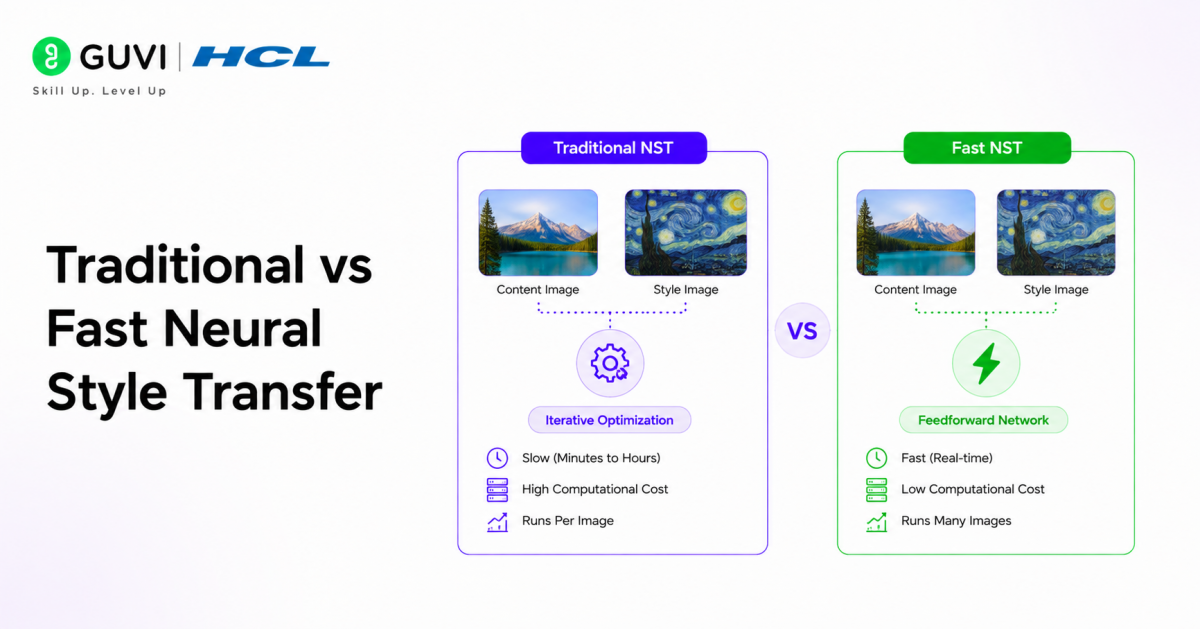
Traditional Neural Style Transfer optimizes each generated image individually.
This provides flexibility but can be computationally expensive.
Fast Neural Style Transfer uses a separate transformation network that is trained to produce stylized images more efficiently.
Once trained, the transformation network can generate results much faster than optimizing every output image from scratch.
The trade-off is that training such a network requires additional preparation and may be designed for particular styles or style families.
Neural Style Transfer With Python
Deep learning frameworks such as PyTorch and TensorFlow can be used to implement Neural Style Transfer.
A typical implementation involves:

content_features = model(content_image)

style_features = model(style_image)

generated_features = model(generated_image)

content_loss = calculate_content_loss(

    generated_features,

    content_features

)

style_loss = calculate_style_loss(

    generated_features,

    style_features

)

total_loss = content_weight * content_loss + style_weight * style_loss
An optimizer then updates the generated image to minimize total_loss.
In practical implementations, additional preprocessing, normalization, feature-layer selection, and optimization details are required.
Key Takeaways
- Neural Style Transfer combines content from one image with style from another.
- CNNs provide feature representations used to compare images.
- Content loss helps preserve image structure.
- Style loss helps reproduce visual patterns and textures.
- Gram matrices are commonly used for traditional style representation.
- Content and style weights control the resulting balance.
- Fast approaches can provide much quicker inference.
- Results depend heavily on image selection and optimization settings.
Explore generative AI with HCL GUVI’s Artificial Intelligence & Machine Learning Course. Learn deep learning, computer vision, and neural networks through practical, industry-focused projects.
Conclusion
Neural Style Transfer demonstrates how deep learning can move beyond traditional prediction tasks and generate creative visual transformations. By using CNN representations to separate content from style, the technique can create images that preserve the structure of one image while adopting the artistic characteristics of another.
Although traditional NST can be computationally expensive and sensitive to optimization settings, it provides an intuitive introduction to neural image representations, feature extraction, and image generation. Its concepts also contribute to the broader understanding of how deep learning models can represent and manipulate visual information.
FAQs
What is Neural Style Transfer?
Neural Style Transfer is a deep learning technique that combines the content of one image with the artistic style of another to generate a new image.
Which neural network is commonly used for Neural Style Transfer?
Traditional implementations commonly use a pretrained convolutional neural network to extract content and style representations.
What is content loss?
Content loss measures how different the generated image’s content representation is from the content image’s representation.
What is style loss?
Style loss measures differences between the visual feature relationships of the generated image and the style image.
How can I control the strength of the artistic style?
The balance between content and style can be adjusted using the corresponding loss weights. Increasing the style weight generally produces a stronger style transformation.
Success Stories

About the Author
HCL GUVI
This article was selected and published as part of the HCL GUVI AI Blogathon 2026, an initiative designed to encourage students, AI enthusiasts, and aspiring tech writers to simplify complex AI concepts through impactful technical content. The contest recognized high-quality, original, and insightful AI-focused blogs, with selected authors receiving publication opportunities on the HCL GUVI blog platform along with official author credits and recognition.
View all posts by HCL GUVI
Connect with me @










Did you enjoy this article?