


Product Management Articles
How to Write a Product Requirements Document That Teams Actually Use
What Is Net Promoter Score? A Beginner’s Guide to NPS
Top Product Analytics Tools Compared: Amplitude vs Mixpanel vs Google Analytics


Get In Touch For Details! Request More Information
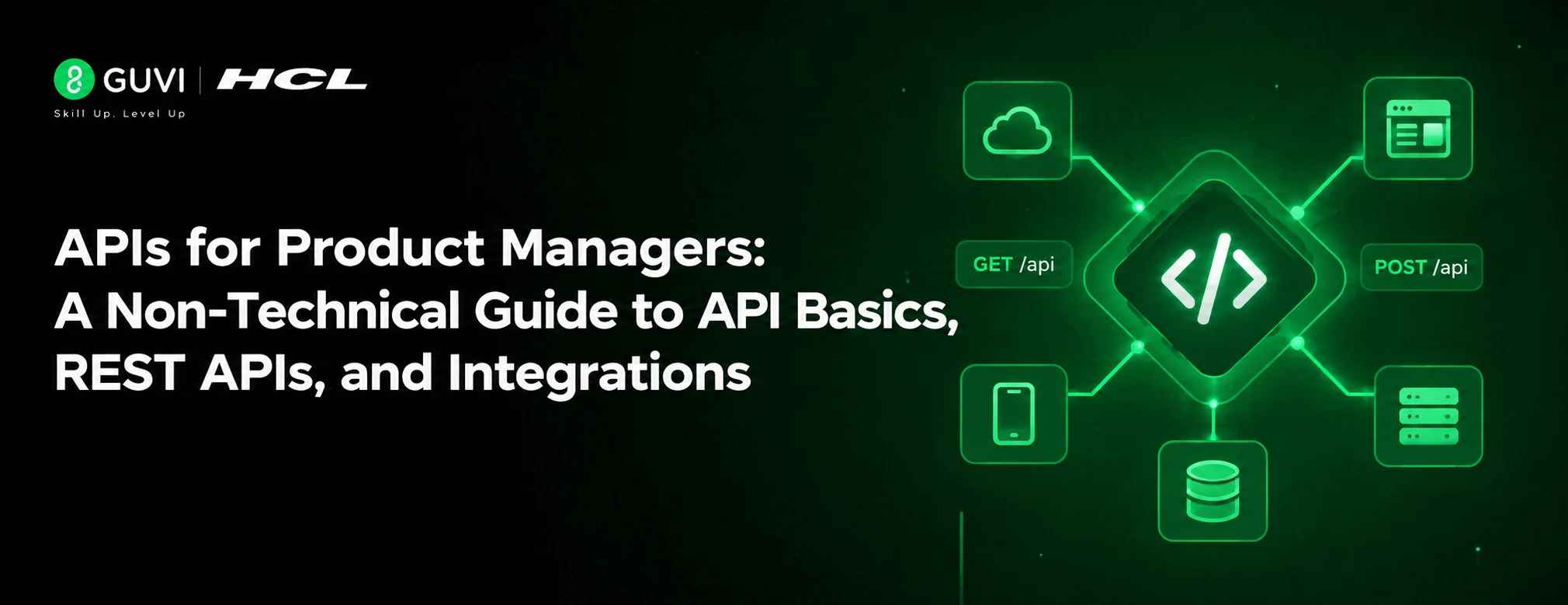
APIs for Product Managers: A Non-Technical Guide to API Basics, REST APIs, and Integrations
Aug 21, 2026 5 Min Read 72 Views
(Last Updated)
Table of contents
- TL;DR Summary
- Introduction
- What Are APIs for Product Managers?
- How APIs Work in Plain English
- Why Product Managers Need API Basics
- Better Collaboration With Engineering
- Faster Product Discovery
- Stronger Business Models
- REST API Explained Without Code
- What Is a REST API?
- REST API Actions Product Managers Should Know
- Why REST API Matters in Product Decisions
- API Integration in Product Management
- What Is API Integration?
- Example: API Integration in an eCommerce Product
- What PMs Should Ask Before an API Integration
- REST API vs Webhooks vs SDKs
- Which One Should a PM Care About Most?
- Product Scenarios Where APIs Matter
- Fintech: UPI and Payment Workflows
- SaaS: CRM and Productivity Integrations
- AI Products: Model and Data Connections
- Common Mistakes Product Managers Make with APIs
- Treating APIs as Purely Technical Work
- Ignoring Error States and Fallback Flows
- Not Reading API Documentation at a Product Level
- Forgetting Security and Permissions
- Measuring Launch, Not API Success
- Wrapping Up
- Frequently Asked Questions
- What are APIs for Product Managers?
- Do Product Managers need to learn coding to understand APIs?
- What is a REST API in simple terms?
- Why is API integration important for Product Managers?
- What should a PM ask during an API planning meeting?
- Is API-first product development useful?
- What is the difference between an API and an integration?
- How do APIs affect product strategy?
TL;DR Summary
APIs for Product Managers are important because APIs decide how products exchange data, connect with partners, enable new features, and scale business models. You do not need to code to understand API basics, but you should know what an API does, how a REST API works, what API integration means, and how to ask the right product, user, security, and business questions. With 74% of organizations adopting an API-first approach, API literacy is now a core product management skill.
Introduction
APIs for Product Managers are no longer “engineering-only” knowledge. If you manage a SaaS product, fintech app, health-tech platform, eCommerce system, AI tool, or internal dashboard, APIs quietly shape your product’s speed, partnerships, revenue, and user experience.
An API, or Application Programming Interface, is a structured way for two software systems to communicate. For Product Managers, APIs help define what data moves between systems, which actions users can trigger, how partners connect, and how reliably a product can scale.
Postman’s 2024 State of the API Report found that 62% of companies generate revenue from APIs, which means APIs are not just technical components anymore; they are product and business assets.
What Are APIs for Product Managers?
Before you discuss API scope, timelines, or integration dependencies, you need a simple mental model. APIs are like product contracts between systems.
APIs for Product Managers refer to the practical understanding of how software systems share data and functionality so PMs can define requirements, prioritize integrations, collaborate with engineers, and evaluate user impact without writing code.
For example, when a food delivery app shows live order tracking, it may use APIs from maps, payments, restaurant systems, delivery partners, and notification tools.
How APIs Work in Plain English
Think of an API as a restaurant waiter.
You do not enter the kitchen yourself. You place an order through the waiter. The waiter takes your request, gets the response from the kitchen, and brings it back in a structured format.
In product terms:
- The user action is the request.
- The API is the messenger.
- The backend system processes the request.
- The response updates the product experience.
Also Read: Product Manager Roadmap
Why Product Managers Need API Basics
API basics help you make better product decisions. You may not write API documentation, but you will often decide what the API should enable, who will use it, and how success will be measured.
Better Collaboration With Engineering
When engineers say, “This integration needs authentication, rate limits, and error handling,” you should understand the business impact.
For example, a failed payment API is not just a technical issue. It affects checkout completion, revenue, support tickets, and user trust.
Faster Product Discovery
APIs help you validate whether a feature can be built through existing systems.
A Product Manager can ask:
- Does this data already exist?
- Can we access it through an existing API?
- Is the API internal, partner-facing, or public?
- What happens if the third-party API fails?
- Are there compliance or privacy risks?
Stronger Business Models
APIs can also become monetizable products. MuleSoft’s 2025 Connectivity Benchmark Report notes that API-related implementations account for 40% of enterprise revenue on average, showing why PMs must treat APIs as business enablers, not backend details.
APIs are sometimes called the “waiters of the internet.” You ask for something, the API carries your request to another system, and then brings back the response. As a Product Manager, your job is not to cook the meal, but to make sure the user gets the right dish, at the right time, without confusion.

REST API Explained Without Code
REST API is one of the most common API styles used in modern products. As a Product Manager, you do not need to memorize syntax, but you should understand the flow.
What Is a REST API?
A REST API is a web-based API that lets systems create, read, update, or delete information using standard request methods. It is commonly used because it is scalable, predictable, and easier for teams to document and consume.
REST API Actions Product Managers Should Know
| REST API Method | Product Meaning | Example |
| GET | Fetch information | Show user profile details |
| POST | Create something new | Place a food order |
| PUT/PATCH | Update existing data | Edit shipping address |
| DELETE | Remove something | Delete saved payment method |
Why REST API Matters in Product Decisions
REST API design affects:
- Feature speed: A well-designed REST API helps teams build and release features faster because data and actions are easier to access.
- Mobile app performance: Faster API responses make app screens load quickly, improving the user experience on mobile devices.
- Partner onboarding: Clear API structure and documentation help partners connect with your product without long back-and-forth discussions.
- Data accuracy: REST APIs ensure the right data is fetched, updated, or deleted consistently across different systems.
- User permissions: API design controls who can view, edit, or access specific data inside the product.
- Error handling: Good APIs return clear error messages, helping teams design better fallback flows when something fails.
- Analytics tracking: APIs can capture important user actions and system events, making it easier to measure product performance.
For example, if a banking app takes too long to fetch transaction history, the issue may sit in API response time, not screen design.
API Integration in Product Management
API integration means connecting two or more systems through APIs so they can exchange data or trigger actions automatically.
What Is API Integration?
API integration is the process of linking software systems so they can share information and perform workflows without manual effort. For Product Managers, API integration matters because it affects feature feasibility, user experience, operational efficiency, and partnership strategy.
Example: API Integration in an eCommerce Product
Imagine you manage an online fashion store. Your checkout flow may depend on:
- Payment gateway API for transactions
- Inventory API for stock availability
- Logistics API for delivery estimates
- CRM API for customer history
- Notification API for SMS and email updates
If one API fails, the user may face delayed checkout, incorrect stock status, or missing delivery updates.
What PMs Should Ask Before an API Integration
Use this checklist before prioritizing an integration:
- What user problem does this integration solve?
- Is the API internal, third-party, partner, or public?
- What data will be exchanged?
- Who owns the API documentation?
- What are the rate limits and failure scenarios?
- What privacy, security, or compliance rules apply?
- How will we measure success?
MuleSoft reported that only 2% of businesses have integrated more than half of their applications, highlighting why integration complexity is a real product and operations challenge.
REST API vs Webhooks vs SDKs
Product Managers often hear these terms during planning meetings. Here is a simple comparison.
| Concept | What It Means | Best Used When |
| REST API | System asks for data or sends an action request | Fetching orders, updating profiles, processing payments |
| Webhook | System automatically notifies another system when something happens | Payment success alert, shipment status update |
| SDK | Pre-built toolkit that helps developers integrate faster | Adding maps, analytics, chat, or payment features |
Which One Should a PM Care About Most?
You should care about all three, but from a product angle.
REST APIs support planned actions. Webhooks support event-based updates. SDKs reduce implementation effort when a platform provides ready-made tools.
Product Scenarios Where APIs Matter
APIs become easier to understand when you connect them to product outcomes. Let’s look at practical scenarios.
Fintech: UPI and Payment Workflows
A fintech Product Manager may rely on APIs for bank verification, UPI payments, KYC checks, fraud detection, and transaction status.
The PM’s responsibility is to define the user journey, fallback states, retry flows, and compliance needs.
SaaS: CRM and Productivity Integrations
A SaaS company may offer integrations with Slack, HubSpot, Salesforce, Google Workspace, or Microsoft Teams.
Here, APIs directly influence adoption because customers expect tools to work together instead of operating in silos.
AI Products: Model and Data Connections
AI products often depend on APIs to send prompts, retrieve context, connect enterprise data, and deliver generated responses.
Postman’s 2025 State of the API Report notes that OpenAI accounted for 56% of total Postman AI traffic over the past 12 months, showing how AI adoption is increasing API usage across workflows.
When your payment fails but the money is debited, an API response may be stuck, delayed, or mismatched between systems. That is why Product Managers must think about failure messages, retries, refunds, and user reassurance before launch.
Common Mistakes Product Managers Make with APIs
API mistakes can delay launches, frustrate engineers, and damage user experience. Here are the most common ones to avoid.
Treating APIs as Purely Technical Work
Many new PMs assume APIs belong only to engineering. That creates gaps in product requirements because APIs also affect user journeys, partner experience, pricing, support, and analytics.
A better approach is to define the “why” and “what” clearly. Explain the user problem, business outcome, required data, expected response, and success metric before engineering decides the “how.”
Ignoring Error States and Fallback Flows
A product may work perfectly in demos but fail in real-world conditions. APIs can time out, return incomplete data, hit rate limits, or become unavailable during third-party downtime.
As a PM, you should define what users see when something fails. For example, should the app retry, show cached data, send an alert, or ask the user to try again later?
Not Reading API Documentation at a Product Level
You do not need to understand every technical field in API documentation. But you should still scan the documentation for authentication rules, endpoints, limits, sample responses, and error codes.
This helps you identify hidden constraints early. For example, an API may not support the data field your feature depends on, which can change scope, timeline, and priority.
Forgetting Security and Permissions
APIs often move sensitive user, payment, health, or business data. If permissions are poorly defined, users may access information they should not see.
A Product Manager should ask who can access the API, what data is shared, how consent is handled, and whether the integration follows relevant privacy or compliance rules.
Measuring Launch, Not API Success
Shipping an API integration is not the finish line. You need to track whether it improves the product.
Useful metrics include API uptime, response time, error rate, integration adoption, partner activation time, checkout completion, support ticket reduction, and revenue impact.
If you want to move from understanding API basics to making stronger product decisions, structured learning can help you connect technology, market strategy, analytics, and product execution. The Certificate Programme in Product Management by IIM Indore is a useful next step for professionals who want to build, launch, and scale products with more confidence. The programme includes structured product management learning, analytics, AI, product design, and hands-on project exposure.
Wrapping Up
APIs for Product Managers are not about learning to code. They are about understanding how products connect, scale, exchange data, and create value. Once you understand API basics, REST API workflows, and API integration decisions, you can write better requirements, ask sharper questions, reduce delivery risks, and collaborate more effectively with engineering teams. In a market where APIs drive revenue, partnerships, automation, and AI-powered products, API literacy gives you a serious product leadership advantage.
Frequently Asked Questions
1. What are APIs for Product Managers?
APIs for Product Managers are the practical API concepts PMs need to define product requirements, understand integrations, collaborate with engineers, and evaluate business impact without writing code.
2. Do Product Managers need to learn coding to understand APIs?
No. Product Managers do not need to code APIs, but they should understand API basics such as requests, responses, authentication, documentation, rate limits, and error handling.
3. What is a REST API in simple terms?
A REST API is a common type of web API that lets software systems send or receive data using standard actions such as GET, POST, PUT, PATCH, and DELETE.
4. Why is API integration important for Product Managers?
API integration is important because it connects products with payment systems, CRMs, analytics tools, logistics partners, AI models, and other platforms that shape user experience.
5. What should a PM ask during an API planning meeting?
A PM should ask what user problem the API solves, what data is exchanged, who owns the documentation, what failure states exist, and how success will be measured.
6. Is API-first product development useful?
Yes. API-first development helps teams align earlier, reuse services, onboard partners faster, and build scalable products with clearer technical contracts.
7. What is the difference between an API and an integration?
An API is the interface that allows systems to communicate. An integration is the completed connection between systems using one or more APIs.
8. How do APIs affect product strategy?
APIs can unlock partnerships, automate workflows, enable platform business models, improve customer experience, and generate direct or indirect revenue.
Success Stories












Did you enjoy this article?