


Product Management Articles
How to Write a Product Requirements Document That Teams Actually Use
APIs for Product Managers: A Non-Technical Guide to API Basics, REST APIs, and Integrations
Top Product Analytics Tools Compared: Amplitude vs Mixpanel vs Google Analytics


Get In Touch For Details! Request More Information

What Is Net Promoter Score? A Beginner’s Guide to NPS
Aug 17, 2026 6 Min Read 100 Views
(Last Updated)
Table of contents
- TL;DR Summary
- Introduction
- What Is Net Promoter Score?
- Net Promoter Score Customer Groups
- How Is Net Promoter Score Calculated?
- Net Promoter Score Formula
- What Is a Good Net Promoter Score?
- Why Net Promoter Score Matters for Businesses
- It Measures Customer Loyalty, Not Just Satisfaction
- It Helps You Spot Revenue Risk Early
- It Gives Teams a Shared Customer Metric
- Net Promoter Score vs Other Customer Satisfaction Metrics
- Comparison of NPS, CSAT, and CES
- How to Improve Net Promoter Score
- Close the Feedback Loop Quickly
- Fix Repeated Customer Pain Points
- Segment Your Net Promoter Score Data
- Improve the Moments That Shape Customer Loyalty
- Business Scenarios Where NPS Creates Impact
- SaaS Product Teams
- E-Commerce Brands
- Banking and Fintech Companies
- EdTech and Learning Platforms
- Common Mistakes to Avoid While Using Net Promoter Score
- Treating NPS as a Vanity Metric
- Surveying Too Often
- Ignoring Passives
- Not Sharing NPS Insights Across Teams
- Chasing the Score Instead of Improving the Experience
- Wrapping Up
- Frequently Asked Questions
- What is Net Promoter Score?
- How do you calculate Net Promoter Score?
- What is a good NPS score?
- Why is the Net Promoter Score important?
- Is the Net Promoter Score a customer satisfaction metric?
- How often should companies measure NPS?
- What is the difference between NPS and CSAT
- How can a company improve customer loyalty using NPS?
TL;DR Summary
Net Promoter Score is a customer loyalty metric that measures how likely customers are to recommend your product, service, or brand. It is calculated by subtracting the percentage of detractors from the percentage of promoters. A strong NPS helps businesses identify loyal customers, unhappy users, and improvement areas. To improve NPS, you must close the feedback loop, fix recurring pain points, personalize customer experiences, and connect NPS insights with product, support, and business decisions.
Introduction
Customer loyalty is no longer built only through discounts, features, or fast delivery. Today, customers stay with brands that listen, solve problems quickly, and make every interaction feel easy.
That is why Net Promoter Score has become one of the most widely used customer satisfaction metrics. It gives businesses a simple answer to a powerful question: Will your customers recommend you?
Net Promoter Score is a customer loyalty metric that measures how likely customers are to recommend a company, product, or service to others. Customers rate their likelihood on a 0–10 scale, and the final score shows whether a brand has more loyal promoters or unhappy detractors.
Bain & Company says Fred Reichheld created the Net Promoter System in 2003 to help organizations measure loyalty and build stronger customer relationships.
What Is Net Promoter Score?
Net Promoter Score, commonly called NPS, is a simple feedback system used to measure customer loyalty. It asks customers one core question:
“How likely are you to recommend us to a friend or colleague?”
Customers respond on a scale from 0 to 10. Based on their rating, they are grouped into promoters, passives, and detractors.
Net Promoter Score Customer Groups
| Customer Group | Score Range | Meaning |
| Promoters | 9–10 | Loyal customers who are likely to recommend you |
| Passives | 7–8 | Satisfied but not emotionally loyal |
| Detractors | 0–6 | Unhappy customers who may leave or discourage others |
A high NPS usually means customers trust your brand enough to recommend it. A low NPS means customers are facing issues that need urgent attention.
How Is Net Promoter Score Calculated?
NPS is easy to calculate, but the real value comes from interpreting it correctly. You should not treat it as just another dashboard number.
Net Promoter Score Formula
Net Promoter Score = % Promoters – % Detractors
For example, suppose 100 customers respond to your survey:
- 60 are promoters
- 25 are passives
- 15 are detractors
Your NPS will be:
60% – 15% = 45
So, your Net Promoter Score is 45.
What Is a Good Net Promoter Score?
A positive NPS means you have more promoters than detractors. However, a “good” score depends on your industry, customer expectations, and competition.
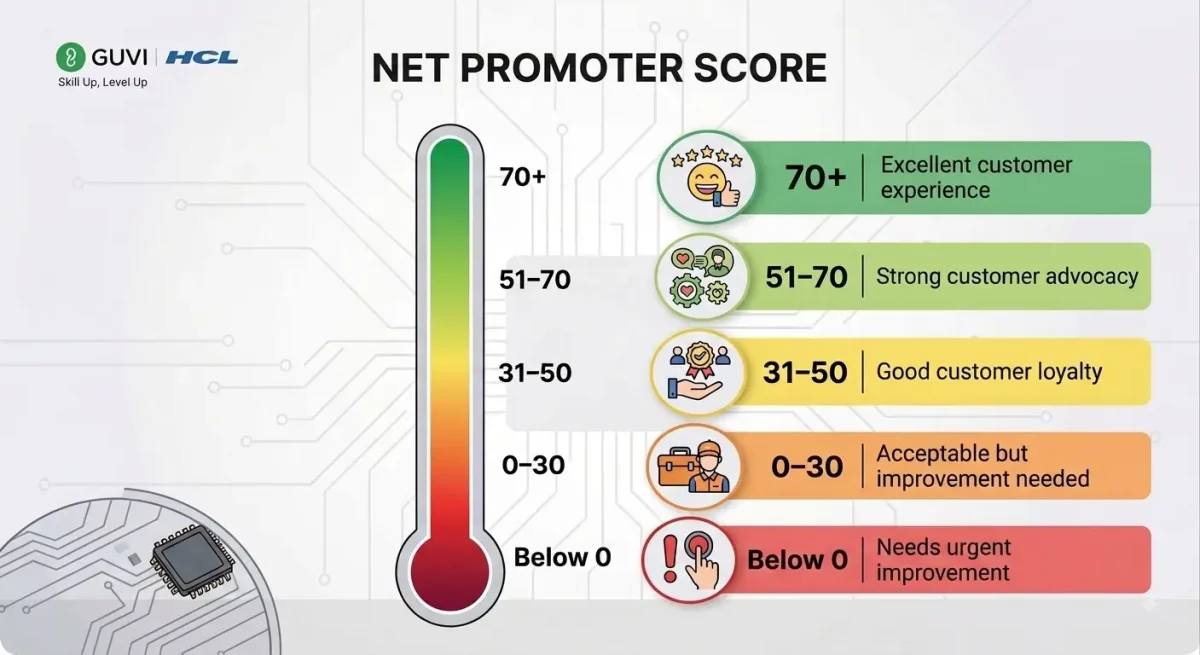
Bain notes that sustained value creators often have Net Promoter Scores two times higher than the average company, showing why NPS is closely linked to customer-led growth.
Why Net Promoter Score Matters for Businesses
NPS matters because it connects customer emotion with business performance. It tells you whether customers are simply buying from you or actively supporting your growth.
It Measures Customer Loyalty, Not Just Satisfaction
Customer satisfaction can be temporary. A customer may be satisfied after one purchase but still switch to a competitor next month.
Net Promoter Score goes deeper because it measures recommendation intent. When customers recommend your brand, they put their own credibility behind your product.
That makes NPS a strong indicator of future retention, referrals, and repeat purchases.

It Helps You Spot Revenue Risk Early
Negative experiences directly affect spending. Qualtrics XM Institute reported that bad customer experiences put $3.7 trillion of global sales at risk in 2024, based on consumer behavior after poor experiences.
This is why NPS should not sit only with the customer support team. Product managers, marketers, sales teams, and leadership should all study it.
It Gives Teams a Shared Customer Metric
NPS works well because it is simple. Everyone can understand whether promoters are increasing or detractors are growing.
For example:
- Product teams can identify confusing features.
- Support teams can reduce repeated complaints.
- Marketing teams can find happy customers for testimonials.
- Leadership teams can track customer loyalty over time.
Net Promoter Score vs Other Customer Satisfaction Metrics
Net Promoter Score is powerful, but it should not be used alone. The best customer experience teams combine it with other customer satisfaction metrics.
Comparison of NPS, CSAT, and CES
| Metric | Measures | Best Used For |
| NPS | Customer loyalty and recommendation intent | Long-term relationship tracking |
| CSAT | Satisfaction after a specific interaction | Support tickets, purchases, onboarding |
| CES | Ease of completing a task | Checkout, app usage, issue resolution |
NPS tells you whether customers will recommend you. CSAT tells you whether they liked a specific experience. CES tells you how easy that experience was.
Together, these metrics give you a clearer view of customer loyalty and customer friction.
How to Improve Net Promoter Score
Improving NPS is not about asking more surveys. It is about acting on what customers already told you.
Close the Feedback Loop Quickly
When a detractor gives negative feedback, respond fast. A simple follow-up can turn frustration into trust.
You can ask:
- What went wrong?
- What did you expect instead?
- What can we fix immediately?
- Would you be open to a follow-up conversation?
The goal is not to defend your brand. The goal is to understand the customer’s pain clearly.
Fix Repeated Customer Pain Points
One angry response is feedback. Ten similar complaints are a pattern.
Group NPS feedback by themes such as:
- Pricing confusion: Customers may not clearly understand what they are paying for or why certain charges apply.
- Slow support: Delayed responses can make even small issues feel frustrating and unresolved.
- Product bugs: Recurring glitches can reduce trust, even if the core product is useful.
- Poor onboarding: Customers may struggle to see value if the first-time experience is confusing.
- Delivery delays: Late deliveries can damage expectations, especially when communication is unclear.
- Complicated cancellation: A difficult exit process can turn a neutral customer into a detractor.
Once you identify patterns, assign owners to fix them. This turns NPS from a reporting metric into an improvement system.
Segment Your Net Promoter Score Data
A single company-wide NPS can hide important insights.
Segment NPS by:
- New vs repeat customers: New users may reveal onboarding issues, while repeat users show long-term loyalty trends.
- Free vs paid users: Paid users often have higher expectations around value, support, and reliability.
- Product category: Different products may create different levels of satisfaction and frustration.
- Region: Customer expectations, service quality, and delivery experiences can vary by location.
- Customer plan: Premium users may expect faster support, better features, and smoother experiences.
- Support experience: Customers who recently contacted support may rate you based on how well their issue was handled.
- Acquisition channel: Users from ads, referrals, or organic search may arrive with different expectations.
For instance, an edtech platform may find that learners love the course content but struggle with doubt resolution. That insight is far more useful than a generic NPS score.
Improve the Moments That Shape Customer Loyalty
Customers usually remember peak moments, painful moments, and final outcomes.
Focus on improving moments such as:
- First purchase or signup: A smooth first step creates confidence and reduces early drop-offs.
- Onboarding: Clear guidance helps customers understand value faster.
- Payment experience: A simple and secure payment flow builds trust at a critical moment.
- Support escalation: Fast escalation shows customers that serious issues are being handled with priority.
- Renewal: A transparent renewal process makes customers feel informed, not trapped.
- Refund or cancellation: A respectful exit experience can preserve trust even when customers leave.
- Product upgrade: A helpful upgrade journey shows customers why the higher plan is worth it.
Forrester’s 2024 US Customer Experience Index found that CX quality in the US reached an all-time low after declining for three consecutive years, which makes consistent experience improvement even more important.
Your happiest customers may be your best unpaid marketers. A promoter does more than buy from you; they can influence friends, colleagues, social media followers, and review platforms without being asked.
Business Scenarios Where NPS Creates Impact
NPS becomes useful when it is connected to real business decisions. Here are practical scenarios where teams can apply it.
SaaS Product Teams
A SaaS company can use Net Promoter Score after onboarding, feature adoption, and renewal cycles.
If detractors mention “too many setup steps,” the product team can simplify onboarding. If promoters praise one feature repeatedly, marketing can highlight that feature in campaigns.
E-Commerce Brands
An e-commerce business can send NPS surveys after delivery.
If customers rate the product highly but complain about delivery delays, the issue may not be product quality. It may be logistics, communication, or tracking transparency.
Banking and Fintech Companies
A fintech app can measure NPS after KYC, loan approval, payment failure, or customer support interactions.
This helps teams identify whether customers trust the platform enough to continue using it for sensitive financial tasks.
EdTech and Learning Platforms
An edtech company can measure NPS after course completion, mentor sessions, placement support, or project submission.
For example, if learners praise project-based learning but struggle with career guidance, the company can strengthen mentorship and placement-readiness support.
Common Mistakes to Avoid While Using Net Promoter Score
NPS can be extremely useful, but many teams misuse it. These mistakes can make the score look impressive without improving customer loyalty.
1. Treating NPS as a Vanity Metric
Many teams celebrate a high Net Promoter Score but do not investigate why customers gave those ratings. This is risky because a score without context does not explain customer behavior.
You need to read the comments behind the score. A promoter may love your support team but dislike your pricing. A detractor may like your product but be frustrated by billing issues.
The score tells you what happened. The comment tells you why it happened.
2. Surveying Too Often
Asking customers for feedback too frequently can create survey fatigue. When customers feel interrupted, they may ignore your surveys or give careless responses.
Instead, ask for NPS at meaningful moments. Good timing includes onboarding completion, purchase delivery, subscription renewal, or support closure.
A well-timed survey gives better insights than a random monthly survey.
3. Ignoring Passives
Passives often get less attention because they are not angry. But this group is important because they are vulnerable to competitor offers.
A passive customer may stay with you only because switching feels inconvenient. That is not loyalty.
To improve customer loyalty, study what would move passives from “satisfied” to “delighted.”
4. Not Sharing NPS Insights Across Teams
NPS feedback should not stay inside a CX dashboard. If support receives complaints about a product bug, the product team must know.
If customers mention unclear pricing, marketing and sales should review the communication.
Customer feedback becomes powerful only when it reaches the team that can fix the issue.
5. Chasing the Score Instead of Improving the Experience
Some teams focus on pushing customers to give higher ratings. This creates biased data and weak decisions.
The better approach is to improve the actual experience first. When customers feel heard, supported, and valued, your Net Promoter Score improves naturally.
If you want to understand how customer insights shape product decisions, roadmap priorities, and business growth, explore IIM Indore’s Certificate Programme in Product Management. It can help you build the practical thinking needed to connect customer loyalty metrics with real product strategy. Plus you get access to guidance from a renowned faculty, a valuable campus experience besides opening doors to some great networking opportunities!
Wrapping Up
Net Promoter Score is more than a customer survey. It is a practical way to understand customer loyalty, identify experience gaps, and build stronger relationships with users.
Use NPS with other customer satisfaction metrics like CSAT and CES for a complete view. More importantly, act on the feedback quickly. When teams close the loop, fix repeated issues, and design better customer journeys, NPS becomes a growth tool, and not just a number on a dashboard.
Frequently Asked Questions
1. What is Net Promoter Score?
Net Promoter Score is a customer loyalty metric that measures how likely customers are to recommend your product, service, or brand to others.
2. How do you calculate Net Promoter Score?
You calculate Net Promoter Score by subtracting the percentage of detractors from the percentage of promoters.
3. What is a good NPS score?
A positive NPS is generally good, but the benchmark depends on your industry. A score above 50 usually indicates strong customer loyalty.
4. Why is the Net Promoter Score important?
NPS is important because it helps businesses understand customer loyalty, referral potential, and early signs of churn risk.
5. Is the Net Promoter Score a customer satisfaction metric?
Yes, NPS is one of the most popular customer satisfaction metrics, but it focuses specifically on loyalty and recommendation intent.
6. How often should companies measure NPS?
Companies should measure NPS at key customer journey points such as onboarding, purchase, support resolution, renewal, and course or product completion.
7. What is the difference between NPS and CSAT
NPS measures customer loyalty, while CSAT measures satisfaction with a specific interaction or experience.
8. How can a company improve customer loyalty using NPS?
A company can improve customer loyalty by responding to detractors, learning from promoters, fixing recurring issues, and improving high-impact customer journey moments.
Success Stories












Did you enjoy this article?