


Artificial Intelligence and Machine Learning Articles
What is Contrastive Learning Explained: A Complete Guide
AI in Legal Tech: Contract Review and Case Research


Get In Touch For Details! Request More Information
Autoencoders Explained: Compression and Reconstruction
Aug 27, 2026 4 Min Read 26 Views
(Last Updated)
Autoencoders are a perfect place to start. If you have ever wondered how a neural network can learn useful patterns without labels, they are simple to understand, easy to implement, and surprisingly powerful for tasks like compression, denoising, and feature extraction.
Table of contents
- TL;DR Summary
- What Is an Autoencoder?
- How Autoencoders Work
- Encoder: Compressing the Input
- Bottleneck: The Latent Space
- Decoder: Reconstructing the Input
- Reconstruction Loss: How Autoencoders Learn
- Why Compression Matters
- Common Types of Autoencoders
- Undercomplete Autoencoders
- Denoising Autoencoders
- Sparse Autoencoders
- Convolutional Autoencoders
- Variational Autoencoders (VAEs)
- Real-World Applications
- A Simple Implementation Sketch
- Common Mistakes to Avoid
- What to Do Next
- Conclusion
- FAQs
- What is an autoencoder?
- Are autoencoders supervised or unsupervised?
- What is reconstruction loss?
- What is the bottleneck in an autoencoder?
- How does an autoencoder learn?
TL;DR Summary
- Autoencoders are unsupervised neural networks.
- They compress data into a compact latent representation.
- They reconstruct the original input from the latent representation.
- They minimize reconstruction error to learn meaningful patterns.
- They are useful for feature extraction, denoising, dimensionality reduction, and anomaly detection.
- They also provide a foundation for generative models like Variational Autoencoders (VAEs).
What Is an Autoencoder?
An autoencoder is an unsupervised neural network that learns a compressed representation of data and then reconstructs it. The goal is not to predict a label, but to learn a compact code that captures the most important structure.
At a high level:
- The encoder maps the input to a lower-dimensional latent space.
- The bottleneck holds the compressed code.
- The decoder reconstructs the input from that code.
- The loss measures how far the reconstruction is from the original.
If the reconstruction is close to the input, the latent code must contain enough information to rebuild it. That is how the model learns useful features.
Autoencoders compress data into a compact latent code and then reconstruct it to learn key features. Learn AI & ML with HCL GUVI’s Artificial Intelligence and Machine Learning course.
How Autoencoders Work
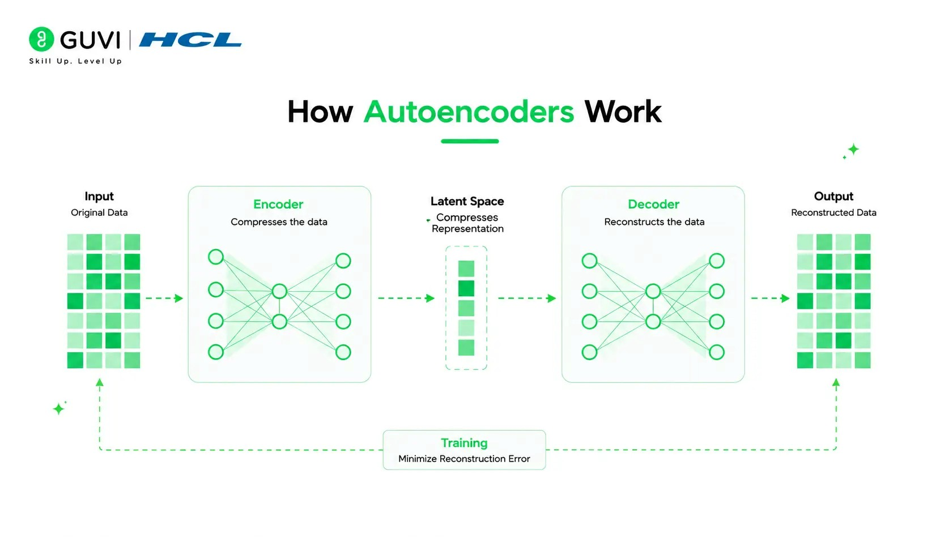
The training loop is simple in concept:
- Feed an input xxx into the encoder.
- Compress it into a latent code zzz.
- Reconstruct xxx from zzz using the decoder, producing x^\hat{x}x^.
- Compute reconstruction error (for example, mean squared error between xxx and x^\hat{x}x^).
- Update weights to reduce that error.
Over many iterations, the network learns to keep the most important patterns in the latent space and discard noise or redundancy.
1. Encoder: Compressing the Input
The encoder is a neural network that maps the input to a smaller representation.
- Input: high-dimensional data (for example, an image, a signal, or a feature vector).
- Output: latent code zzz with fewer dimensions.
The encoder learns which features are essential for reconstruction.
2. Bottleneck: The Latent Space
The bottleneck is the narrowest layer in the network. Its size controls how much information can pass through.
- Too large → the network may just copy the input without learning structure.
- Too small → the network cannot reconstruct well.
Choosing the bottleneck size is a key design decision. It balances compression and reconstruction quality.
3. Decoder: Reconstructing the Input
The decoder takes the latent code and tries to rebuild the original input.
- Input: latent code zzz.
- Output: reconstructed data x^\hat{x}x^, same shape as the original input.
If the decoder succeeds, the latent code must have captured meaningful patterns.
Autoencoders use the same data as both input and target, so they can learn useful representations without requiring labelled datasets. They can also detect anomalies because unusual inputs produce much higher reconstruction errors than normal data.
Reconstruction Loss: How Autoencoders Learn
Autoencoders are trained by minimizing reconstruction loss, which measures the difference between the input xxx and the output x^\hat{x}x^.
Common choices:
| Mean Squared Error (MSE): L=1n∑i=1n(xi−x^i)2L = \frac{1}{n} \sum_{i=1}^{n} (x_i – \hat{x}_i)^2L=n1i=1∑n(xi−x^i)2 Good for continuous data like images or signals. |
| Binary Cross-Entropy: Used when inputs are normalized to and treated as probabilities (for example, pixel intensities).0 |
The smaller the loss, the better the reconstruction. But very low loss with a large bottleneck can mean the model is memorizing rather than learning structure.
Why Compression Matters
Compression is not just about saving space. It is about forcing the model to learn a meaningful representation.
When the network must reconstruct data from a small code, it learns to:
- Ignore noise.
- Focus on dominant patterns.
- Capture structure that generalizes to new data.
That learned representation is useful for downstream tasks like classification, clustering, or anomaly detection.
💡 Pro Tip: Treat the latent space as a learned feature extractor. You can freeze the encoder and use its output as input to another model.
Common Types of Autoencoders
Different autoencoder variants emphasize different goals.
1. Undercomplete Autoencoders
The classic form: the latent dimension is smaller than the input dimension. This enforces compression and is the standard starting point.
2. Denoising Autoencoders
These models are trained to reconstruct clean data from noisy inputs. The input is intentionally corrupted, but the target is the original clean data.
- Input: noisy version of xxx.
- Target: clean xxx.
This forces the network to learn robust features that ignore noise.
3. Sparse Autoencoders
These add a sparsity constraint on the latent code, encouraging only a small subset of neurons to be active for each input. This can lead to more interpretable features.
4. Convolutional Autoencoders
For images, convolutional layers are used in both encoder and decoder. This leverages spatial structure and usually works better than fully connected layers for visual data.

5. Variational Autoencoders (VAEs)
VAEs add a probabilistic layer to the latent space. Instead of a single code, the encoder outputs a distribution. This enables generating new samples by sampling from the latent space.
Real-World Applications
Autoencoders are used in many practical scenarios.
- Autoencoders offer a non-linear alternative to PCA. They can capture complex structure that linear methods miss.
- They are used to clean images, audio, or sensor data by learning to reconstruct clean signals from noisy inputs.
- The latent representation can serve as input to classifiers or clustering algorithms, especially when labeled data is scarce.
- If an autoencoder is trained on normal data, it will reconstruct normal samples well but struggle with anomalies. High reconstruction error can flag unusual inputs.
- Autoencoders can compress data, but they are not general-purpose compressors like JPEG or ZIP. They work best for specific data distributions they were trained on.
A Simple Implementation Sketch
Here is a minimal example in Python using a common deep learning library.
python
mport tensorflow as tf

from tensorflow import keras

from tensorflow.keras import layers

# Assume input_dim is the dimensionality of your data

input_dim = 784  # for 28x28 flattened images

latent_dim = 32

# Encoder

encoder = keras.Sequential([

    layers.Input(shape=(input_dim,)),

    layers.Dense(128, activation="relu"),

    layers.Dense(latent_dim, activation="relu")

])

# Decoder

decoder = keras.Sequential([

    layers.Input(shape=(latent_dim,)),

    layers.Dense(128, activation="relu"),

    layers.Dense(input_dim, activation="sigmoid")  # for normalized [0,1] data

])

# Autoencoder

autoencoder = keras.Sequential([

    encoder,

    decoder

])

autoencoder.compile(

    optimizer="adam",

    loss="mse"

)
# Train: x is your input data
# autoencoder.fit(x, x, epochs=50, batch_size=256, validation_split=0.2)
This pattern input equaling the target is the hallmark of autoencoder training.
✅ Best Practice: Start with a simple undercomplete autoencoder. If performance is poor, try denoising, convolutional layers, or a different latent size.
Common Mistakes to Avoid
- Making the bottleneck too large, so the model just copies the input.
- Using a bottleneck that is too small, causing severe information loss.
- Forgetting to normalize input data (for example, images to ).0
- Evaluating only on training data; always check reconstruction on a held-out set.
- Expecting autoencoders to act as general-purpose compressors like JPEG.
- Ignoring the shape of the latent space when using it for downstream tasks.
What to Do Next
If you are new to autoencoders:
- Start with a small undercomplete autoencoder on a simple dataset (for example, MNIST).
- Visualize reconstructions to see what the model is learning.
- Experiment with different latent dimensions.
- Try denoising by adding noise to inputs during training.
- Use the encoder as a feature extractor for a downstream task.
Autoencoders are a strong foundation for deeper generative models and representation learning. Once you understand compression and reconstruction, models like VAEs and diffusion become much easier to grasp.
Autoencoders compress data into a compact latent code and then reconstruct it to learn key features. Learn AI & ML with HCL GUVI’s Artificial Intelligence and Machine Learning course.
Conclusion
Autoencoders are neural networks that learn to compress data into a latent space and then reconstruct it with minimal error. The encoder reduces dimensionality, the bottleneck stores the compressed code, and the decoder rebuilds the input.
They are widely used for dimensionality reduction, denoising, feature learning, and anomaly detection. Start simple, tune the bottleneck size, and let reconstruction quality guide your design.
FAQs
What is an autoencoder?
An autoencoder is a neural network that learns to compress input data into a smaller latent representation and then reconstruct the original data from that code.
Are autoencoders supervised or unsupervised?
Autoencoders are typically unsupervised. They use the input data as both input and target, so no labels are required.
What is reconstruction loss?
Reconstruction loss measures the difference between the original input and the reconstructed output. Common choices are mean squared error and binary cross-entropy.
What is the bottleneck in an autoencoder?
The bottleneck is the narrowest layer that holds the compressed latent code. Its size controls how much information can pass from encoder to decoder.
How does an autoencoder learn?
It minimizes reconstruction error between the input and the output. The network adjusts its weights so that the compressed latent code can still rebuild the input accurately.
Success Stories

About the Author
HCL GUVI
This article was selected and published as part of the HCL GUVI AI Blogathon 2026, an initiative designed to encourage students, AI enthusiasts, and aspiring tech writers to simplify complex AI concepts through impactful technical content. The contest recognized high-quality, original, and insightful AI-focused blogs, with selected authors receiving publication opportunities on the HCL GUVI blog platform along with official author credits and recognition.
View all posts by HCL GUVI
Connect with me @












Did you enjoy this article?